

This is a tricky topic, which has recently become increasingly important for entities which operate across multiple jurisdictions in Africa. Regional integration, in the form of the SADC, COMESA, EAC and AU (regional organisations), is meant to bring uniformity among the member states. The aim is to remove trade barriers, promote easy movement of labour, increase cross border investment and, in some cases, to facilitate easy access to capital for public and private entities, with better terms through financial institutions established and funded by the regional organisations. However, despite the benefits of regional integration, there is a challenge lurking behind the scenes, in the form of the M&A regulatory burden posed by the regional organisations.
ANTI-TRUST AND MERGER APPROVALS
Some African countries have national merger authorities (NMAs) which are responsible for merger approval processes, and each of these countries’ NMAs has unique key areas on which they focus. Historically, entities operating in multiple African countries would file merger approvals with the NMA in each of those countries. However, regional organisations are now focusing on becoming more integrated and uniform to prevent anti-competitive behaviour and monopoly across the continent, so merger approvals from the regional competition authority are increasingly required. Unfortunately, NMA approvals and local competition laws remain intact and do not cede to the regional competition authority, which means that M&A transactions are notified at both the NMA and regional organisation level. Trying to navigate the multiple regulatory hurdles contributes significantly to the regulatory burden, including time and cost.
Arguments have been presented that national authorities should focus on the local policies, laws and economic impact of the transaction within the member state, while the relevant regional organisations should focus on the impact across multiple African countries. While this argument is valid, there should be proper integration and uniformity, where each NMA is entrusted with the duty to focus not only on its own market, but also on how the M&A transaction affects the member states of the regional organisation. Alternatively, the NMA should cede control to the relevant regional organisation to make such analysis, with internal dialogue and correspondences between the regional organisation and the NMA to avoid multiple filings.
REGULATORY APPROVALS
Aside from the anti-competition approvals, there may be lack of support or uniformity by regional organisations when it comes to regulatory approvals across multiple jurisdictions on the continent. Some jurisdictions have simpler regulatory controls, while others impose more stringent requirements. These can include free carry in favour of the member state, and/or mandatory local ownership requirements to qualify for the granting of some permits/licences or approvals. It becomes a challenge for businesses to navigate different regulatory approval requirements across each of these jurisdictions, which then hinders cross border investment and the easy flow of capital between member states. With regional organisations pushing for more integration and uniformity, this aspect must be investigated, especially for businesses which have attained an agreed threshold to qualify for merger approval with the regional competition authority.
DIVERGENT TAX REGIMES
The inconsistency of tax frameworks across member states belonging to the same regional organisation calls for harmonisation. These inconsistencies range from withholding tax obligations, rates and accrual, capital gains tax rates and assessment mechanisms, and VAT frameworks, among others. Ultimately, M&A transactions have to comply with the tax laws of each jurisdiction, but in some instances, approvals and implementation timeframes differ significantly from one member state to another. Overall, this impacts the confidence of investors seeking entry into the continent. In addition, it affects the financial support from external financiers, since the continent still largely depends on financing from non-African financial institutions and banks.
Regional integration should unlock growth, not entrench fragmentation. Aligning competition, regulatory and tax laws, policies and systems should be a priority. It is the key to turning Africa’s economic blocs into engines of cross-border investment. It should make us more competitive and reduce the hurdles of investment across member states, whether emanating from within or from outside the continent.
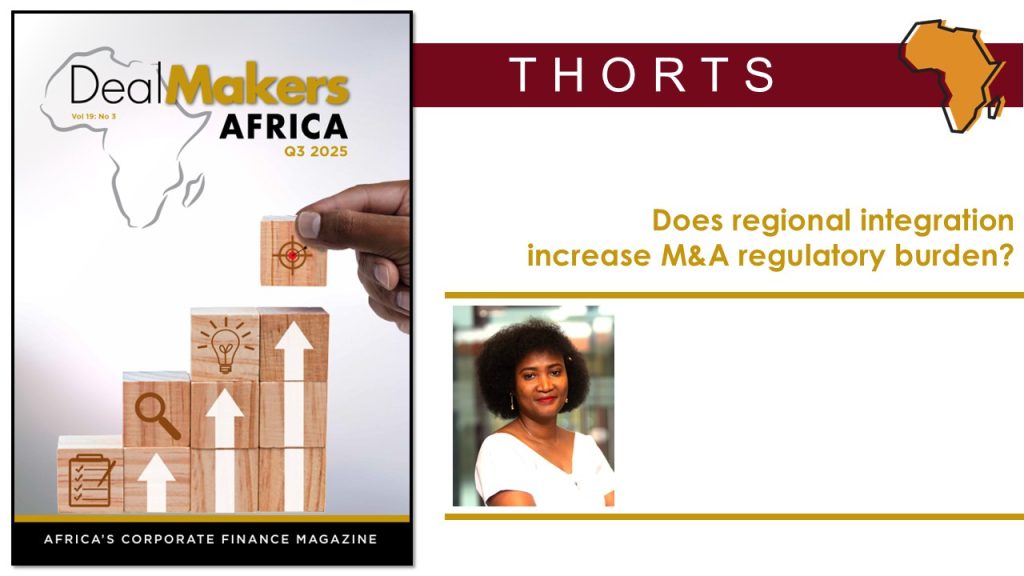
Lui is a Partner | Clyde & Co (Tanzania)
This article first appeared in DealMakers AFRICA, the continent’s quarterly M&A publication.
DealMakers AFRICA is a quarterly M&A publication
www.dealmakersafrica.com