
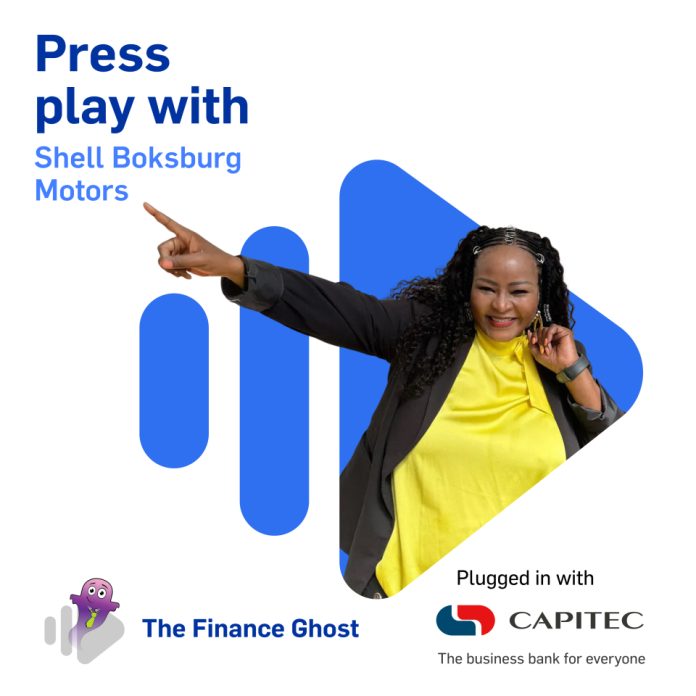

Introducing Shell Boksburg Motors owner Priscilla Msimanga:
Priscilla Msimanga made the leap that so many dream of, yet few are willing to make: leaving a big corporate role and shifting into the grinding world of entrepreneurship. To add to the intrigue, she bought a Shell forecourt and stepped into specialist retail.
From managing staff to complying with petroleum regulations, the learning curve was steep. Drawing on her corporate experience, her love of sales and her passion for service, Priscilla rolled up her sleeves and did everything – from pumping fuel to serving food.
And yes, that means there’s a food truck to go with this great story!
On episode 7 of The Finance Ghost Plugged in with Capitec, Priscilla tells us more about her leap from corporate life to entrepreneurship.
Episode 7 covers:
- Her corporate background and why she wanted to do something of her own
- How she prepared before leaving corporate
- Finding the right forecourt to buy
- The retail strategy of a forecourt and adapting to local consumer tastes
- Why hands-on involvement matters for success
- An honest look at the short-term financial impact of leaving corporate and starting a business
The Finance Ghost plugged in with Capitec is made possible by the support of Capitec Business. All the entrepreneurs featured on this podcast are clients of Capitec. Capitec is an authorised Financial Services Provider, FSP number 46669.
Listen to the podcast here:
Read the transcript:
The Finance Ghost: Welcome to this episode of The Finance Ghost plugged in with Capitec. What a wonderful podcast season we are having. We’ve spoken to some really interesting entrepreneurs doing all kinds of different things.
We’ve covered retail, we’ve covered restaurants, we’ve covered pharmacy. We’ve covered a whole bunch of things, and today we are doing something completely different.
What I’m particularly excited about with this podcast is that we will be speaking to someone who has done something that so many people dream of, and that is to leave their corporate job and go off and either start a business or acquire a business.
So many of the other people I’ve spoken to on this podcast season, they either started the business quite young or they’d been entrepreneurs for a very long time. Whereas for Priscilla Msimanga, the owner of Shell Boksburg Motors, this is actually quite new for you, which I think is great! A nice fresh journey into entrepreneurship, having left the typical corporate jobs and very senior roles.
So, Priscilla, thank you so much. Really excited to just get to know you and to talk about this. Because, as I say, I think what you’ve done is something that many people, when they’re sitting in traffic on the way to work, fantasise about doing. So, congratulations!
Priscilla Msimanga: Thank you! Good morning, Ghost, and good morning to your listeners. Thanks for having me.
The Finance Ghost: No, it’s great to have you. Let’s jump straight into that path that you have travelled, and then we’ll talk about the business that you own today.
So, let’s just get a backstory here. What was your career before you decided to get out of corporate and go into entrepreneurship?
Priscilla Msimanga: It was a weird sort of career, right? So, I studied business engineering, but I ended up in IT about 20 years ago – by chance, because I’m one of those people who like taking risks. So, I went into IT.
I got to move into SAB (South African Breweries) after being headhunted, and went into Head of IT (well, not Head of IT, but sort of Service Operations Manager, which is a Head of IT at a smaller scale) for a site, which was Egoli. That’s where my journey started, with IT, until three years ago when I decided I needed to pursue my love.
I’ve always been an entrepreneur at heart. I’ve always been that person who grew up in the dusty streets of Sebokeng, selling stuff. My mother never had a job. She made jobs by selling, and had a spaza shop, so that’s where the passion came from.
From a corporate perspective, I grew up in the ranks and became Head of IT for a multinational in Cape Town. Two multinationals, actually – by the time I left, I was a Head of BSS (Business Support Systems) for MiX Telematics, and before that, I worked for Philip Morris.
But MiX Telematics was more of a contract role, because I had started on the journey of, “I want to be an entrepreneur. I want to build a legacy, as opposed to being an employee.”
So, yeah, that’s kind of my journey. Loved corporate, loved IT, loved doing it. Loved the interaction with people – that was my passion. My last VP actually said to me, “You are more of a marketing person than an IT person.” I was like, “Yeah, maybe I am!”
So, yes, that’s how I started my journey. It wasn’t easy leaving corporate, because of the security around where your next salary is going to come from. I’ve grown quite a bit. I have a growth mindset. Studied quite a bit – you don’t have to pay for it, they actually pay for it. So, it was quite easy to do that.
It wasn’t a very easy decision to say, “I’m going into entrepreneurship,” but I was pushed more about building my own legacy and actually being an employer, as opposed to being an employee.
The Finance Ghost: Absolutely, I love that story. So, I always laugh – there’s this standard joke that goes along the lines of, “Instead of working 40 hours a week for someone else, I want to work 60 or 70 hours a week for myself!” Because entrepreneurs, of course, have gone through the long hours. They understand this. I’m sure that’s been your experience as well (although it doesn’t sound like your jobs were exactly 40 hours a week to start with). But I think there’s a good underlying point there around what it’s like to go from corporate into an entrepreneurial environment, and actually deal with that adjustment.
I love the reference there to taking risks, and that informal economy experience when you were growing up. It’s amazing how those experiences shape what people do later in life, it really is. And it comes through as you speak to entrepreneurs. They all have a relatively common thread that goes through their backstories around either their parents were hustlers, or they were, or it’s side gigs, or it’s holiday jobs, or it was something at high school. Something triggered an interest for them, and then it’s stayed with them.
And that comment you made about being more of a marketing person, I also really like that. Because if you work for yourself, you work in sales. Primarily, you work in sales. You’ve got to keep everything else going, all the operational stuff, but you’re a salesperson.
So, well done on making the leap. I think that’s fantastic. How did you actually make the final decision? Because, as you say, it’s not an easy thing to do, it’s not an easy decision to make, especially with large corporates.
It is quite a nice safety net, and like you say, lots of opportunities to grow, to study further. When you get to that level, you’re leaving behind quite a lot, and I think that’s what stops people from doing it.
So, what was the final decision for you? What made you say, “That’s it, I’m out of here. I’m leaving corporate”?
Priscilla Msimanga: Age. And moving to Gauteng. This was weird, how this came about, right? A friend of mine, while I was busy with a presentation for the ExCo, said to me, “There is a site in Leeu-Gamka.” Leeu-Gamka, of all places!
She kept on pestering me, and I was like, “Okay, let me just do this for them, let me get it out of the way,” because she had already acquired one. And two years later, then the process started, right?
And I’m still working. And I’m like, “Maybe let me pursue this,” and it started being interesting. I don’t know this, and I want to see what this has got for me. Because I always took risks, I was like, “I’m going to go for it.”
And that was the time when I made a decision, “In two or three years, I must be out of corporate.” I had to move to Gauteng in…2023? 2022, actually, and then I got to do the job with MiX in 2023.
But during that time, when I got into MiX, it was already set up. It was just getting a site and getting in there and starting the business, because I started in 2024. I was appointed in 2024 very early, around Feb. So, yeah, that’s how it started.
It was more of a push that, “You’ve got to go. Now it’s time.” Because I put it off, from the age of 27 until later in life. That I needed to go. So, until later in life, I’m like, “If I don’t do this now, I’ll probably never do it.” And then I just decided not to go for corporate anymore, and to pursue this full time.
The Finance Ghost: So, the one thing there that’s so interesting, Priscilla (and it’s, I think, also in my own experience, so true) is that kind of two- to three-year runway from when you decide, “Okay, it’s time to go.” It’s almost impossible to then do it straight away. You’ve still got to actually give yourself runway.
And two to three years is pretty common, actually. I think mine was even longer than that. I had this spreadsheet on my computer for a very long time, called ‘Escape Plan’.
And ‘Escape Plan’ was basically me making sure that whenever I added a monthly overhead, I used to put it on the Escape Plan and be like, “Look, is this an overhead where there’s no flex? Is this an overhead that can go away if it needs to? And then, what would I have to earn in order to escape?”
And people think people just wake up – they look at a successful entrepreneur, and they go like, “This guy or this lady just left corporate one day, and it worked.” It’s not actually how it works. You’ve got to plan for this thing, and you’ve got to adapt your life to it. You’ve got to get ready for it. Maybe we can chat about that just now.
But what I would like to understand is, you talk about these sites being ‘ready’, so this is the decision to go into fuel retail, these forecourts. As I said earlier, Shell Boksburg Motors – that’s you.
From Cape Town to Boksburg, that’s a reasonably unusual path (I think the other way around is more common, let’s be honest). So, from Cape Town to Boksburg you went, and you went and got this forecourt site.
How did this happen? How did the sites become available? What was the situation to be able to get one, to qualify? What was the backstory that got you to say, “Not only am I leaving corporate, I’m going to go and acquire a petrol station”? Which is a really interesting thing to do!
Priscilla Msimanga: So, to answer your first question, how did it happen? Moving to Joburg was an “I need to go back home”. Because Joburg is home. Boksburg, I already had a base because I held a house there, so it made more sense that I move back to my place.
So, the place that I applied for was not in Boksburg, it was somewhere in the Pretoria area. But there are a couple of sites that usually come up. When, during that process, the Boksburg site came up, I was like, “Okay, maybe I should try this one.”
It takes, literally, a year before everything is sorted, because it’s quite a process. It’s an advertisement on the site – I recommend that people check the fuel sites, different brands. They advertise petroleum sites on there. That’s what I did. I found a site, and I went and applied.
You’ve got to have a good idea of the area. You’ve got to create a business plan that shows the financials, the marketing. You’ve got to know at least a lot about the financial and the environmental sort of SWOT of that area.
I had to create that in preparation for this, because you go through three different interviews. The first one is pretty much around, “What is it that you know about the site?” You present your basic business plan – there’s a template, of course, but you’ve got to have your own so that it can feed into this.
It was luck that I actually lived in Boksburg before. So, I understood the area very well. I understood the LSM, which worked in my advantage. I understood the dynamics that they wanted in the place.
Then we went to the second interview, which is pretty much about the sales and the execs of Shell that will sit down and say, “What do you know about this place? What value are you bringing? What is it that you will change? What do the financials look like? Most importantly, do you have the money to buy it?”
So, the preparation we spoke about (of three years) was the money part, right? Because you’ve got to have at least 20% – depending on which bank you go for, 20% to 40% – of the actual capital. I needed to have that money. So, during that time, it was the savings, it was like, “Every penny counts, because this is what I want to do.” It’s the availability of that money – proving that you have it.
Then after that, it’s the actual work. After they say yes, it’s the licensing from a DMRE (Department of Mineral Resources and Energy) perspective. It takes about six months for that to happen, to have a final trading licence.
You’ve got to go into, “What’s my working capital? What does the site look like?” Now it’s real. It’s no longer pen and paper. It’s, “How do I make this work? How do I get the money to actually make it work?”
And I had to get the 20%, of course. I proved that. I had to go to all the banks – and Capitec (yay!) was amazing, they actually came out quicker than most of the banks – because they look at the risk, right?
“This is Priscilla, who comes from corporate, who’s an IT Head. What does she know about petroleum?” So, it presents a little bit of a, “Are we getting ourselves into a corner here? Will she do this? From computers to petrol – what is she doing?”
I think they took a leap of faith and appointed me. I went through a couple of sort of government financial institutions, which couldn’t come through in time. Some of the banks were a bit slower, but Capitec was much, much faster.
And this is where I am. And then the work starts. You pay the person, then you start working. You do not know anything about this business. But what I did, though, which was smart, was, between the Leeu-Gamka situation and when I took over, I took time to learn the business.
Being in a petrol station and just putting petrol is the least complex of all, but when you get into the business, there are so many things that you have to be aware of. There are so many things that you have to comply with.
There are a lot of requirements. From a business, from a South African perspective, from the licensing, from the food safety. There are so many nitty-gritties that I had to comply with.
But because I had already, for at least a year, been going to this other lady who helped me quite a lot in Pretoria. At least 180 hours, which I spent with her, just to understand the business.
Because the first one, I didn’t get, because I didn’t have the operational knowledge. And it was a challenge for me, like, “Go for the operational knowledge.” I had to go and learn, and it was quite interesting.
I’m like, “Sho. We just come in and pump petrol, and then you’re like, ‘I’m paying.’ And that’s it.” But there are quite a lot of things that happen behind the scenes.
So, yeah, that’s how the journey was, and how I got into a relationship with Capitec, as well.
The Finance Ghost: Yeah, very cool. I love that that’s come through. I was going to ask you what difference Capitec made in the process, and you’ve already answered the question, which is lovely.
And like you say, it’s such a big adjustment actually going into a business, right? You spoke earlier about how, if you’d stayed in corporate, maybe you would have been able to study further. I think you’ve learned much more by leaving corporate and actually spreading your wings and going out into a business like this.
Because that’s the biggest thing with entrepreneurship – you have to understand the entire business, and then you have to actually figure out how all of the different elements work. And this is where it’s so interesting.
So, especially with a business like that, I can imagine the risk and compliance stuff must be through the roof. Because, I mean, it’s as flammable as it gets. Let’s call a spade a spade – a forecourt is basically a great big bomb inside concrete. So, it comes with a ton of health and safety stuff.
And then you’ve got the store, which has to have the right strategy for the area. So, like you said, you’ve got to understand the local area. Because it’s a retailer, and like any retailer, if you don’t understand the average customer – a forecourt in a very rich area is going to sell something completely different to a forecourt in a lower-income area.
And you can see it when you look at the specials. If you go into a fancy area and you put petrol in your car, you’re going to go into the forecourt – they’re going to have freshly baked goods, it’s going to be Magnums on sale. It’s that kind of vibe.
When you go into a lower-income area, it’s pies, and it’s Score energy drinks. You’ve got to respond to the people in the area. That’s how retailers make money. So, there’s a lot to learn. I can imagine it’s been such an interesting business.
When you look back on it now, and as you continue to run this thing, what would you say was actually the biggest challenge in getting up the curve on understanding how the business works?
What was really, really difficult, and which pieces do you think were maybe a little bit easier?
Priscilla Msimanga: I think for me, the people part was the most challenging part. Forecourt, there is a best practice, so you probably can – if you’re from corporate, you’re used to standard operating procedures, you know that in terms of compliance, this is what I should do.
From the shop perspective, I had a little bit of knowledge around what LSMs are there and what it is that I need to sell. We used to sell things that are not relevant, and you look at the pricing and that, so you kind of have a strategy.
But human beings, you can’t have a strategy for. Because they are very different in nature. But I’ve always been very fascinated by the human mind, especially now that I’ve moved from managing professionals to now managing the forecourt staff. It’s very different, the different spaces.
So, for me, it was that. You’ll be surprised that, because this is a cents and rands business, theft is a huge thing. So, that was my challenge. How do I make the team be part of the business, if you get what I mean?
Most of the time, we employ people, but I wanted them to be part of the business and care about the business. Because if you do, then you get them to be loyal and know that “If I steal, then I would not be able to get a salary.” That understanding.
And also the customer service aspect of it, because I’ve always been very passionate about customer service. We don’t want you to come to the garage… The last thing I want is for you to be in the forecourt, trying to pour petrol, and it takes 10 minutes. I’m like, “What are we doing?”
So, I wanted people who are energetic. I wanted the spirit that I have – the passion of what I do, and the pride of what I do. I love owning a petrol station. I love being on that forecourt and gooi-ing petrol into that car.
The Finance Ghost: I was going to ask, if you are there pumping petrol sometimes! I can totally imagine you doing it.
Priscilla Msimanga: I am pumping petrol.
The Finance Ghost: There we go, I knew it!
Priscilla Msimanga: I’m being the cashier. I am everything, basically, most of the time. Of course, not all the time, because there are things that I need to do. But if the forecourt is full, I will say, “Give me my tag, I’m going to go on that forecourt and gooi.”
The Finance Ghost: Nice.
Priscilla Msimanga: Because we need those cars to move. And also, this is a business where you have to be highly involved. And the fact that I knew I didn’t know. It’s a very good position to be, when you say, “I’ve only learned this for the past 14 months.”
Compared to someone who’s been doing it for five years, they assume that they know. But I knew I didn’t know enough, so I had to learn. What I learned in the other spaces, now I had to practice, replicate.
And the only way to do that is to be involved. Be that cashier. Understand when a customer says, “Oh! You’re always out of Grand-Pa, what is wrong?” Then you know what to address.
Or when you are in a forecourt, and the person is upset because he said he wanted R100 and they gooi R200. So, you find ways of having a strategy on, “How do we satisfy a customer and, at the same time, not lose money?”
So, yes, I love being on that forecourt. I always say, “I’m from heels to boots.” Safety boots, because you’re wearing your safety boots on the forecourt. You have to be an example. I can’t come in wearing high heels on the forecourt. It will be an HSSE (Health, Safety, Security, and Environment) issue.
So, yes, I am on the forecourt all the time, very involved financially. Cash-ups, I do it. I check every little cent from banks. The merchants were another thing where I thought, “It’s easy.” Banks do not take two seconds to open a merchant account. It took, like, months. So, yeah.
The human element was the challenge, but I think I’m in a space where everyone understands what I expect. It’s been 14 months or so, and they understand what I’m at. They see it live, they see the passion. You can’t not have passion if the person who owns the place actually goes on the forecourt. Why do you say I can’t? So, it’s been quite a challenging part of this for me. The other parts are pretty much standard. I was able to comply.
And why I say it’s been something that I’m proud of is, this quarter, out of 583 stations, I’m number 15, and I haven’t even traded for two years. So, there’s something that we are doing right.
The Finance Ghost: Well done! And, yeah, I love the passion coming through there. It’s so obvious. That’s why I guessed that you were probably out there, as you say, gooi-ing petrol, because you just strike me as someone who gets involved. And I think that’s key here.
I was going to ask you if you have to actually be there all the time? Or can you trust a station manager to get it done? I guess when people own multiple forecourts, you can’t cut yourself into lots of pieces, so you have to get to the point where you have people you can trust.
But I guess, early days like this, you’ve got to understand how the entire business works. And that’s an interesting point. Because I’ve seen people in my life who have started businesses, and they start something where they either have very little idea of how it works – and that’s still okay, provided you’re willing to learn.
But sometimes they say, “Well, I don’t really know how this works, and I’m going to find someone who knows how it works, but I’m going to be the business owner.” It’s just…it’s a structural problem.
You need to understand your business inside out. You need to be able to do all the things it needs. You’re not going to do them forever – you’ve got to outsource, you’ve got to find staff, etcetera – but you’ve got to be able to jump in and be like, “I understand that job, this is how it’s going to work.” Especially for small businesses.
And that’s one of the big differences to corporate. In corporate, everyone is a cog in the wheel. You understand your world and how it fits in with everyone else, but that’s all you need to understand. Whereas when it’s your own business, you need to understand the whole thing, right? Inside out.
Priscilla Msimanga: Yeah, so I do have a site manager. Because part of my role is to scan the environment around me. To check the prices in other areas, to understand if I stand in the middle of a Makro, or any other warehouse, and go like, “What would I buy if I were my customer?”
And I would then do that buying and saying, “It’s Christmas, we have extra money from the bonuses. What would I want?” Instead of having Cadbury, I want to indulge and buy a Ferrero Rocher.” So, why not get Ferrero Rochers and test the market?
So, I do have someone that I now feel comfortable to leave when I’m not around. But it will be for a couple of hours, of course. He would be an operational person.
The other thing is the growth, right? So, the innovative part. I’m a Select store. Select store means I don’t have that big bakery. So, I don’t have hot food, but can I stay without hot food? Hell no. So, I needed to find a way to be creative around it.
If I can’t make my place bigger, I need to make a plan to sell hot food, and I did. I got the food truck. It was the first [laughing]. I have a little food truck…
The Finance Ghost: I love that! So cool [laughing]. That’s great!
Priscilla Msimanga: …and I’m selling hot food, and I’m selling what I think people would like for the market that I’m in. So, I have hot food now. When I got there, there was no gas. I’m like, “I have a gas stove, we have an electricity problem, so why not sell gas?”
Started the process of being compliant with the gas, because I didn’t have a licence, and I now sell gas. So, it’s those kinds of ideas. This is how you see it. When you scan your environment and say, “What do we need? Do we need gas? Yes, we need gas.”
The people who are selling gas close at 6pm or 8pm. I’m 24 hours. So, that market after 24 hours, that is why we are a convenience store. Your gas finishes at 8pm, you’re having a braai, so you come to me and buy the gas. So, yeah, that’s pretty much how it works.
The Finance Ghost: Yeah, it’s crazy interesting. The food truck is fascinating. Tell me about the menu. What can someone get when they’re hungry, there at Shell Boksburg Motors?
Priscilla Msimanga: We get from sandwiches to pap and steak, because my market is really people who are working in the area. I’m in between the car dealerships. Most of the people on lunch don’t have anything to eat. So, we have the best mogodu as well.
We have fancy foods like chicken and chips. We sell kota – I don’t know if you know what kota is? [laughing] It’s a little bunny chow.
The Finance Ghost: Yeah!
Priscilla Msimanga: So, we sell those and vetkoeks in the morning, to accommodate that market. We also have samosas. We are purely non-pork. If you eat pork, don’t come to us. Because my market is either people who are halal or people who are not eating pork.
We all need to test the market, I started selling pork, and no one bought. And I’m like, “Okay, so what is wrong?” Because I love pork! So, we then saw that it’s either a religious thing. So, then we stopped selling it, and we’re now getting traction. People are buying more.
We sell toasted sarmies, we have burgers and all that. So, yeah. But most of the high sellers are actually food – pap, rice and stew and all that. Mogodu is the high seller on Monday, because people have babbalas, so they want something like mogodu to take away the babbalas [laughing].
The Finance Ghost: Sort them out [laughing]. Ah, that’s great. I have small children, so now I just have ‘Are you achin’ for some bacon?’ in my head, courtesy of The Lion King. A gift that I’ve passed on to them.
But there’s a great story in there. Just because you are achin’ for the bacon doesn’t mean that your customers are. So, you’ve got to then adapt to the people who are actually coming to your store. If pork is not going to cut it, you take it out. You respond to what people want.
It does not help to sell premium croissants to a market that is actually looking for a babbalas cure on a Monday morning and cheap sources of maximum protein and carbs to keep them full. That’s the reality. So, that’s the cool thing with being in retail. It’s also the challenge with being in retail.
Let’s talk a little bit then – because I’ve always wondered about these forecourts. My understanding is that, when you sell a litre of fuel, basically, the amount of money you make per litre is just about fixed. It’s a very highly regulated space around pricing, etcetera.
So, you’ve actually really only got two ways of making more money, because you can’t just put the price of fuel up. You either have to sell more fuel, you’ve got to get more people coming, or you’ve got to get people to get out of their cars and walk into your shop, right?
I mean, that’s what this business comes down to. And I guess at the end of the day, getting people out of their cars is going to be stuff like service, how long it takes to get fuel. But then the shop, again, you need to give people a reason to come there. Like your food truck, etcetera, etcetera. It’s very clever.
So, is that essentially how the business works? Selling fuel is really only one part of it, and the shop is absolutely key to the economics of this thing?
Priscilla Msimanga: The fuel, as in 93 and 95, that’s the case. It’s highly regulated. You’ve got to sell it at the amount that the DMRE sets. Even with diesel. But there is a little bit of space to play around with diesel, because it’s not as regulated as the fuel.
So, you can go down or up, depending on your market. Because diesel is mostly for trucks, and you want to attract the trucks. So, you’ve got to be smart around how you price your diesel so that you still have the market come to you.
And for me, who has two competitors that are literally 900 metres away, I have to be very cognisant of how I price my diesel. It is also very regulated. They tell you how much you can go up by, but then the way that you would want to go down is dependent on you.
So, yes, it is regulated, and there is a margin that we do. There is a RAS (Regulatory Accounting System) model, and I don’t want to get into the technicalities (that I had to learn, by the way, when I got into this) on how much money or how much margin you make.
Then the shop, yeah. Ideally, we want to be able to pump more on the forecourt and also get people out of their cars to the truck or to the shop. Because I still sell pies, so if you don’t want my truck food, we still sell pies and other snacks and carbonated drinks and cigarettes.
So, basically, we are happy to give you the best service, and also, we are happy for you to say to my forecourt attendant, “Hey, can you get me a packet of ciggies when I pay?” And they can do that.
So, we have extended a value for your money kind of service, where you know that it’s a one-stop shop, kind of – not yet a one-stop shop, it will be one day – but you can get your cigarettes and pay at the same time, and this guy will do it for you in the quickest way possible.
Yeah, we do measure. I’m an efficiency kind of person at heart, so I do literally stand outside and see how long people wait, and if there’s no one servicing them, I’m like, “What is going on?” to the person in charge, or I will personally go and assist.
So, you want to get more people in the shop because the shop margins are a little bit different. Because we are a convenience store. We are not priced like Pick n Pay, because of the timing. We are 24 hours. You’ve got to pay two different shifts, as opposed to just one shift for the day.
So, yeah, what we used to do on Saturdays, we used to have boerewors rolls. That is the one that’s built into the truck. Boerewors roll – it smells nice, you see it with my little gas, so you get out of your car and park and buy the boerewors roll. So, those are the kinds of little things that we do.
Sometimes we then partner with some of our suppliers and get little ice creams and give them out on the forecourt so that people come back again.
But the service component is the most important. I want people that I would have tested. These people are passionate, they are proud, and they love serving people. And they like talking to people. People just want to be spoken to. It’s like a salon. When I go to do my hair, the last thing I do is my hair. It’s actually the conversation around what is happening around us.
So, I’ve had quite a few comments, people saying, “Thank you, just for talking to me.” And they are sure to come back. So, those are the kinds of things that my team and I are doing so that people would want to come back to us, as opposed to the other petrol stations.
The Finance Ghost: Boeries and ice creams. You’re definitely speaking my language. That sounds excellent. And the human touch, as you say. Just being friendly. I mean, it’s the basics, but this is what we crave.
We crave human connection – and ice cream, and boeries. And if you can get all three of those right, then you are golden. That’s how it works.
So, Priscilla, without giving away specifics (obviously this is private), but I’m just curious. What has the journey, high-level, been like for you, going from essentially a corporate salary in a big job into your own business? You had to borrow money for it. Would you say it’s been tough? Would you say it’s been in line with expectations? Again, no specifics here. Just high-level, for people thinking of doing this, what’s been your experience of it?
Priscilla Msimanga: So, if you are going into this business, you’ve got to be able to stop living the posh life. There’s no longer any going out and eating out. That has stopped, because your salary is the challenge for you.
You’re paying yourself little. Sometimes you don’t pay yourself at all, if it’s a bad month. So, you’ve got to be able to have a cushion on the side, or you’ve got to have some support, something. Or you have to downscale quite a bit, which I have done.
But for me, it’s a downscaling that you know, in five years, it will pay you back. You know what I mean? It’s just a temporary sort of inconvenience, but you have to be able to take it and be agile enough to adjust to your new reality now. I am not getting that salary that I was getting in corporate. I’m not going to get the 13th cheque. So, how do I balance my life to live the way that I’m living now?
If I were to give you an idea, my salary is not even half of what I used to get in corporate. But I love it. Because at the end of a year, when you look at your financials month-to-month, you’re like, “Okay, so it’s worth it.” At the end of a year, you will see the results, and you’re like, “In five years, I probably will pay myself a little bit better.”
But I think I would do it again. I don’t want to be promising people that you’ll get double your salary, because you won’t – you’ll bankrupt yourself. So, you’ve got to be smart around how you balance.
Because they do manage your expectations, the franchisors, to say, “You’re from corporate, you’re not going to get that salary. How do you balance your finances to still be able to maintain your life?”
Because you’ve got debts and whatever, right? So, you’ve got to package your life in such a way that you’re not going to struggle, but at the same time, you don’t pay yourself so much that you won’t even make a profit.
The Finance Ghost: Thank you. I think that’s a very honest and sobering viewpoint, and that’s why I asked the question. Because I always think people must just go into this with their eyes open.
It’s basically… There’s this quote that goes roughly along the lines of, “Living the life that others won’t, so that you can live the life that they can’t in years to come.” Take the hard stuff now, and it will pay off later.
I’ve always loved cars, and so I had some interesting stuff – nothing crazy at all, I was always careful, but I had some fun stuff. And then, when I finally decided, “It’s time to start getting out of corporate now. This is the opportunity in front of me, let’s do it.” I remember I downscaled all the way down to this leaking Fiat.
Basically, if it had rained, it would leak straight through the door, basically onto me. I was this ex-investment banker and CA in this leaking Fiat, but that’s what you’ve got to do. You’ve got to humble yourself down to that level. Because that tiny little overhead every month is going to make the difference if something goes wrong in the business, while your friend is paying off R15,000 a month on some fancy German car.
And that’s why entrepreneurs actually end up being much better at managing their money, because they don’t take on unnecessary overheads. They go into a cash mindset of, “Okay. Did I already make this money? All right, I’ll spend some of it. I’ll leave behind a buffer, spend some of it, but I had to make it already.”
They don’t go and throw debt at their personal lives. Whereas when you’re a salaried employee, you assume that money’s always going to be there, and then you’re very happy to layer on these big overheads.
And it’s dangerous, because corporates do retrench people. Things don’t always go to plan. And then you’re in serious trouble, because now you don’t have a plan B.
So, as much as it’s hard to go and do what you’ve done, you’re also in control of your own destiny, right? And that’s a nice way to wake up in the morning.
Priscilla Msimanga: Yes, I’ve been retrenched three times in my life.
The Finance Ghost: Wow! Yeah, you know that gig well.
Priscilla Msimanga: So, I know how that feels. I’m driving a 12-year-old car. Everyone asks me, “You’re still driving this thing?” I’m like, “Yes. Until it stops working, I will still drive it.” I’m not going to buy anything that will get me into a position where I struggle right now. If it moves, it moves. I get there!
The Finance Ghost: 100%. I love that. So, last question on this podcast. It’s been such a lovely look at just life leaving corporate. What advice would you give to someone who is maybe thinking about doing this in 2026 or beyond?
Or to someone who’s now maybe at that point, as we spoke about, where you kind of say, “Okay, two to three years from now.” That’s actually the safer runway. If you’re sitting here listening to this and you’re going, “Oh, 2026 is my year to leave corporate,” be careful. It takes longer than that.
So, what advice would you give to someone who’s in that situation? They’re in their corporate job, they’re dreaming of leaving to go and do this thing – what would your one piece of advice be?
Priscilla Msimanga: Stop being fearful. Just jump into it, and start planning today. Because, as you said, the day that you decide, it takes at least two years. So, it’s just a change of mindset. “I’m going to stop being afraid. I’m going to do this.” And now, you start defining the how. You start saving money. You start looking into where you want to go.
It was a collision with petroleum, but I loved it. I think it was meant to happen. I do think that our journeys are supposed to be ‘somewhere’, and you will be ‘somewhere’. But it collided with me, and I love it.
Sometimes people are born with a passion that they are underestimating, and then they die without actually pursuing it. So one day, in 2026, make a decision: “I’m an artistic person, I need to get in to open my art shop.” Start working towards that art shop!
There are a lot of banks that are actually – with a good business case, like Capitec – able to fund you if they see the logic. If they see that you have managed your money properly, and you have a contribution, they’ll be able to help.
I think a lot of people have this comment that, “I don’t have money, it’s a limitation.” Only because you are fearful. So, if you stop being fearful, then you look at possibilities. You can see that it is possible if you really, really want to do it. And that is where I was.
I would say, “Stop being fearful. Pursue what you love, and go for it.” Even if it doesn’t yield the result in two days. Because I was an impatient person. I think the one thing that this business has taught me is to be patient.
The waiting game. In four years, three years, whatever, it will be a different thing. Just hold on. And when they listen to this kind of podcast, they’ll be able to see that it can be done. If a dusty kid from Sebokeng can do this, anyone can, really.
Just go above the fear. And leave corporate. And I know I used to be one of the execs, and I’m like, “Oh, yeah, it’s prestigious,” but for whom? For me, now, I’m prestigious to me. I’m the one who makes decisions, and that’s different.
So, when you’re in corporate, you’re working for someone else who had the dream to do what they are doing, and they hire you to do it for them. So, in my opinion, I’m better off doing my dream than working for someone else’s dream. So, dream, go for your dream, and stop being fearful.
The Finance Ghost: I love that. Loads of great advice in there. It’s funny, so my thing is being able to fetch my kids from school without having to ask someone. That’s the biggest win for me. It’s not even about the money or whatever. It’s literally just the freedom.
The richest person you know is the person who has the most control over their time. That is my honest opinion on the world, really.
Priscilla, have you read The Alchemist before? Because if you haven’t, you should.
Priscilla Msimanga: Yes, I have read The Alchemist, funnily enough. It was like 14 years ago! [laughing] I still have it. I go back to it. So, yes, I have.
The Finance Ghost: You struck me as someone who should read it. And for anyone listening to this, there really are two types of people who read The Alchemist. There are those who read it and go, “I don’t understand the hype, what is this?” Then it just wasn’t for you, that’s fine. And then, if it is for you, it will really be for you.
So, I was one of those people where it was really for me. I took a lot from The Alchemist. I remember reading it on a flight between Joburg and Cape Town – a late-night, very tired, hardcore-financial-services-career flight, and I read The Alchemist.
And I remember” I basically read it, closed it, and that was the start. It ended up being much more than two to three years, but that was the start of me going, “Okay, I need to do something else long term.” So, yeah, it’s a lovely thing.
Priscilla Msimanga: There are just those books that never leave my shelf, and The Alchemist is one of them. Rich Dad Poor Dad is one of them. It’s just those that always remind me, “You know what? These people could do it. I can too.”
And there are people that have poured into me as well that would say, “You can do this,” and I’m like, “Okay, okay.” And so, yeah. But The Alchemist was one of them.
The Finance Ghost: It’s fantastic. So, there’s a dog in the background there that is calling you to go and run your business, so I’m going to let you go, Priscilla.
Priscilla Msimanga: [laughing]
The Finance Ghost: Thank you so much. We were done anyway, but it has been lovely. Thank you so much. We’ll take the dog’s hint here.
And just, good luck. Well done on everything you’re doing. It’s a very inspiring story, and I really wish you the best with it.
Priscilla Msimanga: Thank you so much, Ghost.