
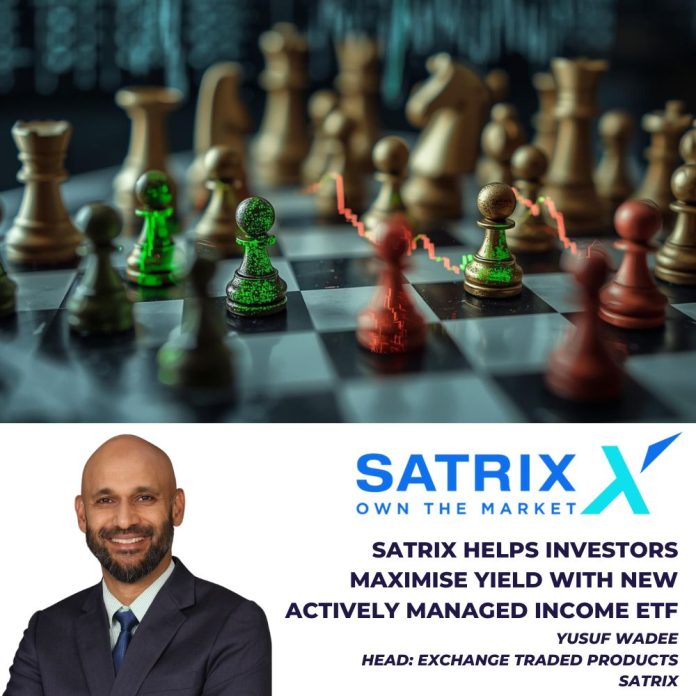
For over two decades, Satrix has been synonymous with index tracking, democratising the market by giving investors low-cost access to the JSE Top 40, the S&P 500, and many more indices. But with the listing of the new Satrix Income Actively Managed ETF (JSE code: STXINC), the business is proving that its philosophy of efficiency and cost effectiveness can also be applied to active management.
The new ETF, listed today on the Johannesburg Stock Exchange, is designed to offer investors a step up from traditional money market funds, targeting a yield enhancement of between 50 and 100 basis points per annum while maintaining a conservative risk profile.
Yusuf Wadee, Head of Exchange Traded Products at Satrix, explains that while the mechanism is active, the product remains true to the Satrix DNA.

The Case For Active In A Passive World
“When people hear Satrix, they think indices,” says Wadee. “However, nothing has changed in our philosophy. We are still dedicated to cost-effective, efficient exposure. However, when we looked at the short-term fixed income market, we recognised a specific challenge: there is no perfect ‘investable index’ to track. Indices like the STeFI measure performance, but they don’t provide a recipe for investment.”
Wadee notes that in the income space, active management is necessary to navigate the thousands of available instruments – such as bank NCDs (Negotiable Certificates of Deposit), floating rate notes, and Treasury Bills – to construct a portfolio that optimises yield.
“By launching an Actively Managed ETF (AMETF), we can offer the flexibility required to navigate the interest rate yield curve, while delivering it in the efficient, transparent, and liquid wrapper of an ETF,” he adds.
Making Cash Work Harder
The fund is managed by Satrix with investment management provided by Sanlam Investment Management, leveraging its extensive fixed income track record and specialist capabilities. Positioned for investors with a time horizon of three months or longer, it fills the space between a call account and a traditional bond fund, offering an efficient short‑term investment solution.
James Turp, the fund’s appointed Portfolio Manager at Sanlam Investments, says: “Globally, investors are embracing the convenience, transparency and sophistication of actively managed ETFs for both short‑ and longer‑term fixed income needs. These vehicles deliver access to institutional‑style investment strategies in a cost‑effective format, making high‑quality portfolio construction available to all investors.”
Solving The “Lazy Cash” Problem
Beyond yield, the ETF addresses a common behavioural hurdle facing South African investors. Wadee points out that investors often leave cash in low-interest accounts far longer than intended.
“Cash is very behavioural,” he explains. “An investor might park money in a bank account, intending to use it in a month. But life happens, and suddenly six months or a year has passed, and that capital hasn’t worked for them. If your horizon is longer than three months, you are better off in an income fund. This ETF provides a yield component that rewards that timeframe.”
Efficiency And Liquidity
The Satrix Income AMETF launches with a targeted Total Expense Ratio (TER) of just 0.46%, making it a highly competitive option in the income category. Furthermore, the ETF structure offers distinct liquidity advantages. Unlike some unit trusts, which may ring-fence assets during periods of extreme market stress, ETFs trade as equity securities on the JSE.
Wadee concludes, “You can buy and sell this ETF just like shares in Apple or the Satrix Top 40. It offers the liquidity and capital growth potential of a market-traded instrument, combined with the income-generating characteristics of a robust fixed-income portfolio.”
Disclaimer:
Satrix Managers (RF) (Pty) Ltd is a registered and approved Manager in Collective Investment Schemes in Securities. Collective investment schemes are generally medium- to long-term investments. With Unit Trusts, Exchange Traded Funds (ETFs) and Actively Managed ETFs (AMETFs) the investor essentially owns a “proportionate share” (in proportion to the participatory interest held in the fund) of the underlying investments held by the fund. With Unit Trusts, the investor holds participatory units issued by the fund while in the case of ETFs and AMETFs, the participatory interest, while issued by the fund, comprises a listed security traded on the stock exchange. ETFs and AMETFs are registered as a Collective Investment and can be traded by any stockbroker on the stock exchange, LISP platforms and or via online trading platforms. ETFs and AMETFs may incur additional costs due to being listed on the JSE. Past performance is not necessarily a guide to future performance, and the value of investments / units may go up or down. A schedule of fees and charges, and maximum commissions are available on the Minimum Disclosure Document or upon request from the Manager. Collective investments are traded at ruling prices and can engage in borrowing and scrip lending. Should the respective portfolio engage in scrip lending, the utility percentage and related counterparties can be viewed on the ETF and AMETF Minimum Disclosure Document. AMETFs are ETFs which are actively traded by a Portfolio Manager to adjust the AMETF holdings and asset allocation with the aim to outperform the benchmark. AMETFs differ from ETFs which only track indices. The Manager does not provide any guarantee, either with respect to the capital or the return of a portfolio. The index, the applicable tracking error and the portfolio performance relative to the index can be viewed on the ETF and AMETF Minimum Disclosure Document and/or on https://satrix.co.za/products.