
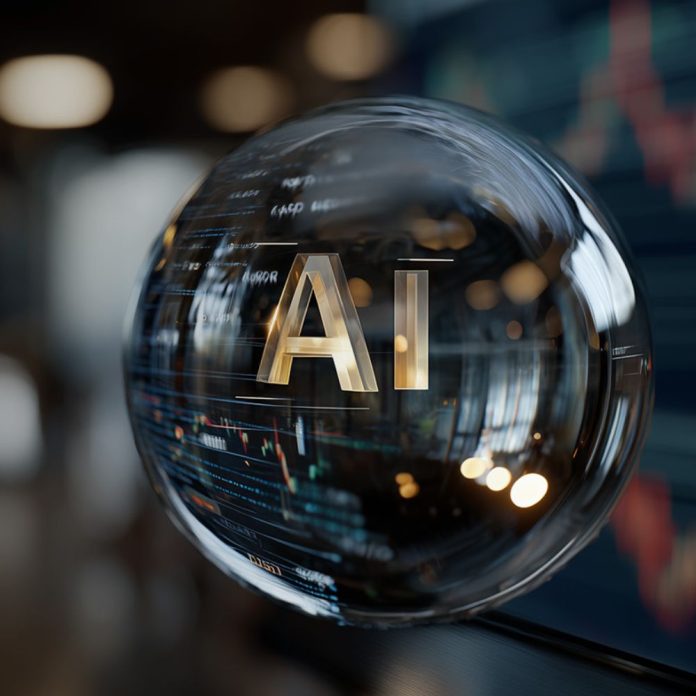
The talk in investment markets is that the AI “bubble” may soon burst. Nico Katzke, Head of Portfolio Solutions at Satrix, disagrees with these predictions, though he does caution investors about potential risks.
“In market terms, a bubble means irrational pricing,” he says. “It occurs when hype eclipses reason. Prices then reflect investors’ urgency to buy, as they fear they’ll miss out. This hype pushes prices even higher, reinforcing positive sentiment in a self-perpetuating loop.”
In other words, bubbles occur when asset prices far exceed their sustainable value. This happened with tulip prices in the 1600s (“tulip mania”) and tech stocks in the early 2000s (“dot-com” bubble). Some analysts believe it’s happening to artificial intelligence (AI) shares now.

Katzke is not convinced by that analysis. He points to the 2000 dot-com crash as a lesson from the past that informs the current market. “In the early 2000s, there were naysayers who wrote the obituary for a tech industry that – at the time – looked like it had died before it had even matured,” he says. “A few analysts were saying, ‘We told you so. This was all hype, all bubble, no substance.’ But hindsight shows us that the market was not irrational in valuing highly the companies that would ultimately benefit from widespread internet adoption.”
Instead, the dot-com crash was simply a case of not all tech companies becoming winners. There’s a lesson there for today’s AI companies and today’s investors.
“Markets tend to be remarkably resilient and efficient over time,” says Katze. “The dot-com crash simply preceded an era of enormous stock market growth – particularly in companies that succeeded in the Internet age. Were there failures? Of course. But after the stock market correction, many analysts pointed to the irrational behaviour of companies that were overly enthusiastic about building the internet’s infrastructure, including laying the same fragile undersea fibre-optic cables that have enabled our current era of global connectivity. In hindsight, we’ve come to rely on that infrastructure. And the technology is still here. After all, you’re likely reading this on the internet.”
The long-term market rebound that followed the dot-com bubble of the 2000s highlighted the importance of staying calm and avoiding panic selling. Stock markets truly are the only marketplace where customers flee when there’s a sale. Building long-term exposure to equity markets and remaining invested has been shown to deliver long-term value.
Katzke recommends adopting a cautious but open-minded approach to the current AI bull run. “Will there be pain from AI? More than likely. Some companies may disappoint. Others will fail entirely. Are valuations stretched today? I would incline to agree, but at the same time, I would point out that traditional accounting measures aren’t great at measuring the value of technology companies,” he says. “Even though markets will likely remain volatile for some time to come, investors should not forego long-term investment discipline due to short-term uncertainty.”
Like AI, other assets – such as cryptocurrencies, commodities and resource stocks today – also face “bubble” warnings. “It’s not helpful to label everything a bubble,” says Katzke. “All that does is create fear among investors, who then view those industries or stocks as being irrationally priced. This fear affects behaviour, and investors remain on the sidelines without a sober consideration of the long-term risk/reward trade-offs in investing in an asset class.”
Instead, he suggests taking a pragmatic, long-term view of the market. “AI stocks may look expensive today, based on fundamentals, but how relevant are those fundamentals?” he concludes. “Many of these companies are building the infrastructure for tomorrow’s AI-powered world. I would argue that building exposure to companies developing the infrastructure that will power future AI integration is still a sound investment. Here we like the larger, well-diversified technology indices such as the Nasdaq 100 as opposed to smaller, more niche and predominantly software exposed indices.”
This article was first published here.
Disclaimer
Satrix consists of the following authorised Financial Services Providers: Satrix Managers (RF) (Pty) Ltd and Satrix Investments (Pty) Ltd. The information does not constitute financial advice. While every effort has been made to ensure the reasonableness and accuracy of the information contained in this document (“the information”), the FSPs, their shareholders, subsidiaries, clients, agents, officers and employees do not make any representations or warranties regarding the accuracy or suitability of the information and shall not be held responsible and disclaim all liability for any loss, liability and damage whatsoever suffered as a result of or which may be attributable, directly or indirectly, to any use of or reliance upon the information.