
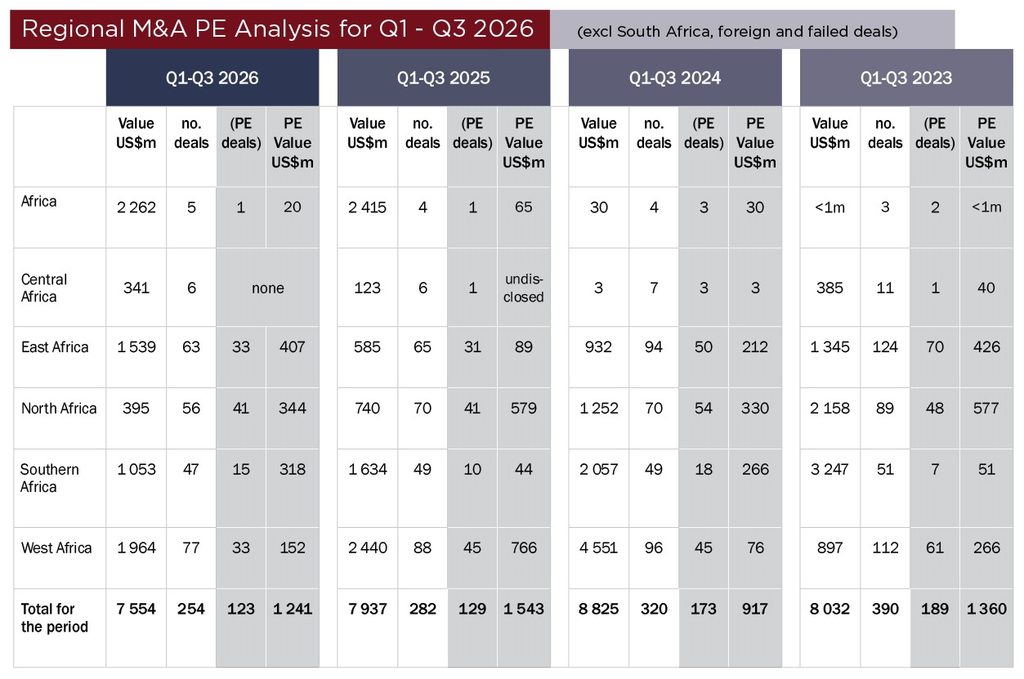
The African dealmaking landscape continues to present a picture of contrasts. In the nine months to end-September 2026, DealMakers AFRICA recorded merger and acquisition (M&A) transactions valued at US$7,55 billion (excluding South Africa), a 5% decline on the corresponding period in 2025. Deal volumes were down 10%. Yet beneath these headline figures, the composition and geographical spread of activity reveal some interesting developments.
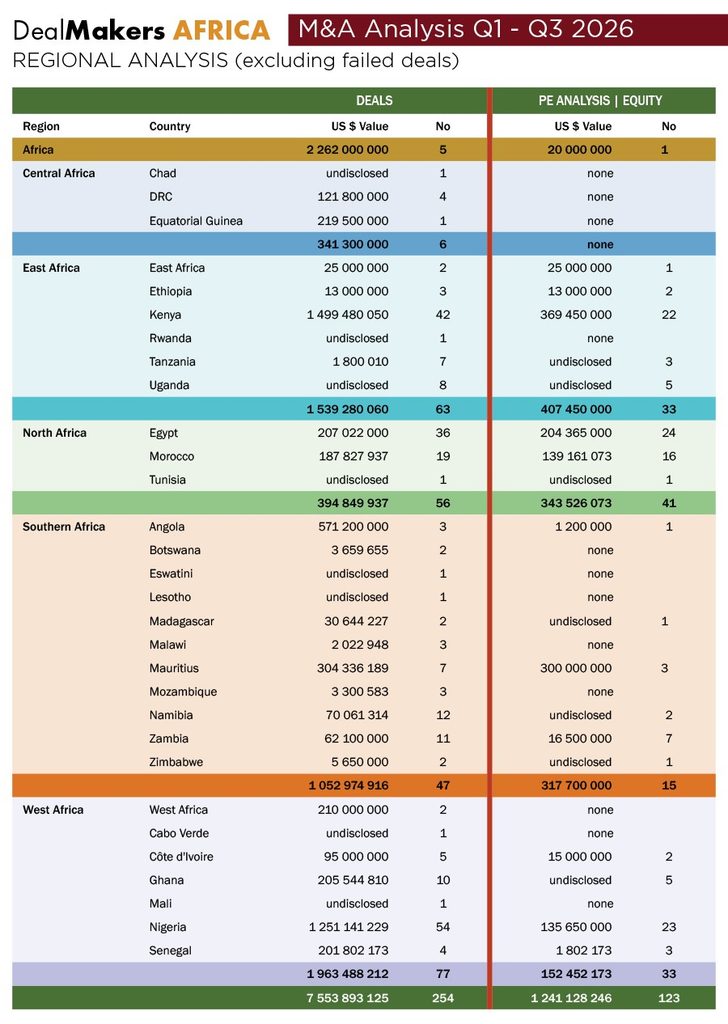
Perhaps most notable is the contribution of private equity, which accounted for 48% of reported deal activity. Its influence was particularly pronounced in North Africa, where private equity (PE) transactions represented 60% of regional activity with 41 deals recorded – approximately one third of all PE transactions captured across the continent. This clearly highlights the importance of private capital in the African transaction landscape.
West Africa remained the most active region with 77 deals, representing 30% of reported activity, followed by East Africa with 63 and North Africa with 56. Nigeria, Kenya and Egypt led at country level, recording 54, 42 and 36 transactions respectively.
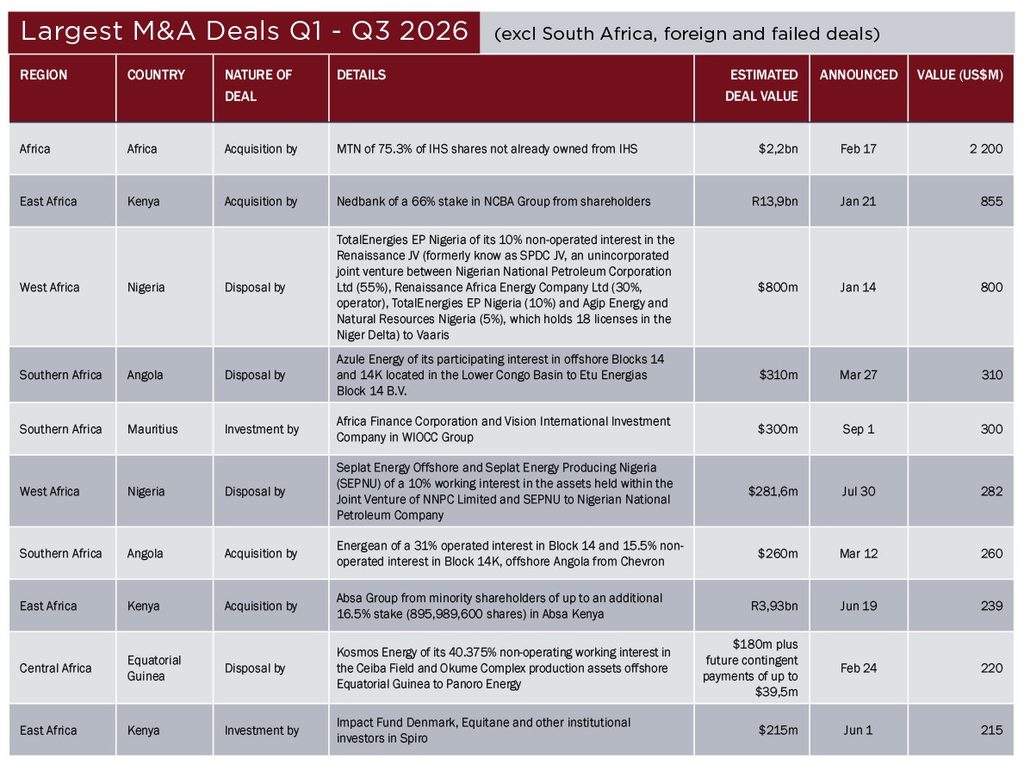
Deal value, however, tells a somewhat different story. The 10 largest transactions accounted for 46% of aggregate deal value, with energy featuring prominently, particularly across Central, South and West Africa. At the top of the rankings was MTN’s $2,2 billion acquisition of the remaining 75.3% stake in IHS, followed by Nedbank’s $855 million acquisition of a 66% interest in Kenya’s NCBA Group. Both transactions underline the increasingly cross-border nature of African dealmaking.
Beyond M&A, developments in the capital markets also deserve attention. Dangote Refinery’s enlarged $2,1 billion initial private offering (IPO), scheduled for listing in Nigeria later in November, and Continental Holdings’ successful listing on the Malawi Stock Exchange in August (where shares closed approximately 75% above the offer price and attracted some 10,000 retail investors) offer encouraging examples of capital market activity.
But the numbers only tell part of the story. Doing business in Africa requires more than capital and a willingness to take risk. Understanding where to invest, how to enter a market, what to acquire and, ultimately, how to exit are decisions that demand preparation, local insight and a clear investment strategy. Equally, with holding periods extending, the responsibility does not end once an investment has been made. Building stronger systems, improving operational performance and developing management capability are essential to preserving value and ensuring businesses are ready for their next phase of ownership.

The African investment landscape is complex and far from uniform. Success will increasingly depend not simply on identifying opportunities, but on how well investors prepare for, manage and ultimately realise them.
The latest magazine can be accessed and downloaded the DealMakers AFRICA website
DealMakers AFRICA is a quarterly M&A publication
www.dealmakersafrica.com