

Ghost Mail is a daily dose of analysis on JSE-listed company news. If you’re craving a proper financial lens on local company performance, view the recent newsletters and sign up here>>>
Before I get into the latest results from Purple Group (JSE: PPE), I want to point out something I’ve noticed. The EasyEquities app has become a lot more cluttered. The incredibly simple interface has evolved into a surface that offers a number of financial services.
I think this page from the latest integrated report with all the various “Easy” brands shows how things have broadened out:
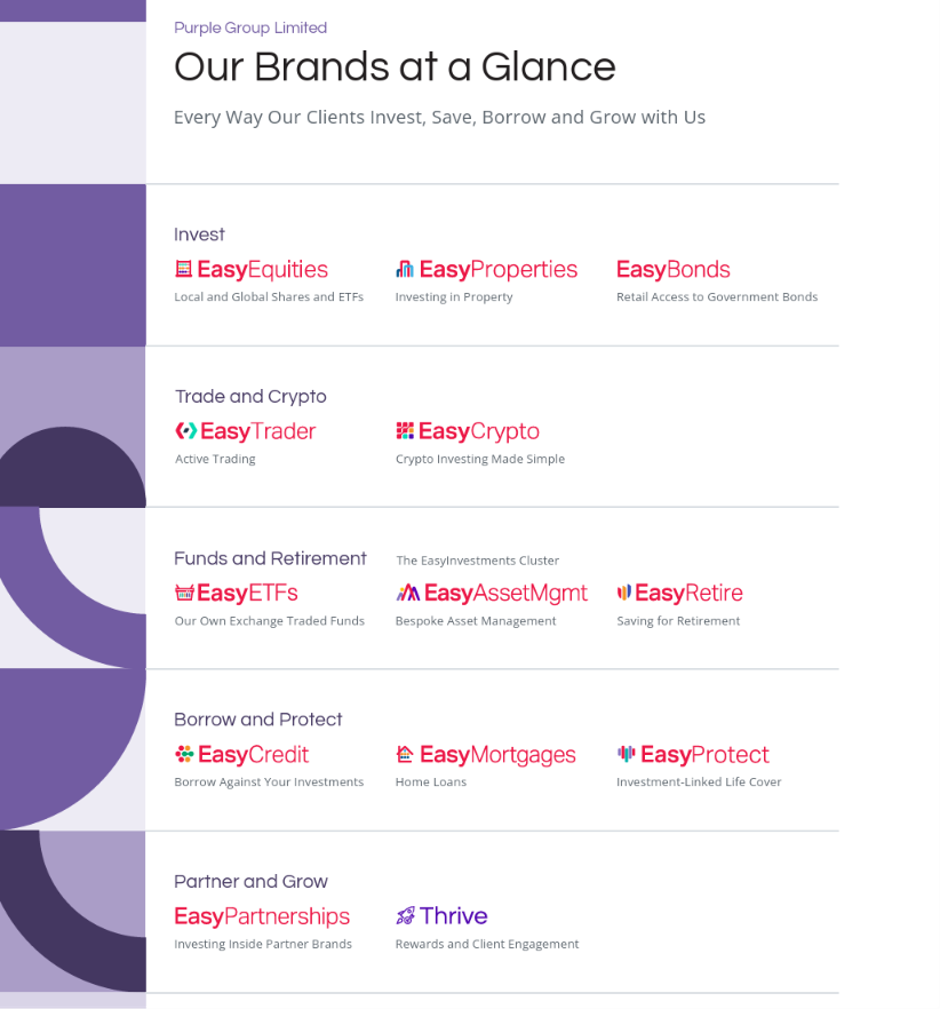
But is this strategy working?
More on that to come. First, we need to understand something about platform economics.
Platform business, meet contribution margin
To their absolute credit, the team at Purple Group discloses a number of interesting metrics that make it easier to explain how this business actually works.

The underlying theory is simple enough: a platform business comprises mainly fixed costs. There’s a minimum required competence to be able to offer a regulated financial service in South Africa. The infrastructure is expensive to build, but can become highly valuable if it scales to a point where each new client is highly profitable.
In other words, scale is absolutely critical in this space.
Above a certain level of usage, the profit made on an additional unit (i.e. client) is substantial. This is the concept of “contribution margin” referenced above.
For example, Purple notes that in FY23, they made just R2 in profit per active retail client. This year, they made R146 per client. These certainly aren’t normal percentage growth rates! Instead, this reflects the phenomenon of a platform business hitting an inflection point in profitability.
The profit per customer is a combination of two things: (1) spreading the costs across a broader client base (thereby reducing the cost to serve each client), and (2) average revenue per client increasing over time.
The first point is just common sense. The second point is confirmed by Purple consistently highlighting that older client cohorts are more valuable on a per-client basis. Intuitively this makes sense, as a client committed to multiple years of investing has probably developed the kind of financial habits that Purple likes to see, namely regular deposits and activity in the markets.
The company provides this incredible statistic as well: in FY15 (the first full financial year of operations), Purple had R155 million in client assets on the platform. Today, they are attracting that value in new deposits every 3 days or so.
There are very few businesses in South Africa that have grown like that over the past decade.
Room to grow
Easy Group, the part of Purple that everyone cares about (because it owns EasyEquities), now has 1.3 million active clients. This number increased by 14.8% in the past year. There’s undoubtedly a long tail of low-value clients here, but the argument is that today’s small clients are tomorrow’s larger clients.
Purple has relied on organic growth and clever partnerships to make this number happen. Absa is the latest such example, although the numbers aren’t even in this period as the partnership kicked off in mid-October. It attracted 16,000 registrations in the first weeks and nearly 6,000 funded accounts.
But nobody is good at everything
It can’t all be rainbows and unicorns. There’s an ugly duckling as well in the form of EasyTrader, which I’ve been saying for years doesn’t belong in this group. Purple is very good at offering tech-driven simple investment solutions to a wide user base of people who have straightforward needs. A business like EasyTrader is nothing like that. Fancier services require a different level of focus.
EasyTrader suffered a R22.6 million hedge book loss in this period. Sadly, it’s by no means the first time that this part of the business has been a disappointment for investors. Although progress was made in reducing the loss in the second half of the year, the “why bother?” question remains.
It feels like the business equivalent of putting your hand on the stove: a good outcome isn’t much of a thrill, while a bad outcome puts you in the emergency room.
The institutional business is also highlighted by management as leaving room for improvement. EasyRetire’s revenue growth of 5% is running behind asset growth of 27.5% due to the mix of mandates. This isn’t a straightforward space.
Management also notes that the efficiency ratios aren’t quite where they need to be, although they are being hard on themselves here. The goal is for revenue growth to be double the increase in expenses, and they didn’t miss this by much.
That’s a good time for us to dive into the numbers…
Selected numbers at Easy
Let’s do a quick run-through of the performance.
Easy Group revenue was up by 14.6%, while operating expenses only increased by 8.2%. Like I said, they weren’t far off the self-imposed target of a two-to-one relationship.
This combination led to profit before tax growth of 49.4%. Such is the joy of operating leverage!
Clients are putting more money in the market over time, with retail inflows up by an encouraging 51.1%. Client assets increased by 32.8%, with this metric impacted by prevailing asset prices in the markets.
Retail revenue lagged these growth rates though, up by 20.3%.
The annuitised revenue streams needed to do some heavy lifting here, as activity-based revenue (e.g. trading commissions) only increased by 14.2%.
That all sounds great, but that’s not actually what investors are buying – at least, it’s not entirely what they are buying.
Rolling it up to Purple
The listed company is Purple Group, not Easy Group. Purple only owns 70% of EasyEquities, 49.02% of EasyCrypto and 100% of EasyAssetManagement and EasyTrader.
Put differently: the best part of the group has to be shared with Sanlam as the 30% holder of EasyEquities.
In the crypto business, the absolute lack of irritating accounts on my X feed with red laser eyes proved to be a useful leading indicator for performance. Revenue fell by 38.5% and client assets are down 31.6%.
We’ve already dealt with the disappointment at EasyTrader.
Bring these issues into the mix and the result at listed company level isn’t as exciting as you’ll find at Easy Group. Purple revenue was up by 9.8%, while operating expenses increased by 9.3%. That’s certainly not the magical two-to-one target.
Still, HEPS increased by 27.3% at Purple level. That’s still very good. It’s just not as good as it could’ve been.
Fingers in many pies
Purple is busy with all sorts of things. They’ve made important acquisitions in international investment tools (Telescope) and AI agents. There’s also an agreement to acquire a platform serving financial advisors (Wealthport).
The one that just doesn’t seem to be happening is the Philippines. Easy has been at it for what feels like ages, especially in the context of how quickly the rest of the business has grown. The regulator seems to be taking a very long time to let Purple get going there.
This represents optionality in the current business model, which is always helpful, but anyone who understands options will also know that their value decays over time.
A cautious outlook
If you read to the bottom of the CEO’s letter, you’ll find a note that the group is planning for fewer tailwinds. There’s an acknowledgement that growth is weak in South Africa at the moment. Having a gazillion funded accounts is great, but it only works if people actually have money to invest. The non-activity-based fees only get them so far.
There’s nothing that Purple can do about the macro situation. The company can only keep working at achieving earnings growth. There’s not much to criticise here, but I do think that a wider service offering doesn’t necessarily create a better business. Purple should focus all their energy on the areas where they have a right to win.
I remain a happy shareholder. A quick check on my EasyEquities app (!) reveals a position that is up 69% since I invested.
Of course, this doesn’t mean that the share price will overcome the current weakness in South African consumers, with a year-to-date drop of over 18% reflecting the concerns in the market.
Remember, I share my opinion here for informational purposes only. I disclose my position because it’s important to make that disclosure. You must always do your own research on these companies and speak to your financial advisor. This article is not financial advice or an endorsement of the company.
Keen to get JSE-listed company insights in your inbox every morning? Sign up to Ghost Mail here: