
Ghost Mail is a daily dose of analysis on JSE-listed company news. If you’re craving a proper financial lens on local company performance, view the recent newsletters and sign up here>>>
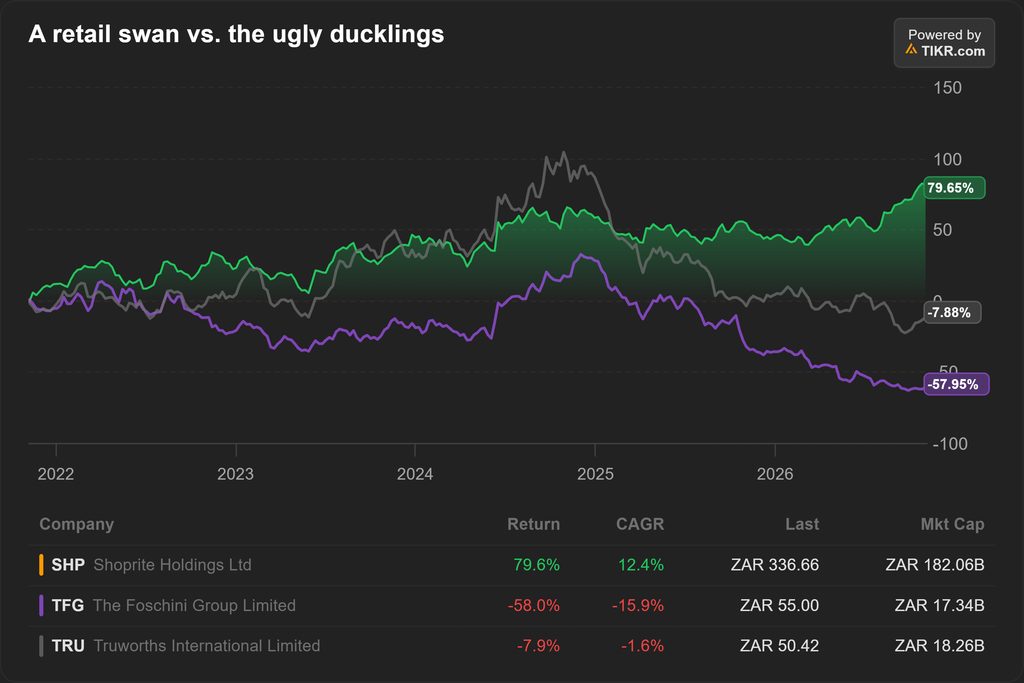
Shoprite: coming for (almost) everyone’s lunch
Shoprite (JSE: SHP) released an operational update for the four months to October 2026.
Your eyes aren’t deceiving you – this is a period that sits outside of the typical quarterly cadence that we see in operating updates. The reason for this is that Shoprite wanted to include the most recent metrics possible before heading into closed period.
Fair play to them. It’s always good to see more disclosure rather than less!
On a year-on-year basis, sales growth from continuing operations was up 6.4% at group level. Supermarkets RSA grew 7.1% and Supermarkets non-RSA was up 7.0%. Other operating segments fell by 1.5%, an interesting divergence from the rest of the group that is largely explained by the OK Franchise division.
The key segment is Supermarkets RSA, which achieved that 7.1% growth rate without much help from inflation. Selling prices were up just 0.7% for this period, so they needed to rely on growth in volumes and the number of stores.

Speaking of stores, Supermarkets RSA got the lion’s share of net new stores: 61 out of 71 at group level. There’s quite a spread across banners, with 12 Shoprite, 11 Usave, eight Checkers and one Checkers Hyper on the traditional supermarket side. The rest of the new stores comprise 21 LiquorShops (!), 10 Uniq Clothing, seven Petshop Science and one Checkers Outdoor store.
The fulfilment layer that sits on top of everything, Sixty60, grew sales by 33.4% for the four months. The convenience offering continues to resonate with South Africans and Shoprite is taking full advantage.
Supermarkets non-RSA was flattered by the forex movements, as constant currency sales growth was only 4.3% vs. the 7.0% reported increase in rand.
Those who have followed Shoprite closely may have a good idea of why the other operating segments dipped by 1.5%. The mutual termination of an OK franchise agreement led to the closure of 51 stores, which obviously creates a strong headwind for this division. Here’s something that may surprise you though: despite this move, OK Franchise reported positive trading profit growth!
The other operating segments also include the pharmacy businesses, where Shoprite is making serious progress. Medirite increased sales by 9.7% for the four months, while Transpharm (the pharmaceutical distributor) increased sales by 21.3%.
It feels like Shoprite is coming for everyone’s lunch in retail.
Well, not quite everyone. Furniture is one of the areas that Shoprite is trying to step away from, with the disposal of that business remaining subject to approval by the Competition Tribunal.
Offshore troubles for The Foschini Group
The Foschini Group (JSE: TFG) released results for the six months to September 2026. At group level, revenue was largely flat and HEPS fell by 6.8%. The interim dividend was down by a similar 6.9%.
But TFG is a collection of three largely unrelated geographies, so it’s important to drill down and understand the segmental performance.
TFG Africa contributed 68% of group sales in this period, so that’s clearly the most important business. Things have been tough, with the group closing 120 underperforming stores in this period (mostly as leases expired). This reduced trading space by 2.6%.
Despite this, TFG Africa managed to increase sales by 3.8%, including a 2.0% increase in like-for-like sales.
This was in no small part due to Bash and the 53.3% jump in online sales. Bash is now 10.9% of TFG Africa’s sales, a remarkable increase from 7.4% in the comparable period. Much like at Shoprite where Sixty60 is servicing multiple brands, the Bash model is to bring together the various TFG Africa brands in a single online ecosystem. It seems to be working, with Bash reporting that orders are 28% larger when several TFG brands are combined in the cart.
Here’s the stat that really caught my eye though: Bash has now achieved an EBIT margin that is equivalent to stores. If you can achieve scale in online, you can do well. But you must achieve scale, as getting stuck halfway tends to be a heavily loss-making outcome.
At category level, Beauty was the standout performer with growth of 11.4%, although it contributed just 3.6% of TFG Africa’s sales. Competition has really heated up in this category, with various retailers jostling for market position.
If you dig into the Clothing category, you’ll find that Sports led the way with turnover growth of 7.7% and gross profit growth of 12.3%. At the other end of the spectrum, we find Menswear with a decline in turnover of 1.5% and gross profit down 4.0%.
Encouragingly, TFG Africa increased its gross margin by 10 basis points to 41.4%, so gross profit was up 4.1%. This brings us neatly to the highlight in the numbers: thanks to trading expenses increased by only 4.0%, TFG Africa managed to grow its segmental operating profit by 2.7%!
That’s where the good news ends, I’m afraid. We now move on to the international businesses that have been dragging the group down.
At TFG London, sales fell by 2.2% in local currency, with online sales down 4.2% and in-store sales down 0.6%.
Online is 42.6% of the sales mix, as the UK is a far more mature online market than South Africa. Any pressure in that sales channel has a significant impact on the results.
Gross margin fell by 10 basis points in TFG London to 64.0%. Despite trading and other expenses being 0.4% lower in TFG London, the business suffered a nasty 26.5% decline in EBIT.
At TFG Australia, sales were down by 4.4% in local currency, with like-for-like sales down by 3.6%.
Online sales contributed 7.6% to TFG Australia’s sales, so we find ourselves in a fascinating position where Bash’s contribution to TFG Africa is now higher than the online contribution in Australia.
Gross margin was up by 40 basis points to 65.3%. That gave some relief to the numbers, but nowhere near enough. Trading expenses were up 0.5% in this business, leading to a 28.3% decline in EBIT.
The group also gave an update on trading performance for the five weeks to 31 October 2026, representing the initial weeks of the second half of the financial year.
Sales by TFG Africa unfortunately fell by 0.7% in those weeks, so that’s a really poor start.
The overseas businesses are even lighter on good news, with a cybersecurity incident in TFG London putting serious strain on the legacy brands (Phase Eight, Hobbs and Whistles) – demand on those websites is down 30.2% for the period. White Stuff, the more recent acquisition in the UK that wasn’t affected by the attack, saw sales increase by 4.8% for the five weeks.
Finally, TFG Australia continues to head down under, with sales down 5.3% in local currency for the five weeks.
There are some important changes to the board, including the retirement of Michael Lewis as chairman after 11 years in that role (and 38 years on the board). There are a few changes to the board, but the one that raised some eyebrows in the investment community was the appointment of Craig Butters as a non-executive director. Butters has a long history in the industry and isn’t shy to speak his mind, so that might be the kind of energy that the board needs to make tough decisions for the company.
Truworths has been focusing on margin
Truworths (JSE: TRU) released a sales update for the first 17 weeks of the 2027 financial period. It doesn’t give us all the details to work with, but there’s enough in here to help us understand the focus areas.
Unlike at The Foschini Group, Truworths’ offshore business (Office UK) has been the highlight of the story. With Truworths Africa down 2.7%, the pressure is firmly on Office UK To keep delivering. Alas, the increase in sales in the UK was just 0.3% in local currency. When you factor in the stronger rand and the pressure in Truworths Africa, you’ll find a decline in group sales of 4.3% for this period.
That’s not a great start to any story.
Here’s another sign of consumer pressure: group cash sales fell by 7.5%, while the contribution of account sales increased from 44% to 46%.
There is a silver lining, though. Truworths opted to be less promotional in this period than in the comparable period, so gross profit was flat at Truworths Africa and 2% higher at Office UK. This is the actual value of gross profit, not the gross profit margin.
It’s unlikely that this has done enough to protect operating profit margins in this inflationary environment, but time will tell.
Digging deeper, Truworths Africa experienced a 0.2% dip in account sales and an 8.6% drop in cash sales. With this change in mix, account sales were 73% of total sales in this period. Credit quality is thus very important in the local business, with overdue balances unchanged at 16% of gross trade receivables.
Online sales grew by 16.9% in Truworths Africa. The contribution to total sales increased from 8% to 10%. People don’t talk much about the online operations at Truworths Africa, yet there’s a meaty contribution here that isn’t terribly different to Bash within TFG.
In Office UK, online sales fell by 6% in local currency as the business became less promotional overall and opted to protect gross margin. Online sales contributed 40% of segmental sales (down from 43% in the prior period).
Truworths doesn’t provide an outlook for the critical November and December trading months, but the announcement does include a reminder for investors that this is a seasonal business. In other words, the overall performance for the interim period will be materially impacted by whatever happens over the rest of this calendar year.
Do your own research and speak to your financial advisor. Nothing you read or listen to in Ghost Mail should be interpreted as financial advice. This is not a complete review of SENS and does not replace the need for you to refer to company announcements and reports yourself. Every effort is made to avoid errors in Ghost Bites and related podcasts, but I am only human.