

There are various forms of investment vehicles, each with their own advantages and disadvantages.
Private equity (PE) faces distinct structural headwinds in Africa. Shallow and illiquid capital markets make exits hard to execute because initial public offering opportunities are thin, and trade sale buyers with the balance sheet depth to pay full value are scarcer than in developed markets. Currency volatility and limited hedging instruments erode USD-denominated returns even when the underlying business performs well in local currency terms, while inconsistent regulatory enforcement, land/title uncertainty and slower judicial recourse raise the cost and duration of due diligence and post investment monitoring. The result is that closed-end funds are often required to (i) extend their term, or (ii) establish a continuation vehicle. However, these routes merely serve to manage the symptoms and do not cure the root problem.
A third option is highlighted in this article, namely a permanent capital vehicle (PCV). A PCV is a fund structure with no fixed term or mandatory wind-down date. Capital is raised to hold assets indefinitely (or on a rolling, evergreen basis), rather than being returned to investors within a typical fund life. Returns to limited partners come through periodic distributions (dividends, refinancing or partial realisation) rather than a forced sale of the underlying asset at a predetermined point.
For African assets spanning multiple jurisdictions, which inherently take longer to reach full value, a PCV should be treated as a structuring choice made from the outset, rather than a fallback used once the fund reaches its investment horizon. Unlike the first two solutions mentioned above, a PCV does not manage the exit better, it removes the need for one. The trade-off, however, is a significantly narrower investor universe, typically limited to development finance institutions (DFIs) and other investors willing to commit patient, long-term capital.
ON THE CLOCK
A closed-end fund (Fund) is a PE structure with a capped pool of capital and a fixed lifespan. Investors (being limited partners) commit capital during a defined fundraising window. That capital is deployed over a period of three to five years, with the Fund then expected to exit its assets and return proceeds within a total life of ten years, sometimes even between twelve and fifteen years.

The clock does not pause for a distressed buyer pool or for assets still in their ramp-up phase. When a Fund reaches its investment horizon, its managers owe their limited partners liquidity, not because the assets have reached the right moment to sell, but rather because the Fund’s constitutional documents say so.
WHY THIS IS NOT AN IDEAL FIT FOR AFRICA
Such a fixed timeline is a particularly poor fit for the kind of assets common across African PE, which are often held across several jurisdictions at once, each with its own regulator, exchange control regime, currency, and a pool of potential buyers, forcing that complexity to resolve on one calendar and in one process, regardless of which country’s market is actually receptive to a disposal at the Fund’s horizon. This mismatch can be compounded by the asset class itself. A large share of African PE activity is in infrastructure, where early years are absorbed by development and construction costs, gearing is typically high to fund that build-out, and cash flows only turn stable and distributable once the asset reaches operational maturity – a profile that rarely aligns with a fixed Fund clock.
There is growing optimism around dealmaking across the continent, supported by improving macroeconomic conditions, expansion of investable opportunities, and more attractive entry valuations.1 However, this optimism often fades when it comes to exiting these assets. Given global uncertainty, the current backlog looks more like a slow unwind than a healthy, ongoing cycle, with a large share of it concentrated in infrastructure, energy and other long duration assets.
Perhaps the greatest weakness of the traditional Fund model is that time eventually dictates the sale. Once a Fund nears the end of its life, it becomes a known seller. Sophisticated buyers recognise this dynamic and understand that the seller’s need for liquidity may outweigh its ability to wait for the best price. The result is a gradual transfer of negotiating leverage to the buyer, even where the asset itself continues to grow in value. However, some Funds may mitigate these pressures by extending their lifespan or transferring assets into a PCV. Such measures are exceptions, rather than the norm, and usually require investor approval and careful structuring.
THE BENEFITS OF A PCV
A PCV offers a different set of benefits, precisely because it removes the fixed clock. Assets are held for as long as they continue to earn their place in the portfolio, rather than being sold on a schedule dictated by a Fund’s remaining life. Capital is recycled internally as distributions come in, redeployed into new opportunities or reinvested in existing assets, rather than being returned to limited partners and then re-raised, with all the fundraising drag and timing risk that entails.
Liquidity for investors is decoupled from any single sale event, since returns can flow through periodic distributions, partial realisations or secondary transactions in the vehicle itself, rather than depending on one disposal landing at the right time in the right market. Governance also shifts accordingly. As no exit deadlines force the sponsor’s hand, incentive structures and reporting cadences can be built around long-term value creation, rather than a countdown to realisation.
Taken together, a PCV is not a liquidity workaround dressed up in different packaging. It reflects a different ownership philosophy – one built for assets whose value is created over decades, rather than realised on a Fund’s timetable.
WHY NOW?
Two converging forces make this structure more than a theoretical proposition on the continent, given that (i) listed exit routes are becoming less reliable, and (ii) limited partners continue to cite exit unpredictability as their principal reservation.2 By way of an example, in 2024, a fund holding stakes in African energy, infrastructure, digital and aviation assets across multiple jurisdictions reached its investment horizon of fifteen years, at a time when multi-country sale processes would not have realised significant value for its limited partners. Rather than forcing a sale, the Fund’s managers, supported by PSG Capital, restructured the Fund into a PCV – Harith InfraCo – providing the Fund with an alternative exit strategy and materially benefitting limited partners. In recognition of its innovative structure and successful execution, the Harith InfraCo transaction was awarded the DealMakers 2024 Private Equity Deal of the Year award.
The sectors best suited for a PCV share a common profile across African markets, being (i) long duration, contracted cash flows, (ii) assets whose value compounds over a horizon longer than a typical Fund life, and (iii) assets and/or operations which span more than one jurisdiction. Infrastructure is a clear fit for PCVs, but energy, digital and healthcare platforms with similar cash flow and multi-country footprints would also benefit from a PCV structure. Given the scale of infrastructure development still required across the continent, PCVs are not a short-term trend. The pipeline of long duration, multi-jurisdictional infrastructure assets suited to a PCV structure should continue to grow, rather than taper off, over the medium to long-term.
IS A PCV A NICHE SOLUTION OR IS IT A STRUCTURAL SHIFT?
A PCV is not a replacement for a Fund; most PE assets benefit from the disciplined fixed horizon, with most investors not looking for an indefinite hold. But for specific growing African assets across the infrastructure, energy and healthcare sectors, with multiple jurisdictional footprints and a narrow universe of natural trade buyers, a Fund is not a discipline, but rather a liability forcing sales of assets at the wrong time, in markets that would benefit from being held long-term to realise value.
A PCV does not require stepping outside of PE. The PCV structure remains fit for PE, given the nature of the underlying entity; rather, the exit mechanism changes and not the underlying investment discipline. A PCV allows different investors – whether international DFIs, strategic or public market participants – to participate alongside conventional limited partners within the same structure. When the medium to long-term ambition is a public listing, a PCV can be built as a listing ready vehicle from the outset. The vehicle is not tied to a single exit route either. Depending on the nature of the underlying investments, different assets or portfolios within it can find alternative exit routes if required, without forcing the whole vehicle towards one outcome.
A PCV, is not, in itself, a panacea for the structural headwinds discussed above. However, it should be considered as part of the standard structuring toolkit when acquiring and holding assets across multiple jurisdictions, rather than being viewed as a solution of last resort when traditional Fund structures have exhausted their options in a particular market.
Harith InfraCo is proof that a PCV works at scale, spanning several African jurisdictions in a single platform, because the sponsor treated permanent capital as a genuine ownership philosophy rather than a liquidity workaround in challenging markets.
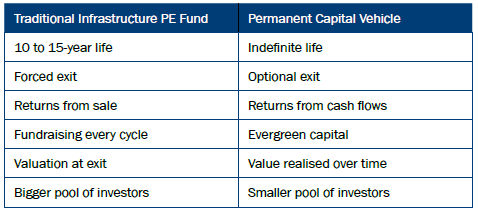
Finally, for the reader’s convenience, the table below summarises the key distinctions between the traditional Infrastructure PE Fund model and a PCV, bringing together the principal themes discussed in this article.
Mikayla Barker is a Corporate Financier | PSG Capital

This article first appeared in DealMakers AFRICA, the continent’s quarterly M&A publication.
DealMakers AFRICA is a quarterly M&A publication
www.dealmakersafrica.com