

Sunday, January 11, 2026
Home Blog Page 13

The billion-dollar cameos: how do brands get themselves on the big screen?

There’s a secret economy that turns movie props into million-dollar billboards.

Every movie has its stars – the leading man or lady, the love interest, the plucky sidekick. But look closely and you’ll notice another recurring cast member quietly stealing scenes: the brands.

Cars, laptops, beers, trainers, blenders – all playing their supporting roles in the background of our favourite stories. Sometimes they strut across the screen in slow motion, like a Lexus cruising down the coast at sunset. Other times, they lurk unnoticed, like a casual takeaway coffee cup on a counter, a phone glowing in a hero’s hand, a beer that just happens to be facing the camera.

These moments might look incidental, but they’re anything but. Behind every branded bottle cap and badge is a negotiation, an invoice, or at the very least, a very enthusiastic email chain between a prop master and a marketing executive.

Hollywood’s most expensive extras

Let’s start with the blockbuster stuff – the product placements that cost more than the average indie film.

Harley-Davidson once spent around $10 million to get its new electric motorcycle a spot in Avengers: Age of Ultron, presumably because nothing says “eco-friendly” like a superhero on a high-voltage bike. Heineken forked over $45 million for a brief but memorable moment in Skyfall, where James Bond swaps his signature martini for a cold beer. The deal went beyond screen time to include permission for Heineken to make ads starring Daniel Craig himself.

Then there’s the long-running arms race between luxury car brands to secure the 007 garage. BMW held the crown throughout the 1990s, spending around $110 million across three films before Aston Martin outbid them with a $140 million deal for Die Another Day. And in 2013, Man of Steel practically turned Superman’s cape into a billboard. More than 100 brands including Nokia, Gillette, and Carl’s Jr. paid a collective $160 million to be part of the reboot.

Big money, big egos, big exposure. And yet, most product placements in film don’t involve any money at all.

The box office barter system

We already know that making movies is expensive. Really expensive. A typical studio production costs around $65 million, and that’s before marketing or distribution. Props, costumes, and set dressing eat up huge chunks of that budget – and that’s where brands come in.

Property masters (the unsung heroes who make sure every gun, gadget, and gadget holder looks authentic on screen) are always hunting for ways to stretch their budgets. And that’s the basis for something called “corporate generosity”.

In many cases, studios simply borrow real products from real companies in exchange for a bit of screen time. No cheques, no contracts, just mutual benefit. The film gets realism and savings, and the brand gets a cameo in front of millions.

Some of cinema’s most famous product placements were (surprisingly) unpaid:

  • Reese’s Pieces only ended up in E.T. because M&M’s turned Spielberg down (apparently out of fear that the titular alien would scare their target audience – kids). M&M’s blunder became Reese’s win, as sales of Reese’s candy shot up 65% during the film’s opening week.
  • Ray-Ban didn’t pay for its iconic appearances in Risky Business and Top Gun – yet both films sent its Wayfarer sales soaring from 18,000 to 360,000 pairs.
  • Google didn’t just get free inclusion in The Internship (a movie about working at Google), it also got editorial control to shape how its offices and culture were portrayed. All that without paying a cent!
  • And while action franchises like Fast & Furious have made careers out of obliterating cars, many of those vehicles were provided (or at least heavily discounted) by the manufacturers themselves. Across its first seven films, the series destroyed around 1,487 cars, which is a theoretical $30 million in automotive carnage.

The agents behind the appliances

Of course, not every blender gets to flirt with fame. Hollywood is flooded with products vying for a spot in the background, and most don’t make the cut. To improve their odds, many brands hire product placement agencies, which are the equivalent of professional Hollywood matchmakers who introduce brands to productions and broker deals.

A typical arrangement goes something like this: a company pays an annual fee (anywhere from $40,000 to $300,000, depending on ambition). In return, the agency pitches the brand to prop masters, set decorators, and stylists, all while combing through scripts to spot potential fits. Need a tech brand for your sci-fi thriller? They’ve got options. A luxury car for your billionaire villain? Done. A specific brand of kitchen mixer for your holiday romance movie set in a bakery in 1960s suburbia? They’ll find one.

It’s all about context and character. The right product has to feel natural, not forced. Nobody wants their high-end watch on the wrist of a serial killer unless it’s a horror franchise with a sequel clause. Apple famously has a rule that their phones can never be used by villains on screen – so if you’re watching a murder mystery and trying to figure out whodunnit, you can cross the iPhone users off your list.

Some companies skip the middlemen altogether. Dell, for instance, started managing its own placements two decades ago by cold-calling Hollywood studios and building relationships directly. The strategy worked: in 2020 alone, Dell appeared in 19 films, including Bad Boys for Life, where it racked up over five minutes of screen time and roughly $8.5 million worth of ad value.

But are product placements worth all this effort?

In short: absolutely.

When Toy Story came out, Etch A Sketch sales jumped by as much as 4,500%. And when the Chevy Camaro starred as Bumblebee in Transformers in 2007, it single-handedly revived a struggling car model that had been gathering dust in showrooms.

Academic studies back this up – product placement can boost brand awareness by around 20%, increase positive associations, and drive higher purchase intent. People remember what they see on screen, even if they don’t consciously register it. That’s the real magic of product placement. It doesn’t feel like advertising (unless it’s really overt). It’s ambient marketing. The brand becomes part of the story’s texture, absorbed through osmosis rather than shouted through a megaphone.

Of course, subtlety is everything. Done well, product placement makes a film feel authentic. Done badly, it feels like an ad break with better lighting. When James Bond cracks open a beer mid-action sequence, it’s clever branding. When a character dramatically praises their laptop’s processing speed, it’s cringe. Viewers are surprisingly sensitive to that balance – they’ll forgive a logo, but not a sales pitch.

The future of on-screen advertising

As traditional advertising gets easier to skip — blocked, muted, scrolled past — brands are getting smarter about where they hide. Product placement offers something rare: undivided attention. You can’t fast-forward through a logo if it’s stitched into the plot.

In the end, product placement is less about selling objects and more about selling associations. Brands borrow the halo of Hollywood – the glamour, excitement, and emotional resonance – and in return, films borrow a bit of real-world texture.

It’s a fine dance between art and commerce, and when it works, both partners look good.

Ghostly editor’s note: my Ray-Bans have nothing to do with Top Gun, ok? Nothing. Absolutely nothing at all. I deny it.

About the author: Dominique Olivier

Dominique Olivier is the founder of human.writer, where she uses her love of storytelling and ideation to help brands solve problems.

She is a weekly columnist in Ghost Mail and collaborates with The Finance Ghost on Ghost Mail Weekender, a Sunday publication designed to help you be more interesting. She now also writes a regular column for Daily Maverick.

Dominique can be reached on LinkedIn here.

Ghost Bites (Cashbuild | DRDGOLD | Gemfields | Labat Africa | Premier – RFG | PSG Financial Services | Sanlam | Vukile Property Fund)

Things are picking up at Cashbuild (JSE: CSB)

Bit by bit, sales growth is increasing

Life is tough at Cashbuild. The SARB loves nothing more than high interest rates, so we live in a country where consumers prefer sports betting to investing in physical assets like property (at every income level). They just have to keep grinding away at Cashbuild, with the great hope being that SARB will finally deliver some meaningful interest rate relief.

In the quarter ended September 2025, Cashbuild’s group revenue increased by 6%. In Cashbuild South Africa, existing stores were up 5% and new stores contributed 2%, so the growth in the local business was 7%.

This may not sound like much, but it’s a bit better than what the company has been able to manage over the past year or so. Importantly, volumes are the biggest driver of growth here, as selling price inflation was just 1.4%.

Sadly, P&L Hardware continues to fall, with existing stores suffering a turnover decline of 11%. This segment is only 6% of group sales, but that’s enough for the poor performance in this segment to continue to be annoying.

Onwards and upwards – ever so slowly!


A slight quarter-on-quarter uptick at DRDGOLD (JSE: DRD)

Cost pressures are evident, but are mainly due to timing

DRDGOLD released an operating update for the quarter ended September 2025. All the comparisons are made to the quarter ended June 2025, so this is a sequential quarter-on-quarter view rather than the typical year-on-year approach that would use the September 2024 period as a base.

In other words, don’t be shocked by relatively small movements, as these would annualise into bigger moves.

Gold production was up 2% and gold sales were up 1%. They achieved a better yield on the ore that was milled (i.e. more gold per tonne milled), which is why cash operating costs were up 8% per tonne milled and only 3% per kg of gold.

Adjusted EBITDA was only up by 1% though, with cost pressures leading to this modest growth rate. Annual labour increases were felt in this quarter and they also had to deal with winter electricity tariffs applicable in July and August (vs. only June in the previous quarter). When a business has seasonal factors, using quarter-on-quarter numbers can lead to distortions like these.

Cash and cash equivalents fell by R257.1 million to R1.05 billion. This is because of the dividend and the capex during the quarter. Importantly, the company remains debt free.

Thanks to the leveraged exposure to the gold price (in the form of plenty of operating leverage in this model), DRDGOLD is up a whopping 233% year-to-date!


Gemfields has suffered a very concerning security incident in Mozambique (JSE: GML)

Lives were lost at the mine gate

The risk factors at Gemfields seem to be through the roof right now. The company recently noted the illegal mining issues at the Montepuez Ruby Mining (MRM) facility and how this has delayed the next auction. Things are clearly getting much worse, with 40 illegal miners having marched on the mine gate and attacked Mozambican police officers. Two officers (including a commander) lost their lives.

Sure, no employees or contractors were hurt, but this is clearly an escalation in violence and risk. The company has been given information that this attack may be linked to an investigation by immigration authorities of illegal immigrants in a local village, which also led to loss of life.

Getting rubies out the ground at a profit is hard enough. Doing it under armed guard (which seems to be buckling under the pressure) makes it even worse. I worry about how this security incident is being downplayed in the market, with the share price closing just 1.5% lower in response to this news.


A truly wild day for the Labat Africa share price (JSE: LAB)

At one point in morning trade, it was up 230%!

Labat Africa is a small cap that really captured the imagination of the market on Thursday. There are normally fewer than half a million shares changing hands each day. Thanks to the release of a trading statement, over 18 million shares traded!

After a chaotic trading day, the share price eventually settled 50% higher. This was driven by the trading statement for the year ended May 2025 (yes, very late) that noted a jump in HEPS of a casual 436%. If you’re going to be late, you may as well make an entrance!

In this swing from profits to losses, the HEPS was 13.28 cents for the period. The share price was trading at 6 cents at the start of the day and ended on 9 cents, so it’s trading on a P/E of less than 1x!

The net asset value (NAV) per share is expected to be 21.87 cents, so the share price is also a significant discount to NAV. There’s a whole lot going on at Labat, so treat it as a speculative punt and do your research very carefully here if you are tempted.


Premier proposes a share-for-share acquisition of RFG (JSE: PMR | JSE: RFG)

As usual in these deals, the market sold Premier and bought RFG

It feels like we’ve seen some exciting deals on the local market this year, and now we have another example. Premier Group – the very successful FMCG business that was unleashed by Brait (JSE: BAT) – is looking to acquire sector peer RFG Holdings in a share-for-share deal that would lead to current RFG shareholders having a 22.5% stake in the combined group.

This exchange ratio is calculated based on a price of R22 per RFG share (vs. the prior day’s closing price around R16) and R154 per Premier share (in line with the prior day’s closing price).

What is the rationale for the deal?

Well, if we start with an understanding of Premier, we are looking at a company that has 28% market share in the formal bread market, 38% of the wheat market, 15% of the sugar confectionery market and 22% of the feminine care market in South Africa. It exports 14 brands in its portfolio to 41 countries worldwide. Recent performance has been very strong, with the benefit of operating leverage coming through in the baking business. It’s therefore likely that RFG shareholders would be quite happy to be involved in the merged group, as Premier is a successful story.

Over at RFG, the focus is mainly on key fresh and long-life categories. Recent performance has been difficult, with a number of market factors that can influence the pricing of key products both locally and abroad. There is minimal product overlap with Premier and the operations are (and would remain) distinct. On the one hand, that’s good news for the likelihood of a successful Competition Commission process and the culture of RFG being retained, with Premier seeing this deal as a way to expand and diversify the group. But on the other, this calls into question why it actually makes sense for the groups to belong together and why Premier should be paying a 37.5% premium to the 30-day VWAP of RFG.

It’s worth noting that a typical control premium is around 20% – 25%, so part of the premium is justified purely by Premier taking control of RFG. I think there’s also an element of opportunistic dealmaking at play here, as the RFG Holdings share price was depressed and Premier has been riding high:

The deal is being structured as a scheme of arrangement in which 1 new Premier share would be issued for every 7 RFG shares. Fractional entitlements would be settled in cash. This means that arbitrage traders will keep an eye on the share prices and see if there are any profits to be made based on the exchange ratio, although there’s obviously loads of deal implementation risk at this stage as shareholders still need to vote on the transaction and regulators will need to approve it. There are also a number of material adverse change provisions, which would give the parties a way out if something goes badly wrong at either company.

There are dividends to consider, with RFG entitled to pay a dividend for the 12 months to September 2025 and Premier entitled to pay a dividend for the six months to September 2025.

A break fee of 1% of the deal value would be payable by RFG to Premier in certain circumstances, but this excludes a situation in which RFG’s board recommends a superior proposal. This deal is wide open to a bidding war, so one wonders if we might see a competing proposal emerge.

In that context, it’s important to note that holders of 49.5% of RFG shares have given irrevocable undertakings to accept the offer, including Capitalworks with its 44.5% holding. There are non-binding letters of support from holders of a further 28.3% of shares. Those holders are mainly large institutions and they are clearly keeping their options open in case a better deal arrives.

The scheme circular is expected to be distributed on or about 11 November 2025.


PSG Financial Services’ advice-led model continues to do so well (JSE: KST)

Distribution power is king

When it comes to financial products (and especially in the investment space), it’s really hard to differentiate based on investment performance. As we know, only a handful of active managers reliably beat the market index over the long term. This means that distribution is where the real moat lies, with advisors out there structuring portfolios on behalf of clients and helping to attract flows.

PSG Financial Services is evidence of this, with the results for the six months to August 2025 reflecting a 19% increase in total assets under management. There’s an 18% increase at PSG Wealth (the advice business) and a 21% increase at PSG Asset Management. Thanks to a really good year in the markets, performance fees were 7.3% of headline earnings (up from 6% in the prior year).

PSG Insure also contributed positively, with gross written premium up 6%.

With underlying growth drivers of that nature, it’s little surprise that recurring HEPS increased by 21%. But here’s the interesting thing: despite having a modest growth rate, PSG Insure posted the best recurring headline earnings growth of 26%! The insurance sector really has had an amazing year.

Part of the jump in earnings is the approach taken by the company to managing its margins and investing in efficient growth. Technology and infrastructure spend was up 15%, while fixed remuneration was up just 5%. It’s a good time to be a data centre and not such a good time to be a young professional in the market, although full credit must go to PSG for their graduate programme and their initiatives like Think Big South Africa. The company does the right thing for shareholders and also does the right thing for the country.

Return on equity was a juicy 28.6%, up from 26.2% in the prior period. Just to cap off the good news for investors, the dividend per share was up 18%.

This is an impressive performance that explains why the share price is up 24% year-to-date. Interestingly, the share price dipped 2.6% on the day of results. Some profit-taking after a strong run isn’t uncommon.


Sanlam’s capital markets day details the next era of growth (JSE: SLM)

There’s always something interesting to learn from these events

Sanlam hosted a capital markets day and made all the presentations available here. This gives you an opportunity to really dig in if you’re interested in how the company will drive growth in years to come.

Remember, Sanlam is not shy to do deals. The company tends to make big moves both locally and internationally, with a focus on high growth emerging markets like India and the rest of Africa.

This comes through in the slide deck, like in this slide which shows the ex-South Africa growth opportunity across GDP and financial product penetration:

The group is looking to grow operating profit by more than 600 basis points above South African inflation. That’s significant real growth! In terms of returns to shareholders, they aim to grow the dividend at a rate 400 basis points about South African inflation. They also aim to keep return on equity above 20%.

How will they do it? Aside from organic growth, there are substantial growth drivers in the business that have been unlocked through recent transactions. For example, the growth runway in Africa for SanlamAllianz is exciting. In India, the ShriramOne app is is a “one-stop financial hub” that looks like an interesting strategy. Sanlam is also looking to ramp up its specialist insurance capability via the Lloyd’s transaction. There’s work to be done in some cases to get these deals across the line and to integrate them into the operations, but this is nothing new to Sanlam.

There’s plenty to dig your teeth into in the slides. As a final comment, this chart shows the recovery from the COVID lows and the base for further growth:


Unsurprisingly, the market threw money at Vukile Property Fund (JSE: VKE)

The property sector is hot and Vukile is one of the brightest flames

On Wednesday, Vukile announced a plan to raise around R2 billion through an accelerated bookbuild process. As usual, it didn’t take them long. Also as usual, institutional investors jumped at the opportunity to get their hands on more shares in Vukile at a discount.

In the end, Vukile upsized the raise and placed shares worth R2.65 billion, or 10% of the company’s market cap. In percentage terms, that’s a capital raise that was 32.5% larger than planned!

The property sector has come so far since the pandemic. I’m not ready to reduce exposure just yet, as we are still in a situation where only the best funds are raising money. When the more marginal players start to achieve oversubscribed bookbuilds, it’s time to take my money elsewhere.

In terms of pricing, the shares will be issued at R21.30 per share, which is a 4.3% discount to the 10-day VWAP. This of course is the challenge for retail investors in this sector: our phones don’t ring with the opportunity to buy the shares at a 4.3% discount. Instead, we just get diluted over time, with the hope being that the fund puts the capital to good use and keeps generating strong returns.


Nibbles:

  • Director dealings:
    • Ex-CEO and outgoing director Jan Potgieter has sold more shares in Italtile (JSE: ITE), this time to the value of over R8 million.
  • I was slightly off on the estimated pricing at which the underwriters have bought the ASP Isotopes (JSE: ASP) shares as part of that capital raise, as it seems that I misunderstood the option granted to the underwriters. A subsequent announcement by the company has confirmed that the price is $11.65 per share (for both the initial issue to the underwriters and the option). The underwriters will obviously try to offload them at a profit.
  • Southern Palladium (JSE: SDL) has requested a trading halt in Australia based on a pending announcement of a capital raise. This is how the listed environment in Australia works. We don’t have this rule in South Africa, so we end up in the odd situation where the company’s shares are suspended from trading in Australia but not in South Africa. The halt will be in place until the company makes the announcement about the capital raise or until the commencement of trading on Monday 20th October, whichever happens first.
  • Mantengu Mining (JSE: MTU) announced that Magen Naidoo, currently the CFO, will be appointed as the Deputy CEO as well. The drama around the company continues, with the company noting that this appointment is because of the death threats that have been received by CEO Mike Miller.
  • Shuka Minerals (JSE: SKA) is still holding its breath for the funding that is expected to be received from Gathoni Muchai Investments (GMI) for the acquisition of Leopard Exploration and Mining. There’s a $1.35 million cash consideration due to the sellers. The amount has been delayed yet again, with promises now made that the money will clear next week.
  • Kibo Energy (JSE: KBO) announced that the company has received an initial advance of funding under the convertible loan note issued to an institutional investor. This is to help the company with the process of acquiring Carbon Resilience Pte Limited, a utility-scale industrial decarbonisation and renewable energy company focused on Australia. The balance of the funds under the convertible loan note is expected to be received by 29th October. This capital is purely to fund the process of the deal, not the deal itself.
  • Universal Partners (JSE: UPL) will issue shares worth roughly R1.25 million to Argo Investment Managers in part settlement of the carry fee that is payable after the disposal of the company’s investment in YASA Limited. This represents less than 0.1% of shares in issue.
  • Here’s something for those keeping an eye on Mondi (JSE: MNP): the company has announced the launch of a €550 million Eurobond with a 5-year term and a coupon of 3.375%. They will use this to refinance existing debt, including the €600 million notes due April 2026 that they are currently busy with a tender offer for.

Note: Ghost Bites is my journal of each day’s notable news on SENS. It reflects my own opinions and analysis and should only be one part of your research process. Nothing you read here is financial advice. E&OE. Disclaimer.

Who’s doing what this week in the South African M&A space?

0

Consumer-packaged goods company Premier Group has launched a takeover bid of leading producer of convenience meal solutions RFG in a share swap transaction valued at c.R5,78 billion. Premier will issue shares in the ratio of 1 Premier share for every 7 RFG shares and a cash amount in respect of fractional entitlements to Premier shares. The share swap ratio is based on a reference price of R22.00 per RFG share and R154.00 per Premier share and will see RFG shareholders holding an aggregate 22.5% stake in the combined group. Based on the share swap ratio, the scheme consideration represents a premium per RFG share of 37.5% based on the 30-day VWAP. Shareholders collectively holding 77.8% of RFG’s shares in issue have undertaken to vote in favour of the transaction. Upon completion of the transaction, RFG will delist from the JSE. The enlarged group will have a combined annual revenue of c.R27,9 billion and profit after tax of c.R1,7 billion.

Growthpoint Properties has entered into a partnership with RSA Aero, the owners and operators of Cape Winelands Airport, making an initial investment with the right to co-invest and develop the new Cape Winelands Airport precinct – set to be developed on the site of the airfield previously known as Fisantekraal, north of Durbanville. The airport is expected to sustain c.35,000 direct and indirect jobs with an initial investment of R8 billion which will deliver the terminal buildings, runway and a 450-hectare developable estate. Construction of airport could begin in early 2026, pending Environmental Impact Assessment (EIA) approvals, with the projected opening in 2028.

Afhco Holdings, a subsidiary of SA Corporate Real Estate (SAC), has added to the residential portfolio with the acquisition of Parks Lifestyle Apartments at Riversands in Fourways. The development with a transaction valued of R1,67 billion will, once completed, comprise 2,000 residential units and will increase SAC’s exposure to suburban estates to 67.2% (currently 58.7%) of its residential portfolio. The purchase consideration will be funded through a combination of existing and new debt facilities, disposal proceeds and/or equity to be raised. The deal, a category 2 acquisition does not require shareholder approval.

Exemplar REITail has acquired two retail properties – a 50% stake in Boitumelo Junction in Welkom and Stimela Crossing in Barberton. The consideration payable for the Boitumelo Junction stake is R124,28 million to be paid to Masingita Property Investment Holdings. The second property owned by Zoviblox, a wholly-owned subsidiary of Masingita, will be sold for a purchase consideration of R235,47 million. The acquisitions constitute category 2 transactions for Exemplar and as such do not require shareholder approval.

ASP Isotopes has acquired an independent radiopharmacy located in Florida, US. The transaction is in line with the company’s strategy to expand PET Labs Pharmaceuticals’ nuclear medicine business, building a vertically integrated supply chain, manufacturing and distribution system for the delivery of radiopharmaceutical products. The acquisition represents PET Labs’ first expansion outside of South Africa.

The Canal+ offer to MultiChoice shareholders closed on 10 October with shareholders holding c.92.54% of the issued share capital accepting the offer. These acceptances together with the shares held by Canal+ prior to the offer will result in Canal+ holding a c.94.39% stake. The remaining shares will be compulsorily acquired in terms of the ‘squeeze out’ mechanism as the offer has been accepted by more than 90% of MultiChoice shareholders.

In early September Shuka Minerals informed shareholders that the finalising of the acquisition of Leopard Exploration and Mining (LEM) which owns the Kabwe Zinc Mine, first reported in December 2024, had been hindered due to the delay in the remittance of funds in the form of a loan from Gathoni Muchai Investments (GMI). The loan is necessary to satisfy the US$1,35 million balance of cash consideration due to the LEM vendors. GMI has now confirmed that payment is in process.

Kuunda, a B2B fintech solutions provider, has closed a Pre-Series A funding round of US$7,5 million. The funding round was supported by Portugal Gateway Fund, Seedstars Africa Ventures, 4Di Capital, Accion ventures, Nedbank and E4EAfrica. The funding will be used to scale inclusive digital lending by building the infrastructure as Kuunda expands into new markets in Africa and the MENA region.

Abland Property Developers and The Cavaleros Group have entered into a joint venture agreement on key land holdings. The partnership aims to accelerate the creation of sustainable, world-class developments and in doing so stimulate economic growth and empower communities.

Thebe Solar Energy has disposed of a portfolio of operational solar and battery energy storage assets to Westbrooke Renewable Energy Alternatives, a partnership between Westbrooke Alternative Asset Management and French renewable energy company CVE’s local subsidiary. The portfolio, located at 91 Shell-owned services stations across South Africa, generates c.7.8 GWh of renewable power annually. Financial details were undisclosed.

Weekly corporate finance activity by SA exchange-listed companies

0

This week Vukile Property Fund successfully undertook an equity capital raise of R2,65 billion, up from the initial R2 billion announced, representing 10% of the company’s market capitalisation. Vukile will issue c.124,5 million shares which were placed at a price of R21.30 per share representing a 4.8% and 4.3% discount to the pre-launch Vukile closing price and 10-day VWAP respectively on 15 October 2025. The proceeds of the bookbuild will enable Vukile to capitalise on accretive opportunities in the deal space.

Orion Minerals has issued 290,239,214 shares at an issue price of 1.5 cents to raise A$4,35 million. This finalises the issue of shares under the first stage of the placement. The second stage of the placement which involves the issue to its chairman, is subject to shareholder approval on 27 November 2025.

ASP Isotopes which took a secondary inward listing on the JSE in August 2025, following the offer to Renergen shareholders, is to raise c.$210,3 million in an underwritten public offering. The company has granted the underwriters a 30-day option to purchase c.$31,5 million of additional shares. The proceeds will be used for general corporate purposes.

Anglo American has purchased 71,444 shares on behalf of its shareholders in terms of its Dividend Reinvestment Plan (DRIP). 46,632 shares were acquired at an average price of £27.69 per share for electing shareholders on the UK register and 24,812 shares on behalf of shareholders on the South African register at an average price of R649.59 per share. Shareholders on the Botswanan register did not participate.

In terms of its Dividend Reinvestment Plan (DRIP) Mondi has, on behalf of shareholders electing this option, purchased 181,725 shares in the market at an average price of £10.15 per share and 186,886 shares in the local market at an average price of R237.78 per share.

Universal Partners has issued 69,658 shares by way of consideration issue for the part settlement of the carry fee owed to Argo Investments Managers in relation to the disposal of the Company’s investment in YASA.

Southern Palladium has requested a trading halt on ASX pending an announcement due on 20 October regarding a capital raising to be undertaken by way of a share placement and share purchase plan. The JSE has not declared a corresponding trading halt.

Trustco has renewed its cautionary notice advising that the company is to appoint an independent expert to prepare a fairness opinion for delisting purposes.

Shareholders have voted in favour of the change in name of the company from PBT Group Limited to PBT Holdings Limited. The special resolution for the name change will be lodged with the Companies and Intellectual Property Commission.

The JSE has informed Telemasters’ shareholders that the company had failed to submit its annual financial statements timeously and that its shares are under threat of suspension. If the company fails to submit these by 1 November 2025, its listing may be suspended.

This week the following companies announced the repurchase of shares:

Combined Motor Holdings is to undertake a repurchase of shares programme. The decision stems from surplus funds and low interest rates with directors of the view that returning the surplus to shareholders by way of a pro rata share repurchase offers the most optimal use of the funds. The repurchase programme will be restricted to a maximum number of 11,220,000 shares, representing 15% of the company’s total present issued ordinary shares.

South32 continued with its US$200 million repurchase programme announced in August 2024. The shares will be repurchased over the period 12 September 2025 to 11 September 2026. This week 1,739,172 shares were repurchased for an aggregate cost of A$5,43 million.

The purpose of Bytes Technology’s share repurchase programme, of up to a maximum aggregate consideration of £25 million, is to reduce Bytes’ share capital. This week 506,500 shares were repurchased at an average price per share of £3.93 for an aggregate £1,99 million.

Glencore’s current share buy-back programme plans to acquire shares of an aggregate value of up to US$1 billion. The shares will be repurchased on the LSE, BATS, Chi-X and Aquis exchanges and is expected to be completed in February 2026. This week 10,800,000 shares were repurchased at an average price of £3.57 per share for an aggregate £38,51 million.

In May 2025, British American Tobacco extended its share buyback programme by a further £200 million, taking the total amount to be repurchased by 31 December 2025 to £1,1 billion. The extended programme is being funded using the net proceeds of the block trade of shares in ITC to institutional investors. This week the company repurchased a further 733,248 shares at an average price of £38.12 per share for an aggregate £27,95 million.

During the period 6 to 10 October 2025, Prosus repurchased a further 1,264,403 Prosus shares for an aggregate €77,34 million and Naspers, a further 1,168,469 Naspers shares for a total consideration of R1,49 billion.

One company issued a profit warning this week: Santova.

During the week two companies issued or withdrew a cautionary notice: Combined Motor Holdings and Trustco.

Who’s doing what in the African M&A and debt financing space?

0

Botswana-based private equity firm, Africa Lighthouse Capital, has announced the acquisition of a significant minority equity stake in Bayport Financial Services Botswana, a regulated microfinance provider serving government and other wage-earning employees, for an undisclosed sum.

Caisse des Dépôts et Consignations de Côte d’Ivoire Capital (CDC-CI Capital) has made an equity investment FCFA350 million in the E-Health Development Agency (ADES) to support the development of telemedicine and connected care in Côte d’Ivoire. ADES offers telemedicine and outpatient care services through its UMED platform, which includes online consultations, home medical visits, biomedical analyses, and remote medical monitoring for patient follow-up, particularly for those with chronic diseases.

Moroccan fintech, Chari, has raised US$12 million in a Series A round led by SPE Capital and Orange Ventures, and including Verod-Kepple, Global Founders Capital, Plug and Play, Endeavor Catalyst, Pincus Capital, Al Khwarizmi Ventures, UM6P Ventures, Axian Group, Uncovered Fund, AfriMobility, P1 Ventures, Reflect Ventures, Dragon Capital, MyAsia VC, Harambean Prosperity Fund and H&S Invest Holding. Business angels Michael Lahyani and Karim Beguir also joined the round. Chari is the first VC-backed startup in Morocco to be granted a payment institution license by Bank Al-Maghrib, the country’s central bank.

In Nigeria, online travel group, Wakanow, has acquired Nairabox, a Nigerian event and cinema ticketing platform, for an undisclosed sum. The acquisition signifies Wakanow’s expansion beyond traditional travel services into the broader entertainment and lifestyle sectors, aiming to create a comprehensive digital ecosystem that integrates travel, entertainment, and cultural experiences.

Mi Vida, a Kenyan residential build-to-sell developer, focusing primarily on affordable and mid-market green-rated housing, has announced the signing of a share purchase agreement for a management-led buyout of the business from Actis for an undisclosed sum.

Cameroon-based fintech, REasy, has raised US$1,8 million in pre-seed funding to expand its operations across West Africa and strengthen its trade infrastructure. The round was led by Ingressive Capital, Launch Africa, and 54 Collective, with participation from Digital Africa, Christophe Chausson, Mathias Léopoldie, and Joël Nana Kontchou. The trade-finance platforms, founded in 2023, offers cross-border payments, logistics and compliance services to SME importers.

Kestrel Capital East Africa, an East African investment bank and stockbroker in Kenya, announced its acquisition by Theo Capital Holdings through a landmark Management Buyout. The deal was announced at the firm’s 30-year anniversary celebrations. Financial terms were not disclosed.

A consortium of investors comprising SPE PEF III (SPE Capital), Proparco and Amethis MENA Fund II (Amethis) has invested in Delta Holdings B.V., a prominent manufacturer of specialty additives with a focus on the paint and coatings industry that has a strong international presence in Egypt and India. Financial terms were not disclosed but the investment will support Delta Holdings in broadening its product offering and accelerating its export-oriented initiatives.

Tunisian fintech, PayDay, has announced the closing of its first pre-seed financing round led at a valuation of US$3 million, by UGFS North Africa (United Gulf Financial Services), with participation from TALYS Group and BioProtection SA. The startup combines salary-backed financing and micro-Takaful protection to foster financial well-being and inclusion across Tunisia and beyond.

Jahazii, a Kenyan fintech startup providing earned wage access and payroll infrastructure for Africa’s informal economy, has raised US$400,000 in pre-seed funding. The blended round—featuring equity, debt, and grant funding —drew investors including Antler East Africa, DEG Impulse, Jozi Angels, Innovest Afrika, and several strategic angel investors. The company will use the new capital to scale its software platform that unifies HR management, payroll processing, and embedded financial services for operations-heavy sectors such as manufacturing and agriculture.

Practical considerations when implementing ESOP and HDP transactions

Employee share ownership programmes (ESOPs) and HDP (historically disadvantaged persons) transactions have gained prominence in the context of mergers and acquisitions, where the South African competition authorities have increasingly conditionally approved mergers subject to ESOPs or HDP transactions to address public interest concerns. These conditions aim to ensure that ownership by workers and HDPs is not adversely affected by mergers and, in some cases, they seek to enhance such ownership. However, the implementation of ESOPs and HDP transactions introduces complex legal, financial and operational challenges for both acquiring and target firms.

This article examines the evolving approach of the South African competition authorities regarding ESOP and HDP transaction-related conditions, and the practical implications for firms implementing these conditions as part of the merger approval process.

In recent years, ESOPs and HDP transactions have emerged as a transformative tool in South Africa, playing a crucial role in economic empowerment and inclusive ownership. The South African competition authorities’ focus on ESOPs, HDP transactions and other public interest conditions in merger approvals, as seen in the recent Vodacom/Maziv merger, has contributed to a surge in their implementation, particularly as a remedy for ownership dilution concerns, and to address potential anti-competitive effects.

These programmes and transactions are often integrated into Broad-Based Black Economic Empowerment (B-BBEE) strategies, reflecting their significance in promoting equitable economic participation, and as a tool for B-BBEE compliance. This is particularly relevant to the ownership element of the B-BBEE scorecard. Firms are recognising the dual benefits of ESOPs: enhancing employee engagement and meeting regulatory mandates.

Another trend is the diversification of ESOP structures. Firms are exploring various models, such as restricted share schemes, share purchase plans, option schemes and phantom schemes to tailor ESOPs to their specific needs. This flexibility allows companies to align ESOPs with their strategic objectives, whether it’s incentivising employees, enhancing B-BBEE compliance, or facilitating mergers and acquisitions. We have also noticed a trend with the Competition Commission affording itself the right to approve the B-BBEE shareholder in the context of HDP transactions.

Lastly, the regulatory environment surrounding ESOPs and HDP transactions is becoming more supportive. The publication of the Commission’s Revised Public Interest Guidelines Relating to Merger Control has provided clearer frameworks for the implementation of ESOPs and HDP transactions. We have also seen the competition authorities slowly move away from imposing ownership conditions where it is not feasible to do so, or where there are no concerns about ownership dilution.

While ESOPs and HDP transactions are generally seen as a positive development, their implementation can be complex and costly.

Merger conditions imposed by the competition authorities usually contain a time period within which merger parties are required to implement an ESOP or an HDP transaction. This period is typically between 12 and 24 months from when the deal has been closed. This often means that parties are required to begin implementing an ESOP or HDP transaction as soon as possible, so that they do not breach the merger conditions.

To do so, merger parties should begin considering the structure of the ESOP or HDP transaction at an early stage. This may entail, for example, considerations on whether an ESOP will be established as a trust or a company. Parties must also consider financing considerations, drafting the required documents, engagement with key stakeholders, due diligence processes, tax, and other implications. These considerations may be complex, depending on the structure of the ESOP or HDP transaction, and may have an effect on the timing of the implementation of an ESOP or HDP transaction.

To mitigate timing risks, parties need to develop and implement a clear roadmap with key milestones. They should involve transactional and legal advisors at an early stage of the implementation of an ESOP or HDP transaction. This will assist parties to identify any issues that may delay implementation. Merger parties should also be upfront and make submissions to the competition authorities during the investigation or adjudication of their deal. They should set out realistic timelines for the implementation of the ESOP or HDP transaction, depending on the particular facts of their case. Where parties have been unable to start with the implementation of an ESOP or HDP transaction in a timely manner, they should seek to engage with the competition authorities as soon as possible to mitigate the risk of non-compliance with their ESOP or HDP condition.

If it becomes evident that the ESOP/HDP condition will need to be varied from a timing perspective, merger parties should engage proactively with the competition authorities. Early engagement may help avoid opposition from the competition authorities and other key stakeholders.

Given the rise in mergers being approved subject to ESOP and/or HDP transactions to address public interest concerns, parties need to plan proactively and exercise caution when agreeing to the timing of the implementation of these conditions. This will ensure that parties meet their regulatory mandates and achieve the desired outcome for ESOPs or HDP transactions.

Masango and Mmutle are Senior Associates | Webber Wentzel

This article first appeared in DealMakers, SA’s quarterly M&A publication.

Musings from a reconditioned private equity fund partner

0

Good corporate governance makes sound commercial sense (Part 2)

On my return to legal practice from the world of private equity, the first article I wrote was about good corporate governance. You might think it a dry topic for the first round, but it made sense to me at the time because, in my experience, its relevance is so often underappreciated. I also thought that although it may be dry, at least it should resonate somehow with most people. Even if it only results in a brief re-examination of any established biases about governance, it will have achieved something.

There is a trend for people who are involved in the transactional side of business – generally senior management – to shy away from the subject of governance. Surely that’s what company secretaries and compliance officers are for? But it’s this kind of thinking which undervalues the importance of good governance.

In case you are picking up this article first, although the two may easily be read independently of each other, the following is the link to Part 1. I mentioned then that there is an established connection between good corporate governance on the one hand, and enterprise valuations and the ability to raise debt on the other. A company which has its corporate governance ducks in a row creates an immediate impression of being well run, where executive management knows what is going on and, to mix metaphors, has a firm hand on the tiller. It demonstrates, for example, engagement with a board that functions effectively, that has the information it needs at its fingertips, and that plays a proactive and valuable role in the affairs of the company.

Private companies looking for equity investors or for finance from any third party could benefit from answering questions with the following flavour:

 What does the Board of Directors look like? Are most members of the board independent non-executives? Is it suitably representative of individuals from different backgrounds, and do they collectively bring relevant industry-specific or other expertise?
 Is there a board charter or corporate governance framework in place that explains, at least, the following: what corporate governance means in the context of the company, the expectations the company has of each of the members of the board, and roles and responsibilities of board subcommittees?
 Do each of the board members understand their legal (both statutory and common law) responsibilities, as well as what is expected of them at board level?

 Have the relevant board subcommittees been constituted and are they functioning properly? Consider the following:

  • Is there an Audit Committee, or a combined Audit and Risk Committee? If the mandate of the Audit Committee does not also address the company’s risk environment, is there a separate Risk Committee?
  • Is there a Remuneration Committee? While the requirement for such a committee has not been legislated, it is addressed in the proposed new section 30B of the Companies Act (which has not yet been promulgated).
  • Is there a Social and Ethics Committee?

 Who are the members of these committees, and are their qualifications and experience relevant to their respective roles? In the case of the Audit Committee, for example, are the members aware of section 94 of the Companies Act (helpfully entitled Audit Committees), and does the committee comply with the requirements of this section?
 Are the responsibilities of each committee set out in a clear Terms of Reference or other formal document, and has this been circulated to, and acknowledged by, both the board and all the relevant committee members?

 Is there a corporate calendar that sets out, annually in advance, the dates upon which the board and its various subcommittees are to meet?
 Are meetings properly minuted, and are these reviewed and signed off by the relevant committees?
 Is there a comprehensive set of properly prepared and executed resolutions for all decisions taken?

A bugbear of mine is that although minutes and resolutions are the official record of decisions made by the company, they are frequently either wrong, or sometimes plain misleading. When they are well prepared, they provide a comprehensive history of the company’s affairs, and detailed rationale for and background to decisions taken. When they’re badly done, as all too often appears to be the case, they frequently don’t comply with the applicable law, are often incomplete, and they generally gloss over material facts or issues. These types of records ask more questions than they answer.

A final thought is that all executive decisions need to be critically examined. It is all very well for busy executives to make important decisions in the corridors, but we all have blind spots – unconscious biases about our own decision-making ability. These biases lead even the smartest people to make stupid decisions sometimes, as they believe emphatically that, because they are equipped with their unique intelligence and their experience, they are right even when they are wrong.

A board whose members possess relevant experience and expertise can challenge a decision, and can ask for more information where it appears that insufficient information was provided. It provides accountability for decisions, and ensures that the decision-making process is robust. It monitors decisions made, and ensures that any deviations or variations are noted. All this means (and this should be of considerable comfort to the executive team) is that an engaged board is likely to make better decisions.

To quote an old friend: ‘A decision-making process that provides some guidelines and guardrails provides some safeguards against really stupid decisions.’

Peter Mason* is a Senior Consultant | Bowmans

  • Peter is an ex corporate finance and banking lawyer. After leaving banking, and a brief sojourn at a large SA law firm, he spent 10 years as a partner of a private equity fund manager based in Johannesburg.

Ghost Bites (ASP Isotopes | Exemplar REITail | Karooooo | Vukile Property Fund | Vunani)

ASP Isotopes looks to raise $210 million (JSE: ISO)

That’s a clever move after the recent jump in the share price

Smart companies know that the time to raise capital is when the share price is high and everyone is in love with your story. The very worst time is when the share price is depressed and you’re raising money just to survive. In fact, if you read some of the stories of US-based tech companies, the common thread seems to be that they raised money when they didn’t need it!

ASP Isotopes has been listed on the Nasdaq since 2022 and only recently added the JSE to the mix. American investors have a completely different mindset to South African investors, so ASP Isotopes is able to play the game that works in the US. In other words: raise capital when the share price has jumped.

Based on recent news around major supply contracts (the main driver) and bolt-on acquisitions (to a lesser extent), ASP Isotopes’ share price has increased over 46% in the past month. This is therefore a very good time to tap the market for capital.

The company is leaving itself some headroom, as they’ve filed a “shelf registration statement” which includes a prospectus that gives them the flexibility to raise up to $250 million across multiple types of instruments and over time in various tranches.

They aren’t wasting any time, with a public offering to raise $210.3 million in equity for general corporate purposes. They are doing this through underwriters and it looks like the price will be roughly $12.25 per share. The recent price on the Nasdaq was around $14.05 per share, so the underwriters will try and get that price in the market and make their margin in the process. This is very different to how you’ll typically see things play out in South Africa. Everything about the US market is geared towards large and successful capital raises, which is precisely why I have core holdings in my portfolio of US-based investment banks.

Like I said the other day in Ghost Bites: ASP Isotopes is run by investment bankers and they know how to use the capital markets.


Exemplar REITail’s latest deals tap into the informal-to-formal retail trend (JSE: EXP)

I can’t say I blame them

In South African property investing, there’s one class of retail properties that is really standing out at the moment: township-adjacent and commuter properties. Essentially, anything that allows for heavy foot traffic of lower income consumers who are shifting their spend from the informal sector to the formal sector. This trend is driving the story at grocers like Shoprite (JSE: SHP) and Boxer (JSE: BOX), so it’s the real deal.

Exemplar REITail isn’t scared to own these properties, with the latest acquisitions being firmly in this bucket. The first is a 50% share in Boitumelo Junction in Welkom and the second is a 100% share in Stimela Crossing in Barberton.

The Boitumelo Junction deal is priced at R124.3 million and the Stimela Crossing deal is priced at R235.5 million. In both cases, the deals are priced at net asset value (NAV) and Exemplar reckons these are the fair values. Based on the accounts for the year ended February 2025, the yields are 9.7% and 8.3% respectively. They just refer to the “profits” rather than net operating income, so I’m not 100% sure if the profits used to calculate the yield are directly comparable to how one would normally do it.


Karooooo banks more mid-teens growth (JSE: BYI)

The company keeps delivering

Karooooo released results for the second quarter and thus the half-year as well. It’s a solid set of numbers overall, with guidance for FY26 reaffirmed.

For the quarter, subscribers increased by 15% and net additions were 70,740 vs. 89,168 in Q1. This means that the rate of growth slowed down in Q2 vs. Q1, but the year-on-year growth remains strong. They grew subscribers by 15% year-on-year in South Africa, which is impressive given the maturity of the home market. Asia Pacific and the Middle East grew 21%, with Southeast Asia as the second largest contributor to group revenue. They are investing heavily there, with the sales headcount in Southeast Asia expected to be 70% higher by February 2026 vs. February 2025! Just to finish off on the geographical review, Europe increased 19%, while rest of Africa actually suffered a small dip.

Importantly, subscription revenue was up 20% in ZAR or 21% in USD, so average revenue per user (ARPU) increased. This is a key driver of earnings. There is some dilution to the profit margin though, as operating profit increased by 18% and earnings per share came in 15% higher. Cartrack’s operating profit margin was steady at 29%, while Karooooo Logistics dipped from 9% to 8%.

If we look over six months to take out some of the quarterly noise, Cartrack subscribers increased by 15%. The slower rate of growth is evident here as well though, with net new subscribers of 154,753 vs. 165,078 in the comparable period. Subscription revenue was up 19% in ZAR and 20% in USD. Operating profit increased by 18% and earnings per share was up 17%. Again, Cartrack’s margins were steady and Karooooo Logistics suffered a dip in margin from 11% to 8%.

You have to dig into the underlying report to get the cash from operations, as Karooooo doesn’t highlight the cash in the SENS commentary. Due to the capital-hungry nature of the business model from a working capital perspective (investment in devices), a period of growth often has a negative impact on cash. Sure enough, cash generated from operating activities for the quarter was up 22% before working capital changes and down 32.2% after working capital changes. They were still cash positive, just less so than in the comparable period.

So, aside from some growing pains in Karooooo Logistics (not to mention the volatility in earnings that is always going to be a feature of low-margin businesses), Karooooo is on the right track.


Vukile taps into a hot property market (JSE: VKE)

A bookbuild of around R2 billion is likely to be oversubscribed

Vukile Property Fund is among the best of the best when it comes to REITs. This means that there’s likely to be a bunfight among institutional investors over the shares that the company will issue to raise approximately R2 billion in fresh equity. We will no doubt find out early on Thursday morning, as accelerated bookbuilds tend to live up to their name.

Why does the group need more money? For acquisitions, of course! They’ve locked in two deals (one in each of South Africa and Iberia as the core markets). The South African deal is just waiting for Competition Commission approval. The Iberian deal is much earlier in the process, with Vukile in the offer stage with sole exclusivity on the opportunity (important as it avoids a bidding war).

As you can see, the details on the acquisitions are light. To help shareholders feel motivated to throw more money at Vukile, the company reminded the market that they are “confident” of the guidance of at least 8% growth in funds from operations per share and dividends per share.

Vukile’s share price is up 24.5% year-to-date.


Vunani expects a significant jump in earnings (JSE VUN)

Here’s some more good news for the company

Vunani released a trading statement for the six months to August 2025. They expect to report an increase in HEPS of between 32% and 52%, which means a range of between 8.8 cents and 10.2 cents.

This comes after the recent news of a merger between Vunani Fund Managers and Sentio Capital to create a fund manager of significant scale. Things seem to be on the up at Vunani, although there’s still limited liquidity in the stock and thus it’s difficult for institutional investors to really get involved here (assuming they would want to).


Nibbles:

  • AECI (JSE: AFE) unfortunately needs a new CEO and for seemingly unhappy reasons. Holger Riemensperger has only been in the job since 2023 and has been driving a turnaround at the group. Due to “personal and family reasons” he will be stepping down from 15 October, which is literally straight away. It’s never nice to read that stuff. The market hates news like for this for more than just the underlying human reasons, with the share price down 8.5% on the day. Dean Murray, Executive Vice President of AECI Chemicals, has been appointed interim CEO. He’s been at the company for over 18 years in leadership positions. To find a permanent CEO, the company will consider external and internal candidates. Good luck to Murray!
  • Cashbuild (JSE: CSB) announced that the subscription for shares representing a 60% controlling stake in Allbuildco Holdings (Amper Alles) has met all conditions. The effective date will be 1 December 2025.
  • Metrofile (JSE: MFL) announced that Mango Holding (the offeror that wants to acquire Metrofile) has an interest of 9.96% in Metrofile’s shares via a total return swap with Standard Bank.
  • Anglo American (JSE: AGL) announced the results of the dividend reinvestment plan. Holders of 3.37% of shares participated in this plan and elected to receive shares in lieu of cash.
  • Curro (JSE: COH) announced that JPMorgan now holds 5.01% of the company’s shares in issue. I suspect that this is an underlying arbitrage trade based on the offer to shareholders that will involve Capitec (JSE: CPI) and PSG Financial Services (JSE: KST) shares.
  • If you think you’re having a bad week, then spare a thought for the broker who experienced a system malfunction that broke the share prices of several small caps on Tuesday. Insimbi Industrial Holdings (JSE: ISB) was the first of these companies to explain what happened, with an announcement on Wednesday morning explaining that trades happened without any instruction from Insimbi shareholders. This includes the sale of 6.85 million shares by the CEO! They are hoping that these trades can be reversed. There were a number of companies affected, with Cilo Cybin (JSE: CCC) releasing a similar announcement later in the day. What a mess.
  • I think we can safely conclude that Accelerate Property Fund (JSE: APF) shareholders have had enough of Michael Georgiou. A whopping 97.08% of votes were cast against his re-election as a director. Shareholders also aren’t interested in giving the directors any ability to issue shares without permission, with the same percentage of shareholders voting against that resolution as well. That makes sense, given the huge discount to NAV at which the fund is trading.
  • Sirius Real Estate (JSE: SRE) announced that Fitch has reaffirmed its BBB investment grade credit rating with a stable outlook. This is of critical importance to property funds, as their cost of debt is a core input to their economic returns due to the extent of debt that they always use in the portfolio. Sirius is one of the best in the business, so this news about the credit rating is no surprise.
  • Trustco (JSE: TTO) seems to have made some progress with the JSE regarding the audit of the financials for the period ended August 2024. I honestly don’t know who must be more excited for Trustco to leave the JSE at this point: the directors or the issuer regulation execs at the JSE!

Note: Ghost Bites is my journal of each day’s notable news on SENS. It reflects my own opinions and analysis and should only be one part of your research process. Nothing you read here is financial advice. E&OE. Disclaimer.

Ghost Bites (Bytes Technology | CMH | Ninety One | Santova | Tharisa)

The shine has come off Bytes Technology Group in a big way (JSE: BYI)

The company has bigger problems than repairing its reputation after the shocking governance around the ex-CEO’s trades

In February 2024, former Bytes Technology Group CEO Neil Murphy resigned after an astonishing number of undisclosed share trades suddenly came to light. The share price was obliterated in response, with Sam Mudd promoted to CEO shortly after the initial chaos.

The share price bounced back strongly initially, but the unfortunate reality is that the company has much bigger problems than a badly behaved ex-CEO. The UK market hasn’t been great for the past couple of years and Bytes was priced for growth, so a nasty slowdown in performance can only lead to a drop in the share price. With the release of results for the six months to August 2025, the market has been disappointed once more and has shown its displeasure:

The problem seems to primarily lie in the margins. Gross invoiced invoice (GII) might be up 9.1% year-on-year, but revenue is up just 2.5% and gross profit increased by a measly 0.4%. Costs unfortunately didn’t sit still (especially with headcount up 12% year-on-year), so operating profit dropped by 7% and operating margin dipped from 43.4% to 40.2%. By the time you get to HEPS, the decrease is 5.1%.

There clearly aren’t many highlights here. A slightly silver lining is growth in the interim dividend per share of 3.2%, although this isn’t a sustainable trajectory unless earnings improve. The board’s confidence to increase the dividend would’ve come from a 15.1% increase in cash on the balance sheet.

The problem is that Bytes doesn’t really have a moat. They are selling products on behalf of the likes of Microsoft, so a change to how Microsoft incentivises its partners can cause considerable pain. This is why the company is focusing on services vs. software, as it gives them more control over their margins. That strategy is bearing fruit, with software GII up 8.9% and services GII up 15.1%. But what investors really want to see is an uptick in revenue and margins, as that’s what counts.

It’s unlikely that the trajectory will be any prettier in the second half of the year, as they are up against a particularly strong base period.


Combined Motor Holdings gives us the rarest of examples of capital allocation (JSE: CMH)

Not only are they doing huge buybacks, but it’s instead of the dividend

In South Africa, many corporates are obsessed with the idea of paying an annual dividend and ensuring that it increases each year. To be fair, there are lots of mature companies in the US that are no different. As a reward for having an artificially low payout ratio and a dividend that keeps going up, those US companies even form part of a special club: the Dividend Aristocrats.

In truth, the decision to pay a dividend should always be weighed up against other capital allocation decisions. This is dividend theory 101, with the “bird in the hand” argument suggesting that the market pays a premium valuation for companies that show commitment to the dividend.

At CMH, we are going to find out if that theory holds in South Africa. Having just released results for the six months to August 2025 that reflect revenue growth of 16.3%, operating profit growth of 14% and HEPS growth of 22.7%, you would expect to see a juicy dividend. Instead, there is no dividend whatsoever! The company has decided to rather invest that cash into share buybacks, with a plan to repurchase up to 15% of the shares currently in issue. They won’t be able to execute a buyback of this size on-market and without shareholder approval, so a circular will no doubt follow in due course.

This approach to buybacks feels sensible, as these charts demonstrate that profitability hasn’t been nearly as smooth as the revenue journey thanks to all the distortions of the pandemic margins and then the significant change to the local market from the influx of Chinese cars:

Due to the cash-hungry nature of the operations from a working capital perspective, the cash generation story is even more volatile. For example, in the latest period, cash generated from operations fell by 14%.

When you’re dealing with this kind of volatility, buybacks give you flexibility that dividends simply don’t.

If we dig into the segments, then we find the usual situation that is such an amazing example of structural differences in margins. The car hire business generates profit before tax of R77 million from external revenue of R389 million, a profit before tax margin of almost 20%. The motor retail business has revenue of R7.1 billion, yet it only manages profit before tax of R104 million – a margin of just 1.5%. Talk about picking up pennies in front of a steamroller!

There is another element to the economics of the motor retail business that we need to consider. Selling cars feeds the financial services segment at CMH, which made profit before tax of R27.6 million from revenue of R74.9 million. That’s a margin of nearly 37%, which makes this the most profitable segment of the group!

CMH has done a commendable job of adapting here, with the management commentary noting that Chinese and Indian cars are nearly 50% of group new car sales. The traditional names at CMH (Nissan / Ford / Volvo) are really struggling. Hybrids are just 3% of the market, way below NAAMSA’s target of 20% this year and 40% by 2030. I have no idea how NAAMSA arrived at that target, but there is no chance of that happening here at the tip of Africa.

The car rental business also isn’t without its challenges, as they operate in a highly competitive environment. One of the ways they generate usage of the vehicles is the insurance replacement market. Now, we know from reading the results of short-term insurers that underwriting profits have been strong recently, which means that claims have been lower. Sure enough, CMH echoes this view in the commentary, noting a decrease in the level of insurance claims.


A juicy jump in AUM at Ninety One (JSE: N91 | JSE: NY1)

The rise in global asset prices has no doubt helped them here

There are literally only two ways in which an asset manager like Ninety One can increase its assets under management (AUM). The first is the “controllable” way, being the attraction of net inflows through marketing strategies and possibly a dedicated distribution network (depending on which asset manager we are looking at). The second is based on exogenous factors to a large extent, with an increase in asset prices over time leading to growth in the funds.

Sure, the company’s investment philosophy (which is controllable) will also have an impact on fund growth, but it doesn’t make as big a difference as the broader macroeconomic environment, especially not once you reach the scale of the likes of Ninety One.

There are a lot of concerns out there around global asset prices, but for now at least Ninety One is riding that wave. AUM as at 30 September 2025 came in at £152.1 billion, well up from £139.7 billion as at June 2025 and 19.4% higher than the AUM a year ago (September 2024).

The announcement doesn’t indicate the extent to which this is driven by asset prices vs. flows.


A nasty downturn at Santova (JSE: SNV)

Much of the strong recent share price performance has now reversed

In May this year, the Santova share price went mad in response to the news of an acquisition and subsequent buying of shares by directors and execs. My dad joke of the day is that the share price has now been Santova the edge:

As you can see, the drop came suddenly on the day of release of a trading statement for the six months to August. The company was impacted by lower volumes and freight rates in Africa, Asia-Pacific and North America. The resilient performance in the UK and Europe wasn’t good enough to offset the impact, which is why HEPS is down by between 20.1% and 25.1%.

The global trade environment is volatile to say the least.


Tharisa had a strong finish to the financial year (JSE: THA)

Q4 production numbers were excellent

Mining companies can’t do anything about commodity prices in the market, but they can make sure that their production is strong when those prices are lucrative. Tharisa has played their part in the latest quarter, with PGM production for Q4 up 19.7% vs. Q3. Chrome production increased by 2.9% vs. Q3.

Before you get too excited, I must note that PGM production for the full year was down 4.7% and chrome was down 8.5%. The acceleration in the fourth quarter wasn’t enough to offset the drop in production earlier in the year.

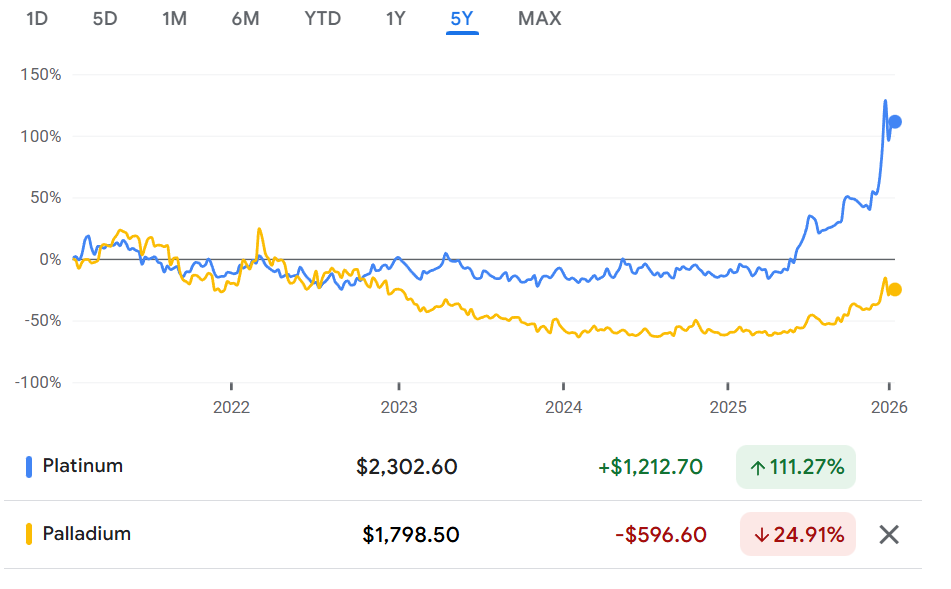
In terms of pricing, the USD price of PGMs increased by 18.6% for the year and 24.1% in Q4 vs. Q3. This jump in price is why the PGM sector has been flying. Chrome prices didn’t behave themselves though, down 11% for the full year and nearly 6% quarter-on-quarter.

The group’s net cash position improved from $43.1 million as at June 2025 to $68.6 million as at September 2025.

Production guidance for FY26 is between 145koz and 165koz for PGMs (vs. 138.3koz in FY25) and 1.50Mt to 1.65Mt for chrome (vs. 1.56Mt in FY25).


Nibbles:

  • Director dealings:
    • At Growthpoint (JSE: GRT), CEO Norbert Sasse retained shares worth R10.9 million as the non-taxable portion of a share award (meaty enough to deserve a mention – especially at this point in the property cycle). The company secretary of the company sold shares though, to the value of R857k.
    • The Chief People Officer of Quilter (JSE: QLT) sold shares worth R4.1 million.
    • Here’s some novel wording for you: Super Group (JSE: SPG) announced that the company secretary and a director of a major subsidiary sold shares “in part to settle tax obligations” – in other words, the sale was in excess of the amount needed for tax. I just haven’t seen a company word it that way before. The total value of the trades is R1.77 million.
  • AYO Technology (JSE: AYO) released the final timetable for the offer by Sekunjalo Investment Holdings and the delisting of the company. The listing will be suspended from 22nd October and terminated from 28th October.
  • PBT Group (JSE: PBG) has obtained shareholder approval to change the name to PBT Holdings.

Ghost Stories #75: A structured approach to global equity exposure

We know that global equities have outperformed global bonds and money market investments over the long term, but this comes with the risk of higher volatility. The current investment climate has also called into question the traditional 60/40 approach to a balanced portfolio, with problematic correlation for investors.

With a track record in structured products spanning 23 years, Investec has seen practically every type of market cycle play out. As a response to relative global equity valuations across multiple regions, Investec (in its capacity as investment advisor and promoter) brings you Advanced Investment Holdings.

This is a Guernsey-based structure that holds a portfolio of the S&P 500, Euro Stoxx 50, Nikkei 225 and FTSE 100 indices. Over a term of five years and one month, the investment offers full downside protection (100% capital preservation at maturity in USD) and will multiply the upside by 125% (to a maximum return of 50%).

Japie Lubbe brings his extensive experience to this discussion, explaining exactly why Investec has taken this approach to structured equity exposure in the current environment. He also explains the nuts and bolts of the structured product and exactly how the returns and risks work. 

Applications close on 28 November 2025. As always, it is recommended that you discuss any such investment with your financial advisor.

You can find all the information you need on the Investec website at this link.

Disclaimer

Listen to the podcast here:

Transcript:

The Finance Ghost: Welcome to this episode of the Ghost Stories podcast. It’s going to be a really interesting look at a new structured product that is coming your way from the team at Investec. And we’ve got Japie Lubbe on this one which is always exciting because Japie, you have been doing this for a quarter of a century as you pointed out to me before we jumped on to start recording. So that is an amazing innings – well done! You’ve basically been at Investec since the beginning of Structured Products there, right? You essentially launched this business with them.

Japie Lubbe: Yes. At that stage, you may remember we’d had the big ‘99 crash and 2002 was also a bad time for equities. So when we launched the product range we were initially focusing a lot on downside protection. Subsequently over the years we’ve had markets improving a lot and after the GFC we had like 13 years – what I refer to as Goldilocks years: porridge is always half warm. In that phase we introduced the autocalls and the digital notes and some of the others that you’ve had us on air, where in that type of product you do take some downside risk if markets move down by a certain percentage. And that’s served us well because it’s been a very long bull market.

This one we’re going to be talking about is one back to the product range where you have full protection just because at the moment our view is markets are quite high.

The Finance Ghost: I just want to touch on one or two of the points from the track record because it’s actually in the presentation that Investec has made available for this particular product. So roughly 126 public products over that period of which none have incurred a loss for investors. Absolutely none. So that is a fantastic track record – well done!

Four of them have returned capital to investors. So if we’re going to get technical, obviously their investors would’ve been on the wrong side of inflation, they kind of just got their money back. But that’s still a really decent outcome versus what would have happened had they just taken the naked exposure. And 85 with a positive return – so that’s 85 out of 89 matured structures with a positive return. And the remaining products, roughly 37 of them still live in the market, so obviously we’ll wait and see what happens to them at maturity.

So just well done Japie, I guess is the overarching point here. What’s interesting when you look at those stats is positive returns are great – I mean it’s nice to be up, definitely rather be up than down – but what about outperformance of the underlying indices? Because of course that’s the real goal, that’s the really, really big thing to aim for is not just that the returns were positive, you can technically achieve that by just putting your money in an Investec bank account actually and earn some interest – you want to outperform.

What’s been the journey with that? You’ve been there from the beginning. There’s no one better to talk to that than you.

Japie Lubbe: Yes. So we have three listing platforms. We have the Johannesburg Stock Exchange, we have the Dublin Stock Exchange for hard currency notes. Those two products are on Investec’s balance sheet, so the investors are taking Investec risk, Investec issues them with a note. And then we have the Guernsey companies listed in Bermuda. And these companies are totally independent companies. Investec doesn’t own any assets in them. They’re totally independent. That will be the one that we’ll discuss today.

So across these three platforms, of all 89 products that have matured and they’re shared amongst the three platforms, on the JSE our returns have been – average across all the matured products – 11.6% per annum. And the benchmarks that were the underlying assets of the indices that we’re tracking was 6.4%. On the Dublin market, this is now non-rand, so mostly US dollars – this has been a shorter-dated period, so it has had much more of these good times in markets – our returns were 9.6% and the underlying benchmark is 8.4%. These are the price-only indices.

And in the Guernsey companies we’ve had a very long period of time – we’ve had 23 years, and once again our returns have been in excess of the underlying indices and the extent of it has been that we’ve had – just for the listeners, maybe to start with something, the Guernsey companies is an investment for a five-year term and at the end of five years that share so to speak matures and they can stay and keep the shares or they can sell the shares. And they can also sell the shares intermittently, which will come to you a bit later in the liquidity. But importantly, these shares – over the term we had 23 of these companies – so it’s a Guernsey company, the client buys a share in the company, the shares last five years and the share has 100% capital protection and it has upside linked to markets, which we’ll give an example of shortly. And of those, we had 22 of 23 that matured where the clients made a profit. That’s 96%. They made a profit compared to the underlying indices.

Now we had a look at Morningstar, which has information about the best fund managers and all the fund managers in the world. And across all the fund managers, there have been just under a thousand that were trying to beat the MSCI World over the last five years and 30% could outperform the underlying indices after fees, costs and expenses. And over a 10-year, 34% could beat the price-only index. Our experience with the way we do it has been that we’ve beaten it 96%.

Secondly, when you look at total return, because as an investor you may want to say: how does my performance compare to the total return of the market? Across the 23 companies that we’ve had that have matured, we’ve beaten the underlying performance by 2.58% per annum for a five-year term across 23 companies. Now, the fund management industry, which is not John, Peter or Paul or A, B or C, it’s just the industry – there were only 7.5% of fund managers over the last 10 years that could beat the total return. And because we beat the price only by 2.58% per annum – the average dividend yield on all these underlying companies for all that period was under 2.58% – so effectively, after fees, costs and expenses, net investment to the customer, they beat the total return by doing it the way that we’ve done it here.

Now it’s very important to highlight that this return was achieved with taking the credit risk of the banks that we used. Because in our structure you don’t own the shares underneath directly, you don’t own the bonds directly, you own a share in a company and that company makes investments and for that you’re taking credit risk. But also interesting is that because we’ve done this for 23 years – it’s been a long time – and we know with investments you must always test something over different cycles. We’ve had early years like 2008-12 was a very big GFC crash, then we’ve had some very good years. So it’s good to have a product that you can test its performance over various cycles and over a long period of time.

We found that 30% of our outperformance came from not losing when other investors lost. So in the world of your portfolio management, over a long period of your money, it’s very important that you have a portion – and our offering is always only for 15% to 20% of the total, we don’t put all the client’s money in this – it’s very important to reduce the opportunity for losing. The loss is the important thing to avoid.

Now you mentioned earlier that we had these four where we returned capital – just to give the listeners some sight of it, one of them, the one that had the worst performance in the physical world, the equities that were our underlying indices were down 44% over the five-and-a-half -ear term. That was a five-and-a-half-year one. And our investors got the hundred back. Now if you don’t take a 44% loss, what you do is you take your portfolio actual current value and you can add on top of that the loss you did not incur. So if you lose 44% and I lose nothing and we both go into the market tomorrow morning at spot, because that’s what will happen at the end of five years, if I have a hundred in my hand and you’ve got a statement telling you you’re worth R56, maybe R58 with positive alpha or R52 with negative alpha, but roughly R56, okay, you’ll have a hard time catching up. So this is very important, is that this structure is there to give clients over the long term, and we’ve seen that on aggregate stellar return, and they must allocate an appropriate portion for the risk they’re prepared to take on the supplying banks.

The Finance Ghost: Japie, that’s fantastic. That really does give so much context to this whole story. And I love that you’ve brought up the fees there as well because I think that’s an important part of comparing these Investec products to anything else in the market.

And interestingly enough, even if you look at the index, you actually really need to be looking at an ETF because you can’t just go buy the index, you have to buy it through an ETF which has some fees, low fees admittedly, but something, it’s not zero. Even if it’s 20 basis points, it’s still something and that adds up over time. So that’s the fairest comparison, right, is to actually say, well what is the ETF you could have bought on that index, compare it to some of the structured products and then see where you come out.

And obviously there are pros and cons to everything, as always. An ETF has immediate liquidity, it’s not a multi-year structure. Your minimum, you can go and put in 10 bucks if you want through your friendly local stockbroker.

It’s not that structured products are better than ETFs in every single application at all, but the point is that for the right clients, you are able to actually point to this amazing track record. So congratulations. I think it is, it is very, very cool.

Japie Lubbe: If I could add one further point for consideration in that discussion. If you were to buy an ETF and let’s say an MSCI World ETF for five years and you didn’t want to take the risk that the market goes down over these five years that you were holding it, you can buy a put option. Now, a put option’s like you’re buying car insurance, household insurance, medical aid, you’ll protect an asset, but you’ve got to pay a premium and you’ve got to pay the premium up front.

And we’ve priced it – at institutional level, a premium would cost you 12% of your money. So if you had $100, you’d have to pay away $12 to protect the $100. But you would get the dividends, but you’d only get 88% because you had to pay the $12 up front. So when you look at returns like we’ve had, it’s very important to appreciate that over the 23 years of five-year protection as a separate investment would have typically cost 10% to the investor. If you’re getting these returns and you didn’t take the risk because remember, they were without the risk, then that utility is worth 10% more. Okay, so what this actually proves is because we’ve had cycles where we’ve had down markets and up markets, it’s that inherent value that comes from not having lost, but without having to have paid insurance premiums for doing so.

The Finance Ghost: Yeah, there’s a lot of cleverness in the maths, there’s a lot of cleverness in how this thing actually works. And we’re going to get into the nuts and bolts of the latest product.

But I think before we do that, Japie, it’s such a good opportunity to tap into your extensive market experience. While you were busy launching this thing amidst the dot com bubble and the aftermath of that and everything else, I mean, I was finishing primary school, literally, so it’s always so fun for me to have you on the show because I always get to learn a lot from you as well, which is brilliant. And one of the things that’s been a discussion point in the market recently is that traditional 60/40 split of equities/bonds. Arguably maybe some outdated thinking about whether or not that actually works well as a tool for diversification and growth. It feels like the last few years has been positive correlation between bonds and equities as opposed to the negative correlation that actually makes that work from a diversification perspective. And this is something that you’ve raised in the presentation for the latest product, so this is not just a completely random point, this is something that you guys are thinking about when you put these products together.

I guess let’s just start with what you think is driving this reality where correlations have changed and what risk does that then create for investors if they actually follow the traditional approach and they just blindly do the sort of 60/40. Why is this relevant in your world and why do you think investors need to think about this?

Japie Lubbe: If we have a look in our presentation, we show the last 26 years of total return on equities – MSCI World – versus total return of bonds. And it’s interesting to note that equities obviously have massive gyrations or volatility in five-year type returns. You can have a fantastic time or you can have a negative time. Importantly, the aggregate total return – and this is no fees applied, just the market – was 6.7% per annum for equities and was 3% for bonds. And it follows the empirical knowledge that we have that equities tend to – because inflation was for that 26 years average 2.6% – so bonds had a, let’s say below average type of very long-term returns. Possibly because we had equity interest rates rising in the world in the last few years, but they still gave a real return, bonds.

Equities gave what is on average a 4.1% per annum real return, inclusive of dividends. So it follows that a lot of investors have said to reduce the volatility of the equity, I buy this 40/60 split and although I’m getting a lower return on the bond component, it is mitigating the risk of the equity component. Now we come along and we have a look at this and we say but if you look at the cycles, what you’ve had of late is that you had interest rates go in the world from let’s say the 1.5% / 2% to 4% / 5%.

Interest rates went up across the world after Covid and with the amount of money supply that the governments are putting in to the system. Because remember what they’re doing is printing money and they’re creating more supply of money. So this has the consequence that interest rates went up for multiple reasons. But at such a time then bonds are inversely priced. The bond component of a 60/40 gets hurt when interest rates go up. And when the interest rates go up and the bond yields rise, firstly the bonds’ valuations come down. But secondly the bonds become now – for the new investor – more attractive than equities. So you get a switch, institutional switch from equities to bonds because now they’re anticipating a real return and it’s less risk. So what happens is that the correlation actually increases – both the bonds are going down in price – as a consequence of that, they have a higher yield – and now the equities go down in price because the people are switching out of the equities into the bonds.

And conversely, if the interest rates come down, like you’ve seen in the most recent past, there’s interest rates coming down, now look how hard the equities start running. So the correlation is the rates come down, the bonds are more valuable, they have a higher price and equities go up. Because the alternative to go into bonds is viewed as less, so equities attract more cash.

Okay, so put the two together. We’ve just recently been in a conference in Switzerland given by international players where they anticipate going forward, the anticipated return if you just take historic norms, is about 6.5% per annum for a 60/40 split.

Now what we’re going to show you – what we’re doing here is we create something which has got a maximum return of 8.3%, but with zero downside risk as opposed to the 60/40 split. Because we believe that if you can have equity as your asset class, but have protection on that equity, then over time that’s a good blender. It’s not that you have one or the other, it’s just an addition to the portfolio and the amount that you put in would depend on your client’s personal circumstances.

The Finance Ghost: Would it be safe to say that with the latest product you really are competing with, at least to some extent, balanced funds and that way of thinking? That’s very much where you’re pitching this, right?

Japie Lubbe: Yeah, definitely. And also obviously hedge funds, because hedge funds by definition try and give you a return where your perception is that your capital is more protected because they can take short positions, long positions.

So in a portfolio, an investor would want some racy potentials, let’s say direct equities, hedge funds possibly, and then they’d like some more sort of “sleep well, eat well” stuff where that’s your core portfolio and this is where this competes with the ETF, with the fund managers that are trying to beat the ETF and with the balanced funds.

The Finance Ghost: Super interesting. We know now we’re talking equities, that’s effectively where this latest product is focusing. There’s a basket of indices in it and we’ll talk about that just now. And certainly something that I do when I do my stock picking specifically, which is obviously something I love, I always look at the current valuation multiple versus historical averages as one of the points to look at. If a stock is trading at a P/E of 20x and for the last 15 years it’s been on a P/E of 10x, you’ve got to ask yourself some very, very big questions about why on earth the P/E has doubled and is that remotely realistic? And I know it sounds crazy, but if you look in places like the US market, it really is like that. P/E multiples are sometimes double or more their 10 year averages, less so in South Africa certainly. But in terms of index level stuff and capital allocation to various indices, you would look at those average multiples as well, right? You’re just doing it at index level to say, well, here’s an equity market that relative to historical averages is either cheap or expensive. Is this one of the building blocks in your approach?

Japie Lubbe: Yeah, absolutely. In our presentation we show that the MSCI World All Country Index is currently trading at a price/earnings ratio of 22.1x and the long-term average was 19.5x. On a relative valuation at world index level, it shows that markets are expensive. They’re not massively expensive, that is, they’re not like two standard deviations expensive, but they are definitely expensive. And then in the context of that, the US is really expensive compared to the others.

When we do our products, we’re obviously cognisant that if the market’s so expensive, what you really want to as an investor is be certain that you try and protect some of the value you’ve made by having this capital protection. But importantly, we don’t think that it’s suitable for clients to say, I’m just going to take all the money out the market now, put it in cash. Because the long-term average and the long-term stats show that cash and bonds far underperform equities. And in the context of what’s happening in the world with so much ballooning of debt on national balance sheets, the debt is increasing massively and the counter-side of the balance sheet is the assets. The assets are creating inflated asset values in bitcoin, gold, property a bit less because interest rates are too high, equities.

As an investor it is really penal to say I think the markets are very high, so I’m going to take all the money and put it in bonds or cash. You can’t do that. What you’ve got to do is stay with the equities, but on your allocation, maybe go more for defensive equities, either on a style, or on small cap versus big cap, etc. etc. But in the structured product space, allocate to the structured product which gives you the capital protection in case it’s a bad time, but stays with equities. So that’s really how we’re seeing it.

The Finance Ghost: There’s an important point you’ve made there which is stay with the equities because obviously we all wish we could time the market perfectly, but there is so much uncertainty out there. There are so many things that drive the market, so many geopolitical things, so many things that are just completely outside of even the ambit of what the management team of that company can control or even the country where that index is found could possibly be expected to control.

Volatility is just a feature, not a bug of the market, right? I mean, that’s part of why we can all earn a return from it and why you get paid to be there is because of the volatility. So, staying with equities is important. And yes, you can certainly allocate more in relative terms when something is a bit cheaper. But the problem is if you try and get too cute, which is your point, then you miss the best days in the market. You’ve got to be in it to win it. If you’re sitting on the sidelines and that best day happens without you and then you climb back in, long-term there’s some interesting maths that says that this is not good, right? That approach will hurt you.

Japie Lubbe: Absolutely. In our presentation, we show that if you take the last 20 years of the MSCI World and if you were fully invested for every single day of the 20 years, your total return was 8.2% per annum for the last 20. But if you missed the best 10 days, to your point, then it goes down to 4.9%. And if you miss the best 20 days it goes to 2.7% and if you miss the best 30 days, it goes to 1%. So two points that come out of it, and that is that if you look at from 2005 to now, if you’d been putting a hundred dollars in the market every year and you had the best timing possible, you would have gone to $7,200. If you picked the worst days possible to put your $100 in the market, you would have gone to $5,400. But if you stayed in cash, you’d have been at $2,500. So it is extremely penal to try and time the market. That’s why you know the old saying: it’s time in the market that makes the money.

So two things that come out of this history. Firstly, the fact that if you’d been in every day for the last 20 years with dividends and no fees i.e. like an ETF, MSCI World will have given you 8.2% per annum. This is what we target for our product that we’re doing now. We’re saying if at these levels you can for the next five years get that, but not have to put your capital at risk, that would be a great outcome.

The Finance Ghost: Yeah, it’s very interesting. And this is all of the thinking that obviously goes into the products that you guys put together at Investec. And there’s a few of them every year, well, more than a few. They come through kind of thick and fast and they’re always a bit different, which obviously makes these podcasts really useful and interesting for those particularly trying to just understand what’s going on.

And the latest example is called Advanced Investment holdings, and as I mentioned, this one is focused on various equity indices. So that’s the building blocks of this thing, essentially. I think let’s start there, Japie, if you could just walk us through what is the basket of indices that you’ve decided to allocate to here. And I guess why – what made you choose them? What made you choose those weightings as well?

Japie Lubbe: Sure. So firstly, this is an existing company, it’s called Advanced, and it’s going into its umpteenth phase. The shares, as we said, are issued for five years. The existing investors have now got the chance to roll those shares, lock in all their profits and have a new capital protection level. And they’ve made roughly 60%, last five years, in dollars. Secondly, new people can come in and for new people that come in, the minimum is $12,000. That’s the minimum threshold. It’s a five-year-and-one-month term because you’ve got Christmas coming up shortly and you’ve got 100% capital protection if you stay the full five years.

The upside is linked to a portfolio of indices where the weightings are 35% S&P, 35% Euro Stoxx, 20% Nikkei and 10% FTSE. If you back test that, that’s 90% correlated to the MSCI World Developed Markets. Now we’ve specifically, to your point, underweighted the S&P because our internal valuation is that that one’s very expensive and frothy. So we’d like to allocate less to it because we think the opportunities are better in the other markets.

But we can’t reduce it too much because the US is too important a place in the world. By reducing it to this threshold, we still get to a 90% correlation to the World Index. Now, performance wise, these investors will get 1.25 of what the index does until the index hits 40 on those weightings. And that’s all in US dollars.

Now, just because markets are volatile and the like, what we have done at Investec, we’ve hedged out the risk to interest rates for a portion of this, but we don’t know how much we’ll sell. We normally sell very large trades. So we reserve the right to make the 1.25 as low as 1.15.

But what this means is that if the market did 40 just on the current pricing at 1.25, the investor would make 50. So it’s like saying to you, you buy a share and if the stock exchange goes down 40, you get your $100 back and you can buy the market the next morning, it’s priced at 60, with 100 in your hand, if it crashed.

If it went up, then to avoid you feeling that I could have picked the shares better myself or gotten someone to manage my money, you’re getting 1.25x what the index does. Bearing in mind that we said only 34% of the fund managers after fees, costs and expenses could give you one for one. So now you’re getting 1.25 for one and you’re getting this until the index is 40.

Now why 40? Because if we said looking in the history, the average 5-year total return on the market was 6.7 and if you compound that number, it comes to 38/40. So we’re saying if the market’s already high and you take what they did, bearing in mind that they had all-time highs, okay, the history and if you can get that as an average return, it’ll take you to 40. You compound that now with 1.25. You’re getting 50, getting 10% more, which is in fact more than the anticipated dividend yield because the dividend yield is about 2 per annum.

So it’s like you can now get the total return, okay, but you are going to lose out if the market does 55 or 60. But you just got to ask yourself, what’s the likelihood? And remembering now, this is part of your portfolio and so you’re not going to be very unhappy if you can get 50% in dollars over five years from these levels. That’s really the makeup of it.

How we do it, maybe just to go to the maths, is we get the money into the company. Let’s say that’s $100 / $200 million. We’re going to take roughly 75.9% of that to buy a credit-linked note from a bank. And we’ll go through the credit in a moment and that over the five years grows to 100. Now, this company that we have in Guernsey that we put the money into, we’re the investment advisors to the company, Investec, and that’s our only role. The bank doesn’t own shares in this company.

So the 75.9 grows through to 100, and we put 7 aside for fees, costs and expenses. That’s for the distributors, for us, and Grant Thornton as auditors, because this is a highly regulated company. It’s regulated in Guernsey, Bermuda and South Africa under the Companies Act and it’s been signed off. The 7 amortises to 6, 5, 4, 3, 2, 1, 0 over the time. Not all up-front, gradually.

And then lastly, we’ve got 17 left over. If you take the first two numbers from 100, there’s 17. And what we do with the 17, we’ve got a panel of major banks. They have to have a credit rating of S&P A or better to price to us. And we say to them, if we were to buy a call option, what would it cost? A call option gives you 100% based on 100 of whatever the index does. And so that would cost 17 as we speak, we said, and if we sell you a call option at a level of 140, they say, well, we’ll give you a rebate. And the rebate is 3.4. So it follows that if something costs 17 and you take 3.4 off that, it’s 13.6. But you still have 17 cash flow in your hand, so you can buy 1.25.

So that’s how simply the leverage works. It’s not like many hedge funds do where you borrow money from a bank. We’re not incurring leverage by borrowing money which has an interest charge associated and which could be favourable or not favourable. It’s just absolute cash premium.

The two things to observe here is the fact that the fees, the 7.1 are part of the original hundred, so we say they baked into the cake. Secondly, that this structure has no outperformance fees. It doesn’t enable Investec to charge the client because they made a lot of money, more than some threshold – all the returns accrued to the client. And because we’ve got this open architecture in our company, in other words this company can buy the debt from any one of five big banks, it can buy the options from any one of five or six big banks. And we’re the option structurers at Investec, we can get the best price from the best bank, so a shareholder goes in for $12,000, gets price calibration for a $200 million investment because they just own the same shares as anybody else in the market.

Whereas the small client if they try to go and engage a bank and buy their own product then they wouldn’t have the same buying power, they wouldn’t have the same ability to leverage volumes. And this is what we do for our clients.

So that’s really the mechanics of that, how it works. And after five years – let’s quickly fast-forward five years, the stock exchange can only be up or down. It’s like life, you’re either lucky or you’re unlucky. If you’re unlucky, it went down. If it went down 40, you say fine, let’s accept that. But now I’m getting 100 back and I can buy the market at 60 the next morning, saving the loss. Secondly, if it’s been positive, you can say, well, I’ve made good money. I’m still at an age where I need equity, I must always have equity and I roll the share. If you roll the share, whatever profits were made in that phase is now included in the new capital protection that you have for the next phase.

In this manner, you can stagger like five-year intervals and just sit out one day when there is a crash, if there is a crash. 200-year equity history shows that problems come, but they come like a thief at night. You don’t know when they’re going to come. It’s very important – and this is why at Investec you’ve seen we have eight of these companies so that every six months, every nine months, there’s one rolling. So every six or nine months you’re locking in whatever you made for that period. If there is a correction, you only lose the amount that has been growth above where you last locked in.

And this you can’t do with equities or ETFs or unit trusts. You’ve got to take your chances. And if you want to make the money, you got to sell the investment. When you sell an investment, you’re liable for tax – only when you sell the investment.

The one thing I would just like to quickly cover as well as the credit. So who do we buy these bonds from? How does it actually work? We have a panel of five banks where we can potentially buy the note that protects that capital. And those are depicted in our documentation and include Citibank, Goldman Sachs, Morgan Stanley, Bank of America or BNP Paribas.

They issue us a note and then in that note they reference five of six banks that we agree with them. The reference is to the tier 2 debt, the debt that’s subordinate to the depositor. This debt ranks ahead of ordinary shares, preference shares, perpetual debt. Now, no bank that we know of since the GFC has actually defaulted on this type of debt. This debt is all investment grade ranked worldwide debt. But what we do to make the risk as low as possible is we allocate 20% to one of five names. And the five are Deutsche Bank, Commerzbank, SocGen, Barclays, Standard Chartered and Santander Bank. The actual debt is rated in the market by rating agencies and it’s all investment grade rated, much better than our SA government rated debt, because our sovereign isn’t at that rating.

So what happens if something happens with one of these reference entities, let’s say Santander, I’m just using an example? Then there’d be a recovery percentage on that debt and that would be a total of 20. So let’s say you recovered 50%, you’d lose 10. But the equity share upside is independent of the debt. As I say, over all those that we’ve done in history, none of those are defaulted. And, worst case, if as a shareholder you weren’t happy with Santander, intermittently you can sell your shares.

The Finance Ghost: Japie, so much experience coming through there, which I just love. I think, to maybe anchor people back to the underlying equity indices that you’re using here. The one thing I just want to highlight, underweight S&P certainly versus what a lot of people – not necessarily relative to the others in your basket – but certainly relative to what most people hold right now. And I think that’s an interesting point because it’s quite nice diversification for people who are sitting with very tech heavy, US heavy portfolios, which I would wager is most South Africans – when they go offshore the default setting is “I want the US” and that has worked really well in the past few years. That’s exactly where you wanted to be.

But the point is that a lot of those valuations have gotten to a stage now where if you back up the truck and you go and buy a ton of S&P 500, there’s no guarantees that you’re going to do well. You might even underperform some of the other options in the world. So that’s where a product like this becomes interesting.

The other thing that I think you made clear there, which I always appreciate when you talk through these structures, is it’s not actually a black box. Everything is there in the documentation that deals with the structure in terms of what you do with the money. No one has to guess how you get to the point where there’s downside protection, upside multiplier, etc. etc. It’s all there – fees included. So that’s quite different to – or not quite different, it’s entirely different to how international hedge funds, bluntly, any hedge fund works. You don’t get to see every single thing that’s in the hedge fund all the time and it’s going to change every day. Whereas here, what you’re saying is, look, here’s a return profile. This thing exists today, it’s going to exist for five years, whatever the case may be. Five years and one month this time – and this is what we’re going to do with your money. It’s set out for you. You don’t have to guess, you don’t have to worry, you don’t have to wonder if someone wakes up one morning and had a bad day or makes an emotional trade or all of the other things that come with active management.

Active management done well is amazing. But as you say, the stats tell us that there’s only a portion of active managers who can actually get it right and most of them don’t. So lots of interesting stuff coming through there. And I think maybe this is a good time to talk to just the liquidity because as you said, in life you can either get lucky or unlucky, it’s like the market goes up or down – unfortunately, that is true for life. And sometimes life happens and people do need to get their money before the end of the term. I mean the flip side of that is life goes beautifully and you invest in this thing and it compounds and you roll it. And I’m sure you’ve had clients who have done that from the beginning or hopefully from the beginning, I’d actually love to know that. And then the flip side of that is if something goes wrong, what is the liquidity availability if someone needs to get their money out? Death, divorce, take your pick.

Japie Lubbe: Yeah, sure. So, having done this for 23 years, we have had obviously a number of people who have faced those liquidity requirements. And there are three levels of liquidity. So the first level of liquidity is John wants to sell and Peter’s happy to buy. Willing buyer, willing seller, shares transferable, no costs. And normally this happens at advisor level. The advisor’s got two clients and the one’s wanting to sell and the other one’s prepared to buy. So that’s very simple. That happens maybe 5% of the time.

95% of the time, or 94% of the time, a client wants to sell and we haven’t got an immediate buyer. We have roughly 26,000 transactions on our books, so in other words, our business is now, let’s say R48 billion of assets. And so there’s a huge base of people to understand how this stuff works. We have a secondary market process. And what we as Investec do is we provide market making function whereby we buy – this is the second level of liquidity, which is mostly utilised, you want to sell the shares, it’s the prevailing price, that day’s price, less 1.25%. Much like if you sell your Sasol, your Anglos, you’ve got a back-end fee to get out.

So there is a process that follows – it’s normally about a week or 10 days to do it because we’ve got to notify the directors in Guernsey. It’s not like you’re picking on-screen, you sell your Sasol and tomorrow morning you got the money in the bank account. It’s not that liquid. It’s not as liquid as a traded stock, which you would expect to sell today and tomorrow you see the cash in your account. But we’ve not had any clients who’ve tried to sell over the 23 years and not been able to sell.

Now the third level of liquidity is we have a portfolio that we can utilise to buy this.

If we are full up on our capacity or we don’t like the share, then what we do is we unwind the underlying assets. Because remember, we’ve bought a bond, the bond’s got a value in the market, that’s how we pricing it daily. And options are provided by bank which we can provide liquidity requirements with that bank when we trade with them. We say if we want to sell these options back to you, you’ve given us a daily price. And we agree with them that they’re prepared to buy this back because this is very infrequent and small compared to the trade size. To put it into perspective, let’s say of these Guernsey companies, the ones that we’re talking about Today, we’ve got $1.8 billion in our book. We maybe have $1 million, $1.5 million available on stock. Because what happens with options is often a lot of value comes in at a latter stage of a five-year term. If you’ve heard of the J-effect of options or hockey stick effect. And so that’s when secondary buyers we see line up to buy and we’ve got specialist people have worked out how the secondary pricing works and are always on the lookout for the low hanging fruit.

So it is not clever to sell early, but you can sell early. And why it’s not clever is invariably certain of the setup costs have been incurred, certain of the annual fees that have to be deducted have been deducted. And most importantly, certain of the option profits will come at maturity when there are no bid-offer spreads on the debt or the equities. So we haven’t had anybody try and sell and not be able to get out.

The Finance Ghost: That’s again a really important part of the track record I think, because life does happen and it’s important that people understand they are signing up for something that has a minimum term here, but in the event of, you know, some kind of disaster, it’s not handcuffs, you can at least get out even if you have to take a little bit of a knock at the time.

Not really that different to anything else you might own, but maybe just slightly different.

I think maybe to start to bring this to a close Japie, those who are listening to this thinking “hmmm that’s a good idea, I’m interested” – how do they go about investing in this product? Do they need to always go through an advisor. Can they contact Investec directly? You mentioned the minimums earlier, but maybe worth just highlighting again just in terms of people getting their money into this thing.

Japie Lubbe: Yeah, so the shares are issued to three decimal points. You can invest $12,000 or more. It’s like you can invest $12,200 or any number bigger than $12,000 and it’s just the allocation of the shares. So these shares can be purchased with the R1 million allowance per annum or R10 million that you can clear through SARS. People can buy in a company, in a local trust using asset swap and Investec and other organizations have asset swap capacity whereby you give them rand, they convert it for you to dollars and then they make the dollar investment. It can be purchased from offshore. So if the investor has a trust offshore or a company offshore, these companies have an ISIN number so they can be bought on online platforms.

I think the best would be anybody who’s interested is just to revert to us. We’ll ask them a few simple questions. If they are clients of Investec Bank there’s a process that they can follow through our private bank and through our My Investments platform. If they’re external we can chat to them and make sure what’s the quickest, easiest way for them to access the shares. But we do have 320 companies, distributors, 320 different organisations. So invariably if they ask their financial advisor, there’s a very good chance the financial advisor is one of our distributors. We will check that with them and give them guidance.

Because it closes on the 28th of November – so practically we want to close on the 28th of November, there’s ample time to clear these matters in advance – but you do need to give a FICA and let’s hope that we get off the greylisting, that would be a big advantage, so you have to go through that. And you may need a distributor or you may not depending on your circumstances. If you want advice, we have got access to roughly 2,000 financial advisors that we can put on depending where you live to make sure that you put an appropriate portion in and you have liquidity and all the other good things you need. But you know we’ve got some savvy investors who want to just invest directly and our process caters for both.

So we’ve got a team of six people that can easily respond, they indicate that they’ve got any requirements and the information that we’ve discussed here, both our 23-year track record, so the history of the products, plus the actual frequently asked questions which you and I have taken snippets out of, is available if they want to get the material, have a read up, ask some more questions, we’re available to answer.

The Finance Ghost: Brilliant, Japie, I will include the link to that in the show notes and yeah, I think we’ve done a great job of really just running through not just the nuts and bolts of this thing, but also the thinking behind it that leads you to the way you build these products, the goal, where they fit into a portfolio, how to access them and what they do. So thank you – I think it’s been a really good run through of the latest product.

I don’t really need to wish you luck because you’ve been doing this for 25 years and you’ve done 126 of them and counting, so I think you’ll be okay on this one. But thank you as always for I guess for just bringing the story to the Ghost Mail audience.

And I would encourage listeners, obviously do your research, speak to your financial advisor, all of the usual T’s and C’s, disclaimers, caveats apply. The track record here is incredibly strong and so obviously this is something that I think you could certainly at least consider as part of your broader capital allocation strategy as you look to build wealth in this uncertain and slightly chaotic world that we live in.

So Japie, you’ve seen plenty of that chaos over the past 25 years, you’ve seen a lot of good stuff too. You bring all the experience to this chat and it shines through every time. Thank you for making time and as I say, good luck with getting this one across the line and enjoy what’s left of your 2025.

Japie Lubbe: Thank you and thanks to you and your listeners.

This podcast is for informational purposes only and does not constitute advice. You must speak to your independent financial advisor before investing in any product, and especially this one. Investec Corporate and Institutional Banking is a division of Investec Bank Ltd, an authorised financial services provider, a registered credit provider, an authorised over the counter derivatives provider and a member of the JSE. Ts and Cs apply to this product and you should refer to the Investec website for full details.

Verified by MonsterInsights