
Monday, December 15, 2025
Home Blog Page 144

Ghost Bites (British American Tobacco | EOH | Gemfields | Glencore | Liberty Two Degrees | MC Mining | Mr Price | MTN | Orion Minerals | RMB Holdings | Southern Palladium | Stefanutti Stocks | Telkom)


British American Tobacco to reduce debt by $2.9bn (JSE: BTI)

This is a debt tender offer with different acceptance priorities

A group as large and complicated as British American Tobacco runs an equally large and complicated balance sheet, which includes numerous debt instruments that have different funding costs and tenures. Yes, British American Tobacco effectively has its own yield curve!

When they aren’t paying ESG consultants a fortune to make tobacco look like rainbows and unicorns, the group is highly focused on capital allocation decisions that help boost earnings growth off modest revenue growth. This debt tender offer is a perfect example of active balance sheet management.

British American Tobacco has allocated $2.9 billion to this initiative, in which holders of the various debt securities can “tender” their securities i.e. ask to be repaid. There are different pools of securities and the company has indicated the priority levels for each pool. Obviously, the priority is to repay the most expensive debt. The holders of those instruments are also the least inclined to sell them because the yields are good, so there’s a natural tension there.

Still, there will no doubt be sellers in every debt pool. The question is whether the full $2.9 billion will be taken up by debt holders and in which pools.


EOH seems to be stable (JSE: EOH)

There’s still a loss after tax for this period, hopefully for the last time

For the six months to January 2023, EOH grew continuing revenue by 8% and achieved 45% growth in international revenue, which tells you that the local story is slow. This is particularly the case in the public sector, where challenges continue to be faced.

Gross profit margin was stable at 29% and adjusted EBITDA more than doubled, with continuing operating profit of R110 million. That’s more than they managed in the last full financial year, let alone the interim period!

Unfortunately, the equity capital raise of R600 million was only completed in February 2023, so this period still reflects the full impact of the debt on the balance sheet. This is why there is still a loss after tax, albeit reduced by 82% vs. the comparable period. The company used the announcement to remind the market that the capital raise was significantly oversubscribed, although this was certainly helped along by the huge discount at which the capital was raised.

Aside from the IFRS2 charge on the discounted equity issue to the Lebashe Investment Group, there was also a R65 million impairment to the tech leasing book. Most of the legacy debts are from customers in the casino industry and they were badly hit by lockdowns. Although EOH is trying to recover the debt, they have provided for it in full.

Importantly, as at the end of July, there’s no overdraft and a positive cash balance of R255 million.


A strong half at Gemfields (JSE: GML)

The rubies and emeralds continue to shine

Gemfields is one of the most interesting companies on the local market. Unlike anything else we can invest in here, the group mines emeralds in Zambia and rubies in Mozambique. Unrest in Mozambique is one of the reasons why the company tends to trade on modest multiples.

For the six months ended June 2023, the company highlighted the third highest interim period in company history in terms of auction revenues. This includes the highest ever revenue from a Kagem emerald auction.

The group has net cash of $62 million and auction receivables of $64 million. The balance sheet is very strong despite paying a $35 million dividend to shareholders in May 2023.

The problem child in the group is Faberge, which continues to have pretty questionable economics. I love the monthly disclosure, as it shows the big clearance of goods in March 2023 at a large loss. The provision on the inventory was recognised in previous years but that’s not the point. I highlight this because the harsh reality is that being in the “luxury” sector isn’t a guarantee of success. When there is strong demand for products, you don’t need to sell them at discounted prices.


Glencore invests further into Copper (JSE: GLN)

Does the deal team at Glencore ever rest?

The flurry of deals at Glencore is quite something. The group is always busy with something, ranging from large proposed mergers through to mine-level deals.

The latest announcement is a smaller transaction than some of the other opportunities the company has looked at, but is still substantial. The MARA project is a copper and gold project in Argentina that already has significant infrastructure, so Glencore describes it as one of the lowest capital-intensive copper projects in the world. The project has a life-of-mine of 27 years and has proven and probable mineral reserves of 5.4 million tonnes of copper and 7.4 million ounces of gold.

Glencore has been involved since the inception of the project in December 2020 when it was formed as a joint venture between Yamana Gold, Glencore and Newmont. Glencore subsequently acquired Newmont’s 18.75% stake in October 2022, taking its shareholding to 43.75%.

When Pan American acquired Yamana Gold Inc. it also acquired the company’s 56.25% stake in MARA. This is the subject of the latest deal, with Glencore acquiring that 56.25% for $475 million and a net smelter return royalty of 0.75%. Mining deal structures really are fascinating.

MARA is expected to be a top 25 global copper producer when operational and will be 100% owned by Glencore after this deal.

At this point, if you’re a young finance professional looking for M&A exposure, you would probably see more deal flow by joining Glencore than many of the local advisory houses!


Liberty Two Degrees releases results (JSE: L2D)

In case you’ve been under a rock, Liberty has made a bid to take the company private

We now know that the net asset value of Liberty Two Degrees is R7.59, up 0.8% and well above the R5.55 price that Liberty has put on the table. With retail reversions improving to -0.3% vs. -9.7% in full year 2022, Liberty seems to have swooped in just as things were improving. That makes sense for obvious reasons.

The interim distribution of 18.77 cents is 7.4% higher than the comparable period.

The loan-to-value is 24.58%, so Liberty is looking at acquiring a group with a solid balance sheet.

You may find it interesting to compare the trading density at Sandton City (R78,800/sqm) to Eastgate (R39,274/sqm). The fastest growing mall in the portfolio in terms of turnover was Melrose Arch, up 10.9% for the interim period. Sandton City was just behind it at 10.2%.

Office leasing remains a challenge, with occupancy of 82.1% vs. 97.1% in retail. The negative reversion in office was a monstrous -20.4%, which is at least an improvement on the truly shocking 2022 number of -25.5%. They are practically begging tenants to sign office leases.


MC Mining quarterly report (JSE: MCZ)

The focus is on Makhado, with the Uitkomst colliery continuing to be impacted by Eskom

In the quarter ended June 2023, MC Mining’s coal production at Uitkomst was 1% lower year-on-year, with load shedding and some geological conditions having a negative impact. Although production fell slightly, coal sales were way up on last year.

At the Makhado project, the updated life of mine plan and coal reserve estimate have improved the project’s economics. The tender processes to select the outsourced mining, plant and laboratory operators are expected to be completed in the next quarter. Where possible, the company is negotiating build, own, operate, transfer (BOOT) funding arrangements.

After the end of the quarter, the IDC extended the repayment date of the R160 million loan to 30 September 2023.


A change of CFO at Mr Price (JSE: MRP)

This sounds like a difficult exit

Mr Price hasn’t been performing well recently, so a change of management brings more uncertainty into the investment story. CFO Mark Stirton has stepped down from the CFO role as of 31 July 2023, which is basically “with immediate effect” without them saying as much. The change is on “mutually agreed terms” which also makes it sound like this wasn’t the standard process.

He will be sticking around until March 2024 to assist with a handover to new CFO, Praneel Nundkumar, who has been with the group for 7 years and is currently the Managing Director of Mr Price Money.

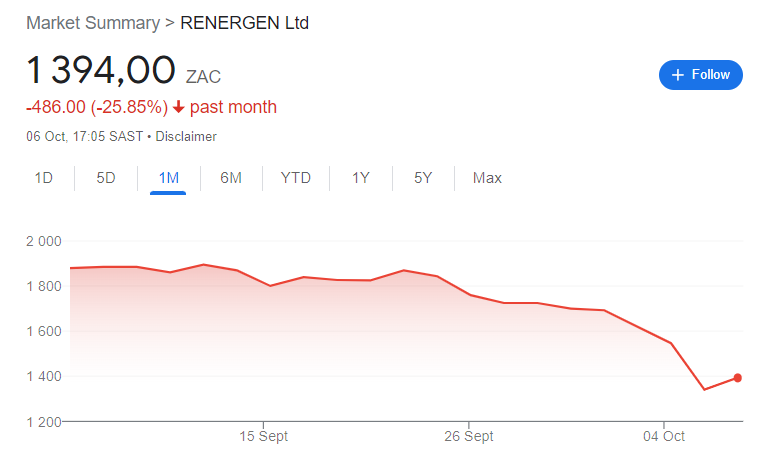
It’s been a very volatile year in the local retail industry, with Mr Price not escaping the sharp swings in sentiment:


MTN grows HEPS by between 0% and 10% (JSE: MTN)

A difficult industry is made much harder by African currency challenges

A trading statement has confirmed that in the six months to June, MTN grew HEPS by between 0% and 10%. This means a range of 506 cents to 557 cents for the interim period. The forex losses were huge in this period, impacted HEPS by 169 cents. Hyperinflation of 38 cents didn’t help either.

Within the forex losses, 128 cents is from Nigeria of which 95 cents was incurred in June when the naira was allowed to float. This caused a rapid depreciation in the Nigerian currency. The shortage of forex reserves in Nigeria (and Ghana for that matter) makes life difficult for MTN, with the company electing to receive scrip dividends rather than cash. This is good for attributable earnings and bad for cash upstreaming.

Group holding company leverage is towards the upper end of the guidance range of less than 1.5x. Net debt to EBITDA on a consolidated basis is in line with the December 2022 level. Consolidated numbers don’t really help though, as it matters where the cash actually sits in the group.

In a separate announcement, MTN Nigeria released numbers for the six months to June. Service revenue increased by 21.6% and EBITDA margin fell by 60 basis points to 53.0%. Because of forex losses, profit before tax fell 25.4% and earnings per share fell 29.3%. Capital expenditure fell by 14.4%.

Here’s a reminder that your life in South Africa can always be worse:

“As a result, the inflation rate in Nigeria rose to an 18-year high of 22.8% in June 2023, representing the sixth consecutive month-on-month increase in 2023, with an average of 22.2% in H1. To rein in inflation, the Central Bank of Nigeria (CBN) continued its monetary policy tightening, increasing the monetary policy rate by 2pp to 18.5% in H1, and a further 0.25pp increase in July.”


Orion Minerals quarterly report (JSE: ORN)

Cheekily, they start with the biggest news after the end of the quarter

Orion Minerals released an update on activities in the quarter ended June. The real news of course is the drawdown on the IDC and Triple Flag facilities, which only happened after the end of the quarter. This didn’t stop the company kicking off with a reminder of that news.

On a strict view of this quarter, the big news was actually the share placement with Clover Alloys. If all placement options are ultimately exercised, the total value of the equity funding package is A$73 million.

The focus is on the Prieska Copper-Zinc project, with the goal of accelerated development. An updated mineral resource estimate has been completed. A feasibility study is also well advanced at the Okiep Copper Project. The company is making solid progress at both hubs.


RMB Holdings releases results for the year ended March (JSE: RMH)

This will help you understand why the Atterbury dispute is so important

RMB Holdings had a net asset value per share of 100.3 cents at the end of March 2023. The current share price is 48 cents, which is why the market is focused on the company realising that value.

A very big chunk of the value sits in Atterbury, with whom RMB Holdings is currently in dispute. Here’s an excerpt from the annual report:

The current position is that RMB Holdings has demanded repayment of a R487 million loan from Atterbury. The company previously tried to issue shares to the bankers in repayment of this loan, which triggered RMB Holdings to step into the banker’s shoes and demand cash repayment instead.


Southern Palladium quarterly report (JSE: SDL)

This is a very early stage company that is focused on drilling

At Southern Palladium, the quarter ended June was all about drilling. The company is preparing for the pre-feasibility study in the first quarter of 2024.

Thanks to drilling efforts, the total mineral resource has been increased by 34% since drilling began.

The mining right application remains on track for submission in the third quarter, which is five months ahead of the original schedule.

The company has $11.55 million in cash, down from $12.93 million at the end of March.


More cash flows into Stefanutti Stocks (JSE: SSK)

The costs of the arbitration process have also been received

Back in May 2023, Stefanutti Stocks alerted shareholders to the receipt of a capital award of R90.85 million under the mechanical project termination arbitration.

To give you an idea of how expensive a legal process can be, the company has now also received R15 million for expert and legal fees incurred. This is obviously more good news for the company, especially with a market cap of just R270 million.


Telkom: revenue up, profits down (JSE: TKG)

Recent labour restructuring initiatives supposedly offset the impact of load shedding

Every time I write about Telkom, I remind you that the company finds itself on a treadmill. The legacy business is dying rapidly, with new revenue initiatives struggling to keep pace with the rate of decline in the old business.

In the quarter ended June, revenue was up 3.8% but group EBITDA fell by 4.2%. This is despite the group saying that labour restructuring initiatives offset the impact of load shedding.

Mobile revenue increased by 5.2%, Openserve grew new generation revenue by 10.6%, BCX was up by just 2.9% and Swiftnet limped along with growth of 1.2%.

Legacy voice services in Telkom Consumer fell by 24.2% and only account for 4.8% of group revenue. In stark contrast, mobile data traffic jumped by 25.1%. Once technology reaches an inflection point, the rate of change is remarkable.

In Openserve, fixed voice revenue fell by 29%. This led to the segment reporting an overall revenue decline of 2.7%. Expressions of interest for strategic equity stakes in Openserve have been received, though Telkom isn’t acting on any of them yet.

In BCX, the legacy Converged Communications business saw revenue drop by 12.8%. The IT business was 17.5% higher, giving the blended increase in revenue of 2.9%. EBITDA came under particular pressure in this business, down 38.2% with a margin of just 7.9% (down 520 basis points). Telkom is looking at options to introduce a strategic equity partner in this business, particularly to enhance its capabilities in key areas like cloud services and cybersecurity.

Swiftnet has been impacted by terminations by a mobile network operator customer. The towers business isn’t easy and profitability is very sensitive to changes in revenue. Swiftnet is currently up for sale and Telkom is in discussions with two bidders after refining a list of shortlisted bidders.

Telkom unfortunately finds itself with a portfolio of problematic businesses and a complicated road to travel to improve them.


Little Bites:

  • Director dealings:
    • Value Capital Partners, which has director representation on the board of Altron (JSE: AEL), has invested another R13 million in shares in the company.
    • A director of Argent Industrial (JSE: ART) – and not the CEO who has recently been active in the shares – has sold shares worth R182.6k.
  • Investec Property Fund (JSE: IPF) wants to change its name to Burstone Group. After the (very expensive) internalisation of the ManCo, moving away from the Investec branding is the logical next step.
  • Awkwardly, the chairperson of the Social and Ethics Committee at Clientele Limited (JSE: CLI), Pheladi Gwangwa, has been suspended for 6 months from practising as an attorney by the Supreme Court of Appeal pending an investigation into her conduct at a law firm.
  • Finbond’s (JSE: FGL) acquisition of Trustco Finance Namibia from Trustco (JSE: TTO) is taking longer than expected. The fulfilment date for conditions precedent has been extended from 31 July to 31 August 2023.
  • African Dawn Capital (JSE: ADW) reported a headline loss per share of 24.5 cents for the year ended February. That’s 20.7% worse than the prior year. The auditors have noted a material uncertainty regarding the group continuing as a going concern.

Ghost Wrap #35 (Woolworths | Shoprite | Liberty Two Degrees | Spur | AVI | British American Tobacco | Anglo American | ArcelorMittal)

The Ghost Wrap podcast is proudly brought to you by Mazars, a leading international audit, tax and advisory firm with a national footprint within South Africa. Visit the Mazars website for more information.

  • Woolworths reported solid numbers that seemed to be in line with market expectations.
  • Shoprite has blown competitors away with exceptional growth across the LSM curve.
  • Liberty Two Degrees is only a happy story if you’re a recent investor, giving us another excellent example of why buying the “hype” sector (in this case property on the JSE in 2015 – 2017) is so dangerous.
  • Spur is buying a 60% stake in Doppio Zero, a restaurant group that has grown spectacularly over the past two decades.
  • AVI is proof that consumers will cut back on many things, but not on biscuits and snacks.
  • British American Tobacco is still growing profits, albeit very slowly.
  • Anglo American shows just how quickly a mining cycle can change, with a 55% drop in HEPS.
  • ArcelorMittal is the ultimate basket of risks: single-commodity exposure, high operating leverage and plenty of debt as well!

Listen to the podcast below:

Ghost Bites (AYO | Clientele | Delta Property Fund | Grindrod Shipping | Netcare | Old Mutual | Salungano | Spar | Woolworths)


AYO releases the GEPF repurchase circular (JSE: AYO)

The AYO board has effectively chosen the lesser of two evils

AYO Technology has released the circular dealing with the repurchase of 17.2 million shares from the Government Employees Pension Fund (GEPF) for R619.4 million.

There’s some interesting commentary in the announcement. The independent expert notes that the repurchase is unfair to AYO shareholders. The board says that it is unfair but reasonable to shareholders. That decision is based on the board’s view that the alternative is much worse, being protracted legal action with the PIC and GEPF and the risk of a negative outcome that would “potentially have resulted in the liquidation of AYO.”

It’s a mess, either way.


Clientele is sniffing around a potential acquisition (JSE: CLI)

This cautionary announcement has more details than the last one

Clientele released a cautionary announcement on 15 June that didn’t give the market anything to work with. With the release of a further cautionary announcement, we now know that Clientele is considering a potential acquisition in the insurance sector.

At this stage, there is absolutely no guarantee of a transaction being announced, let alone successfully finalised. That’s exactly why shareholders are warned to act with caution.


Delta Property just can’t catch a break (JSE: DLT)

Transactions with DMFT Property Developers have fallen through

With a share price down 97% over five years, Delta Property Fund is one of those companies that just cannot seem to catch a break. The very last thing the company needs is for transactions to fall through, especially when they went through the expense of issuing a circular and getting all the required approvals.

It’s rare to see an unconditional transaction fall through for reasons other than regulators blocking the deal. In this case, the buyer (DMFT Property Developers) failed to provide the bank guarantee or the required cash. In other words, they didn’t have the money. This sounds a lot like breach of contract, but the announcement doesn’t give any indication that the company is seeking damages. If they can’t afford the properties, I guess there isn’t much available for damages either.

The Capital Towers disposal is thus no longer proceeding. Four other enterprises were also being negotiated for disposal to DMFT. Those deals are also dead, with DMFT trying to reduce the purchase price in a way that is unacceptable to Delta.

That really is bad luck for the company.


A number of ship transactions at Grindrod Shipping (JSE: GSH)

This industry is all about managing the fleet

There’s an argument that this announcement is business as usual, as shipping companies are constantly managing the size and age of the fleet. Perhaps the sheer number of transactions triggered the Grindrod Shipping management team to release this announcement.

Without going into too much detail on the underlying transactions, the interesting thing is to take note of the different types of transactions. For example, one of the deals was to exercise the purchase option on a chartered-in supramax bulk carrier. The company also charters boats out to other shipping companies.

To give you an idea of the value of each vessel, the prices on the various transactions range from $10.8 million to $33.75 million. Age and size are relevant factors.

As a final comment, the announcement talks about “disinterested members” of the board. That always makes me laugh. It means that they have no economic interest in the transactions, not that they were bored at the meeting!

Perhaps the more important announcement relates to disclosures made by Taylor Maritime Investments (which holds 83.23% in Grindrod Shipping) about the company. It notes that the net time charter equivalent (TCE) across the Taylor and Grindrod fleet was $12,735 per day for the quarter. The breakeven level (including finance costs) is $11,700 per day. Again, this is for both fleets, so there isn’t a direct read-through to Grindrod Shipping.

Taylor also disclosed that Grindrod Shipping has repaid $28 million in debt during the quarter, with debt to gross assets now at 37.8% at the end of June 2023 vs. 38.9% at the end of March. That ratio includes Taylor and Grindrod Shipping.

If you follow Grindrod Shipping very closely, that might help with your financial modelling. Just be careful of these numbers as they apply to the broader group, not just Grindrod Shipping.


A changing of the guard at Netcare (JSE: NTC)

After a long innings as CEO, Dr Richard Friedland is retiring

Dr Richard Friedland has been around at Netcare for a very long time: 30 years in total, 18 of which have been as CEO. He will be stepping down as CEO with effect from 30 September 2024. I guess after being in charge for this long, you need to give a lot of notice!

The past few years haven’t been easy at all. Ironically, the pandemic caused a lot of problems for healthcare groups, as evidenced by this chart:

A successor will be named in due course. Goodness knows they have enough time to find someone!


Old Mutual strategic update (JSE: OMU)

There’s a lot of fluff, but there’s some good stuff too

If you like, you can refer to the full presentation from the investor update at this link. You likely need to make time to listen to the recording though, as many of the slides aren’t hugely relevant without the associated voiceover.

The section that caught me eye relates to the launch of Old Mutual’s bank, with a targeted launch in 2024 and breakeven in 2027. As Discovery will tell you, successfully building a bank is a helluva thing.

The benefit to Old Mutual is that retail deposits offer the cheapest source of funding around. Your current account pays you no interest and most savings accounts don’t pay much. This is how banks with a strong deposit base enjoy cheap funding and high net interest margin, as they lend the money out at much higher rates than they pay to depositors.

The presentation notes that the bank will be differentiated by cost. Are we seeing a potential competitor to Capitec here?

Within six years, Old Mutual hopes to be achieving a return on net asset value equal to the cost of equity plus 600 basis points. If they get that right, it would justify the price trading at a substantial premium to book value.

Of course, plans on a slide are easy. Execution is hard, especially in this economy.


Salungano gives some encouraging news (JSE: SLG)

It’s been a weird time for the group

There’s an ongoing delay in the publication of Salungano’s results for the year ended March. Shareholders don’t like that, especially when the delay is because of funding negotiations with lenders that needed to be finalised before results could be released.

It certainly doesn’t help that three directors have resigned during this period, with no replacements named as of yet.

With the share price down a whopping 51% in the past three months, the company needs to get it together. The good news is that the commercial terms for the refinancing have been agreed, subject to lenders’ credit approval. That doesn’t necessarily mean that the worst is over. It’s just a step in the right direction.

The company has committed to released results by no later than 31 August.


Spar announces its new executive team (JSE: SPP)

Megan Pydigadu certainly enjoys a challenge

Mike Bosman has been filling in as CEO after the significant recent upheaval of the Spar management team. New brooms have now arrived to sweep clean, with Bosman returning to his role as Chairman.

In the CEO chair, we find Angelo Swartz who has been with the Spar group for 16 years. His current role is Divisional Managing Director of SPAR KwaZulu-Natal, so he must’ve been having loads of fun with the disastrous ERP implementation that severely affected inventory flow in the region.

Megan Pydigadu joins as COO, moving to the retailer from EOH where she steered the group to financial sustainability as its CFO. She clearly enjoys a turnaround challenge, although Spar is in nowhere near as much trouble as EOH was when she joined.

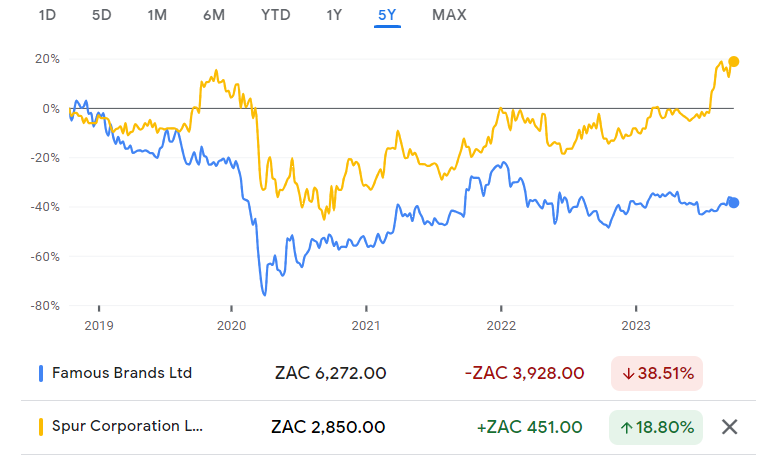
The divergence in five-year share price performance in this sector is breathtaking:


Woolworths expects a decent HEPS uplift (JSE: WHL)

The share price didn’t really react to this update

In the 52 weeks to 25 June 2023, Woolworths needs to split its results into continued and discontinued operations. The latter is David Jones, which was disposed of with effect from 27 March 2023. It wouldn’t make sense to include those numbers in a financial analysis of Woolworths.

From continuing operations (i.e. excluding David Jones), sales increased by 10.8% for the year and 9.3% on a like-for-like basis. Despite the very tough local conditions in the second half of the year, sales increased 9.2% in H2.

There’s been solid follow-through in online sales, up 9.3% and now contributing 8.3% to group turnover.

In the Woolworths Food business, turnover grew 8.5% and 6.3% on a same-store basis. That’s way below the numbers being achieved by Checkers, though that’s not an entirely fair comparison as Checkers has a much broader product range and has likely won most of its market share from Pick n Pay in the past year. The second half of the year was impressive in Woolworths Food, with growth of 9.4% overall and 7.2% on a like-for-like basis.

With price inflation of 8.3% for the year, volumes are down by around 2%. Woolworths is being squeezed on price by competitors. Product inflation was 9.9%, which means the retailer had to absorb some of the pressure in its gross margin.

Online sales in Woolies Food increased by a substantial 28.5%, now contributing 3.8% of sales.

There has been significant focus on Fashion, Beauty and Home at Woolworths. The FBH business grew turnover by 8.9% and 8.3% on a like-for-like basis. Price inflation of 11.6% suggests a 3.3% drop in volumes. Unlike in Food where sales accelerated in the second half of the year, FBH only booked growth of 6.7% in the second half of the year. Online sales grew 3.8% and contributed 4.3% of local sales.

In Woolworths Financial Services, the book increased 14.5% year-on-year which suggests a higher proportion of credit sales. The impairment rate was up to 7.3% from 4.7% in the prior year, a clear reflection on the economic health of consumers.

In Australia and New Zealand, the only business that matters now is Country Road Group. It grew sales by 12% overall and 12.4% on a like-for-like basis. When like-for-like growth is below total growth, it tells you that trading space has been reduced (in this case by 3.9%). Price inflation unfortunately isn’t disclosed. Sales growth in the second half was just 0.6%, so that’s not encouraging. Online sales contributed 27.1% to total sales vs. 31.6% in the prior year, so there has been a return to bricks-and-mortar shopping in the region.

For the 52 weeks ended June, HEPS from continuing operations should be between 10% and 20% higher. If you are happy to work with adjusted HEPS, the range is 396.2 to 432.2 cents. At the midpoint, this implies a Price/Earnings multiple of 18.9x.


Little Bites:

  • Director dealings:
  • The post-commencement finance facility at Tongaat Hulett (JSE: TON) has been extended to 6 October. This is critical to the ongoing nature of the business rescue process.
  • Conduit Capital (JSE: CND) is in the process of selling CRIH and CLL to TMM Holdings for R55 million. The fulfilment date for conditions precedent has been extended to 1 September. It’s already been extended once before, from 1 July to 1 August.
  • African Dawn Capital (JSE: ADW) has a market cap of just R8.5 million. That’s worth about as much as a successful restaurant! For the year ended February 2023, the headline loss per share will be between 23.49 cents and 25.52 cents. The share price is just 12 cents.

Ghost Bites (Anglo American | ArcelorMittal | Hammerson | Liberty Two Degrees | Sirius | Spur | Super Group | Trustco)


Anglo American reports a big drop in earnings (JSE: AGL)

A drop of 55% in HEPS isn’t pretty

The mining industry has been dealing with a drop-off in commodity prices this year. Cycles are nothing new to mining, with volatile earnings as standard practice in this game. That’s even true for the likes of Anglo American, with a diversified portfolio.

Over five years, you’ve still done alright in these names:

For the six months to June 2023, EBITDA fell by 41% in an environment of lower commodity prices. The basket price across the group fell by 19% and unit costs increased by 1%. Volume increases of 10% partially offset the impact, with group revenue down by 13%.

Net debt of $8.8 billion is less than 1x annualised EBITDA, so the balance sheet is ok. This is why the dividend payout policy of 40% has been maintained.

Here’s one for the books though: attributable free cash flow fell from $1.56 billion to -$466 million. Yes, that is negative free cash flow! Welcome to mining, where capital expenditure is huge.

Return on Capital Employed has fallen from 36% to 18%. This isn’t a good enough return for the risk in my opinion.


ArcelorMittal releases detailed results (JSE: ACL)

A headline loss of R448 million broke the share price when warning was first given

Let’s kick off with a share price chart, showing you exactly when news broke of how bad these ArcelorMittal numbers will be:

As you can see, the price partially recovered, although the downward trend is clear.

In the six months to June, a drop in realised rand prices of 8% ruined the fun. Although volumes were up 3%, there’s so much operating leverage in this business that EBITDA crashed by 86%. Operating leverage refers to the extent of fixed costs, something that is incredibly important in manufacturing and mining businesses. With vast fixed costs, a small drop in revenue can cause havoc for profitability.

EBITDA of R499 million was eaten up by the banks before we get to the headline loss of R448 million. Net borrowings increased from R2.8 billion to R2.9 billion, so ArcelorMittal is the poster child for the dangers of combining operating leverage and financial leverage.

As you’ve probably guessed, there is no dividend here.

With cash from operations of R891 million and a huge capital expenditure bill of R818 million, free cash flow is almost non-existent here. The company will need to make some major internal changes before it can make a dent in the debt.


Hammerson is paying dividends again (JSE: HMN)

This is important for local fund Resilient

A property fund that doesn’t pay dividends is about as useful as a leaky bucket. Nobody is buying property funds purely for capital growth, that much I can promise you.

After considerable pressure from shareholders (not least of all local fund Resilient), Hammerson has returned to paying cash dividends with the release of interim results. The disposal of £215 million worth of non-core assets has helped repair the balance sheet. Net debt to EBITDA is now at 7.7x vs. 10.4x at the end of the last financial year. The more common metric is loan-to-value, which is at 33% vs. 39% at the end of the last financial year.

Adjusted earnings increased by 15%, although most of that is because of lower net finance costs because debt was reduced. Like-for-like net rental income only increased by 2.3%.

The interim cash dividend is 0.72 pence per share, which works out to around 16 ZAR cents. The current share price is around R5.88.


A massive payday for Liberty Two Degrees shareholders (JSE: L2D)

There’s nothing quite like a 42% jump in the share price in a single morning

Liberty Group wants to take Liberty Two Degrees private. This will be via a scheme of arrangement, with a proposed cash price of R5.55 per share. Liberty Two Degrees closed at R3.90 the day before the announcement, so that’s a lovely premium for shareholders. Well, recent shareholders at least. If you held since listing, then I’m afraid you’ve had a bad time:

The net asset value per share at the end of December 2022 was R7.51, so Liberty is also getting a pretty good deal if we believe that number.

You may recall that Liberty Group is now a wholly-owned subsidiary of Standard Bank Group. This deal is ultimately a big property play by Standard Bank.

Liberty group already owns around 61% of the shares in Liberty Two Degrees It also owns 66.7% in the underlying portfolio, with Liberty Two Degrees holding 33.3%. In other words, this transaction is about taking out the minority shareholders.

Mazars Corporate Finance was appointed as independent expert on this one, concluding that the transaction is fair and reasonable to Liberty Two Degrees shareholders.

Non-binding letters of support have been received from Coronation (holding 22.5% of the shares or 61.1% of shares eligible to vote) and Sesfikile Capital (holding 1.3% of the shares or 3.6% of shares eligible to vote). This gets them very close to having a successful scheme of arrangement, which requires 75% approval.


Hot potato Royal Bafokeng Platinum is loss-making (JSE: RBP)

Impala Platinum will need to work this asset

Things aren’t great in the platinum group metals (PGM) industry at the moment. Royal Bafokeng Platinum is dealing with additional issues, like operational challenges at the Styldrift mine and a decrease in production.

Even if production went according to plan, it’s hard to do well when the rhodium price tanked by 50% and the 4E basket price fell by 23.6%. As a further squeeze on profitability, mining costs increased by more than CPI inflation.

The headline loss per share is a nasty -113.8 cents, which is way off HEPS of 767.3 cents in the comparable prior period. Impala Platinum is about to own this entire thing, so hopefully it can only get better from here.


Sirius recycles capital in the UK (JSE: SRE)

In other words, it has bought properties after recently selling a couple

In the property sector, funds are forced to “recycle capital” because raising money is expensive. There was a time on the JSE a few years ago when property groups could raise seemingly endless capital in literally a couple of hours. The days of accelerated bookbuilds are long gone, so management teams must earn their salaries by buying and selling properties intelligently.

Sirius Real Estate has announced that UK subsidiary BizSpace has acquired two mixed-use industrial assets for £9.5 million on a net initial yield of 9.6%. This comes after recent sales in the UK at a combined premium to book value. Sirius will want to demonstrate value creation to shareholders by actively managing these new assets.


Spur: people with a taste for Italian (JSE: SUR)

I have fond memories of the Doppio Zero group from my Joburg days

The Doppio Zero / Piza e Vino / Modern Tailors group is focused on Gauteng, so don’t feel bad if you haven’t heard of the restaurants in other provinces. In fact, with a footprint of 37 franchised and company-owned restaurants, only 4 of them are outside of Gauteng.

Spur is acquiring a 60% stake in the chain, as well as the central supply business and bakery. The sellers are the founders, who will remain as executives of the group for a minimum of five years.

The rationale for the deal is to almost double the size of Spur’s “speciality” portfolio, which includes The Hussar Grill, Nikos and Casa Bella.

The Doppio Zero group generated total sales of over R600 million in the year ended February 2023. That’s impressive for a group that was only founded in 2002 as a bakery and cafe in Greenside! There are 669 employees.

The announcement doesn’t disclose the transaction value. It also doesn’t indicate whether there are put / call option structures over the remaining 40%. For the sake of the founders, I hope they negotiated a liquidity mechanism to realise the rest of the value after the five year period as executives.


Super Group reports a super jump in earnings (JSE: SPG)

These are properly impressive numbers in this environment

For the year ended June 2023, Super Group has reported a 20% to 27% increase in HEPS. That’s juicy. Even more impressive is the fact that the base period included once-off benefits of 38.8 cents per share in the HEPS number of 380.7 cents.

The narrative sounds good, with market share gains on the top line and solid cost management to boost profitability. On top of this, the group remained highly cash generative. This supports the ongoing strategy to look for useful acquisitions to supplement organic growth.

The earnings range for the period is 456.8 cents to 483.5 cents. The share price is just over R35, suggesting a Price/Earnings multiple of around 7.5x.


Trustco finally announces the Meya Mining deal (JSE: TTO)

Perhaps unsurprisingly, it’s complicated

The overall story here is that Trustco has raised $75 million for the completion of the Meya Mining development, a diamond mine in Sierra Leone. If you read carefully though, it looks like only $50 million is confirmed.

Sterling Global Trading is subscribing for shares in Meya Mining for $25 million. This gives the company a 70% shareholding. Trustco Resources will hold 19.5% and Germinate will hold 10.5%.

On top of this, Sterling will advance a loan of $25 million to Meya. A mystery market lender is going to lend another $25 million, taking the total to $75 million. It sounds like only the $50 million has been finalised, though.

Trustco is going to subordinate its shareholder loan of $45.4 million in favour of this new debt. In other words, the new debt is repaid first and takes preference in a liquidation event.

Trustco has invested $116 million in this asset since inception. I’m not sure if this included any debt that has been previously repaid, but the current subscription price implies an equity value of $35 million. If we add in the shareholder loan, we get to Trustco having total value here of $45.4 million + $6.8 million = $52.2 million. That sounds like a significant loss, but I’m happy to be corrected here.

This is a Category 1 transaction and so a circular will need to be distributed to shareholders. Irrevocable undertakings have been received in respect of 63.26% of shares in issue, so that should be a done deal as it only needs an ordinary resolution.


Little Bites:

  • Director dealings:
    • An independent non-executive director of RECM & Calibre (JSE: RAC) bought shares worth R516k.
    • An independent non-executive director of Balwin (JSE: BWN) has bought shares in the company worth R135k.
    • Weirdly, the CEO of Argent Industrial (JSE: ART) is now selling shares after buying just a couple of weeks ago. The sale was for R51.8k.
    • A director of Mantengu Mining (JSE: MTU) has bought shares worth R31k.
  • Anglo American Platinum (JSE: AMS) has named Craig Miller as the incoming CEO to replace Natascha Viljoen from 1 October. Viljoen is moving into the COO role at Newmont Corporation. Miller is currently the finance director, a role he has held since 2019. This means that the company needs to find a new finance director, with no successor named as of yet.

Who’s doing what this week in the South African M&A space?

Exchange-Listed Companies

Liberty Group (LGL), a subsidiary of Standard Bank, has announced its intention to acquire the remaining shares not already held in Liberty Two Degrees (L2D). L2D shareholders have been offered a cash consideration of R5.55 per share in a deal worth c.R1,9 billion. The share price closed 44% up on the day. Coronation Asset Management and Sesfikile Capital have confirmed that they will support the scheme and together they represent 64.4% of the shares that may vote.

Spur Corporation, in a move to strengthen its position in the day-time speciality dining space and enter the coffee speciality market, has acquired a 60% stake in the Doppio Group. The stake was acquired from founders Paul Christie and Miki Milovanovic. While financial details of the transaction were undisclosed, it was disclosed in the announcement that the Doppio Group generated total sales of over R600 million in the financial year ended February 2023.

Trustco aims to raise c.US$75 million which will be used to complete the Meya Mining development. Sterling Global Trading (SGT) will subscribe for shares valued at $25 million and will hold a 70% stake in Meya Mining. Trustco Resources will reduce its shareholding to 19.5% and Germinate SL will own a 10.5% stake. SGT will advance a $25 million loan and will work with Meya Mining to raise a further $25 million. The funds will ensure that Meya is fully capitalised and will enable the mine to scale production at an accelerated pace.

Labat Africa has acquired the remaining 30% stake in CannAfrica from H Maasdorp for a consideration of R6,43 million to be settled through the issue of 29,9 million Labat shares and the balance in cash of R2,8 million.

A preferred strategic equity partner (SEP) has been selected for Tongaat Hulett, currently in Business Rescue. The selected SEP is Kagera Sugar, a sugar manufacturing company situated in the North-Western part of Tanzania. The transaction will comprise the acquisition of the complete sugar division of Tongaat Hulett in South Africa and the investments in Zimbabwe, Mozambique and Botswana. Financial details were undisclosed.

Sirius Real Estate, through its UK subsidiary BizSpace, has acquired a portfolio of two mixed use industrial assets located in Liverpool and Barnsley. The assets have a combined area of 71,957 square feet of predominantly workshop accommodation. Sirius acquired the portfolio for £9,5 million representing a net initial yield of 9.6%.

The offer in Q4 2021 by Impala Platinum (Implats) to Royal Bafokeng Platinum (RBPlat) shareholders finally closed this week with RBPlat shareholders holding 121,437,384 shares (96.21% of shares not held by Implats at the time of the offer) accepting the offer. In aggregate Implats now holds 98.35% and will invoke section 124(4) of the Companies Act to compulsorily acquire all the RBPlat shares not already held. Application will be made for the termination of the listing of the RBPlat shares on the JSE which will become a wholly-owned subsidiary of Implats.

ArcelorMittal South Africa is proposing to modify its existing 2016 B-BBEE transaction which, according to the company’s announcement, has not yielded the envisaged value for the empowerment partners and employees. The modified transaction will see the BEE parties (Amandla We Nsimbi, Likamva Resources and the Isabelo 2 Share Trust) holding a 21.75% direct stake in the company. The transaction is subject to shareholder approval and will require the issue of a circular setting out the full terms and conditions of the transaction.

Unlisted Companies

Five35 Ventures a Johannesburg-based pan-African female-focused venture capital fund investing in early-stage tech start-ups, has made an undisclosed investment in Zuri Health. The Kenyan startup provides customers with affordable, convenient and quality healthcare services via its app, SMS and WhatsApp. Zuri Health’s services are available in Ghana, Nigeria, Senegal, South Africa, Uganda, Tanzania and Zambia.

Kasha Global, a Kenyan women-led and focused healthcare retail platform has raised US$21 million in a Series B round led by Cape Town-based Knife Capital. Kasha sells and delivers pharmaceutical products, household goods and consumer health products to low-income consumers, resellers, pharmacies and health facilities in East Africa.

The Competition Tribunal has conditionally approved the acquisition of a 51% stake in SAA by Takatso Aviation. SAA entered business rescue in December 2019. In terms of the deal, Takatso’s major shareholder Harith has raised R3 billion which it will commit to SAA. The Department of Public Enterprises will continue to hold the remaining 49% stake in the airline.

DealMakers is SA’s M&A publication.
www.dealmakerssouthafrica.com

Weekly corporate finance activity by SA exchange-listed companies

Zeder Investments will distribute to shareholders a special dividend of 5 cents per share from income reserves. The company has 1,54 billion shares in issue and will distribute, on 28 August 2023, R77 million to shareholders in terms of the special dividend declaration.

The result of the odd-lot offer by CA Sales to shareholders holding less than 100 CA Sales shares, was announced with the company repurchasing a total of 100,025 CA&S ordinary shares representing 0.02% of the total issued shares of the company. The shares were repurchased for a total consideration of R706,283 and the number of shareholders was reduced by c. 35%. The shares will be delisted and the total issued ordinary share capital of the company will be reduced to 474,870,057 with no treasury shares.

Invicta which has odd-lot holdings equal to 36,349 shares has announced an odd-lot offer price of R29,82 per share. The offer is set to close on August 4, 2023.

Prosus and Naspers continued with their open-ended share repurchase programmes. During the period 17-21 July 2023, a further 2,308,036 Prosus shares were repurchased for an aggregate €155,3 million and a further 427,172 Naspers shares for a total consideration of R1,42 billion.

Three companies issued profit warnings this week: Aveng, Ellies and Royal Bafokeng Platinum.

Five companies issued or withdrew a cautionary notice: Trematon Capital Investments, Afristrat Investment, Ellies, enX and Trustco.

DealMakers is SA’s M&A publication.
www.dealmakerssouthafrica.com

Who’s doing what in the African M&A space?

DealMakers AFRICA

Meridiam has acquired 100% of Rift Valley Energy Tanzania for an undisclosed sum. This is the company’s first acquisition in Tanzania. Rift Valley Energy owns a portfolio of 30MW of renewable energy generation assets in operation, construction and development stages.

Acumen Resilient Agriculture Fund has led a US$4,1 million pre-Series A funding round in Kenya’s FarmWorks. Other investors include Livelihood Impact Fund, Vested World, a number of family offices and some angel investors. The funding will be used to strengthen its data analytics capabilities and brings the total raised by the company since it started in 2020, to $5,6 million.

Nigerian data and marketing technology company, Terragon announced a US$9 million Series B round. Orange Ventures led the round with participation from TLcom Capital, LoftyInc, Sango Capital, VestedWorld and Western Technology Investment.

South Africa’s gender-lens venture capital firm, Five35 Ventures, has invested an undisclosed sum in Zuri Health. This is the second investment this year for the Kenyan e-health platform – Morocco’s UM6P announced it was backing Zuri in January.

Clafiya, a Nigerian healthtech startup, has raised US$610,000 in a pre-seed round. Norrsken Accelerator, Acquired Wisdom Fund, Hustle Fund, Voltron Capital, Microtraction, Ajim Capital, HoaQ, Bold Angel Fund, the Shivdasani Family and other angel investors participated in the oversubscribed round. Funds will be utilised to accelerate growth, product development and new staff hires.

East Africa’s Kasha Global has raised US$21 million in a Series B round led by Knife Capital. Other participants in the round included Finnfund, DFC, Tim Koogle, Beyond Capital ventures, Altree Capital, BLOC Smart Africa Fund and Five35 Ventures.

Kavango Resources has signed an exclusive six-month option agreement to acquire two gold exploration projects in Matabeleland, Zimbabwe. The Leopard Project and Hillside Project will expand Kavango’s existing footprint in the country. Both projects contain historically producing mines.

DealMakers AFRICA is the Continent’s M&A publication.
www.dealmakersafrica.com

Ghost Global: Hunting for Green Flags

Whether you love him or hate him, you can’t deny the irony in the fact that DJ Khalid’s 7th studio album, titled Suffering from Success, was met with lacklustre reviews after it was released almost a decade ago.

What should have been a winning recipe, including guest appearances by big names like Nicki Minaj, Drake and Lil Wayne and collaborations with producers like Timbaland, ended up giving a so-so performance on the charts and was panned by the majority of critics.

As it turns out, 7 was not DJ Khalid’s lucky number after all. Sometimes, success is elusive, even when it seems so guaranteed that you (pre-emptively) name your whole album after it.

Perhaps it wasn’t time for Another One? If DJ Khalid references are lost on you, then don’t despair. We are moving on now.

Products and services that seem destined for triumph may do exactly the opposite. In our Magic Markets research, we often encounter businesses that appear to have all the right ingredients, but end up falling flat (or more annoyingly, sideways). 

And then sometimes, we find the bright side – a business that spots a gap in the market, addresses it with a great solution and nails the pricing. Sometimes, it just works, and as business enthusiasts, we love to see it.

Although luck undoubtedly plays a role in this, we’ve learnt enough over the years to know that there are certain markers – green flags, if you will – that go a long way towards predicting a good outcome for shareholders. 

Here are two examples from our research:

Green flag #1: A coherent ecosystem

Earlier this year, we delved into MercadoLibre, a South American eCommerce platform that looks and sounds as exciting as a Mexican wrestling match. 

Operating in a high growth region with a business model that clearly works, MercadoLibre is a bit of a unicorn: a technology-driven firm that not only makes great profits, but manages to spend those profits wisely.

The appeal of MercadoLibre lies in its seamless integration of growth engines that complement its eCommerce platform. This end-to-end approach reflects a deep understanding of the consumer journey, where every pain point is addressed with a tailored solution. Unlike some conglomerates that attempt to incorporate unrelated services under one umbrella (looking at you, Amazon), MercadoLibre’s cohesive ecosystem offers a strategic advantage that makes it stand out in the market.

By providing solutions for transactions, money transfers, credit services (Mercado Credito), and insurance, they create a comprehensive and convenient environment for users. This all-inclusive approach not only enhances customer satisfaction but also strengthens customer loyalty, as users find all their needs met within a single platform.

What does that look like in practice? Well, see for yourself:

Green flag #2: An understanding of the consumer base

More recently, we looked at Lovesac, the luxury furniture business that claims to be the bestselling couch in America. That’s a big statement to make, but after looking at the numbers, we wouldn’t be surprised if they were correct about that.

Lovesac has doubled both revenue and net income between 2021 and 2023. It’s the fast-growing furniture business most punters have never heard of, let alone looked at from a numbers perspective.

Lovesac’s exceptional ability to cater to the needs of its Millennial consumer base is rooted in a deep understanding of their preferences and lifestyle choices. By recognising the transitional phase that many Millennials find themselves in as they move to new homes and seek high-quality furnishings, Lovesac has strategically positioned itself as a brand that offers both comfort and aspirational value.

Unlike traditional luxury brands that may focus solely on exclusivity and prestige, Lovesac recognizes that its Millennial target audience values practicality. They understand that Millennials work hard for their money and expect products that can withstand the rigours of day-to-day life.

By catering to families with pets and small children, Lovesac ensures that its furniture meets the demands of real-life usage while maintaining its premium image.

Lovesac’s distribution model is perfect for today’s consumer. It’s been built as an omnichannel business from the start, with boutique showrooms and a solid online capability to back it up. By avoiding large expensive showrooms, the trading density (sales per square metre) metrics are fantastic.

The five-year story is nowhere near as exciting as the MercadoLibre performance, but a furniture manufacturer faced a different reality during lockdowns to a technology platform. We think that Lovesac is one to keep an eye on.

Spot successes in the making with our help

Nobody likes betting on a flop. That’s why it’s cardinally important that you research companies before you invest in them. 

With nearly 90 research reports on global stocks available in the library, a subscription to Magic Markets Premium for just R99/month gives you access to an exceptional knowledge base that has been built since we launched in 2021. And if you don’t feel confident enough to spot those green flags yourself just yet, we will help point them out for you. Perhaps most importantly, we also point out as many red flags as possible.

There is no minimum monthly commitment and you can choose to access the reports in written or podcast format. Sign up here and get ready to learn about global companies>>>

Ghost Bites (Advanced Health | AECI | Altron | AVI | British American Tobacco | De Beers (Anglo) | Labat | Naspers + Prosus | RAC)


Advanced Health releases the delisting circular (JSE: AVL)

The proposal is to take the company private at 80 cents per share

After a firm intention announcement was released back in June, Advanced Health has now released the circular for the offer being made by Eenhede Konsultante. There are certain shareholders who are moving into the private space with the offeror, with a collective existing holding of 71.13% in the company. In other words, the scheme will be voted on by shareholders who have 28.87% of the company.

The offer price is more than double the 30-day VWAP before the date of the firm intention announcement. A big premium like this is rare, though it becomes necessary when there is a small voting class.

Based on the opinion from BDO, the Independent Board has determined that the scheme is fair and reasonable to shareholders.

Kudos to the corporate advisors Questco for putting together such a fresh looking scheme document. Circulars are normally very ugly things, but this circular looks fantastic.


AECI: earnings up and dividend down (JSE: AFE)

There’s too much debt at this point in the cycle, so the banks are first in line for cash flow

In the six months ended June 2023, AECI posted a solid set of numbers until you get below the EBIT (Earnings Before Interest and Taxes) line. Let’s start at the top.

Revenue increased by 19%, which is a solid start to any story. Operating margins also look good, with EBIT up by 20% despite a R180 million loss in the problematic Schirm Germany business. This is significantly worse than the loss of R86 million in the prior period. A turnaround strategy is underway in Germany.

EBITDA and EBIT margins were stable at 10% and 7% respectively. This brings us to the end of the good news.

HEPS has only increased by 5%, a direct result of net finance costs increasing from R124 million to R274 million. This is because net debt is up to R5.7 billion, which is pretty chunky vs. interim EBITDA of R1.8 billion. You would need to annualise that number to work out a net debt to EBITDA ratio. The company indicates net debt to EBITDA of 1.6x.

The company acknowledges that gearing is too high at this point in the cycle. Reducing this is a priority, helped by a solid working capital performance that saw cash from operations increase by 20%, ahead of EBITDA growth of 18%.

The clear need to focus on the debt is why the dividend is 48% lower at 100 cents per share.


Altron: a creative use of “once-offs” (JSE: AEL)

The slide in the share price continues

Altron’s recent financial reporting has highlighted some incredibly dubious “once-offs” – theoretically, unusual items that shouldn’t happen again. A problem in the core business that is a clear business risk is not a once-off.

For example, Altron Nexus (now a discontinued operation) engages in public sector work. We know that this is risky stuff, so the fact that the contract for phase 3 of the Gauteng Broadband Network (GBN) contract wasn’t awarded to the business despite having personnel and infrastructure in place from phases 1 and 2 isn’t a once-off. It’s a business risk of a contract not being awarded or renewed!

As another example, the heavily debt burdened City of Tshwane owes money to Thobela Telecoms. Altron Nexus is the EPC contractor to Thobela and won’t get paid unless Thobela gets paid. Again, the government not paying people isn’t a once-off.

Altron Nexus just keeps taking bullets, as there is also litigation underway by Aeonova (a sub-contractor on the GBN contract). It initially looked like the possibility of an arbitration award was remote, but subsequent proceedings have led to a revised view. No provision has been raised as of yet for this matter, so this issue may still be coming in the numbers.

Total provisions for R336 million have been raised for Altron Nexus, which is held as a discontinued operation. Cash restructuring costs of R11 million have also been incurred. There’s a further goodwill impairment of R33 million.

But wait folks, there’s more.

After the failed disposal of Altron Document Solutions, new management was appointed to restructure the business. With two of its large customers facing financial difficulties, provisions of R95 million have been raised against this asset which is also recognised as a discontinued operation.

Together, Altron Nexus and Altron Document Solutions contributed 21% to group revenue in the year ended February. They were loss-making, so no profit will be lost here once they are out of the system.

The continuing operations are Netstar and Altron Systems Integration, with the update giving a more positive outlook on their profitability.

For the six months ending August 2023, Altron expects to generate HEPS from continuing operations of between 43 cents and 51 cents, representing an increase of between 5% and 24%. They really need to sort out the troublesome businesses though, as the headline loss per share from total operations will be between -64 cents and -57 cents, an ugly swing from headline earnings per share of 34 cents in the comparable period.

I could only laugh at this comment in the announcement. If management intervention is required to ensure that “once-offs” do not recur, then they weren’t once-offs in the first place!


AVI managed to push through selling price increases (JSE: AVI)

Even I&J increased revenue – but only just!

For the year ended June 2023, AVI managed to increase revenue by 7.8%. The star of the show was Snackworks, with growth of 11.9% and a contribution of 35% to revenue. As we’ve seen in PepsiCo on the global stage, people are willing to cut their food cost but not when it comes to their favourite snacks!

Footwear & Apparel also did well with a 12.3% increase, though it is the second-smallest segment in the group. The laggard was I&J, up just 0.5% and contributing 16.7% to group revenue. There were various reasons for this, including a fire at one of the I&J facilities.

The overall revenue increase was attributed to selling price increases. Gross profit margin improved slightly, which I think is very impressive in this environment. The revenue mix is a factor here, with higher margin categories doing well in this period.

A less ideal situation is that selling and administrative expenses increased at a rate above inflation, with fuel prices as the major culprit. There were other costs pressures as well.

So, despite revenue growing 7.8%, operating profit was only 6.9% higher. I&J’s earnings were lower because of the sideways performance in revenue. Every other segment experienced positive earnings growth.

Cash conversion sounds promising, with the company noting a decrease in working capital. Net debt is within target range, despite an increase in capital expenditure vs. the prior year as the group caught up on projects that had been delayed during Covid.

As there are more shares in issue than before because of incentive schemes, consolidated HEPS will only increase by between 3% and 5%. AVI is a remarkably defensive business but the share price has been the victim of a valuation that was simply too high.


British American Tobacco is crawling along (JSE: BTI)

Low single-digit growth remains the order of the day

I don’t really understand the appeal of British American Tobacco to investors. I get the arguments around being a rand hedge, as well as the high dividend yield, but that doesn’t make it a great investment. There’s an argument around how defensive the model is, yet I’m quite sure that pharmaceuticals and perhaps alcohol businesses will offer more defensive characteristics in years to come, especially as the British American Tobacco business transitions into “non-combustibles” with unproven profitability.

Interestingly, neither British American Tobacco nor AB InBev have done well over 5 years, though the cigarettes offer a much higher dividend than the beers:

In the six months to June 2023, British American Tobacco achieved revenue growth of 4.4% (or 2.6% in constant currency). New Categories grew by 26.6% and is now 16.6% of group revenue, yet still isn’t profitable.

Reported profit is up substantially because of major once-offs in the base. Adjusted profit is up 3.6% in constant currency, with margin up 40 basis points to 44.3%.

Adjusted net debt has decreased by 2.3% to £37 billion. Yes, billion. This group is an absolute monster, with a market cap of R1.47 trillion. Yes, trillion.

The company is currently paying a quarterly dividend of 57.72 pence per share. That’s roughly R13 per quarter, or R52 a year off a share price of R612.


Are lab-grown diamonds starting to hurt De Beers? (JSE: AGL)

The company is blaming macroeconomic challenges for a slowdown in sales

Luxury groups like Richemont and more recently LVMH have flagged a slowdown in US sales, although Asia seems to be doing just fine. Diamonds are a bit different to these luxury products in my view, as social pressures means that most married couples have bought a diamond at some point even though they can’t possibly afford a Richemont or LVMH product.

This makes diamonds more vulnerable to economic slowdowns than true luxury brands. If that’s the real reason for the drop in sales value at De Beers (part of Anglo American), then so be it. There’s another potential reason though: lab-grown diamonds. I can’t find a reliable estimate of lab-grown diamond market share, but it isn’t insignificant and it is definitely growing quickly.

I suspect that it will be a long time until De Beers publicly acknowledges this issue in a sales value update. With Cycle 6 sales of just $410 million vs. $456 million in Cycle 5 and $638 million in Cycle 6 of 2022, can we really attribute the drop purely to macroeconomic conditions?


Labat is making progress, but is paying big multiples (JSE: LAB)

Acquisitions and store rollouts are underway

Labat Healthcare (the cannabis business) seems to be making progress.

On the acquisition front, the company will acquire the remaining 30% in CannAfrica for a price of R6.4 million, partly settled through the issuance of Labat shares at R0.12 per share. That’s higher than the current price of R0.07 per share. There’s also a cash payment of R2.8 million.

CannAfrica’s profit before tax for the year ended May 2023 was R672k and the net asset value was -R2.4 million. Ignoring the negative net asset value, that’s a gigantic valuation. If we scale up that price to a 100% stake, it implies a value of over R21.3 million or a Price/Earnings multiple of 31.7x! I can see why shares are being issued at a premium to the current price to pay for it.

Importantly, the rollout of Labat Healthcare stores seems to be going rather well. There were 10 franchised stores and four owned stores in the recent financial period, with two of the owned stores sold to franchisees after the end of the period. It’s a good sign that people are willing to buy the stores, as this suggests that the economics are decent.

There’s a long list of identified locations for further store rollouts. That’s meaningless until the stores actually exist.


Naspers publishes the cross-holding removal circular (JSE: NPN | JSE: PRX)

The unwind of the century is upon us

Naspers wants to make sure that shareholders have seen this notice. In fact, they’ve published the full notice in Ghost Mail here.

The other thing you need to read (including if you are a Prosus shareholder) is the actual circular, which you’ll find at this link.

Although the Naspers – Prosus structure is still complicated and has no shortage of critics, this is at least a step in the right direction:


A brief update from RAC (JSE: RACP)

The owner of Goldrush has given an update at the AGM on trading conditions

In an update from RECM and Calibre (RAC), we learn that alternative gaming business Goldrush has seen its trade “recover somewhat” during the first four months of the new financial year. The issue here has been load shedding. You can’t play electronic bingo without electricity, unfortunately.

With power generation shortcomings resolved, the bingo and limited payout machine (LPM) divisions have generated revenue in line with the prior year. The retail sports betting and online divisions are up year-on-year, taking group level results into the green for this period on both a sales and profit basis.


Little Bites:

  • Shareholders of Steinhoff (JSE: SNH) have resolved to dissolve the company. I have no idea why the share price recently more than tripled from 4 cents a share to 13 cents a share. It’s back down to 7 cents.
  • Suspended company Efora Energy (JSE: EEL) is way behind on its financial reporting. The external auditor is reviewing the 2022 interim and annual results, with a plan to finish this process by the end of August.
  • 4Sight Holdings (JSE: 4SI) is changing its financial year-end from 31 December to 28 February. This means that annual results for the next period will be for a 14-month period.

Naspers Notice of Annual General Meeting and Circular 2023

Distribution of Notice of the virtual Annual General Meeting and Circular

Improving everyday life for people through technology

Naspers shareholders are advised that notice is hereby given, in terms of the notice of annual general meeting posted to Shareholders today (Wednesday, 26 July 2023) that the virtual annual general meeting of Naspers will be held at 14:00 SAST on Thursday, 24 August 2023, entirely by electronic communication as permitted by the Companies Act 71 of 2008, and by Naspers’ memorandum of incorporation.

Read the full notice below:

Naspers-Notice-of-Annual-General-Meeting-

Verified by MonsterInsights