Oando Plc has confirmed it has received an offer from its core shareholder Ocean and Oil Development Partners (OODP) to acquire the shares it does not already own in the company. Information contained in a company release in June 2022, stated that OODP held a 57.37% stake with minorities holding the remaining 42.63%. Under the scheme, shareholders will receive ₦7.07 in cash, representing a 58% premium to the last traded share price of Oando on 28 March 2023. In June 2022 a petition was filed with the Federal High Court, Lagos Division for and on behalf of Oando’s minority shareholders led by Venus Construction, requesting that the Court orders the buyout of their entire shareholding.
In accordance with its strategic review of operations, RCL FOODS has entered a binding agreement with EMIF II Investment, to dispose of Vector Logistics for a total cash consideration of R1,25 billion. Earlier this month, the Company resolved to separate its value-added branded businesses from its poultry and logistics operation in order to better position them for optimal growth as independent entities.
PBT Group subsidiary Halliard International Besloten Vennootschap is to dispose of its entire shareholding in Payapps, a global provider of construction payment management Software as a Solutions service. The acquirers, existing shareholders IFM Growth Partners, Saniel Ventures and the Jasper Foundation will pay A$14,35 million (R175,57 million) in cash for the stake. The group intends to distribute the net proceeds to shareholders in the form of a cash distribution.
Murray & Roberts United Kingdom has entered into an agreement with AvidSys Group, in terms of which the company will dispose of its 65% shareholding in Insig Technologies. The disposal consideration for the Perth-based mining technology company was A$1, with AvidSys assuming A$7 million of Insig’s liabilities.
The mandatory offer to Sable Exploration and Mining (SEAM) minority shareholders closed on 24 March with 428,233 shares tendered, representing a 9.8% equity stake in the company. PBNJ now holds 2,6 million SEAM shares representing 59,9% of its issued share capital.
Vukile Property Fund has announced it is to implement, through an accelerated book build process, an equity raise targeting c. R500 million.
Eastern Platinum has announced a rights offering to fund growth opportunities on the basis of one Right for each Common Share held. At a subscription price of C$0.22 or R1.46 per share, the company will raise R200 million if all rights are exercised and an additional 137,820,773 shares are issued.
KAP Industrial will, as from 4 April 2023, trade under its new name KAP. The JSE share code will remain as KAP and the company will remain listed in the Industrials Sector.
Oceana is to take a secondary listing on A2X with effect from 3 April 2023.
A number of companies listed on one of South Africa’s Stock Exchanges have initiated share buyback programmes and each week update shareholders. They are:
Investec Ltd has repurchased 1,307,149 preference shares at an average price of R94.98 per share, representing 5% of the issued preference share capital of the company. The R124,1m paid to repurchase the shares came from excess cash resources. The Company is not entitled to repurchase any further preference shares in issue under the Programme which has now been closed.
Resilient REIT has cumulatively repurchased 11,772,980 shares representing 3.03% of the Company’s issued share capital. The shares were repurchased at an average price per share of R51.40 for a total value of R605,1 million.
South32 has increased its share repurchase programme by c. $50 million in anticipation of a stronger outlook for commodity prices in the second half of its financial year. This will enable the company to return $158 million to shareholders before September 2023. This week the company repurchased a further 2,088,911 shares at an aggregate cost of A$8,66 million.
Glencore this week repurchased 13,340,000 shares for a total consideration of £60,12 million. The share repurchases form part of the second phase of the company’s existing buy-back programme.
Prosus and Naspers continued with their open-ended share repurchase programmes. During the period 20 to 24 March 2023, a further 4,485,843 Prosus shares were repurchased for an aggregate €305,56 million and a further 555,186 Naspers shares for a total consideration of R1,78 billion.
Four companies issued profit warnings this week: TeleMasters, Metair Investments, EOH and Wesizwe Platinum.
Six companies issued or withdrew cautionary notices: Ayo Technology Solutions, Pembury Lifestyle, PSV, Attacq, African Equity Empowerment Investment and Oando.
Globally, 2021 was a knock-out year for private equity (PE) transactions (and M&A generally), with 2022 arriving off a very hot 2021. However, global private equity deal activity slowed in 2022 compared to the previous year. According to Bloomberg Law, investments in the global private equity M&A market in 2022 saw reductions of 38.6% from 2021, with deal value down US$820,5bn to $1,3trn in 2022.
African PE space
In the African PE space, the upward trajectory continued in 2022, albeit more muted than 2021. Going forward, it is expected that PE transactions in Africa will continue to grow. According to the AVCA Private Capital Activity Report, the first half (H1) of 2022, was one of the strongest half years for Africa’s private capital industry, with 338 completed deals valued at $4,7bn. This followed an upbeat 2021 for African PE, a year of ample dry powder.
The confidence instilled in investors by PE fund managers in Africa means the continent is expected to remain a very strong investment opportunity for private investors. This is despite the numerous crises of the last couple of years, especially in terms of the effects of the looming global recession and energy crisis, which is significant in South Africa but also a global issue, with energy prices soaring. In addition, the recent rate hikes mean that money is not cheap and this adds complexity and makes for more risk-averse investors.
These challenges have stalled investors to some extent, but there is still dry powder, and capital is being channelled to the market. It does appear that the ticket size is smaller, but that funds are still able to raise capital. While there are not as many high value deals, the market remains buoyant. The smaller ticket trend is something we have seen for the last few years. Overall, it is a fairly positive and opportunistic market, with managers looking at assets where the price is attractive, and those that will offer an uplift to their portfolios.
Opportunities and Challenges
PE investments in Africa still face numerous challenges, however. Post-pandemic and after the impact of global economic turbulence, investors have been thinking very carefully about which sectors will do well and where the pandemic has allowed for discounts on quality assets. Across the world, including in Africa, General Partners (GPs) have had to address new risks and stabilise their investments. In addition, sellers have been holding on to their assets, waiting for an increase in value. Currency volatility in Africa has also been a challenge in recent years, and the devaluation of certain of the local currencies has impacted the value of deals.
We are also likely to see more take privates in 2023. There have been a number of delistings from the Johannesburg Stock Exchange in the past 18 months and this trend will likely continue. According to the AmaranthCX database of South African company listings and delistings, South Africa has been averaging about 25 delistings per year. This, however, also presents a good opportunity for private equity.
Most opportunities lie in the hot sectors, which are currently technology (especially fintech), agriculture, healthcare, financial services and renewable energy.
Exits
In terms of exits in the African market, the general consensus is that they might take a little longer going forward and the fund life of a typical vehicle might need to be extended as managers hold on to assets a little longer to turn the time and growth into a premium. We have not seen many IPOs recently and this is impacted by the cyclical nature of the market.
The AVCA report details how private capital investors achieved 22 full exits between January and June 2022. This was a 29% increase compared to H1 2021. The number of exits in the continent’s PE sector is expected to continue increasing despite global economic turbulence. Globally, the exit market saw a 37% decline from H1 2021, and fund managers appeared to be holding on to their portfolios rather than risking lower prices as valuations in the markets fell.
Start-ups and venture capital
According to Deloitte’s Private Equity Review 2022, 41% of PE firms in South Africa have prioritised risk management in portfolio companies, and 14% of private equity firms in the country said that they would focus on bolt-on and tuck-in acquisitions to augment their portfolio companies. Deloitte also noted that in 2021, 12.4% of the total value invested in PE firms was in start-up and early-stage companies, and 45.5% went to buyout and replacement capital for businesses that were expanding. There has also been a strong investor appetite for early-stage investments, leading to growth in the number of dealmakers on the continent. Africa’s venture capitalists have also been attracting global investors.
Africa’s fintech ecosystem has been a star performer in the venture capital space. According to Ashlin Perumall, a Partner in our Corporate/M&A Practice, the fintech industry made up more than 25% of all venture capital rounds in the last few years, with South Africa joining other regional leaders, such as Egypt, Nigeria and Kenya. Out of the nine notable tech unicorns in Africa, seven are fintech companies.
We have also seen increased interest in and appetite for start-ups by development finance institutions (DFIs), with some pretty edgy new ventures attracting their attention.
Focus on sustainability
Another trend to take note of is the heightened focus of PE investors on green, low-carbon and sustainable initiatives in Africa. Projects focusing on clean energy, community healthcare, green transport, sustainable water, wildlife protection and low-carbon developments, for example, are attracting much attention. GPs, and the limited partners investing in their funds, have been prioritising investments that meet acceptable Environmental, Social and Governance (ESG) standards. ESG investing has become quite a buzz term driving sustainability and there is some ESG dry powder waiting to be deployed. Energy efficiency, staff training and qualifications, green-house gas emissions, highest standards of governance and best business practices, and litigation risks are some of the factors that they have been considering. Alongside the increased equity investor focus on ESG, some lenders are also prescribing particular ESG principles that a company must meet in order to receive funding.
It appears that the PE sector is shining in Africa as we head deeper into 2023, and investments in the sector are playing a catalytic role in terms of sustainable growth and investment on the continent.
Picking up on another recent trend, I asked artificial intelligence chatbot, ChatGPT, what it thought the future was for private equity and was pleased to see that it confirmed my view, suggesting that private equity would become an increasingly attractive asset class and that, overall, the outlook for private equity in 2023 was positive and would remain so for the foreseeable future.
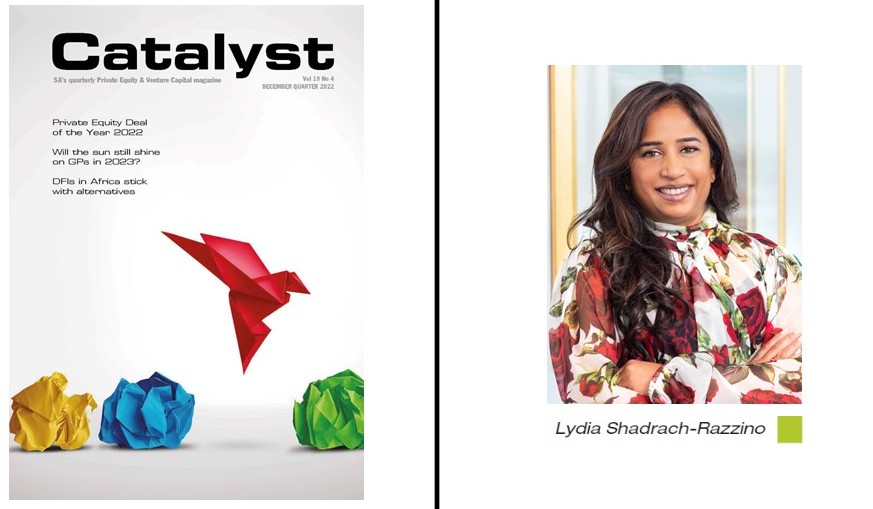
Lydia Shadrach-Razzino is a Partner and Co-head of the Corporate/M&A Practice |Baker McKenzie Johannesburg
This article first appeared in Catalyst, DealMakers’ quarterly private equity magazine.
Unlock the Stock is a platform designed to let retail investors experience life as a sell-side analyst. Corporate management teams give a presentation and then we open the floor to an interactive Q&A session, facilitated by the hosts.
This year, Unlock the Stock is delivered to you in proud association with A2X, a stock exchange playing an integral part in the progression of the South African marketplace. To find out more, visit the A2X website.
In this fifteenth edition of Unlock the Stock, PPC Limited joined us for the first time on the platform to discuss the way forward this group, having made great strides in repairing the balance sheet. As turnaround stories go, this is one of the good ones.
Use the link below to enjoy this great event, co-hosted by yours truly, Mark Tobin of Coffee Microcaps and the team from Keyter Rech Investor Solutions:
If you were able to go back half a century and suggest that in 2023 you will be able to have your hip replaced with a prosthetic and be home the same day, you would be guided quietly to the Mental Health ward for “re-orientation”.
But it is here, now, and the impact on the way we consume healthcare is changing rapidly as various technologies converge, especially in an open competitive market like the USA. With the current buzz across the world now that AI has been commercialized, we look at key trends that are pushing patients out of the hospital systems, increasingly into more customer centric out-patient facilities.
TECHNOLOGY
Telemedicine and remote healthcare have experienced significant growth since the Covid-19 pandemic which has mostly impacted General Practitioners or behavioural health professionals.
Telemedicine was a powerful enabler over the period of the pandemic providing doctors with the tools to consult remotely, continue to service their patients while still receiving a fee for the service. While the number of patients using true telemedicine is still higher than pre the lock downs most consultations are back to “in person”.
Quite simply many consultations require a physical exam, treatment, small procedures, drawing of samples for pathology analysis and more. But Telemedicine is now regarded as a supplementary service and being adopted by many larger family practitioners to be more efficient and reduce the cost of servicing the patient. But why would they be motivated to be more efficient?
BUSINESS MODEL IS CHANGING
The healthcare industry has been plagued by the inefficiencies of the “fee per visit” system costing insurance companies (medical aid) millions of dollars for overservicing. Technology is enabling doctors to charge the medical insurance companies a success-based fee where the practice can charge a flat fee to “cure” the complaint. This has only become possible through a convergence of technologies and the ability to process data to ensure that the correct tariff is applied that will enable the doctor to provide the service at a quality and fee that keeps all parties happy.
Artificial Intelligence is what is on everyone’s mind at the moment. While the possibilities are endless, we are still very much in its infancy stage and even though accuracy has dramatically improved, doctors cannot rely on AI for 100% accuracy, and need to mitigate any negative consequences.
Artificial intelligence is already being used to analyze medical images such as X-rays, CT scans, and MRI scans to diagnose diseases more accurately and quickly. It is being used to analyze large amounts of data to discover new drugs and treatments for disease, and to analyze patient data in EHRs to help doctors make better treatment decisions and to help doctors diagnose diseases by analyzing symptoms and medical records. AI is also being used to analyze patient data to create personalized treatment plans based on a patient’s genetic makeup and medical history.
AI will also assist doctors in automating administrative tasks and better assess the fee to charge the insurance company for the fee per “cure” as that model takes over. It can follow up on unpaid bills, maintaining records and assisting in running their practices at optimum efficiency, ensuring timely rental payments.
From a high level, AI will assist healthcare practitioners to do more with less, also enabling patients to receive specialised services remotely.
AGEING POPULATION
In America, people over the age of 55 are 30% of the population and are the biggest consumer of U.S healthcare services. This age group is forecasted to grow 16.9% by 2025 and the 80+ segment forecasted to grow nearly 50% in the next 10 years. This older population will require more healthcare than the younger population and will drive the demand for outpatient facilities due to affordability, convenience, and accessibility.
SHIFT TO OUTPATIENT FACILITIES
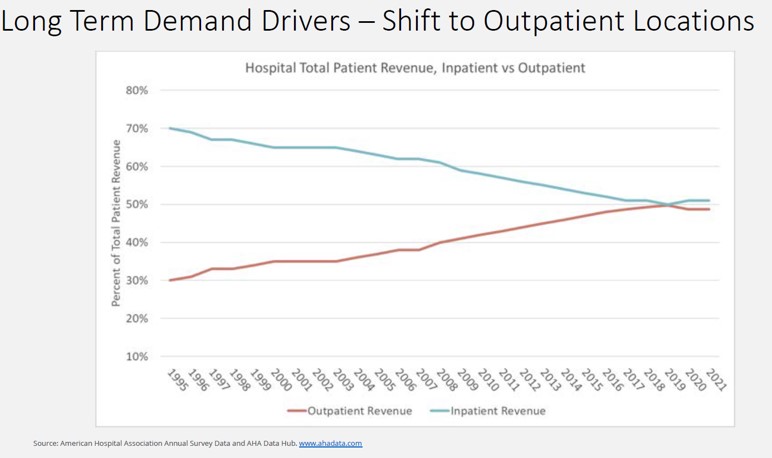
As healthcare costs rise and patients seek more affordable care options, there is a growing trend towards outpatient care. This is a trend that has continued to increase, with the revenue of outpatient facilities overtaking inpatient facilities, as can be seen from the graph below. As mentioned earlier, technology is one of the primary drivers enabling this shift.
This leads to importance of location for these outpatient facilities. Demand is going to be higher where there is a fast-growing population and economy. Access to reliable transportation, freeway systems and ample parking can also play a crucial role in the success of a medical facility. Proximity to schools, work, hospitals, and other medical facilities are all important in today’s world of busy individuals. Patients and medical professionals alike need to be able to easily access the building and both prefer the convenience of having healthcare options in close proximity to where they live. But it is also important to remember that hospitals also are part of the eco-system and refer the post hospital support to the outpatient facilities in that area. Demographic analysis is also a key factor in location and it’s important to conduct research and analysis on the age, income, and health status of the population.
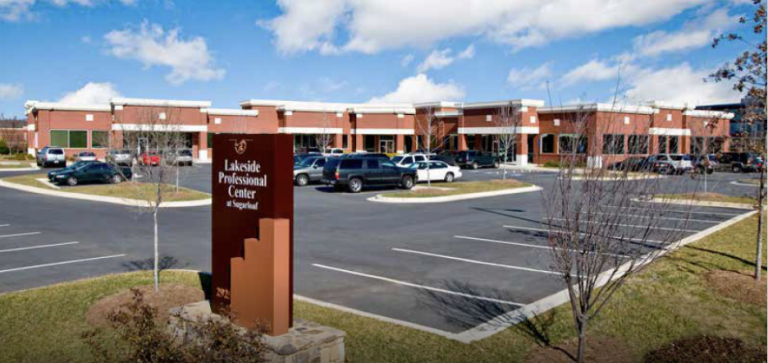
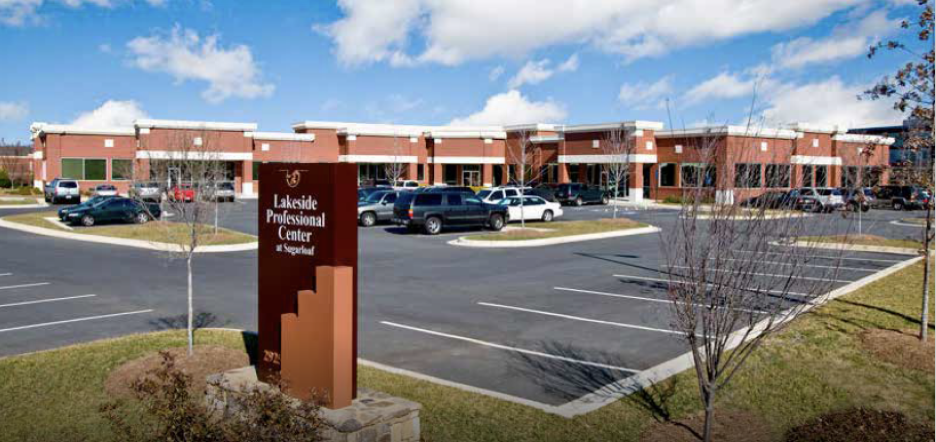
Orbvest’s new building in Duluth, Atlanta, ticks all these boxes. Duluth is an affluent city located in Gwinnett County, Georgia, approximately 30 miles northeast of downtown Atlanta. Atlanta has the ninth largest MSA (Metropolitan Statistical Area) in the United States with over 6.14 million residents.
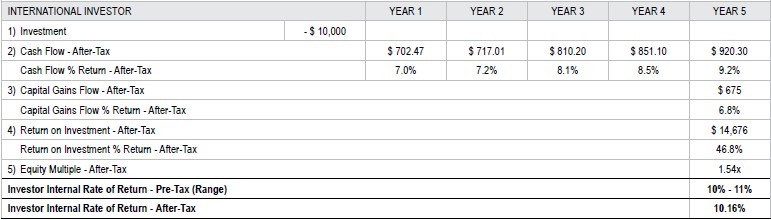
The Atlanta MSA has the third highest concentration of Fortune 500 headquarters in the U.S. Nestled inbetween I-85 and Georgia 400 with two major state highways within the city limits, Duluth provides excellent access to the suburban community of more than 80,000 residents and is part of the Metro Atlanta area, the fastest growing metropolitan region in the US. The county is just 45 minutes from Hartsfield-Jackson Atlanta International Airport (the world’s busiest airport), and 30 minutes from downtown Atlanta. The property is also roughly 4 miles from Northside Hospital Duluth. The tenant mix is a perfect synergy of dentistry practices all with different specializations, providing a flow of referrals between them. Averaging 8% per annum cash on cash yields with 100% occupancy in a great location, Lakeside Professional Center is a fantastic income generating investment that offers capital preservation and quarterly returns for investors in USD.
FOR A FLYTHROUGH OF THE MEDICAL 42 LAKESIDE PROFESSIONAL BUILDING, WATCH THE VIDEO BELOW:
OrbVest SA (Pty) Ltd is an authorised Financial Services Provider. The content and information herein contained and being distributed by OrbVest is for information purposes only and should not be construed, under any circumstances, by implication or otherwise, as advice of any kind or nature, or as an offer to sell or a solicitation to buy or sell or to invest in any securities. Past performance does not guarantee future performance. Returns are taxable and will be taxed as dividends from a foreign source, ordinary income or capital gains, depending on your tax residency. OrbVest is not a tax and/or legal advisor. Owing to the complex tax reporting requirements associated with private equity and private real estate investments, investors should consult with their financial or tax advisor or attorney before investing. For members investing via www.orbvest.com the particulars of the investment are outlined in the property supplement, a private placement memorandum or subscription agreement, which should be read in their entirety by the proposed investor prior to investing and having obtained independent advice.
This tiny company is way off the radar and highly illiquid
You won’t see much trade in 4Sight, with many more offers than bids in the market. The website uses practically every technology buzzword you could think of, with fourth industrial revolution featuring strongly. Even the website domain is .cloud!
Corporate gumph aside, the numbers are the numbers. In this case, they look great year-on-year, with revenue up 20.7% and operating profit up 93.9%. Despite being such an illiquid company, the closing price on Wednesday of 25 cents per share puts the company on a 10.5x P/E multiple based on HEPS of 2.379 cents.
That’s not exactly a small cap bargain.
Barloworld is growing solidly (JSE: BAW)
Life after Zeda is looking good!
With the exit of the Zeda mobility business (now separately listed on the JSE), Barloworld’s shareholders are exposed to a more focused group. The focus now is on growth, with the pandemic behind the business and the balance sheet still in great shape. I’ve commented several times on how well Barloworld has navigated these challenges.
Of course, Russia is still a major problem. Barloworld is still operating in the country, with revenue down by 53% and operating profit down by 37% due to the change in revenue mix. Despite this major drop, the EBITDA margin actually improved from 13.6% to 18.2% because costs in Russia have been slashed. The Russian business is self-sufficient in terms of funding requirements.
If we now lift our heads to group level numbers, we find that the first five months of the financial year have delivered revenue growth of 14.9% and EBITDA growth of 11%, with operating profit up by 18%. Net debt increased to support this growth, as working capital was higher.
In Equipment southern Africa, revenue jumped by a lovely 41.8%, with machine sales up 64.2% and parts up 30.1%. You can see the impact of the commodity cycle coming through here and its knock-on effect into other industries. Operating profit was up 35.9% and the good times look set to continue, with the firm order book up 21% year-on-year.
Russia falls under the Equipment Eurasia segment and we’ve already dealt with that region. The other region in this segment is Mongolia, where revenue grew by 44.6% and operating margin improved from 10.8% to 14.3%.
In the Consumer Industries segment, we find the Ingrain business that was acquired from Tongaat during the pandemic. Although revenue increased by 23.2%, operating margins fell as EBITDA dropped by 12.4%. There were various factors at play here, reflecting the usual challenges of running manufacturing businesses in South Africa.
Overall, Barloworld continues to benefit from this cycle.
Impala’s regulatory journey is nearly over (JSE: IMP)
There is one major approval left for the offer to Royal Bafokeng Platinum shareholders
For Impala, the major remaining condition is the issuance of a Compliance Certificate by the Takeover Regulation Panel. The JSE also needs to give an approval for the listing of more shares, but that’s a formality.
The Takeover Special Committee is expected to issue a ruling soon, with the hearing already out of the way. For the gazillionth time, Impala Platinum has had to extend the longstop date and closing date for the process.
Interestingly, despite the Northam offer, Impala has bought another 0.82% in the company and has taken its stake to 41.54%.
Acquisition target Indluplace gives an update (JSE: ILU)
Vacancies are clearly on the right track
Indluplace is currently under offer by SA Corporate Real Estate (JSE: SAC) at a price of R3.40 per share. A circular will be distributed in due course. In the meantime, the company has released an operating update.
The portfolio is heavily tilted towards inner city residential accommodation and student accommodation. Occupancy excluding student accommodation is at 94% vs. 89.7% in March 2022. In the Johannesburg inner city portfolio, vacancies have been reduced from 14.2% in March 2022 to 9.3%. The rest of the portfolio is even lower, with vacancies down from 8.2% to 4.2%.
Although rental collections are good, the business faces the threat of municipal problems that we all know and love in this country, including the latest valuation roll in the City of Johannesburg that includes some valuations that the company believes are unfair.
More details will no doubt be included in the circular and especially in the interim results to be released in May.
RCL Foods to sell Vector Logistics (JSE: RCL)
This disposal is part of RCL’s strategy to focus on its core businesses
This deal goes back to a strategic review at RCL Foods that was initiated in 2020. The company has taken several steps to restructure the business and focus on the value-added consumer brands component. The sale of Vector Logistics is part of this strategy to sharpen up the group.
Vector Logistics is the country’s leading frozen food logistics operator, facilitating RCL’s own integrated supply chain and also serving third party clients. The buyer of this business is a South African entity that is ultimately owned by an emerging markets infrastructure fund that is part of the A. P. Møller Capital stable. This is a Danish group, so there’s a show of faith in South Africa for you.
The purchase price is R1.25 billion. There is a downward adjustment because Vector needs to settle existing share appreciation rights issued to employees of the company as part of the 2009 RCL Foods share appreciation scheme. It’s common in mergers & acquisitions to see an eventual adjustment to the purchase price for factors that are specific to the deal.
There is also a further adjustment based on actual EBITDA for 2023 and 2024 vs. target EBITDA. This isn’t quite an earn-out, as RCL is receiving all the money up-front. If Vector misses the targets, RCL may need to pay some of it back. But there is the potential for an upward adjustment, so that part is an earn-out. The maximum adjustment in either direction is R100 million.
The numbers for Vector are a little tricky to work with. The net assets were R381 million at the start of January 2023 but that’s before the conversion of a shareholder loan into equity, so we can’t compare that to the purchase price. Interim profits were R34.7 million, which would suggest a large multiple for this deal (even when annualising that number) that I doubt is the case.
This is a Category 2 transaction, so we won’t get any further details than these.
Little Bites:
Director dealings:
Get ready for this one: Koos Bekker has sold Prosus (JSE: PRX) shares worth roughly R3.4 billion. The announcement calls this a “parcel of shares” (because this is by no means the entire holding) and notes that the proceeds will be used to fund the building of hotels in various countries held by the family. Look, I would also rather buy hotels than the garbage Prosus has been buying for the past few years.
A director of Sabvest (JSE: SBP) has bought shares worth R777k,
The CEO of Sirius Real Estate (JSE: SRE) has bought shares in a family trust worth R125k.
Reeza Isaacs has stepped down as Group Finance Director of Woolworths (JSE: WHL), having served for the past 10 years. Zaid Manjra has been appointed as interim CFO, an internal appointment that is always good to see. Whether he not he can make it stick remains to be seen!
Wesizwe Platinum (JSE: WEZ) released a trading statement confirming that the headline loss per share for the year ended December 2022 will be between 8.09 cents and 8.39 cents. That’s worse than the loss in the comparable period of 1.48 cents.
Investec (JSE: INP or JSE: INL) has exhausted its authority to repurchase preference shares, having now repurchased 5% of the shares that were in issue at the date that the current authority was granted.
In case you wondered if you were starting to hallucinate on Wednesday, your eyes were not deceiving you that Oando PLC (JSE: OAO) released a tranche of financial updates in a major catch-up session. It’s funny in a way, as they even include management commentary on results that are years out of date. Still, this process of catching up was needed for the company to remain a listed business.
Load shedding isn’t fun. We know this. In a great example of never wasting a good crisis, there are investment opportunities in solar as South Africans effectively build a decentralised grid on private balance sheets.
Offering investors an indicative 18% IRR over 10 years through their new Twelve B Energy Fund, Jeff Miller of Grovest joined me to take a look at:
An overview of alternative investments and how s12J set the scene for this asset class to be offered to retail investors in South Africa
The danger of assuming that an entire asset class carries a specific risk profile, as the risk ultimately comes from the underlying exposure rather than the type of asset class (e.g. equities / bonds / alternatives)
The way in which the tax allowances give a kicker to returns without increasing the risk of the underlying exposure
The background to Grovest and how the business is positioned to take advantage of this environment
The quality of the investments available to investors if we ignore the tax kicker i.e. the attractiveness of the underlying assets
The way that Grovest thinks about gearing (the use of debt to boost equity returns) in a structure like this and how investors can think about their own gearing
The cash-on-cash return vs. the return achieved through an eventual sale of the solar cash flows at the end of 10 years, with examples of existing market transactions for such cash flows
The project pipeline and the strategy to deploy the full R200 million being raised, with a discussion on the impact of not matching the tax deduction to the cash flows
The relationship with Hooray Power as the EPC for these solar projects and the way that this addresses a key risk in solar: project execution risk
The sensitivity of the returns to the terminal value
Minimum investment size and the important point that there is no cap on the investment
A discussion on the capital gains tax and recoupment considerations
The difference between invested capital and risk capital and how this relates to the Grovest fees in this investment
An overview of the investment committee
For more information, visit twelveb.co.za and reach out to the team with any questions by emailing apply@twelveb.co.za. You can also visit the Grovest website for more information on the broader group.
Twelve B Fund Managers (Pty) Ltd is an approved juristic representative of Black Mountain Investment Management Proprietary Limited, an Authorised Financial Services Provider FSP No 49908.
NOTE: this podcast is for information purposes only and is not a recommendation, nor should it be interpreted as financial advice or an endorsement of the Twelve B product by The Finance Ghost. Do your own research and consult with your independent financial advisor before making any investment decisions.
Alexander Weiss of Trive South Africa shares his views on the local retail industry, including a technical analysis of both Woolworths and Shoprite.
South Africa’s ongoing energy crisis is making headlines for all the wrong reasons as companies battle against the detrimental effects of rolling blackouts and power disruptions, especially within the food retail sector. Food retailers face the cumbersome task of limiting food wastage and remaining profitable despite a growing nationwide energy crisis that has become troublesome for most.
As surging power outages persist and general economic instability arises, local food retailers have expressed concern over the financial repercussions of ongoing power disruptions. Loadshedding has emerged as a familiar yet unpopular theme among South Africans as rolling blackouts intensified during the second half of 2022 and well into 2023.
Food retailers such as Woolworths (JSE: WHL) and Shoprite Group (JSE: SHP) have seen the nation’s energy crisis depress bottom-line figures and cut into shareholder dividends, causing a wave of negative sentiment to enter the local food retail market.
Loadshedding and its Effect on the South African Economy
Despite reaching an all-time high in 2022, the South African economy has only grown by 0.3% from 2019’s pre-pandemic reading, significantly lagging behind the country’s 3.5% population growth. The South African economy contracted more than expected in the fourth quarter of 2022 against persistent loadshedding and rolling blackouts. Despite rallying in the third quarter of last year, Gross Domestic Product (GDP) declined by 1.3% in the fourth quarter, significantly exceeding analyst expectations of a 0.4% decline. This significant contraction in fourth-quarter GDP places South Africa on the precipice of a technical recession as market analysts forecast a further reduction in quarterly growth for the first quarter of 2023.
Food Inflation Surges as Nationwide Energy Crisis Persists
As South Africa’s consumer price inflation ticked up to 7% in February 2023, marginally up from January’s reading of 6.9%, “food and non-alcoholic beverages” emerged as the primary driver behind February’s inflation figure coming in higher than expected. With South African inflation rising for the first time since October 2022, “prices for food and non-alcoholic beverages increased by 13.6%” over the past year, reflecting the highest year-on-year increase in food prices since April 2009, around fourteen years ago. Food and non-alcoholic beverages contributed an alarming 2.3 percentage points to the headline consumer price index (CPI) reading of 7% for February.
Given the extent to which rolling blackouts have intensified nationwide, retailers have to mark up the prices of food items to remain somewhat competitive. Moreover, the intensity of power disruptions has exacerbated the concern over food supply constraints, resulting in many local food retailers taking precautionary measures to avoid excessive food spoilage and waste during extended blackouts.
Woolworths Holdings Limited (JSE: WHL)
Famous South African multinational retail company, Woolworths Holdings Limited (JSE: WHL), reported record-high interim results for the half-year that ended 25 December 2022. Woolies’ shareholders would have been impressed to see the group report a stellar 75% year-over-year increase in half-year earnings per share (EPS) while free cash flow (FCF) per share surged 30% year-over-year. Despite double-digit growth in revenue and profitability, the price action on Woolies has not reflected the same positive sentiment in recent times, with the share price declining more than 15% since the beginning of March as market participants price in forecasts for slower growth.
Given the relaxation of COVID-related restrictions in Australia, the famous retailer benefitted massively from the influx of shoppers returning to stores. However, as consumer demand normalises in Australia, Woolies expects slower profit growth from continued operations due to the “debilitating power crisis” in South Africa. As Woolies struggles to grapple with “crippling power outages”, CEO Roy Bagattini has informed investors that the group is working with property owners at shopping malls to “move towards renewable energy.” Despite record-high earnings and growth, Woolies stated that the country’s energy crisis has “reduced its domestic adjusted operating profit by an estimated R15 million per month.”
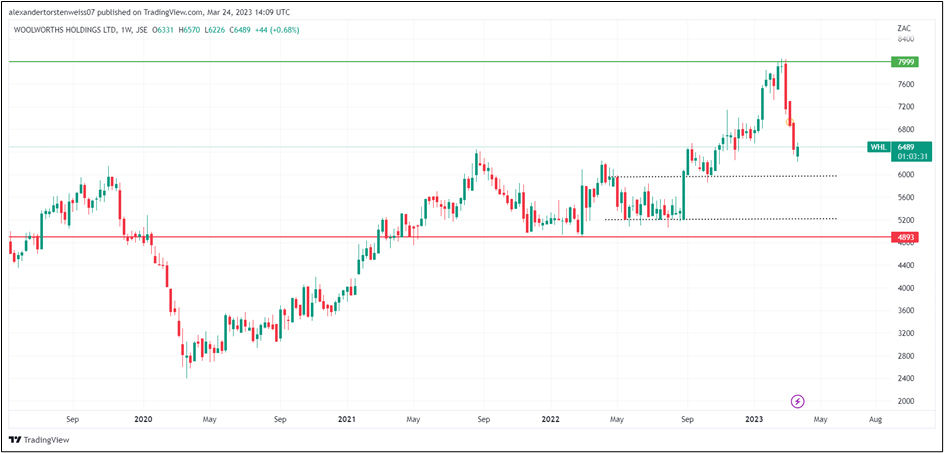
Technical Analysis on WHL
The price action on Woolies reached the significant resistance level at R80.00 per share (green line) as bullish market sentiment sent the share price surging amidst record-high earnings growth. However, given the retail giant’s statement on how the “debilitating energy crisis” in South Africa slashes domestic operating profit by an estimated R15 million per month, Woolies has seen its share price trend lower, declining more than 15% throughout March.
Should negative sentiment persist, the price action could continue to trend lower toward the next support level at R60.00 per share (black dotted line). If that support level does not hold, the bears could see the price action tick down to lower support levels at R52.00 per share (black dotted line) or R49 per share (red line). These levels could be watched closely as a potential entry point for long-term investors. For the bull case, we might expect the price action to retest the resistance level at R80.00 per share (green line), which could lead to a potential breakout.
Shoprite Holdings Limited (JSE: SHP)
Africa’s largest supermarket retailer, Shoprite Holdings Limited (JSE: SHP), reported impressive interim sales growth for the half-year period that ended 1 January 2023. Despite the group realising double-digit sales growth, reporting a stellar 16.8% year-over-year increase in the sale of merchandise for the half-year period, CEO Pieter Engelbrecht raised concerns over the country’s ongoing energy crisis. Due to rolling blackouts and power disruptions, Pieter recently stated that Shoprite is “not reporting the level of profit and dividend growth that would normally be associated with this level of sales growth.”
Constant power outages have resulted in Shoprite incurring a “total spend of R560 million on diesel” for the six-month period that ended 1 January 2023. Should the country’s energy crisis persist or worsen, Shoprite could be staring down the barrel of an R1 billion annual diesel bill come the end of the next half-year period. Excessive spending on diesel has depressed the retailer’s bottom line, with “trading profit only increasing by 8.6%, leaving the group’s trading margin at 5.7%, down from 6.1% reported last period.”
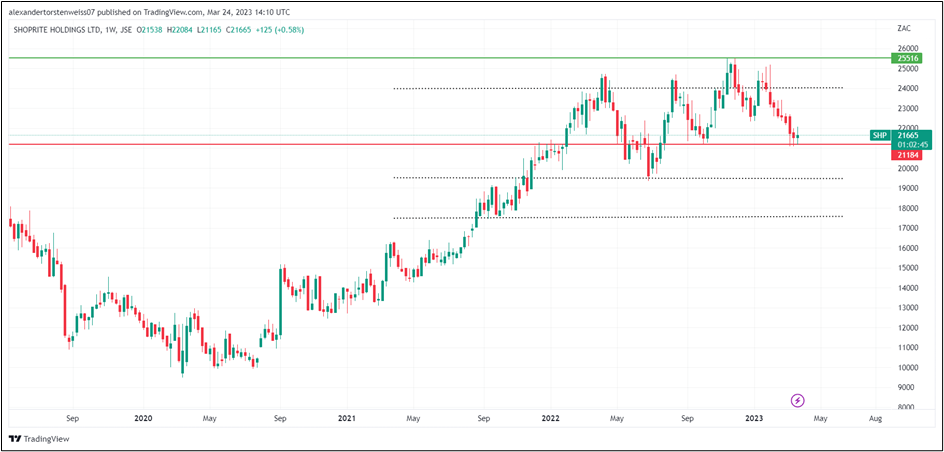
Technical Analysis on SHP
The price action on Africa’s largest supermarket retailer has been consolidating sideways for the last eight months. The primary resistance and support levels are firmly at R255.00 (green line) and R211.00 (red line).
For the bull case, an opportunity could exist if the price action pushes above R240.00 (black dotted line), which could be the first resistance point in the price for the bulls, a share level towards the primary resistance of R255.00 (green line). The bears could see the price action continue its recent downtrend toward the significant support level at R211.00 (red line), which could be the first support level for the bears. Suppose the downtrend persists and the primary support level at R211.00 is tested. In that case, the possibility exists for either a retracement or, if the support level does not hold, the share price can decline to lower support levels.
The proposed sale of the stake in PresMed Australia has been almost unanimously approved
Advanced Health plans to dispose of its entire stake in PresMed Australia (56.44% in the company) for A$45.2 million, which translates to roughly R520 million.
Shareholders like it, with 99.99% of votes cast in favour of the transaction.
The deal will now be implemented, with this major hurdle out of the way. In case you’re wondering, the anchor bidder here is a private equity fund, with management and medical shareholders also part of the bid.
Attacq is still negotiating with the GEPF (JSE: ATT)
The cautionary announcement has been renewed
If you’re a shareholder in Attacq, you are likely aware of the potential deal for the Government Employees Pension Fund (GEPF) to take a 30% stake in Attacq Waterfall Investment Company.
This is a great deal for Attacq shareholders as the price is much closer to NAV than the discount at which the listed shares are trading, so this creates value for listed shareholders (like me).
The cautionary has been renewed as Attacq is still negotiating the legal agreements. This deal isn’t finalised yet.
EOH commences the fight back (JSE: EOH)
The share price is green over the past month – can this be maintained?
In any turnaround story, there’s eventually a bottom. Sometimes, it happens after a horribly painful rights issue. In even more unfortunate cases, the bottom is sometimes zero, as I think we are about to see in Steinhoff.
In a trading statement for the six months ended January 2023, EOH has achieved a modest increase in revenue from continuing operations. Gross profit margins were fairly steady at 28% to 30%. Operating profit of between R100 million and R120 million compares favourably to R100 million in the corresponding prior period.
The problem hasn’t been the operations. No, it has been the balance sheet, which wasn’t fixed by the end of this period. For that reason, there’s still a headline loss for the interim period.
Debt had been reduced to R1.2 billion by the end of January and was then reduced further to R673 million thanks to the proceeds of the rights offer.
This should, in theory, mark the bottom in terms of financial performance. Having been through a torrid time, the onus is now on the management team to deliver operating profit growth.
Masters of drilling (JSE: MDI)
But you’ll need to be a master of timing to make money on this one
Cyclical companies are a wonderful thing. They lure investors in the pursuit of riches, either rewarding or ruining them along the way. Over three years, Master Drilling has doubled in value – admittedly because the Covid low is now the starting point of a three-year view. Over five years, the share price has managed around 17.5% in total, which certainly isn’t a good outcome.
As a supplier to the mining industry, Master Drilling is as cyclical as its customer base. The difference is that it lets you take a view on the commodity sector in general, without having to pick your poison in terms of a specific commodity.
It has worked in recent times, with revenue for the year ended December 2022 up by 31.7% in US dollars and HEPS up by 10.1%. If you prefer the South African view, HEPS measured in rand was up by 21.9%. Both the order book and pipeline look good, so that bodes well for 2023.
The company is investing heavily, with practically all cash generated from operations being sunk into capex. Of that capex spend, 63% is on expansion and 37% is on maintaining the existing business. The company was happy to increase its dividend per share from 32.5 cents to 47.5 cents (measured in rand), so with all the cash going into capex, the only outcome was an increase in debt. This was a deliberate decision to increase the mix of debt on the balance sheet, taking gearing from 5.8% to 7.8%.
Although Master Drilling services clients around the world, the group notes that Africa remains the key area and that further opportunities are being aggressively pursued.
Metair updates its earnings guidance (JSE: MTA)
At least shareholders now have more uncertainty around the recent pain
In its initial trading statement for the year ended December 2022, Metair flagged a decrease in HEPS of at least 104%. Clearly, this meant a loss for the period.
That guidance has now been tightened and it’s hardly any worse than the original guidance, coming in at a drop of between 104% and 106%. This indicates a headline loss of between 14 cents and 21 cents vs. HEPS of 354 cents in the comparable period.
The share price has only lost a quarter of its value over 12 months, which is pretty good under these circumstances.
Murray & Roberts may still hold on to RUC (JSE: MUR)
There’s a big step forward in the voluntary administration of the Aussie business
In the latest example of the public market casino, Murray & Roberts is up 45% in the past week. It remains 82% down over the past six months.
There has been positive newsflow around the latest rally, with another example coming through on Tuesday. Having now agreed a binding Deed of Company Arrangement with the administrators in Australia, Murray & Roberts has taken another step towards being free of the Clough nightmare.
As an additional bonus, ownership of the RUC Cementation Mining Contractors business should revert to Murrays under this agreement. This would retain the multinational status of the group’s mining platform.
These speculative plays can bring huge returns to punters in a short space of time. Those returns can disappear just as quickly as they appeared, so be careful.
PBT is set to sell Payapps and pay shareholders a special dividend (JSE: PBG)
A 13.3% rally was the reward for those who held PBT Group on Tuesday morning
PBT Group is finally selling the Australian business that doesn’t quite belong with the rest of the business. The stake in construction payment management software Payapps is being sold for A$14.35 million to the other shareholders in Payapps, being a group of Australian buyers.
After all transaction costs and taxes, proceeds of R158 million will be received by PBT. This works out to R1.51 per PBT share, which will be returned to shareholders as a cash distribution.
The selling price is well above the fair value of the investment that had been recognised in PBT’s financials of R124.27 million.
Stor-Age looks to be on the right track (JSE: SSS)
The share price pressure over the past year is a function of valuation, not performance
Stor-Age is a solid business. That doesn’t always make it a good investment of course, as it all comes down to market yields and what investors are prepared to pay for these cash flows.
The company can’t control the valuation or the macroeconomic environment. It can control its own performance, something that Stor-Age regularly delivers on.
In an update for the eleven months to February 2023, demand remained robust and churn was below pre-pandemic levels, although the company is seeing some return to seasonal trends.
On a same-store basis, occupancy increased in South Africa and the average rental rate increased by 7.3% in this inflationary environment. Occupancy in the same-store portfolio is 91.7%. The “same-store” concept is important, because Stor-Age is constantly building and acquiring new facilities.
In a sign of the times, the average rental rate in the UK portfolio increased by 8.3%, higher than the rate in South Africa! Occupancies are somewhat lower, coming in at 86.7% in the same-store portfolio.
The development pipeline is still going strong, with R900 million worth of development investment lined up in South Africa. The properties are all being developed in a joint venture with Nedbank, except for a Century City property that is a joint venture with Rabie Group. In the UK, the development pipeline is worth £64 million (note the currency).
Super Group reminds us that equity isn’t everything (JSE: SPG)
There are other ways to raise capital
People tend to forget that equity isn’t the only layer in the balance sheet cake. The local capital market is vibrant for debt raises, with no shortage of institutional investors looking for “corporate paper” – notes and similar debt instruments issued by leading companies.
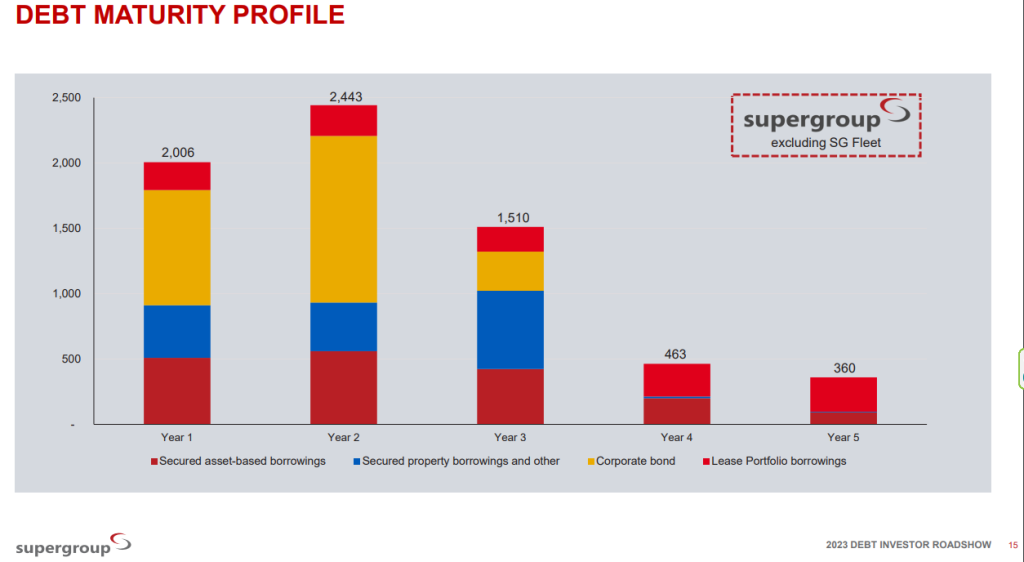
As Super Group announced a further successful debt capital raise on the local market, I went digging for the debt investor roadshow presentation to see if anything interesting popped out. To give you an idea of how interesting managing a balance sheet can be, here’s a useful graph of the type and maturity profile of the debt at Super Group:
The company raised R750 million and received bids for R2.46 billion, so the raise was heavily oversubscribed. Pricing was thus slightly below guidance, which is what the company wants to see.
If you’re curious about the full debt investor presentation, you’ll find it here>>>
Steinhoff: get ready to shout “Whoa!” (JSE: SNH)
This must be the most aptly named process I’ve ever seen
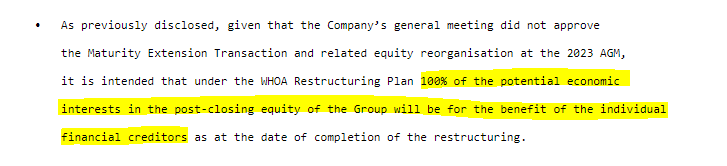
After shareholders chose to rather own worthless listed shares than worthless unlisted shares, Steinhoff’s board had to initiate a Dutch law restructuring plan called a “WHOA Restructuring Plan” – surely the easiest name in law to remember.
There are many complicated details in here about how the debt will be restructured. Here’s the paragraph you need to care about if you still stubbornly own equity in Steinhoff:
As I have been warning you for some time now, the equity is worthless. Despite this, there are still punters sitting on the bid at 26 cents per share. They clearly just hate having money and are looking for innovative ways to get rid of it.
Little Bites:
Director dealings:
The founders of Transaction Capital (JSE: TCP) climbed into more shares, buying R19.8 million worth of shares at an average price of R13.19 per share.
Directors of Premier Group (JSE: PMR) bought shares worth roughly R4.6 million as part of the IPO.
Des de Beer has bought another R3.3 million worth of shares in Lighthouse Properties (JSE: LTE)
The Chief Sustainability Officer of Sibanye-Stillwater (JSE: SSW) has bought nearly R1.2 million worth of shares.
Associates of directors of Nictus (JSE: NCS) have bought shares worth over R52k.
If you are unfortunate enough to be a shareholder in Pembury Lifestyle Group (JSE: PEM), there’s an update on the ongoing soap opera. It includes everything from audits not being up to date through the discovery of historical fraudulent documents, along with a far-too-detailed update on the schools that are being prepared for opening. I’m surprised they didn’t mention a repainting of the school hall, such was the level of detail. It’s incredible how listed companies can become such a mess.
In this special episode of Ghost Stories, there’s no sponsor. There is no company partnering with me to bring a message to market under normal conditions.
Instead, we find a CEO who was willing to engage with me on very short notice after comments I made in Ghost Mail. Given the circumstances around Transaction Capital at the moment, I jumped at the opportunity.
With David Hurwitz in the hot seat, we talked about:
In layman’s terms, what does SA Taxi do and what are the conditions under which the business performs?
What did Transaction Capital mean about the issues in SA Taxi being “structural” and is this really an accurate view on the industry?
A discussion on how the banks play in this space and why Transaction Capital is different.
Whether there is likely to ever be a viable alternative to the taxi sector and how government could play a role in the industry.
The funding model for SA Taxi and how that balance sheet works, including a discussion on the contamination / cross-default risks and the duration of debt.
SANTACO’s position in this crisis and how they are thinking about the relationship.
Bluntly – is SA Taxi going to be OK and to what extent did the management team see this coming?
An overview of the Nutun business and how it will grow.
How can investors be confident that an SA Taxi-style nightmare isn’t brewing at WeBuyCars?
A discussion on the margins at WeBuyCars in cheaper vehicles vs. more expensive vehicles.
An overview of GoMo and how quickly this business can be built up.
I haven’t edited even a single “um” out of this podcast, so this is the conversation precisely as I had it with David.
As anyone who regularly follows me will know, I hold a long position in Transaction Capital at the time of release of this podcast. Please note that you must do your own research before deciding to enter or exit a position in Transaction Capital, or any other company for that matter!
I hope that this podcast will enhance your understanding of what has happened at Transaction Capital and what could happen in future.
We use cookies on our website to give you the most relevant experience by remembering your preferences and repeat visits. By clicking “Accept All”, you consent to the use of ALL the cookies. However, you may visit "Cookie Settings" to provide a controlled consent.
This website uses cookies to improve your experience while you navigate through the website. Out of these, the cookies that are categorized as necessary are stored on your browser as they are essential for the working of basic functionalities of the website. We also use third-party cookies that help us analyze and understand how you use this website. These cookies will be stored in your browser only with your consent. You also have the option to opt-out of these cookies. But opting out of some of these cookies may affect your browsing experience.
Necessary cookies are absolutely essential for the website to function properly. These cookies ensure basic functionalities and security features of the website, anonymously.
Cookie
Duration
Description
cookielawinfo-checkbox-analytics
11 months
This cookie is set by GDPR Cookie Consent plugin. The cookie is used to store the user consent for the cookies in the category "Analytics".
cookielawinfo-checkbox-functional
11 months
The cookie is set by GDPR cookie consent to record the user consent for the cookies in the category "Functional".
cookielawinfo-checkbox-necessary
11 months
This cookie is set by GDPR Cookie Consent plugin. The cookies is used to store the user consent for the cookies in the category "Necessary".
cookielawinfo-checkbox-others
11 months
This cookie is set by GDPR Cookie Consent plugin. The cookie is used to store the user consent for the cookies in the category "Other.
cookielawinfo-checkbox-performance
11 months
This cookie is set by GDPR Cookie Consent plugin. The cookie is used to store the user consent for the cookies in the category "Performance".
viewed_cookie_policy
11 months
The cookie is set by the GDPR Cookie Consent plugin and is used to store whether or not user has consented to the use of cookies. It does not store any personal data.
Functional cookies help to perform certain functionalities like sharing the content of the website on social media platforms, collect feedbacks, and other third-party features.
Performance cookies are used to understand and analyze the key performance indexes of the website which helps in delivering a better user experience for the visitors.
Analytical cookies are used to understand how visitors interact with the website. These cookies help provide information on metrics the number of visitors, bounce rate, traffic source, etc.
Advertisement cookies are used to provide visitors with relevant ads and marketing campaigns. These cookies track visitors across websites and collect information to provide customized ads.