
This was my most-read article in my early days as The Finance Ghost, shared on multiple WhatsApp groups and community platforms. It helped a lot of people with the decision to emigrate (or not) and is replicated here with just a few tweaks and updates where needed. The original publication date was July 26th, 2020.
Is there a more emotive topic for the South African middle class than emigration? With just enough money to contemplate the decision but nowhere near enough for the dream lifestyle of chasing the sun, these inbetweeners face a tough decision. Load shedding doesn’t make it any easier.
The damage to our economy from Covid was severe. It made the 2009 Global Financial Crisis look tame. A significant upswing in commodities in the aftermath of the pandemic has saved the currency and quite possibly our economy as well, although Eskom and numerous other problems constantly remind us that the pain is far from over.
When a ship is battling a terrible storm, the passengers look to the captain and leadership team for hope. Our leadership team isn’t inspiring confidence in anyone right now, forcing the passengers to at least consider whether the lifeboats might be a better option.
This isn’t an SA-bashing article
It’s too easy to just say “of course you should emigrate” – the decision deserves far more analysis than that.
South Africa has problems, but we are still one of the most important emerging markets in the world. There’s still an S in BRICS. We are still in the G20. By no means are we some obscure country that has no relevance to global trends, even if we are a “junk” economy these days.
There is unquestionably opportunity here. Although the overall economy has been stagnant in recent years, many have still made their fortunes here.
I’m going to take you through a decision process that looks at:
- Mitigation of crime as the initial test
- Separation of financial and physical emigration
- How to make the physical emigration decision
- Treating the views of SA expats with some caution
The most important caveat to objective analysis: crime
I want to explain the way I think about the emigration decision and the factors I consider, but I must first touch on the most difficult issue of all: crime.
It’s not about feeling safe, because very few countries are perfectly safe. It’s about feeling like you can successfully mitigate the risks.
I moved from Joburg to Cape Town partially because of how gorgeous Cape Town is, but also because I couldn’t handle the risk of violent crime happening to my family while driving between home and work. Cape Town has crime too, obviously, but the hijacking realities are a fraction of what they are in Joburg.
I felt that hijacking is a risk I cannot mitigate and so I semi-grated, along with thousands of other Joburg families.
Housebreakings, on the other hand, can be mitigated to a great extent by living in a secure complex. The risk is never zero, but it can be managed to an acceptable level in my opinion.
If you feel like you cannot mitigate the risks, or you cannot live a full life in South Africa because of crime, then you can stop reading. You should be on visa application sites instead, giving yourself a shot at happiness elsewhere. I totally get it and respect that decision.
Separating the financial and physical decisions
South Africans are allowed to take R1m offshore every year without jumping through hoops and another R10m per year with permission from the SARB and some other paperwork nightmares from SARS.
I raise this because the vast majority of South Africans will never be at risk of hitting this threshold and not getting their money out. The exception to this would be a Zimbabwe-style liquidity crisis where the Rand literally becomes worthless in a matter of weeks, but I believe we aren’t at that point.
If I believe that we are headed for Zimbabwe status in the next few years, then there are two things I should be doing:
- Selling all my fixed assets (especially my house as soon as possible)
- Shifting all my Rands into offshore investments as first prize or JSE-listed investments with offshore exposure (e.g. S&P 500 ETFs) as second prize
This is the decision to financially emigrate rather than physically emigrate. It is often (but not always) the precursor to physical emigration.
How do I make the physical decision?
Having already discussed the concepts of crime mitigation and financial emigration, we now need to look at the biggest decision of them all: physical emigration. This is the classic “packing for Perth” approach.
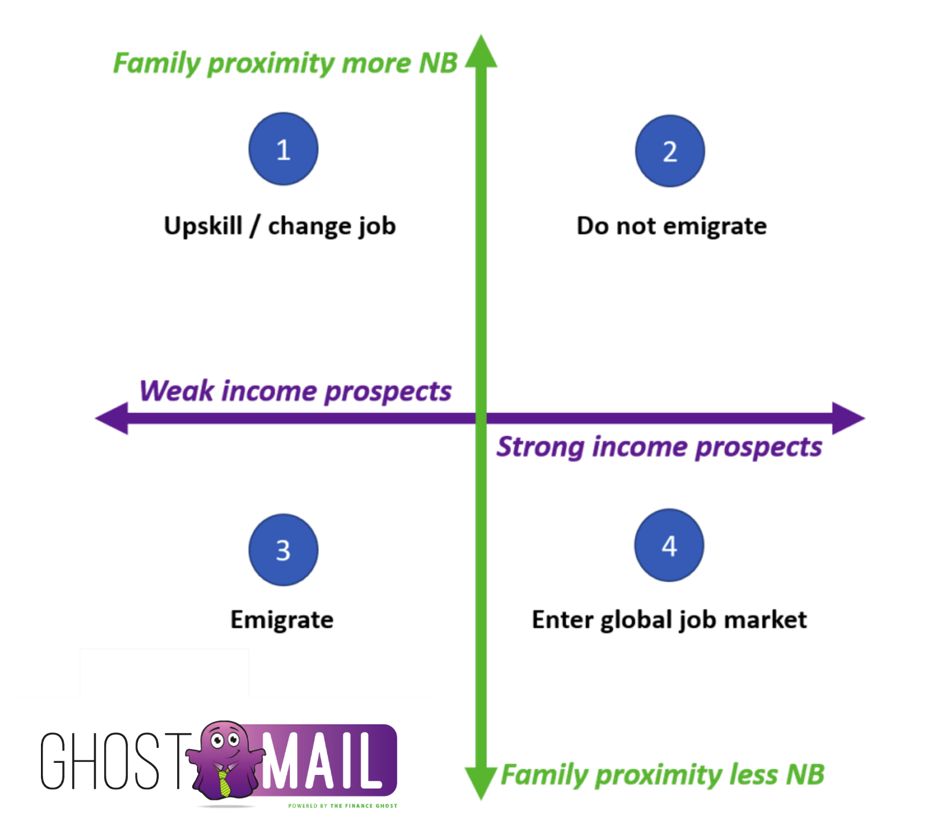
A four-quadrant decision matrix is a favourite tool for strategists. It allows you to assess four scenarios based on two variables. In this case, I believe the most important variables are:
- Importance of proximity to family
- Income prospects in South Africa
The decision needs to be based on your personal circumstances.
Let’s deal with the family point first. It’s easy: you either do or do not place high importance on being close to your family and close friends. This is especially difficult when you have kids. If you’re young and single and most of your friends have left anyway, then it’s much easier than when you are taking your kids away from their grandparents, for example.
The second point is trickier. Your ability to earn an income is a factor of your skills and your relationships. If you go overseas, your relationships start from scratch, so your skill set has to be fantastic and sought after in whichever country you go to. Please don’t underestimate this issue.
Let’s look at the four scenarios:
Quadrant 1: Upskill / change job
If you want to be close to family and friends but your income prospects aren’t looking good, then you have to do a bit of soul searching and figure out how to upskill yourself in a new direction.
Should you start a business? Do you need to study further? Is it time to do something completely different? It’s not a pleasant situation to be in, but the tough survive.
In some cases, there is little choice but to emigrate. This is the most emotional emigration of all, as it is based on push factors rather than pull factors and you leave your family behind. It hurts for everyone involved.
Quadrant 2: Do not emigrate
The decision to not emigrate is clear in only one quadrant. If you want to be close to family and your income prospects are strong in South Africa, then physical emigration makes no sense (unless you cannot mitigate the crime issue).
With the right crime and financial risk mitigants in place, you can keep lighting the braai. I am in this quadrant and I really hope to stay in it forever.
Quadrant 3: Emigrate
The decision to get out is also only clear in one quadrant. With weak income prospects and your family already somewhere else, why would you logically stay here?
Quadrant 4: Enter the global job market
This quadrant is typically where professionals with global mobility find themselves. They are specialists in specific fields and can work in many different countries.
If family isn’t an issue, then these people must logically continuously seek the best possible job market for their skills.
Treat the views of expats with some caution
Ask 10 South African expats whether you should emigrate and I guarantee 8 will give you a resounding yes. Of those 8, maybe half are genuinely happy.
South African expats don’t have it easy. Whether they are willing to admit it or not, their hearts still feel something when they think about braais, biltong and Springbok world cup victories.
Many will tell you that “leaving is the best thing they ever did” and “life is so perfect here” – which, in some cases, it is. In many cases though, it isn’t.
With the greatest of respect to expats and recognition of how hard it is, many suffer from confirmation bias and few are willing to admit it. I have enormous respect for those who are capable of giving a balanced answer.
They so desperately NEED emigration to have been the right decision that they only look for positives in the country they’ve moved to and they only focus on the negatives in their place of birth. This falls away when the Springboks win of course, at which time the expat population is the first to break out the green jerseys.
Once you’ve packed up your family and sold everything to move to a foreign land, you will seek confirmation all the time that you did the right thing. This is human nature. These cognitive biases make our lives (and the markets) so interesting.
Final thought: this is a fluid process
I don’t make this assessment once every 5 years. I do it almost continuously in my mind. The facts in front of us are always changing. Our country seems great one day and terrible the next.
Whatever you do, just do everything possible to take emotion out of the decision. Consider your options objectively and calmly and you stand a much better chance of making the right decision.
And if you are reading this as an expat who made the big decision, then please do your best to deliver a balanced view to those left behind. We all know how broken South Africa is, but I have yet to come across a perfect country.
Good luck!