
In this edition of Ghost Bites:
- Advtech shows that school is still cool – for investors, at least
- Gold Fields doubled free cash flow in the interim period
- Italtile’s business remains under pressure
- MTN’s share price takes another knock
- Southern Palladium has been granted a mining right
Advtech shows that school is still cool – for investors, at least (JSE: ADH)
Mid-teens growth is the order of the day
Advtech is due to release results on 24 August. In the meantime, they’ve given the market a voluntary trading statement to chew on.
The reason why this is voluntary is because the percentage movement in earnings is lower than 20%. If it was higher, then they would be forced to release a trading statement under JSE rules. Instead, Advtech’s approach just reflects a commitment to keeping investors informed – something that a lot of listed companies could learn from.
Speaking of learning, the education-focused group is doing very well. For the six months to June, they grew HEPS by between 13% and 18%. Normalised earnings per share grew by a similar range.
Ghost Bite: It’s a solid growth rate, but is it enough to justify the 46% increase in the share price in the past 12 months? Or the P/E of 20x, for that matter? We will see what the share price does after full results are released.
Gold Fields doubled free cash flow in the interim period (JSE: GFI)
But keep an eye on the inflationary pressures

Gold Fields has released a trading statement dealing with the six months to June. With an increase in both gold production and the average gold price, you can already guess the direction of travel here.
But just how much money did they make? Well, HEPS is expected to be between 72% and 90% higher than the comparable period. That’s a lot!
It gets even better at adjusted free cash flow level, which is a measure of how value is actually flowing to shareholders. This metric is up by between 91% and 111%. At the mid-point, that means that adjusted free cash flow doubled year-on-year.
Management can’t control the gold price, but they can control production. It’s important to see that production for the second half of the year is expected to be in line with the first half. This is part of a broader expectation of meeting 2026 production guidance.
If you dig into specific mines, you’ll see more volatility in expected production – Salares Norte is running ahead of guidance, while Gruyere and Tarkwa are at risk of not meeting guidance.
The other thing to watch will be the cost of production, as there are inflationary and other pressures that have increased the burden associated with getting the stuff out of the ground. All-in sustaining cost per ounce was 13% higher over the six-month period. That’s quite a hurdle rate for the gold price to overcome.
Ghost Bite: Mining share prices move based on current commodity prices, not the earnings that happened months ago. That’s why Gold Fields is down 26% year-to-date despite indicating such strong growth.
Italtile’s business remains under pressure (JSE: ITE)
Management has been incredibly transparent with the market about the issues being faced
Full marks to Italtile – the management team has been committed to keeping the market appraised of the substantial challenges that the business is dealing with. I hope that Brandon Wood, the CEO as of 1 July 2026, will keep that going.
He certainly isn’t taking the top job at a company that is having an easy time of things. A voluntary trading statement for the year ended June shows that HEPS is expected to decrease by between 7.5% and 12.4%. Aside from the obvious stuff like a soft SA consumer environment, there’s the overcapacity in the tile manufacturing segment that is crushing margins in that space.
The problem with manufacturing is the extent of fixed costs and operating leverage. If you lose even a modest portion of sales, it has a significant impact on the bottom line. When weak demand is combined with the proliferation of cheap imports, local manufacturing has a bad time.
There’s at least some relief there, with the International Trade Administration Commission of South Africa (ITAC) announcing provisional anti-dumping duties on various tiles in July 2026. Let’s see how much difference they really make.
Looking at the retail side of the business, system-wide turnover reported by CTM, Italtile and TopT was stable against the prior period. Italtile Retail (the more upmarket offering) performed well, while CTM (more affordable products) was flat. To be fair, CTM’s flat performance was achieved despite the franchising of four company-owned stores, a process that would naturally give revenue a knock.
The webstores registered increased traffic and sales, so people are buying more stuff online – even in discretionary categories like tiles!
The integrated supply chain business saw sales decline by 6% in this retail environment, but they managed to get margins higher due to the exchange rate and improved buying.
Then we get to the problematic manufacturing business, where sales were down by 1%. That may not sound terrible, but Italtile describes margins as being under “severe pressure” from market pricing and energy-related costs.
On the plus side, Italtile’s cash flow story remains strong despite the obvious underlying pressures.
Full details will be available on 24 August.
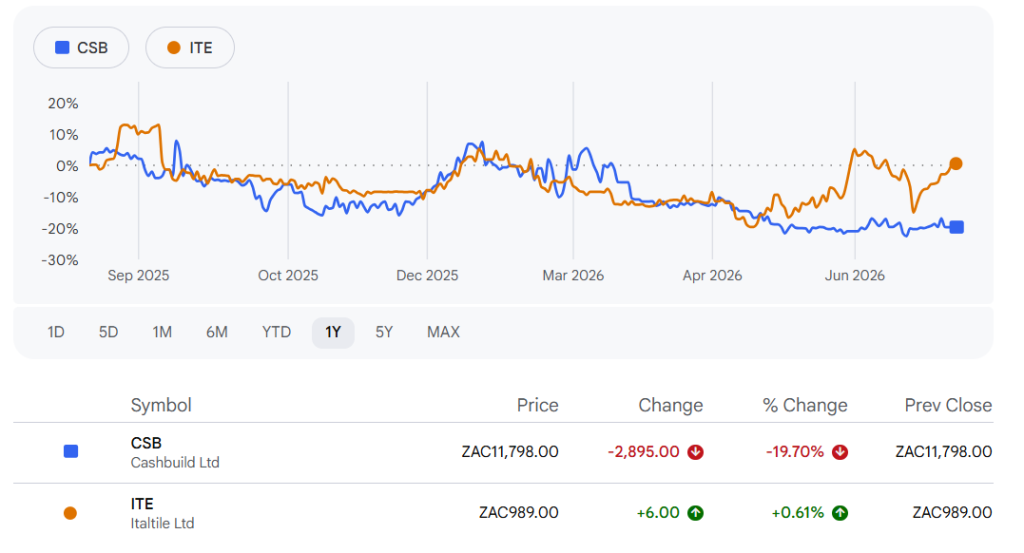
Ghost Bite: For reasons I truly struggle to understand, Italtile’s share price has somehow outperformed sector peer Cashbuild (JSE: CSB) over the past year – despite Cashbuild not having exposure to the manufacturing challenges that Italtile faces!
MTN’s share price takes another knock (JSE: MTN)
Sentiment has soured towards the African telco giant
MTN has already suffered significant selling pressure in the aftermath of the MTN Nigeria numbers that spooked the market. The debate is around how temporary the Q2 slowdown really was in that business.
The group has now added a trading statement for the six months to June into the mix, with a sharp deviation between HEPS and Adjusted HEPS. On the HEPS line, you’ll see an expected move for the period of between -10% and 0%, while adjusted HEPS is expected to increase by between 18% and 23%.
I don’t usually cover EPS because it can be so distorted by impairments and other moves, but it’s worth noting that impairments to operations in Iran (a 49% investment in Irancell) played a substantial role there.
The adjustments to HEPS relate to non-operational items, hyperinflation and a non-recurring deferred tax asset reversal.
The group also notes that total service revenue has grown in line with medium-term guidance, despite a difficult South African prepaid market and the pressures in Nigeria.
Ghost Bite: The market isn’t exactly receptive to the narrative about the broader six months. Instead, investors are focused on the deceleration from Q1 to Q2. This is why the share price has lost 15% of its value in August!
Southern Palladium has been granted a mining right (JSE: SDL)
Now the work really begins at Bengwenyama
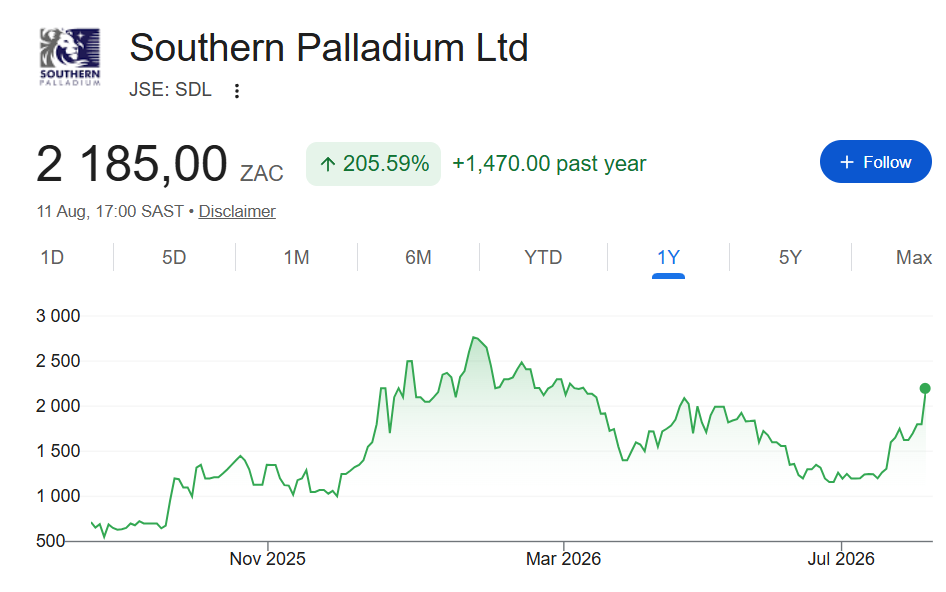
Southern Palladium’s share price jumped 20% after announcing that the mining right has been granted for the Bengwenyama PGM-chrome project. This is the biggest milestone of them all when it comes to junior mining.
Early development work will take place before the end of 2026, while the Definitive Feasibility Study works programme is expected to be delivered in the first quarter of 2027. This delay is being driven by a desire to incorporate the recent metallurgical test results into the plant design and optimisation work.
Ghost Bite: I always chuckle at the fact that that project is owned by a subsidiary called Miracle Upon Miracle Investments. In junior mining, miracles are usually what you need to believe in. Here’s what the share price looks like when miracles happen:
Results of previous poll:
Nibbles:
- Aveng (JSE: AEG) has released a trading statement ahead of full results scheduled for 24 August. For the year ended June 2026, the headline loss per share improved by between 93.5% and 96.4%. It came in at between 4.2 and 2.3 A$ cents, a minor loss compared to 64.6 A$ cents in the prior period. But it’s still a loss.
- Brait (JSE: BAT) announced the results of the renounceable rights offer to raise R2.5 billion. Interestingly, Titan and the additional underwriters didn’t need to take up any shares at all. 95.3% of shares were spoken for based on normal rights, with the remaining 4.7% allocated via excess applications. Another useful point is that they received excess applications for 33.1% of the offer, so there was way more demand than supply of the shares!
- NEPI Rockcastle (JSE: NRP) has signed a €250 million green term loan facility with the European Bank for Reconstruction and Development. The proceeds will be directed to “eligible green projects” that focus on the climate transition objectives. In exchange for being a good corporate citizen, NEPI Rockcastle gets to lock in long-term debt (maturity in 2034) on favourable terms.
- The Trustco (JSE: TTO) board is clearly rattled by the meeting requisitioned by Riskowitz Value Fund. The purpose of the meeting is to vote on a replacement of the current directors with new directors nominated by Riskowitz. In a clever step to cloud the situation, Trustco approached the Namibian Competition Commission and received an advisory opinion that such a change may contravene the Competition Act unless there is prior notification of such a deal. If you would like to read the opinion, you’ll find it here. So the soap opera continues!


The Brait “underwriting” was just jam for the major shareholders. At the least their fee should have been based on other shareholders rights and not their own.
If there’s one thing they know how to do at Titan, it’s earn an underwriting fee!