

MTN’s share price has been slashed in response to recent numbers (JSE: MTN)
The Q2 slowdown in MTN Nigeria is the likeliest cause of this pain
Before I dig into the recent financials from MTN Nigeria and MTN Ghana, I want to highlight the progress made on the IHS transaction. MTN is in the process of acquiring the remaining shares in IHS, giving them more control over the infrastructure that they rely on across Africa. Importantly, shareholders of IHS have approved the transaction. This leaves them with only the regulatory approvals to get in place.
Now, let’s get to the really juicy stuff.
MTN’s African subsidiaries always release their results before the mothership brings us numbers. In practice, it’s the African numbers that tend to drive the MTN share price, as the South African business is a relatively steady (and slightly boring) story.
The recent updates from MTN Nigeria and MTN Ghana drove a nasty correction in the MTN share price:
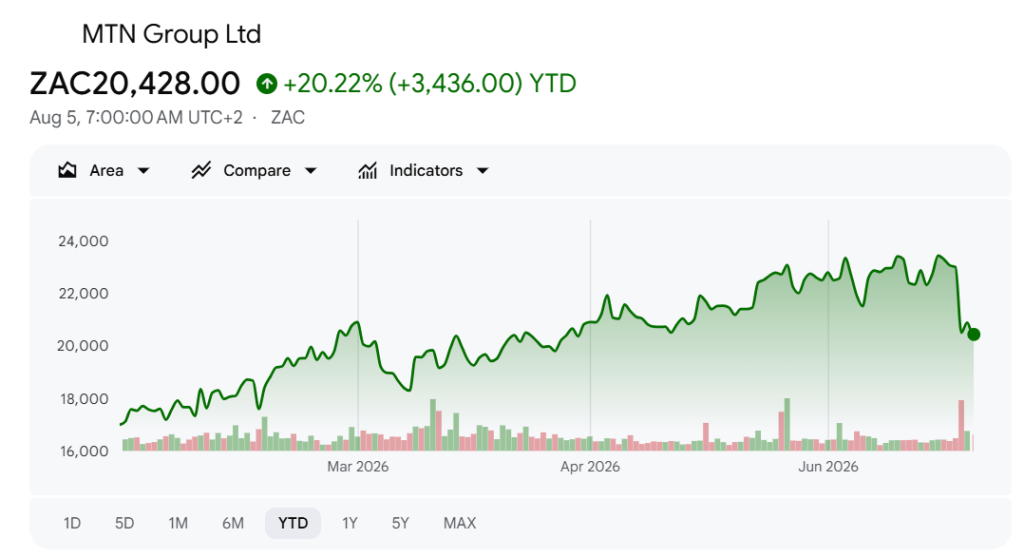
If you look at the numbers through a six-month lens, then both of the subsidiaries look great. But if you take a quarter-on-quarter view to assess momentum through the period, you’ll find a problem in MTN Nigeria that has spooked the market.

Buckle up!
MTN Nigeria: a wobbly, or a bigger problem?
We begin with MTN Nigeria, easily the most important of the African subsidiaries. This means it has caused the strongest headaches and driven the most exciting upside for MTN investors. After all, Africa is always a game of risk and reward.
For the six months to June, MTN Nigeria grew subscribers by 8.9% to 92.2 million. They have 55.7 million active data users. This immediately gives you an idea of the growth runway for data relative to other services.
Thanks to an increase in activity per user, service revenue for the six months was up by a juicy 25.9%. That’s ahead of the medium-term guidance of “at least low 20% growth”. It’s also 10.4 percentage points above the inflation rate for the period, so they are delivering real growth here.
If you exclude the airtime and data credit service (which is where Optasia (JSE: OPA) plays), then growth for the six months was 27.3%. You can see why the market has become worried about whether Optasia has any moat at all. The second quarter tells a very different story though, perhaps giving some reassurance to Optasia investors who have seen their share price fall by 31% year-to-date.
To finish off on the numbers for the first half, operating expenses grew by 11.3%, or less than half the growth rate in revenue. This led to EBITDA jumping by 39.2%, with EBITDA margin expanding by 5.3 percentage points to 55.9%. By the time we reach the bottom of the income statement, we find profit after tax up by a delicious 70.6%. Earnings per share followed suit.
The big question is always around free cash flow, as the telcos can be capex-hungry beasts at times. This period was an exception, not least of all because the naira strengthened against the US dollar (much of the capex is driven by US dollar costs). This is why capex (excluding leases) was up by only 1.2%. Free cash flow jumped by a spectacular 73.9%.
All of this is good news alongside the strong balance sheet. There’s a net cash position of ₦116.3 billion, up 11% from December 2025. This is giving them the confidence to pay dividends.
So, what’s the problem here?
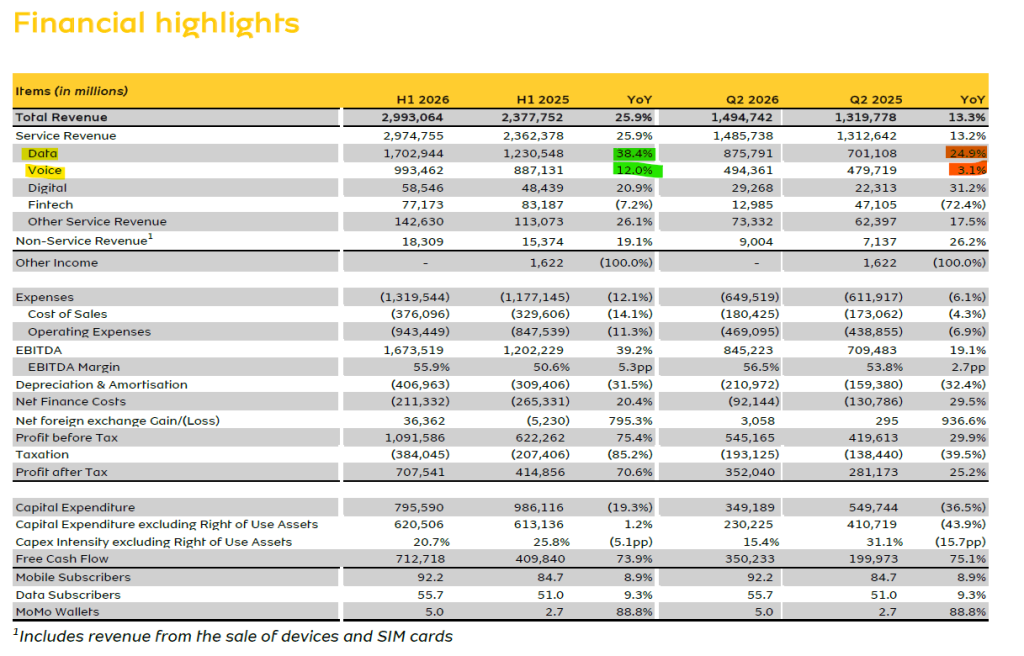
The slowdown in growth in Q2 vs. Q1 is the likeliest cause for the concern in the market. The second quarter only achieved year-on-year growth of 13.2% in service revenue, way below the 25.9% achieved for the six months. Profit after tax for Q2 increased by “only” 25.2%.
The impact of the airtime credit suspension is clearer here, as fintech revenue fell by a nasty 72.4% in Q2. Fintech only contributed 3.6% of service revenue in the comparable period, but that’s still enough to have knocked growth by a couple of percentage points.
The bigger stress points are data and voice revenue, where growth in the second quarter was way down on the first quarter. I’ve indicated in the screenshot below where you would see those percentage movements:
Perhaps the lack of airtime credit services in the second quarter had a much bigger impact than MTN was letting on? If so, then MTN has severely downplayed their importance to the market, much to the detriment of the Optasia investment case.
All eyes are on the second half of the year. The airtime credit issues are behind them, so the market will hope to see a return to growth across the board. It helps that capex intensity (currently 20.7%) is expected to moderate – i.e. it should come down, which implies that capex will grow at a slower rate than revenue in the second half of the year.
The medium-term guidance is unchanged. They are aiming for revenue growth in the low-20% region. EBITDA margin is expected to be in the mid-to-high-50% range.
Another point to note is that MTN Nigeria is still keen to carve out the fintech business and turn it into a distinct business.
MTN Ghana: less to worry about (well, mostly)
At MTN Ghana, let’s just get the new risk out of the way first. The company announced that Clydestone has sued the company based on claims that MTN used Clydestone IP for the launch of mobile money in Ghana. MTN Ghana has come out strongly in response to this case, noting that they are not recognising any related liability.
This is a classic example of a “legal overhang” in the market. Nobody actually knows how it will turn out, but investors need to think about it anyway.
Onwards to the numbers. Mobile subscribers increased by 8.5% to 32.8 million. Active data subscribers jumped by 17% to 21.3 million. It’s a much smaller business than MTN Nigeria, but still a very important one.
Service revenue increased by an impressive 32.3%, a country mile ahead of the average inflation rate of 3.8%. This is significantly higher than the real growth rate we saw in MTN Nigeria. One of the factors was that the fintech business didn’t have any regulatory issues to deal with, so MTN Ghana could just get on with growing their business.
Operating expenses grew by 24.2%, so there’s clearly investment required to achieve these levels of growth. Still, that’s well below revenue growth, so EBITDA was up by 39.8%. This drove EBITDA margin expansion of 3.4 percentage points to 61.8%.
Other notable line items include a 26% increase in depreciation and amortisation, as well as a 12.6% increase in net finance costs. The EBITDA growth was more than enough to cover this, so profit after tax increased by 43.3%.
Capex (ex-leases) for the period was down by 13.3%. This took capex intensity down from 20.4% to 13.0%.
The frustrating thing is that they don’t specifically disclose free cash flow. I can eyeball the numbers and see that it’s gone the right way, but it takes time to calculate properly. MTN Ghana should be providing this number to its investors in the highlights section.
In terms of momentum during the period, the second-half growth in service revenue (29.2%) is only slightly down on the 32.3% for the six months. This shape is repeated in EBITDA and profit after tax. But where you’ll find a big difference is in capex ex-leases, up 12.6% for Q2 vs. a decrease of 13.3% for the six months.
MTN Ghana is ahead of MTN Nigeria in the fintech separation process, having successfully completed the structural separation of the Mobile Money business. It’s just awkward that they now have a legal irritation to deal with.
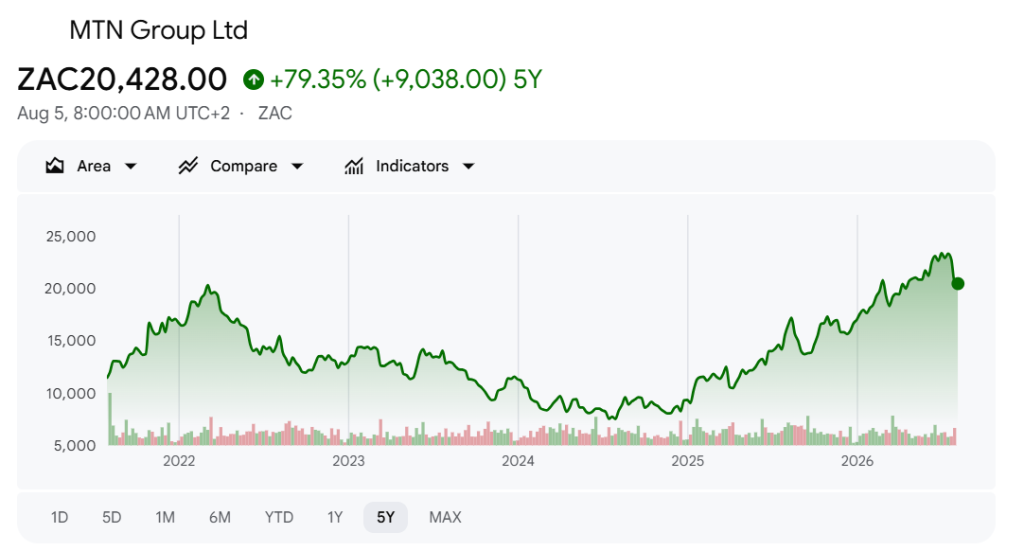
Ghost Bite: Volatility at MTN is a feature of the story. Now on a P/E of 16x and with group numbers coming soon, they are still trading at a premium valuation that requires significant growth to be justified. The debate is raging around MTN Nigeria’s growth and whether this slowdown will stick. Here’s a five-year chart to give this move more context:
Nibbles:
- Director dealings:
- A senior exec at Hammerson (JSE: HMN) sold shares in the company worth £204k. This comes just after the company raised capital from outside investors, so that’s not a particularly great look.
- A director of a major subsidiary of Vodacom (JSE: VOD) sold shares in the company worth R1.7 million.
- A director of Canal+ (JSE: CNP) bought shares worth €75k (around R1.4 million).
- The CEO of Sirius Real Estate (JSE: SRE) and a close associate bought shares in the company in their self-invested pensions worth around R775k.
- The CEO of Salungano (JSE: SLG) bought shares worth R461k.
- An entity linked to a few directors bought shares in Sebata Holdings (JSE: SEB) worth R9k.
- As a reminder of how big some of the corporate balance sheets out there actually are, British American Tobacco (JSE: BTI) casually priced $1.5 billion worth of notes as part of a general refinancing of the balance sheet. This is typical of a treasury strategy at a company of this size, with the proceeds likely to be used primarily for repayment of other notes or debts.
- In case you’re an IFRS nerd and you want to dig into Sanlam’s (JSE: SLM) new reporting framework, the company has announced the release of 2025 comparative information under that new approach. This is in preparation for the release of interim financial results on 10 September.
- Here’s an interesting one: Grindrod (JSE: GND) announced that Value Capital Partners (VCP) now has a stake in the company of 5.239%. This announcement is triggered by VCP moving through the 5% milestone. These sorts of things happen often on the JSE. The difference is that VCP is rarely a completely passive shareholder like most institutional asset managers. Will VCP stop there, or is there a broader plan here?
- Zeda (JSE: ZZD) announced that a company named Mandisa Holdings now has 5.19% in the company. This is worth keeping an eye on.
- Aimia (JSE: AII) has been busy with its share repurchase programme. The company repurchased 0.2% of its shares during July at a weighted average price of $2.67 per share. There’s literally no liquidity in this stock on the JSE. The local market is waiting to see what this company’s bigger plan is.
- Numeral (JSE: XII) released results for the three months to May 2026. There’s almost no liquidity in this tiny (R35 million market cap) company. Revenue for the three months was down 1% at $467k. The group reported a very small headline loss per share.
- Here’s a fun one: Old Mutual (JSE: OMU) announced that Old Mutual Zimbabwe’s listing will migrate from the Zimbabwe Stock Exchange to the Victoria Falls Stock Exchange. It certainly has a more exciting name! In case you’re wondering, this has no impact on South African investors.