

Shock and horror: Aveng won’t be selling McConnell Dowell (JSE: AEG)
It’s not so easy to sell a heavily loss-making business
If you cast your mind back a few months to the year ended June 2025, you may recall that Aveng’s McConnell Dowell business (the Infrastructure segment) reported a pretty nasty set of numbers. Despite this, Aveng’s management team was steadfast in the pursuit of a separation strategy to split this business from the rest of the group.
After months of looking at the options (and no doubt paying fees to Macquarie Capital to advise on a demerger and separation strategy), Aveng has now announced that the separation isn’t going to happen. They are rather going to retain ownership of the problematic Australian business to try and improve it. I’m not super surprised by this to be honest, as this business isn’t exactly the belle of the ball and that makes it hard to sell or even partially offload. McConnell Dowell has at least secured A$1.2 billion in new work. They are also the preferred bidder on a further A$1.2 billion in contracts to be awarded in future periods. It’s not much of a silver lining, but it’s something.
Back home, negotiations for the sale of Moolmans continue. There has been a detailed due diligence on contracts, as one would expect in an industry where just one terrible contract can sink a company. Interestingly, a new Managing Director has been appointed at Moolmans (Pieter van Greunen), an unusual step in a business that might be sold. The key word there is “might” – there’s no guarantee of a deal happening with Moolmans.
The share price is down 62% year-to-date. The construction industry just isn’t for me. If I want to gamble, I would rather go play poker and at least enjoy the experience of losing money.
British American Tobacco unlocks over R7 billion in cash (JSE: BTI)
They will apply this towards their debt targets

British American Tobacco announced earlier in the week that they would be selling down their stake in ITC Hotels, a non-core holding that they have as a result of demerger activity by Indian tobacco and FMCG group ITC.
The initial guidance was that they would sell a stake of between 7% and 15.3% in the company via a block trade. It doesn’t seem as though demand was quite as high as they had hoped, as they only sold 9% in the end – below the mid-point of the guided range.
Still, this means that they’ve unlocked around R7.1 billion in cash that they can use to reduce debt and get closer to the target of 2x – 2.5x adjusted net debt to adjusted EBITDA by the end of 2026.
I’m sure that they will look to sell the remaining 6.3% stake when market conditions are favourable.
Gemfields ends the year with a much better emerald auction (JSE: GML)
They deserve some good news
Gemfields has been through a tough time. The share price has shed almost two-thirds of its value over the past three years. Aside from difficult markets for emeralds and rubies, they’ve been dealing with the typical risks that face mining houses in African countries. Government interference and major security concerns have been a feature rather than a bug. On top of all this, Gemfields executed a risky capex programme that turned out to be too much for the balance sheet to handle.
They are a plucky bunch, so they are fighting back after recapitalising the balance sheet. The latest update is a commercial-quality emeralds auction that has some very encouraging signs.
The auctions are not perfectly comparable to one another, as the underlying mix of quality varies. We therefore have to look at management’s commentary and consider other clues as well.
Management is happy with this one, talking about a strong performance and improved market sentiment. If you look at the numbers, this auction raised $25.4 million in sales vs. $16.4 million in sales in April 2025 (the only other emerald auction this year). Pricing was $7.46/carat vs. $6.87/carat. There were 55 companies placing bids vs. 50 in April. 93% of the lots were sold (based on weight) vs. 79% previously. Wherever you look, the signs are clear that demand has improved.
Can the company pull off a strong comeback in 2026? This one is too risky for me and too dependent on external factors, but I’ll be watching with keen interest!
RMB Holdings: an example of being on the weaker side of the negotiating table (JSE: RMH)
Sometimes, you just have to do the best you can with what you have
RMB Holdings is a cautionary tale around just how hard a “value unlock” strategy can be for an investment holding company. Some investments are far more marketable than others.
The problem at RMH comes down to two numbers. The first is 38.5%: the stake that they hold in property group Atterbury. This is a non-controlling stake that is difficult to sell to anyone other than the other shareholders in Atterbury. When there’s only one realistic buyer in town, the price suffers. The second is 92%: the percentage of RMH’s portfolio value attributable to Atterbury. Not only do they not control Atterbury, but they are also almost entirely reliant on it for any value in RMH.
You can therefore see where the negotiating power lies here.
To make it worse, the yield on the cash in RMH isn’t even enough to cover the operating expenses of the listed structure. The balance sheet isn’t in danger of falling over anytime soon, but you can see that they can’t afford to play the waiting game. Atterbury itself has a solid portfolio, but isn’t structured in a way that promotes a flow of dividends in the way that REITs would operate. For example, Atterbury’s loan-to-value is 60% vs. REITs that tend to operate in the 35% – 45% range. Higher leverage means stronger return on equity in the good times, but the source of the return is less about dividends and more about growth in net asset value. This limits the cash that would flow to RMH and its shareholders over time.
After some tough negotiations and disputes in recent years, it looks like the value unlock for RMH shareholders isn’t going to come from RMH selling the stake in Atterbury. Instead, things have developed to the point where Atterbury is looking at acquiring RMH! Atterbury started this dance by acquiring Coronation’s 28.35% stake in RMH in October 2025, followed by an initial cautionary announcement being released by RMH and now an indicative proposal being sent to the RMH board by Atterbury. This expression of interest has led to RMH releasing a renewed cautionary announcement.
Naturally, Atterbury is well aware of RMH’s weak negotiating position and the pricing will no doubt reflect this. RMH has recognised a significant impairment of R272 million on the Atterbury investment, taking it from R770 million to R498 million.
RMH’s NAV per share excluding treasury shares is now 48.6 cents. The share price is 47 cents, so the market clearly believes this number. Now we wait to see what the Atterbury offer will look like – assuming it becomes a firm offer.
Schroder European Real Estate signs off on a weak year (JSE: SCD)
The underperformance vs. the sector is breathtaking
Even in an environment of a rising tide lifting all boats, there’s always a boat that manages to miss the good stuff completely. In the property sector, Schroder European Real Estate was one of those boats this year that was left behind. Just compare it to the Satrix Property ETF as an indication of sector performance:
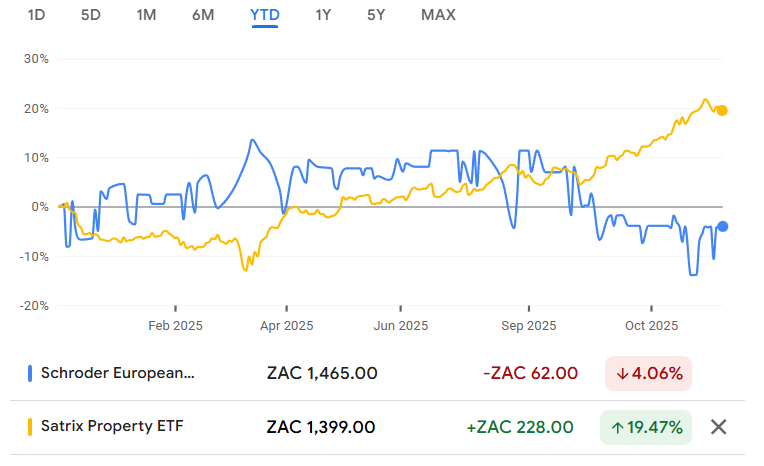
Remember, these share price returns exclude dividends, but both the ETF and Schroder pay strong dividends and so it wouldn’t make a huge difference to the relative story to include them.
The most interesting thing about the chart is that the outperformance by the ETF happened in the final quarter of the year. The initial tariff period was nasty for South African sentiment and actually gave a boost to the European story. Growth may have faltered for Schroder, but it has come through strongly for the South African names.
The key takeout here isn’t that Europe has way underperformed South Africa. To demonstrate that point, we can overlay Sirius Real Estate (JSE: SRE) as a UK and German play:
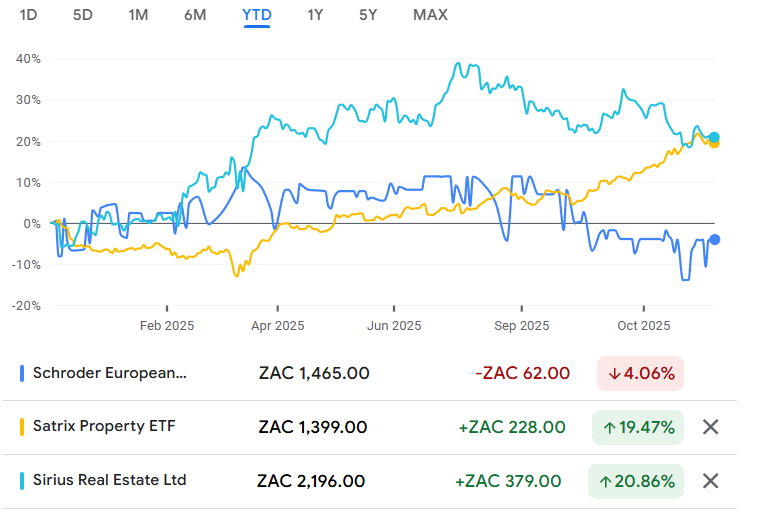
The problem clearly lies in the underlying exposure at Schroder rather than a Europe-wide issue.
In the results for the year ended September 2025, Schroder reported a total dividend for the year of 5.92 euro cents per share. This is exactly the same as the prior year i.e. there was zero growth. The net asset value per share is 119.2 euro cents per share, down from 122.7 cents at the end of the prior year because of negative revaluations.
With the negative NAV move offsetting much of the benefit of the dividend, the total return for the year was only slightly positive.
It’s actually even worse than it looks based on these numbers, as they are in a tax dispute in France worth €14.2 million. Instead of taking the conservative route and raising a provision, they’ve taken the aggressive approach of not recognising any kind of provision due to an outflow not being probable. These things rarely end with no outflow at all. This risk isn’t captured in the NAV at all at the moment.
To add to the risk, they are losing a major tenant in their Apeldoorn asset. If they can’t figure out a plan, then dividends will be impacted.
With so many great property companies to choose from on the JSE, it’s hard for me to understand why anyone would pick this one.
Stor-Age had no trouble raising R500 million (JSE: SSS)
The age of the bookbuild is upon us once more
Brace yourself: there are going to be plenty of capital raises on the JSE in 2026 in the property sector. The companies that have moved relatively early in the cycle have been richly rewarded by strong support in the market, which means that hundreds of millions of rands can be raised in the space of a few hours at only a slight discount to the current share price.
The latest such example is Stor-Age, with a raise of R500 million that was 3x oversubscribed. This means that investors were willing to put in up to R1.5 billion. Now, in this environment, companies need to be disciplined. As tempting as it may be to raise the additional amount and significantly upsize the raise, cash drag is a real risk.
Stor-Age elected to keep the raise at the original R500 million and issue shares at R17.90, or a discount of 0.7% to the 30-day VWAP. But here’s the really interesting thing: the net tangible asset value per share as at 30 September 2025 was R17.44, so they’ve raised at a premium to book. In other words, this raise is accretive to NAV per share!
The property sector has really come into its own in recent months. The market is now pricing in significant growth. That’s usually a sign that investors need to be cautious.
The Great Big Stick of Reality appears to have hit Trematon (JSE: TMT)
There’s an important lesson here about why discounts to NAV are valid
If you follow the investment holding companies on the JSE, then you’ll know that the discount to net asset value (NAV) per share is a sticking point. The companies tend to trade at substantial discounts, putting management in a difficult position around what to do next.
Trematon Capital is certainly in that boat, with the added problem of a market cap of under R250 million and thus all the additional liquidity challenges of being a small cap. Through various asset disposals and distributions to shareholders, this market cap is a lot smaller than it used to be.
The only material operating businesses that remain in Trematon (i.e. other than small balance sheet amounts) are Generation Schools and Club Mykonos. The company has made it pretty clear that they are willing sellers at the right price, with the intention being to eventually sell off the assets and delist the company as it is clearly sub-scale and isn’t getting any benefit from being listed.
Here’s the irony though: after complaining for ages that the share price doesn’t trade at the NAV per share, the company has now sharply decreased the NAV to reflect “achievable market prices” for the assets. In other words, the market was quite right to put the share price at a discount to NAV!
The group intrinsic NAV has dropped from 245 cents (after adjusting for the dividend in May 2025) to 170 cents – a pretty serious decrease. The biggest culprit also happens to be the largest asset, with the value of Generation Schools plummeting by 32% in the past 12 months. Now held at R200.7 million, this investment is 53% of the current group asset value. To give you context, Club Mykonos Langebaan at R82 million is 22% of group assets and suffered a 24% decrease in value.
The pressure at Generation Schools is exactly what you would expect to see if you’ve been following birth rate numbers and general social trends around having smaller and delayed families. There’s a drop in pupil numbers and a 1.3% decline in revenue. Operating profit fell by 17.5% to R25.4 million. They are also incubating some startup education operations within that group, something that they can’t really afford to do when the core business is struggling.
As for Club Mykonos Langebaan, revenue was up 7.4% and the business was cash generative. It suffered an operating loss of R24 million due to downward revaluations of the investment properties.
So, the NAV has come way down to 170 cents per share. Almost 12% of the NAV is attributable to cash. And yet, the share price is sitting at 111 cents per share. Will the market start to bid this share price up, or will it sit at a 35% discount to the new NAV? This type of discount is standard in the market, although very few of the investment holding companies have been through the process of writing down their NAVs to reflect more realistic prices.
Personally, I always look at how easy or difficult it would be to sell the remaining assets. Club Mykonos Langebaan is at least showing a tiny amount of growth, but trying to offload a niche school offering in this environment won’t be easy. When a beast like Curro (JSE: COH) is transforming into a non-profit structure to secure its future, what chance does Generation Education have of attracting a meaty offer?
It says a whole lot about the state of the world when AI businesses are flourishing and schools are going backwards.
Nibbles:
- Director dealings:
- Two directors of AngloGold Ashanti (JSE: ANG) sold shares worth a total of roughly R63 million. Oh, to be a gold exec during a once-in-a-generation rally in the gold price!
- A director of Thungela (JSE: TGA) sold shares worth R655k.
- Vodacom (JSE: VOD) announced that the fairness opinion for the acquisition of a further 20% interest in Safaricom is now available. This is necessary because the deal is a small related party transaction. Acting as independent expert, Deloitte has confirmed that the purchase consideration is fair to Vodacom shareholders.
- It’s the end of an era at Dis-Chem (JSE: DCP), with Ivan Saltzman retiring from his executive director role. He will remain on the board as a non-executive director and Deputy Chairman. What a journey it’s been, having built Dis-Chem for nearly 50 years!
- Marshall Monteagle (JSE: MMP), one of the most obscure and illiquid names on the JSE, released a trading statement dealing with the six months to September. They expect HEPS to be 22.6 US cents vs. 6.2 US cents in the comparable period. This is due to fair value moves and realised profits on the equity portfolio.
- Absa (JSE: ABG) is adding some interesting voices to its board. Although I usually ignore non-executive appointments, I found it fascinating that Brian Kennedy (ex-Nedbank, where he ran the corporate and investment bank) and Paul Smith (ex-Standard Bank where he served as Chief Risk Officer) have joined the board. Green and blue have been added to the red here!
- Super Group (JSE: SPG) announced that S&P has affirmed the current credit ratings of the company. That’s good news in terms of stability.
- In the Australian courts at least, BHP (JSE: BHG) is bringing the Samarco nightmare to a close. They are paying applicants A$110 million in that court process, an amount that is expected to be fully recoverable from insurers. Remember, the company has much bigger court battles elsewhere in the world in relation to the 2015 disaster.