

In this edition of Ghost Bites:
- Corporate actions may be quiet, but JSE Limited is doing just fine
- There’s much to learn from Nedbank’s interim numbers and their focus areas
Corporate actions may be quiet, but JSE Limited is doing just fine (JSE: JSE)
There’s much more to the owner of the JSE than people think
JSE Limited is a listed company. This always surprises market newbies.
People refer to “the JSE” as the exchange, but it’s also a listed company with a market cap of R13 billion and a 12-month share price increase of 12%. Add in the dividend and you get to a total return of over 19.5%. Clearly, they are doing well.
But how can that be? All we hear about is companies delisting from the market. Surely the JSE is going bankrupt at the speed of light?
Although losing listed companies isn’t helpful, the truth of it is that companies with very little liquidity aren’t of much value to the exchange. If they just sit there, often late on financial reporting and dealing with other issues, they just cause far more headaches than they are worth.
Another important point is that the equity market is just one part of the business model at JSE Limited. There’s a vibrant debt market for example, along with other areas like derivatives. The JSE is also required to have an enormous regulatory capital balance (currently R835 million), so the results are impacted by investment returns on that capital. It’s not just about the number of listed companies.

Here’s the proof: we certainly haven’t seen a 14.1% increase in the number of listings on the market, yet that’s the revenue growth that the company achieved for the six months to June 2026. Interesting, right?
This table shows you how diversified the business actually is:
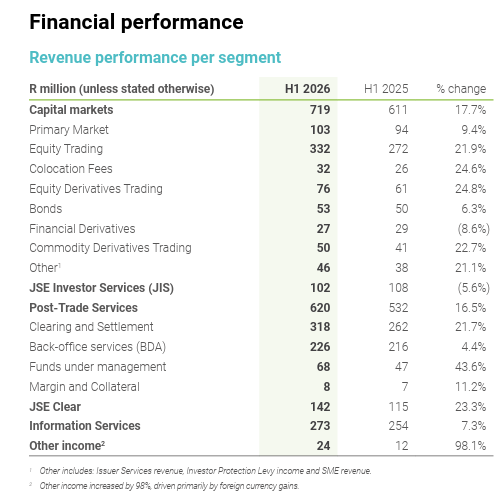
One area where the lack of activity is being felt is in JIS, which earns revenue based on corporate actions (among other things). JIS was down 5.6%, although I suspect that the underlying corporate action revenue was down by a lot more. The corporate finance industry (where I spent several years after articles) has been forced to focus on private company transactions in recent years, as there just isn’t enough going on in the listed space.
Total expenditure grew by 11.5%, so they have achieved margin uplift (revenue growth was ahead of expenses). I must point out the 22.8% increase in personnel expenses within that number. This is something to keep an eye on, although a fair chunk of it seems to relate to “organisational redesign”. If you accept the company’s adjustment for once-off costs, then personnel expenses were up by 7.8% – a far more reasonable number.
Earnings before interest and tax (EBIT) increased by a juicy 21.4%. Below that line, net finance income actually declined by 9.8%, so that took some of the shine off.
Net profit after tax increased by 16.9% and HEPS was up by 18.8%.
Net cash from operations was up by 20.6% to R625 million, so there’s solid conversion of EBIT (R774 million) into cash. But the capex number really stands out, having ballooned from R27 million to R110 million. They don’t really give further details, noting only that they are focused on “protecting and growing the core business” – in other words, it’s a mix of sustaining and expansionary capex.
This is a strong set of interim numbers. Revenue will hopefully continue its positive trajectory in the second half of the year, as expense pressures are coming through the system. The company has revised its full year 2026 operating expenses growth to 6% – 8% (up 100 basis points vs. previous guidance). Full year capex is expected to be between R190 million and R230 million, in line with previous guidance.
Ghost Bite: JSE Limited is certainly investing heavily for growth. I’ll always want to see this translate into more listings, but the business is much broader than that.
There’s much to learn from Nedbank’s interim numbers and their focus areas (JSE: NED)
The strategy in Africa is one thing, but the South African numbers are filled with interesting nuggets
Nedbank has released results for the six months to June 2026. Before I give you my views on them, I want to thank the group for valuing the Ghost Mail audience. Nedbank has placed their results on the Ghost Mail website for your convenience. Please do check them out!

As always, what you’ll read below is my independent take on the numbers.
The green bank came into 2026 expecting a year that would be anything but green. Headline earnings were flat for the six months, with the group noting that this outperformed their expectations. I must immediately highlight that if you exclude the base effect of Ecobank, you’ll find headline earnings growth of 12%. Diluted HEPS on that basis was up 15%. That’s more like it!
Another stat I’ll quickly deal with is the credit-loss ratio, which has moved up from 81 basis points in H1 2025 to 95 basis points in H1 2026. The retail book is currently running above the through-the-cycle target range, so that’s a concerning data point for South African consumers. There’s been a particularly nasty spike in home loans and credit cards.
Just when investors in South African consumer stocks thought it couldn’t get any worse, we get a data point like this. Sigh.
Nedbank’s interim dividend per share is up by 2%, so that’s probably the fairest reflection of the underlying growth in the group at the moment. The numbers only inched upwards as Nedbank moves through a critical transition phase.
But the future is what really counts. Nedbank is making significant strategic changes to their group that will hopefully pay off in years to come. With the shares trading on a P/E multiple of roughly 7.5x, the market isn’t exactly putting a premium on the growth prospects right now. Nedbank bulls will argue that this is where the opportunity lies.
The obvious strategic change for me to mention is in Africa. Having gotten out of Ecobank, Nedbank decided to go after a controlling stake in NCBA Group. This is an East African financial services group that would give Nedbank a far more compelling presence in Africa than they’ve had before.
An argument could certainly be made that the 21% stake in Ecobank was a half-pregnant strategy, which simply doesn’t cut it vs. what competitors like Absa (JSE: ABG) and Standard Bank (JSE: SBK) have been doing on the continent. But with NCBA, the size of the prize after this deal is a controlling stake in a tier 1 bank in Kenya. That’s a whole lot more interesting.
In terms of the deal process, the NCBA offer closed on 10 July and was accepted by enough holders for Nedbank to achieve the desired 66% stake. They now need to achieve the various regulatory approvals to get the deal across the line.
But here’s the thing: even with this transaction, the pro-forma split of headline earnings would be roughly 86% from South Africa. The Africa story is becoming more interesting, but remains small overall.
In Nedbank’s home market, the recent acquisition of iKhokha is an important step into the SME market. The integration of Eqstra has given them a stronger business in fleet management. We have a very competitive market, with Nedbank trying to focus on specific growth engines.
This means we need to take a closer look at the segments.
The Corporate and Investment Banking (CIB) business, which focuses on the biggest corporates, achieved growth in advances of 8%. This part of the business tends to be driven by sector specialisation and deep relationships. For example, trade finance revenue was up by 18% thanks to flows in commodity trading and agriculture.
Deposits went up 14%, so these companies are sitting on significant cash at the moment. Non-interest revenue increased by 16%, driven by strong deal flow.
In Business and Commercial Banking (BCB), which focuses on the mid-market and SME space, advances were up 6% and deposits grew by 7%. This segment doesn’t appear to be as cash flush as the biggest corporates. Non-interest revenue increased by 14%.
In Personal and Private Banking (PPB), which is the retail banking segment, main banked clients actually increased by 2%. I think that’s pretty good when you consider the competitive bloodbath out there. On the higher income side, they grew clients in Private, Wealth and Stockbroking by 8%. Another juicy growth engine to note is insurance income, up by 21%.
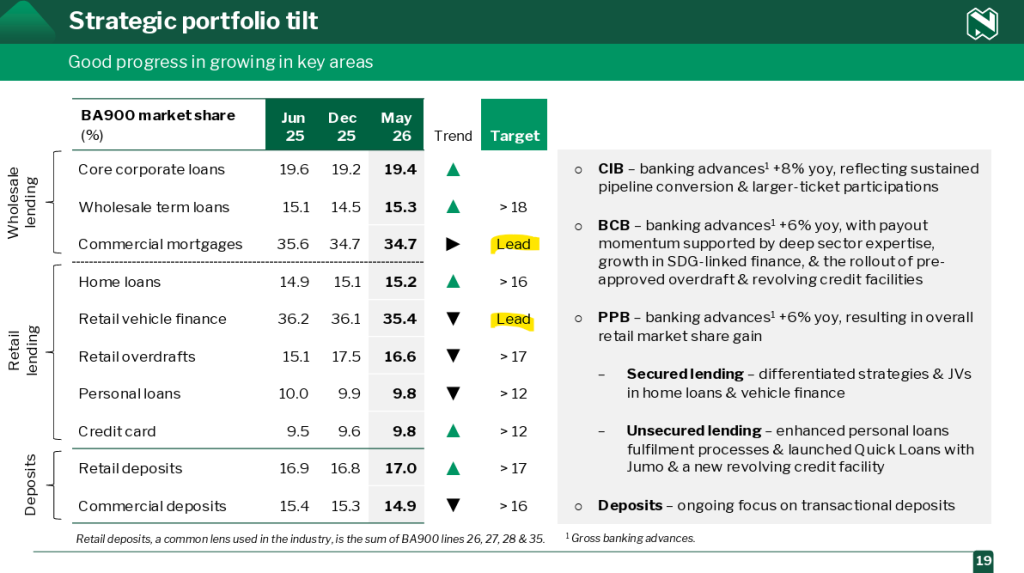
With deposits up by 4%, retail deposit market share increased from 16.8% (December 2025) to 17.0% in May 2026. Their target is to be above 17%, so that’s encouraging.
This is a good opportunity to bring you a particularly interesting slide from the analyst presentation. Regulatory filings (the “BA900” reference) allow Nedbank and its competitors to accurately work out their market share across different categories. As you’ll see below, Nedbank is actually the market leader in commercial mortgages and retail vehicle finance. I must, however, note the decline in retail vehicle finance market share, something to keep an eye on given how lucrative this space is in South Africa:
Another area that I want to focus on is renewable energy financing. They have exposure of R56 billion to this asset class, with a further pipeline of R26 billion for the second half of 2026. To understand more about this space, I recently recorded a podcast with Tokollo Tau of Nedbank. Listen to it below or get the transcript here.
Overall, Nedbank expects Return on Equity (ROE) – currently at 15% – to move above 15% in 2026. Shareholders will be happy to see that direction of travel.
Ghost Bite: The medium-term goal is for ROE to reach 17%. I can tell you for sure that the additional 2 percentage points will be very hard to unlock. If Jason Quinn gets that right during his tenure as CEO, it will go down as a highly impressive stint in local banking.