
In this edition of Ghost Bites:
- At Anglo American, the De Beers story continues to fascinate me
- ArcelorMittal is “fundamentally different” – but when will the profits come?
- Gemfields is being carried by emeralds
- Mondi suffers an ugly drop in margins
At Anglo American, the De Beers story continues to fascinate me (JSE: AGL)
Anglo American has released results for the six months to June 2026. As you are probably aware, the company is in an important transition phase in which they are selling off some major assets.
The steelmaking coal deal is being implemented, with a price of up to $3.9 billion on the table (of which $2.2 billion is payable upfront).
The De Beers sale has been in the headlines, with speculation that the company is in talks to sell the business for $1 billion. I would encourage you to only believe numbers that are officially announced by the company. I must also remind you that such a sale is by no means guaranteed at any price.
There’s also a nickel disposal in the works, with the deal currently going through European competition authority approval processes.
And on top of all this, Anglo American is also busy with the planned merger with Teck to create a “global metals and minerals champion”!
With so much change in the business, Anglo is encouraging shareholders to work with underlying EBITDA from continuing operations. Helpfully, this metric happens to be up 35% for the six months to June 2026. An important and less-than-obvious nuance is that continuing operations actually includes De Beers, making this a more reasonable metric than you might think.

We won’t talk about the loss attributable to equity shareholders of $0.9 billion (driven by impairments), although it’s less ugly than the loss of $1.9 billion in the comparable period.
On the plus side, free cash flow was $803 million – a significant jump from $322 million in the prior period. The interim dividend has also moved much higher, from $0.07 per share to $0.23 per share. It’s still an absolutely tiny dividend yield on a share price of around R850!
If we look deeper, copper production was flat year-on-year, premium iron ore was down 2% and manganese ore increased 52%. Diamonds – those “rare” shiny things from the earth – saw production increase by 46%.
The pain in De Beers is best explained by this EBITDA table:
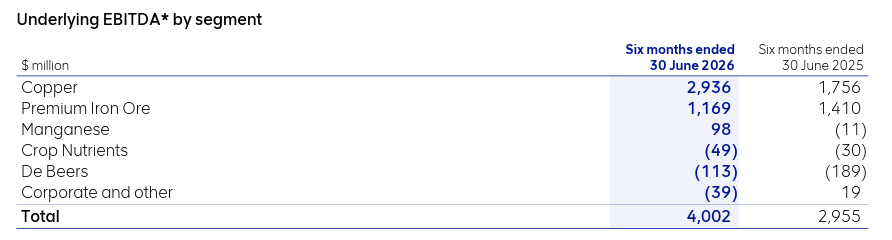
Yes, that’s a loss of $113 million at De Beers in the space of just six months. It’s better than the prior period thanks to the higher production, but that’s not saying much. If that rumoured $1 billion is true, I would take it and run.
Here’s the official wording from the financial report on the diamond market:
“At the retail level, global sales of finished diamond jewellery were stable year-on-year. There were encouraging consumer demand signals in the United States, where natural diamond jewellery sales returned to growth among independent jewellers. Demand in India remained robust, however demand overall in mainland China continued to decline.”
To be fair, they also say this:
“De Beers continued to progress its Origins strategy in the first half of 2026, with a particular focus on revitalising consumer desire for natural diamonds and streamlining the Group to manage the cost base. Following the encouraging performance of the Desert diamonds marketing campaign in late 2025, which seeks to promote natural diamonds across a range of colour hues, De Beers expanded the concept, with a new campaign focused on bridal, with a range of classic ‘icon’ designs set to launch in the second half.”
Ghost Bite: In a world where people can barely afford to have kids or buy a home, I don’t think natural diamonds will ever return to previous glory among mainstream buyers. It just is what it is.
ArcelorMittal is “fundamentally different” – but when will the profits come? (JSE: ACL)
The underlying EBITDA story is encouraging
ArcelorMittal has released results for the six months to June 2026. They start with a rather strong statement: “ArcelorMittal South Africa today is fundamentally different from eighteen months ago.”
That may be true, but they also just reported a loss of R1.49 billion vs. a loss of R1 billion a year ago. The numbers aren’t exactly matching that narrative, are they?
Of course, you have to stop dropping in order to start growing. Have they bottomed out, with management focusing on resizing the business and getting out of severely loss-making operations?
On a like-for-like basis, steel production was down 5%. Revenue fell by 1.4% on a similar basis. If you don’t make the like-for-like adjustments by the way, revenue was down 30%! This is why they can say things like “fundamentally different” – but it is fundamentally better?
Perhaps it is. This is where you have to be very careful, as quarterly momentum is critical in a turnaround. They are still loss-making, but losses are diminishing quickly. In Q3’25, underlying EBITDA (excluding the Long steel business) was a loss of over R1 billion. In Q2’26, it was a loss of only R67 million!
Despite some encouraging underlying momentum, the free cash outflow for the six months was almost R1.2 billion. This is why net borrowings increased from R5.8 billion to R7.9 billion between December 2025 and June 2026.
Looking ahead, one of the positives is the restart of smelting activities in the ferrochrome industry. This should boost commercial market coke sales in the second half of 2026 (of the non-fizzy drink variety). But what would really do wonders here is a return to positive EBITDA…
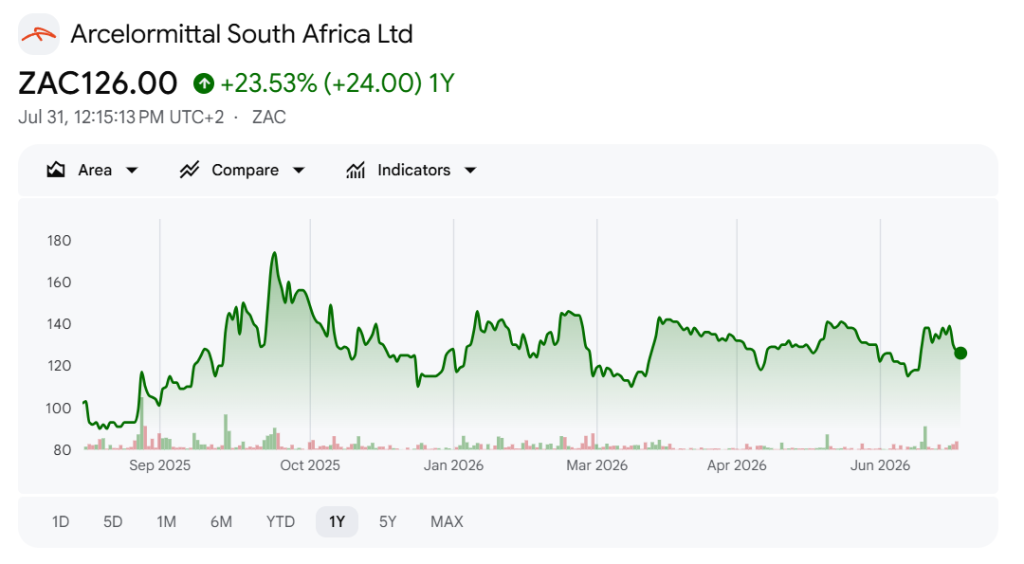
Ghost Bite: The 52-week low on this stock is R0.85 and the 52-week high is R1.88. The current level of R1.26 is pretty much smack in the middle. This remains a highly speculative stock, although range traders might find this chart interesting:
Gemfields is being carried by emeralds (JSE: GML)
Will the rubies play ball later this year?
Gemfields is a stock in distress. The share price has shed 47% year-to-date. If you can believe it, this is after a significant bounce from the 52-week low.
This business model has layers of risks. They have to deal with the variability of Mother Nature, as gemstones come out in all shapes and sizes (and thus grades). They also have to navigate the trials and tribulations of operating in Africa, ranging from fights with governments through to actual conflict on the ground.
To try and navigate this dangerous cocktail, the company has some (but not much) diversification. They mine rubies in Mozambique and emeralds in Zambia.
Mozambique has been a significant challenge recently. Recoveries of premium grade rubies have been weak. The benefit of the second processing plant will only be felt in months to come, as it will be fully commissioned later this year. In the meantime, the share price is as red as the rubies themselves.
In the green corner, we find a happier story in Zambia. Emerald production was strong during the first half, although they’ve had pressure on operating costs from increased mining activities and fuel costs.
Overall, total auction revenues were $102.9 million for the first half of the year, up from $60 million in the comparable period. The emeralds are no doubt doing the heavy lifting here. The net debt position of $44.2 million (before auction receivables of $33.3 million) remains a significant worry for investors.
Aah yes, I forgot to mention this particular layer of the risk cake: Gemfields carries a lot of debt.
Ghost Bite: The combination of operating leverage, financial leverage and political risk has had predictably unfortunate outcomes.
Mondi suffers an ugly drop in margins (JSE: MNP)
But clearly better than the market expected, with the share price up 12% on the day!
Mondi’s share price has been swirling the depths of the toilet since October last year.
The numbers for the six months to June 2026 aren’t a favourable story by any means, but they must’ve been better than the market had feared. That’s the only explanation for a 12% share price increase in response to news of HEPS dropping by 85%!
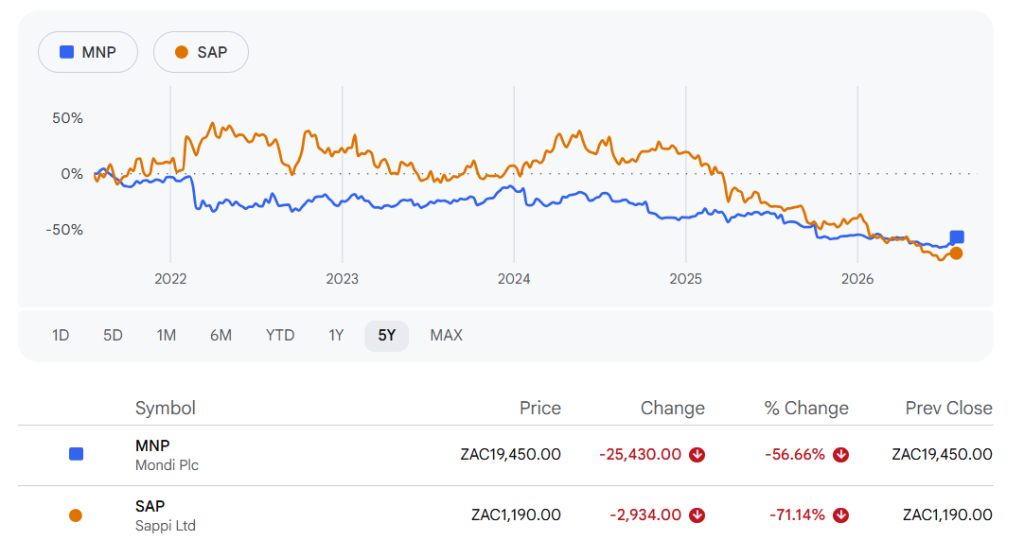
The broader paper and packaging sector is a cyclical affair that tests even the strongest stomachs. The debate at the moment is whether there’s a structural decline in addition to cyclical pressures. Areas like graphic paper (a focus at Sappi (JSE: SAP)) have been terrible, as the world has shunned printed magazines. But even Mondi, with an arguably better mix of products (a tilt towards packaging), has suffered the same fate over the past few years:
Looking at the Mondi numbers specifically, the results for the six months to June 2026 include a 2% increase in revenue. That sounds fine until you look at the profit margins. Underlying EBITDA (excluding forestry fair value movements) fell by 24%. Once you include the forestry movements as well (as Mondi must revalue its plantations), you’ll find that underlying EBITDA tanked by 33%.
This means that underlying EBITDA margin fell from 14.4% to 9.5%. Ouch.
If you’re hoping that the cash picture is more favourable, then I have bad news for you. Cash generated from operations fell by 17% to €347 million. They are clearly still profitable, but the direction of travel isn’t good.
The pain was felt primarily in the Corrugated Packaging segment, where underlying EBITDA margin literally halved from 15.0% to 7.5%. Return on capital employed was just 0.9% vs. 6.6% in the comparable period. The combination of higher input costs and lower average selling prices isn’t fun.
Flexible Packaging was far more resilient. Sure, there was a slight decline in revenue and a decline in EBITDA margin from 14.8% to 12.4%, but that is far more palatable than what we’ve seen in Corrugated Packaging. Return on capital employed was 8.7%, down from 11.5% in the comparable period.
Given the precipitous decline in EBITDA, it makes sense that net debt to underlying EBITDA has jumped from 2.5x to 3.2x. To give the balance sheet some breathing room, expected capex for 2026 has dipped from €550 million to €500 million.
With HEPS down 85%, some of the blow to investors was cushioned by the dividend decreasing by “only” 60%.
It’s worth mentioning the geographical exposure, as Mondi is primarily a European business. They generated 39% of revenue in Western Europe, 44% in Emerging Europe and less than 8% in Africa. In fact, North America generated slightly more than Africa! The European exposure isn’t fantastic for a consumer-focused value chain. The region isn’t exactly famous for growth.
Ghost Bite: There are certain sectors of the market that I just don’t play in. This is one of them.


Fantastic work Ghost. Thanks for all you do!
Always amazing !!!to read your work