
Mr Price shows the finger to the market (JSE: MRP)
And the share price just keeps sliding
If all else fails at Mr Price, perhaps they should start a dating blog. After all, dating is all about confidence, and there’s no shortage of confidence at the company despite a share price that looks like this:
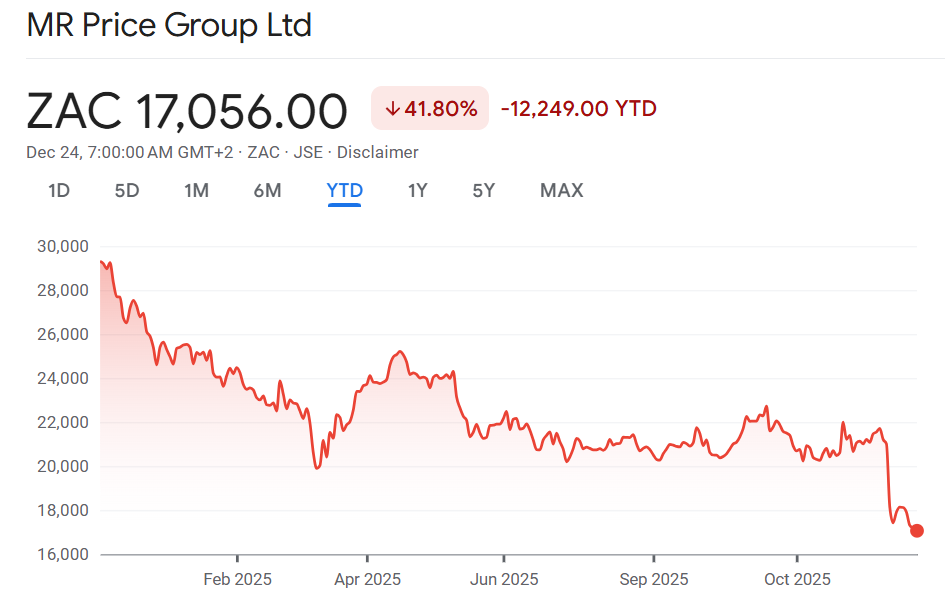
After the market had a small heart attack about the NKD transaction, there was some hope that management would at least reconsider their approach and possibly get out of the deal, or at least respond publicly to the many questions posed by the likes of 36ONE. I have no idea what the engagement behind closed doors with major shareholders has been, but I can tell you that the rest of us who only work off SENS have been flipped the bird.
Here’s a summary of the company’s approach: “You don’t like the deal? Well toughies for you, because we do.” It just gets dressed up in fancy corporate PR speak.
There’s no indication of any wiggle room in the contract. They talk about the deal being contractually complete and only subject to regulatory approvals. As I wrote when the deal was first announced, I would be surprised if the private equity sellers on the other side allowed for a break fee. They know a sucker when they see one.
Mr Price has promised a capital markets day in due course to explain to the market why this is such a good idea. I’m not sure what they plan to share that isn’t already clear to people. Unless the valuation multiple is somehow drastically different to what the market already believes, then the plummeting share price reflects the opinion of the market on the deal.

The company also gave a link to help shareholders find the 2024 audited financials of NKD. It’s just a pity that it lands on a German company register page where it isn’t clear at all how to go about finding the financials. Perhaps you’ll have more luck than me.
The poor ongoing disclosure (how hard would it have been to actually explain the EBITDA multiple?) is actually the perfect summary of their “just trust us, bro” approach to this entire transaction. Low levels of disclosure, substantial levels of hubris and a predictable impact on the share price. After so much good work in the past year or two to integrate the South African acquisitions, management got way ahead of themselves here and completely failed to read the room.
I have still not come across a single investor who is happy with the deal. Not one. It’s rare to see unanimous hatred of a transaction.
NEPI Rockcastle is growing, but it’s not exciting on a per-share basis (JSE: NRP)
And that’s the basis that counts
Property funds tend to achieve significant growth through capital raises and property acquisitions. This is important context, as any growth rate achieved by these funds needs to be considered on a per-share basis to take into account the dilutionary impact of share raises. Increasing the size of the pie is easy. Increasing the size of the slice each shareholder has in their hands is much harder. It’s the difference between inviting extra people for Christmas lunch vs. providing a larger portion per guest.
In a pre-close update, NEPI Rockcastle has highlighted 11% growth in total net operating income for 2025. That sounds amazing obviously, but distributable earnings per share will be roughly 3% higher than in 2024. That’s a big gap.
The like-for-like growth in tenant sales of 3.7% shows you why the per-share growth in distributable earnings is only 3%. Another important point to note is that like-for-like footfall was down 0.5%, so growth in sales is primarily coming from inflation and mix effects.
Don’t get me wrong: the fund is healthy and delivering growth in hard currency. It’s just very important that you anchor to the 3% growth rate, not the 11% growth in total net operating income that was boosted by acquisitions.
The balance sheet reflects the quality of the portfolio, with the fund having no trouble in refinancing debt and raising green finance linked to solar PV projects. The loan-to-value ratio is “well under 35%” – a healthy level.
Nibbles:
- Director dealings:
- I’ve been pretty bearish on the Premier (JSE: PMR) – RFG Holdings (JSE: RFG) transaction. The RFG Holdings directors aren’t exactly sending a bullish message to the market, as there have been extensive on-market disposals by various directors worth nearly R24 million in aggregate. I don’t blame them at all.
- A person closely associated with a director of British American Tobacco (JSE: BTI) sold shares worth nearly R17 million.
- The chairman of Orion Minerals (JSE: ORN) has subscribed for A$1 million worth of shares as part of the company’s broader capital raise that was announced in September. As an aside, the company also managed to settle its South African advisor in shares rather than cash, so that’s a win for the health of the balance sheet.
- An associate of a director of Goldrush (JSE: GRT) entered into a CFD trade over Goldrush preference shares worth R3.3 million.
- The CEO of Argent Industrial (JSE: ART) bought shares worth over R1.6 million.
- The CEO of Aveng (JSE: AEG) retained his vested share awards, but the CFO and the finance director of Moolmans both sold their full awards worth a total of around R410k.
- A director of Spear REIT (JSE: SEA) – and not the CEO for once – bought shares worth R58k.
- Although not a traditional director dealing, this is a related story. Directors of Quantum Foods (JSE: QFH) had previously granted call options to a third party to acquire shares at any time between 2 September 2024 and 31 December 2025. The parties have decided to extend this option to 30 June 2027.
- Curro (JSE: COH) will delist on 13 January. Shareholders are therefore only a few weeks away from having a mix of Capitec (JSE: CPI) and PSG Financial Services (JSE: KST) shares in their brokerage accounts instead. I wish Curro’s management team all the best for the future – this is a very important business in South Africa.
- Kibo Energy (JSE: KBO) continues to be a story of hit-and-miss, with the planned acquisition of Australian renewable energy company Carbon Resilience falling over. This was supposed to be a reverse takeover transaction, but Carbon Resilience and the seller of the asset haven’t provided sufficient due diligence documentation within the required timeframe for the agreement to become effective. To make it worse, the noteholder providing funding to Kibo Energy has switched the taps off and won’t provide the next tranche, so the company is now scrambling for alternative funding and an acquisition. Kibo is currently suspended from trading.
- Here’s an interesting non-executive director appointment that deserves a mention: Richard Wainwright, the ex-CEO of Investec Bank from 2016 to 2024, has joined the board of Pepkor (JSE: PPH).
- In a sad and sorry end to a business journey that in so many ways captures the economic trajectory of South Africa after the FIFA World Cup, Murray & Roberts (JSE: MUR) will delist from the JSE on 19 January as part of the liquidation process. Farewell to one of the craziest examples of value destruction that you’ll ever find on our market.


I could not agree with you more, Finance Ghost, It is very annoying when Boards of Directors make decisions without first thinking about the shareholders and the large number of pension fund contributors that have trusted their hard earnings in their hands. One would think the Steinhoff, Tongaat Hulett and Murray and Roberts and other disasters that have occurred over recent years, would be stark reminders. To make matters worse is the Directors who were guilty of the downfalls never see the inside of a jail and lose all their assets.
360one should gather all the major shareholders of MR PRICE, convene and extraordinary meeting – cancel the deal and fire the CEO and board