
“Despite the challenges faced during the year, we remained firmly aligned to our strategy of building a better-balanced, more branded business. We maintained a disciplined focus on operational efficiencies, ongoing innovation and continued investment in our brands, while remaining agile in responding to a complex operating environment,”
Paul Cruickshank, Chief Executive Officer
Note: these results have been provided by RCL FOODS and do not include any commentary by The Finance Ghost. You can refer to the full results here.
KEY HEADLINES:
- Sugar negatively impacted by increased imports due to ineffective tariff protection
- Production challenges disrupted Pet Food operations in the second half of the financial year
- Market remains subdued with volume pressure across most categories
- Continuous Improvement (CI) and Net Revenue Management (NRM) initiatives continue to support margin protection across the business
- Revised Dollar-based reference price implemented in August 2026, supporting a more favourable outlook for the sugar industry
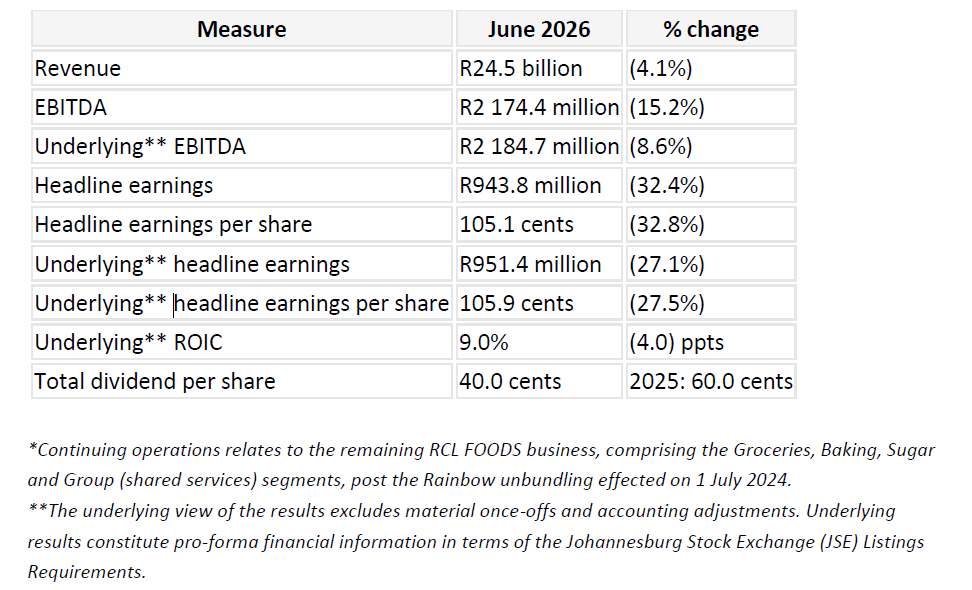
FINANCIAL SUMMARY – CONTINUING OPERATIONS*:
RESULTS COMMENTARY:
RCL FOODS’ results were materially impacted by challenges in its Sugar and Pet Food operations. Sugar was negatively affected by high volumes of deep-sea imports, driven by ineffective tariff protection, which reduced local market demand and increased the proportion of production directed to lower-priced export markets. In Pet Food, production disruptions constrained supply and the business’s ability to meet demand during the second half of the financial year.
Despite a stabilisation in food inflation and lower interest rates compared to prior years, South African households remained cautious with their spending. Several years of elevated inflation, high debt-servicing costs, weak real wage growth and, more recently, higher fuel costs continued to constrain disposable income.
Average international raw sugar prices were down 22.6% from the prior year, which together with an ineffective sugar tariff contributed to 212 684 tons of deep-sea sugar imports, up 24.2% year on year, significantly impacting profitability across growers and millers in the South African sugar industry.
Revenue for the year ended June 2026 decreased by 4.1% to R24.5 billion (2025: R25.5 billion), largely due to lower realised Sugar prices and volumes together with lower Pet Food volumes. Underlying EBITDA declined by 8.6%. Underlying headline earnings declined by 27.1%, compounded by a materially lower share of profits from our associate Royal Eswatini Sugar as it was also impacted by the adverse sugar market dynamics.
The Board of Directors resolved to declare a final cash dividend of 25.0 cents per share for the year ended June 2026, bringing the total dividend for the year to 40.0 cents per share (2025: 60.0 cents per share).
STRATEGIC REVIEW
RCL FOODS completed the agreed reshaping of its portfolio with Rainbow’s exit from the central business services platform at the end of the current year, concluding a journey that began with the disposal of Vector Logistics and the unbundling of Rainbow. The focus going forward will remain on ensuring the platform remains fit for purpose and leveraging its capability through organic and inorganic growth opportunities.
The strategy is guided by three pillars – People First, Right Growth and Future Fit – and by a focused set of Value Creation Levers centred on profitably growing the Culinary core, driving innovation in Baking and Pet Food, building a more sustainable Sugar operation and enhancing margins across the business.
The Group continued to make good progress against the enablers underpinning the People First pillar, with particular emphasis on building a high-performance culture. Leadership changes strengthened capability across the business and new employment equity plans were implemented. The short-term staff level employee incentive scheme is now embedded across the business, aligning effort, performance and shareholder interests.
The Right Growth pillar was advanced through several targeted growth initiatives. The Sunbake Sourdough range was well received by retailers and consumers and rolled out ahead of plan, while Pieman’s Pockets gained promising momentum in the frozen. Culinary maintained category leadership and strengthened brand equity despite intense competition. RCL FOODS also entered into a binding agreement to acquire Martin & Martin, a leading South African producer of wet pet food and pet care products with brands including Husky, Pamper, Beeno and Bob Martin. The acquisition remains subject to Competition Authorities approval.
Under the Future Fit pillar, CI and NRM programmes again performed well and contributed materially to results. The Group advanced the next phase of its IT roadmap, deployed new costing, sales and warehouse-management capabilities and began scaling digital and artificial-intelligence capabilities around a portfolio of high-value use cases to drive competitiveness, manage costs and accelerate innovation.
Sustainability gained further strategic traction as the Group strengthened its ability to support the transition to a lower-carbon, more resilient business. Scope 3 emissions baselining, climate-risk scenario analysis and decarbonisation planning advanced this transition. Enhanced environmental, social, and governance (ESG) data and environmental performance measurement strengthened decision-making, risk management and long-term value creation.
“In a testing year, our response across the business was to focus firmly on the factors within our control. We protected margins in categories under pressure, completed the agreed reshaping of our portfolio, continued investing in our brands and people, and accelerated the programmes that are creating long-term value. CI and NRM remain important drivers of performance across the Group, with further benefits expected in the year ahead,” said Paul Cruickshank, Group CEO.
OPERATIONAL REVIEW – CONTINUING OPERATIONS
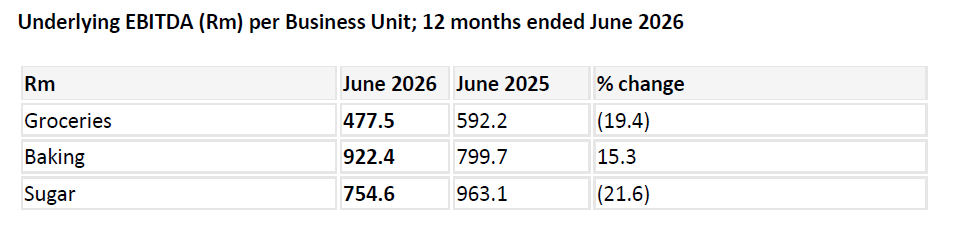
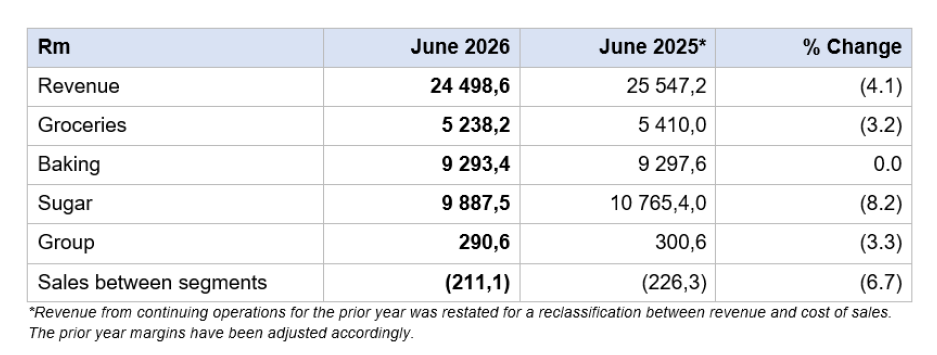
In the Groceries business unit (comprising Culinary, Pet Food and Beverages), revenue decreased by 3.2% to R5 238.2 million, while underlying EBITDA decreased by 19.4% to R477.5 million. Encouraging performances from Culinary and Beverages were overshadowed by Pet Food production disruptions following a nationwide recall in March of certain dry pet food products. Total
Pet Food volumes ended 20.5% down on the prior year. Culinary delivered a pleasing result supported by higher margins from CI and NRM initiatives and volume growth in dressings, despite a highly competitive market.
In the Baking business unit (comprising Bread, Buns & Rolls, Milling, Pieman’s and Speciality), revenue was flat at R9 293.4 million, while underlying EBITDA improved 15.3% to R922.4 million. Pleasing performances from Speciality and Pieman’s, together with manufacturing efficiencies and CI savings, supported the result. During the year, a R206.1 million impairment was recognised in the Sunshine business, which continues to face challenges recovering volumes following the December 2024 labour disruption.
In the Sugar business unit (consisting of Sugar and Molatek), revenue declined 8.2% to R9 887.5 million, while underlying EBITDA decreased by 21.6% to R754.6 million. High volumes of deep-sea imports, coupled with inadequate tariff protection, reduced demand in the local market and increased the proportion of production directed to lower-priced export markets. Total industry local-market volumes declined 10.3%, while export volumes increased 48.3% during the year. Despite these headwinds, the business delivered a good operational result, underpinned by improved agricultural and manufacturing performance. Molatek delivered another positive result driven by an improved sales mix, together with production and CI efficiencies, which was partially offset by lower volumes (down 8.3%), largely due to the foot-and-mouth disease outbreak. Following the reporting date, ITAC concluded its investigation into the Dollar-based Reference Price (DBRP) and a revised DBRP was implemented in August 2026. The revised reference price is expected to reduce the influx of subsidised deep-sea imports and support an improved balance between local-market and export sales into the new season.
These developments mark an important step towards improving the long-term sustainability and stability of the South African sugar industry.
The continued operation of Tongaat Hulett Limited (Tongaat) remains important to the stability of the North Coast of KwaZulu-Natal and the South African sugar industry. Tongaat’s business rescue practitioners filed for the company’s provisional liquidation in February 2026, creating a period of uncertainty for the industry. That uncertainty eased considerably in June 2026 when the application was withdrawn following a funding arrangement involving the Industrial Development Corporation and the prospective buyers, with Tongaat remaining in business rescue.
The approved business rescue plan provides for the payment of historic sugar industry obligations of approximately R517 million relating to the 2023 sugar season. The non-payment of these statutory obligations over an extended period placed severe financial strain across the sugar value chain, particularly on small-scale growers.
During the business rescue process, the business rescue practitioners challenged their obligation to make the relevant payments. Following the Constitutional Court’s recent refusal of Tongaat’s application for leave to appeal, the matter has now been finalised. This outcome, together with the withdrawal of the liquidation application, removes the remaining impediments to the implementation of the business rescue plan and the settlement of the outstanding industry obligations.
PROSPECTS
RCL FOODS does not anticipate a meaningful recovery in market volumes in the near term. However, the Group remains focused on the factors within its control, including CI, NRM, innovation and brand investment, and is confident in its ability to adapt and position the business for stronger returns as market conditions improve.
In Pet Food, the focus is on executing the recovery plan, restoring customer confidence and rebuilding market share while continuing to progress the longer-term growth strategy. In Sugar, the operational and agricultural momentum built during the year is expected to continue. With the DBRP now revised, we expect the influx of deep-sea imports to ease and the balance between local-market and export sales to improve, supporting a more favourable outlook for the sugar industry. The interplay of sugar pricing, the tariff environment and the rand/dollar exchange rate will continue to present a degree of risk and volatility.
A protected strike commenced in the South African sugar manufacturing and refining industry following unsuccessful industry-level wage negotiations. While the financial impact remains uncertain, a prolonged strike may adversely affect production volumes and earnings.
“We remain focused on the factors within our control. We have navigated difficult conditions before and are confident in our ability to continue adapting, executing and creating sustainable value for all our stakeholders,” concluded Cruickshank.