
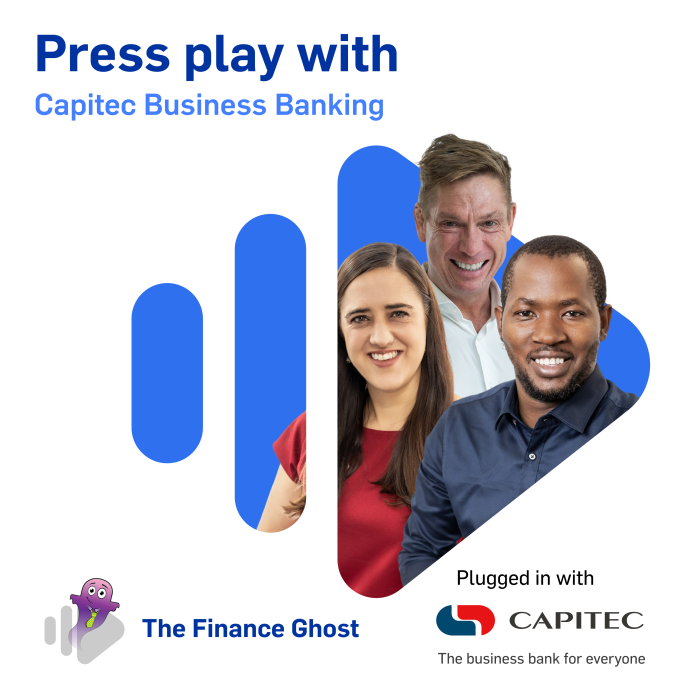

Introducing Capitec Business executives Karl Kumbier, Amrei Botha and Sicelo Mkhize:
Capitec understands the challenges faced by entrepreneurs. Throughout this season of The Finance Ghost Plugged in with Capitec, we’ve explored how affordable transactional banking and access to finance can help business owners grow.
But how does it all come together? And how did Capitec make such a strong impact on the business banking scene so quickly?
In episode 8, we reflect on the acquisition of Mercantile Bank just before COVID hit – and how Capitec’s innovative approach helped shape the products, systems and client experience that followed.
This is The Finance Ghost in conversation with Karl Kumbier (Executive for Business Bank), Amrei Botha (Executive of Client Experience Delivery) and Sicelo Mkhize (Head of Distribution).
Episode 8 covers:
- Why understanding SME challenges is the starting point for better products and solutions – including Capitec’s simple, transparent pricing structure
- The systems architecture of Capitec Business and why it was built to stand alongside the rest of our business
- How the pandemic shaped Capitec’s blend of digital innovation and personal support in the business centres
- The rapid growth from 30 000 to 85 000 clients in just one year – and why individual clients still matter
The Finance Ghost plugged in with Capitec is made possible by the support of Capitec Business. All the entrepreneurs featured on this podcast are clients of Capitec. Capitec is an authorised Financial Services Provider, FSP number 46669.
Listen to the podcast here:
Read the transcript:
The Finance Ghost: Welcome to this episode of The Finance Ghost plugged in with Capitec, where we are building the future of South African business and we’re doing it with, as you’ve guessed, Capitec.
Hopefully you’ve listened to some of the other episodes in the season where I’ve gotten to speak to some really interesting entrepreneurs who are building all kinds of different businesses. Some great stories.
I think South Africa has been a lot more positive in the past year and it’s lovely to see that there are people out there building. And of course, there are a lot of people out there who dedicate their days to supporting the people who are building. That is what this podcast is all about – this particular episode.
Today, we aren’t chatting to small business owners – very far from it, actually. We’re chatting to three executives from Capitec Business.
On the show today, I’m lucky enough to be able to chat to Karl Kumbier, the Executive for Business Bank; Sicelo Mkhize, the Head of Distribution; and Amrei Botha, the Executive of Client Experience Delivery.
All very nice, all very fancy, and ultimately comes down to the same thing, right? Helping small businesses do their thing. Karl, Amrei, Sicelo – thank you. Welcome to the show. It’s lovely to have the three of you.
Karl Kumbier: Thanks for having us on your podcast. It’s great to be here.
The Finance Ghost: Let’s jump in, I think. Karl, we’re going to hear from you first. There are quite a few questions with you. But Amrei, Sicelo, I’m looking forward to chatting to you as well, and obviously jump in as you want to and as you have stuff to add.
Let’s just contextualise the story here, which is that Capitec came from being, as everyone knows, the simple bank. But by ‘simple’, what that really meant is ‘simplicity’ as opposed to simple. So, actually making things easier and taking incredible market share along the way in consumer banking. I mean, everyone knows that story.
Now you’re doing it in business banking. And I can confirm, having opened one of my small business accounts with Capitec now (not least of all inspired by the podcast that we are all working on together) – it works! It does the job. It does exactly what it says on the tin, which was a good experience.
I think where we should start with you, Karl, is just the ‘why’ behind Capitec Business. It really is just important to understand what you guys are building, the journey so far.
And particularly just from a South African context, where small business is difficult – it’s difficult everywhere in the world; it feels like it’s even harder here. How do you help address what small businesses are dealing with?
Karl Kumbier: Yeah. As you said, Capitec’s done really well over the last 22 years in the retail space and grown really nicely. The next logical move is SMEs. It’s a very badly serviced segment. I think SMEs have been ripped off for years on bank charges, etcetera.
And if you think about it, if we can make a difference to an SME’s life – if we can provide access to finance to that small business – what does that do? That helps them grow!
And as the business grows, it creates jobs. As you create jobs, you stimulate the economy. We genuinely believe that we can make a real difference in this country, and help grow this economy.
The Finance Ghost: As you say, it’s fees on one hand. It’s also stuff like access to finance. And there are so many different things that SMEs have to think about, right? It’s also just getting paid!
And I think what triggered this initially was I actually wrote a piece for the Financial Mail (I think this was now last year), because I went and bought coffee at the local Vida. And of course, as I paid, I heard that very familiar little Capitec jingle – you know, that everyone knows and loves and would have heard at the start of this podcast.
I’ll avoid embarrassing myself by trying to replicate it here, but the point is that I heard that and thought, “Hmmm, that’s interesting” – obviously because I’ve been writing about the markets, I’ve been following the Capitec story, but now I just hear it everywhere.
It’s amazing, actually. It’s like the marketing trick of the century, I’ve got to tell you. Very clever that the POS (Point of Sale) machines basically sing to people every time they pay.
Karl Kumbier: We love that sound.
The Finance Ghost: I’m sure! And it actually helps a market analyst like me understand just how well this thing is growing. Because just look around you, right? As you pay, if you hear that, it’s because Capitec is involved here.
Would you say that’s been key to – and we’ll talk about this in more detail – servicing the different needs of SMEs? Because it’s a whole lot of things, right? It’s the basic banking, it’s also payments, it’s access to finance – that’s what SMEs always cry about, right?
Karl Kumbier: For sure. You have to solve for all of the SMEs problems or issues.
And if you think about it, you’ve got a lot of banks out there. You’ve got old legacy banks that have been around forever. Then you’ve got all these fintechs. And if you think about a fintech, they solve for a particular need, right? So, you might have a POS and they solve for that thing really well.
And we see ourselves as a giant fintech – we want to be able to provide those fintech solutions to our clients. But at the same time, we’re able to offer a transactional banking account to be able to facilitate payments.
We can actually do foreign exchange, we can lend you money to buy a car or commercial property or a residential home loan, whatever. We can provide you with a complete solution. So, yeah, you’re exactly right. We’ve had to solve for all of the SME’s needs.
The Finance Ghost: Yeah, it’s a really big part of it. And before we then get into some more detail on how you’ve actually done this, from the outside looking in, people might wonder how Capitec got this big, this quickly – and from a business banking perspective.
One of the ways they did it, of course, is they acquired Mercantile, which is a very classic strategy of buy rather than build. I think what’s happening here is: buy a foundation and then build on it very quickly, right? It feels like that’s what happened here, so maybe just some context to why Capitec took that route.
And then for the listeners, context as well – for the three of you, were you involved before when it was Mercantile, or did you join after that? I’m just curious to get a little one-minute from each of you on your involvement there.
Karl Kumbier: Okay, so I used to run Mercantile. I was CEO of Mercantile Bank. We were owned by the largest bank in Portugal, then we were put up for sale in about 2017.
But selling a bank is a long process to go through, like a tender process. And from a Capitec point of view, if you decide you’re going to go into business banking, you’ve got to make a decision: do you build yourself (which Capitec’s always done), or do you buy something? And if you buy something, the benefit is you’re getting to market much quicker.
Then when we were told we’re going to be sold, I had to go and prepare a presentation and shop around to find out who’s interested in buying us. There were quite a lot of parties interested, but the first place I went to was Capitec, because Capitec was a real success story. It was a case study. We all looked up to Capitec. We were in awe of how Capitec had grown.
At Mercantile, we were a niche business bank. That’s what we did. And we thought if you could combine Capitec’s brand, with Capitec’s balance sheet, with Capitec’s knowledge of scored lending, and then with Capitec’s technology skills – imagine combining that with our business banking skills at Mercantile.
We always thought, “Geez, you can create something really special!” And then when I went to go see Gerrie and the old FD, André (Gerrie just retired recently as CEO of Capitec), the first response was,”Listen, we don’t like buying things. We prefer to build.”
But I think, during the due diligence, they realised that we had a foreign exchange department, we had a rental finance business, we had a POS business, we had a debit order collections business, and most importantly, we had this business banking division that could service transactional banking for clients. We had online banking, we had all the lending products that the traditional banks have. There’s nothing we didn’t offer.
So Capitec looked at this and said, “Wow. If we had to go and build all of those things, it’s going to take…” If you just think about Discovery Bank – it’s a great offering, but it’s taken nine, maybe 10 years? I don’t know how long, to build the bank and have a really good offering in that space.
If you want to get to market quicker, rather buy. So, Capitec decided to up the offer, no conditions, and bought Mercantile – because they could see the benefits.
And yeah, then you’ve immediately got a business that’s profitable from day one – and we pay for all of our own development costs, etcetera – and you can get to market much quicker. So, that’s the reason Capitec bought Mercantile.
The Finance Ghost: Yeah. Fantastic. Amrei, maybe let’s go to you. What was your involvement before/during/after? Were you there with Karl throughout?
Amrei Botha: So, I had the great privilege of joining Capitec just as the deal went through. It’s not often in one’s career where you get the opportunity to start something from scratch. And after a lifetime in small business banking, it was great to join an organisation and a team that’s so passionate about small businesses and making a difference in the SME sector.
And we had all these competencies and skills and capabilities from Mercantile, but also the knowledge and experience of Capitec in scaling a banking operation. It was really great in those early days. Being part of a startup team, very much operating like a fintech.
We were so small at that stage. Karl, I remember the floor I joined was completely empty! We had like four desks for the few of us that started it. Covid hit shortly after, six weeks after. So we had to navigate Covid and building a bank afresh. So, it was a really, really wonderful season and it’s just accelerated from there.
Karl Kumbier: Yeah, I remember Gerrie said to me, “We need someone to set up this area called Client Experience Delivery so that they understand the client experience and they build all the technology to deliver on that and the client’s needs.”
I said, “You know what? There’s one person. She works for the World Bank currently. She’s passionate about small businesses. She flies around the world to countries all over Africa and the Middle East, etcetera, solving for SME’s problems. Let’s have a meeting with her.”
And we met with Amrei and, when we saw how passionate she was about SMEs, we said, “That’s it, then. Come join us and help us build this business bank.”
The Finance Ghost: Very nice. It’s a great story. Sicelo, over to you. How did you get into the fold here? When you joined, were there also four desks on a massive floor that then emptied after that, or was it before or after that?
Sicelo Mkhize: Yeah. Interestingly, my story is quite similar to Amrei’s story. I also joined a couple of months after the conclusion of the acquisition. I think maybe the one part I just want to highlight on my side that actually attracted me to Capitec was really joining an organisation that was founded by entrepreneurs.
When I looked at the landscape, I said, “Who’s the best bank in South Africa that understands the entrepreneurial journey and that can also contribute in terms of really helping entrepreneurs?” So, that’s how my story started.
And to Amrei’s point, obviously, the first couple of months we were hit with Covid. That’s when I actually saw the true culture of Capitec, really being there for entrepreneurs during Covid and helping entrepreneurs to save jobs and ensure that we continue to grow the economy, even at that point in time.
So, yeah, it’s been an exciting journey on my side. And we’re starting to see that fruit coming through, in terms of the benefits that we’re passing on to our small businesses.
Karl Kumbier: Yeah. And also when we met Sicelo for the first time, as well, it’s not often you get a banker that’s got both credit experience and relationship experience.
We just thought, “With Sicelo’s passion for business banking and knowledge of credit, what a fantastic acquisition.” And yeah, now Sicelo runs our entire distribution network and all the larger clients fall under Sicelo.
The Finance Ghost: Yeah, very nice. My little business is also a pandemic baby. It’s interesting how the team that’s on this podcast essentially, from a Capitec perspective (with the exception of you, Karl, who was running Mercantile before), kind of came together around that time and navigated that whole story. It feels like it was so long ago, right? It’s like another era. That was only six years ago.
Karl Kumbier: It was very interesting. And we sat now as Capitec, the deal went through in 2019. Next thing, Covid hits a year later (not even – the deal went through in November and then Covid was in March the next year).
As you can imagine, it was chaos. And Capitec, we sat together as a group exco, and we said, “You know what? We need to keep servicing our clients’ needs. We need to keep making sure we can provide them the necessary service.”
And we said, “How do we get all of our call centre staff – 2,000 people – to actually work from home?” Never heard of, for a call centre. And suddenly, we spoke to our IT suppliers. They delivered like a couple of thousand laptops.
We had these production lines going in head office in Stellenbosch. We had to load all the software and everything we needed on these laptops. We gave them 3G dongles to be able to get Wi-Fi. We trained everyone quickly how to use the new dongle system, etcetera.
And next thing, within three weeks – can you believe it? From the date we made the decision at exco that we’re going to push everyone to work from home to three weeks later, every single one of our call centre staff had a laptop sitting at home and was servicing our clients’ needs. Almost like there was no interruption whatsoever.
And if you had said to us, say six months before Covid, “Would you ever be able to send people home, all your calls and staff and work from home?” You’d say, “No, no chance!” And yet, we managed to do it. We all pulled together as a team and did it.
The Finance Ghost: Yeah, it’s amazing. I think it also talks to the benefit of being part of a larger organisation like Capitec, to be able to do something like that; make those kind of decisions. You know, flick a switch (obviously, way simplifying it) and this amazing production line happens.
Karl Kumbier: Yeah, we’re part of a large organisation, but the way I look at Capitec is as a large business, run like a small business. We have a very flat structure; we don’t care about titles. We can make decisions quickly.
When there’s something to be done, we sit around the table and, once we agree, we all walk out of that office and everyone’s on the same page and we go and deliver. So, it’s a very agile business, for such a large business.
The Finance Ghost: Yeah. I mean, I can give a real-world example of that. Even just discussing this podcast season with the Capitec marketing team, the decision was made quickly and it was made by a few people, so I’ve seen that myself. I agree with you. That does seem to be the way Capitec runs the business, which is great.
Let’s maybe move into that then, and this Capitec culture… You spoke a little bit about how the acquisition helped to plug some gaps, etcetera, but obviously Capitec brought its own culture to this too, versus what you had before at Mercantile.
So, that approach of actually addressing the gap in the market, building out the Capitec Business now from the foundation you had before. Just meshing that culture, the way Capitec thinks and everything else you’ve achieved.
Karl, this is probably a question for you. Just your thoughts around that, as you reflect on that journey?
Karl Kumbier: So, when the deal went through, it took us a year to integrate as a division because the Reserve Bank gave us one year (or two years, I can’t remember, but we did it in one year) to give our banking license as Mercantile.
But the nice thing is that year gave us the opportunity to go and design the business bank of the future. Now the old Mercantile, it was a very high-touch, low-volume business. We only had a few thousand customers, but we had really great relationships with those clients.
We had to say, “Right, but that model’s not going to work for Capitec. You know, Capitec is all about scale, volume.”
Mastercard actually sponsored a session for us, so we (myself, Gerrie, who was the CEO of Capitec, the Financial Director, a couple of my senior team from Mercantile and our Head of Technology, Wim, at the group) locked ourselves into a room in Stellenbosch, for literally three or four days.
We just cleared the diaries – no cell phones on, nothing – and we started just throwing ideas around.
After three days of brainstorming, we decided that what we want to build is a business bank that’s digitally led – so you can do as much as you can digitally, because we know entrepreneurs haven’t got time to go into branches and this and that – but relationship-based – so we must have really good relationships with our business banking clients.
When that client approaches the bank, the bank knows exactly who that client is and what they do, etcetera. That was the concept. So, everything we had to build was based around that.
The Finance Ghost: Yeah. I’ve got to say, as a small business owner, I think the word ‘branch’ is basically a swear word. I can tell you for sure, if I hear that word, it’s not happening. I’m banking somewhere else.
So, got to build it as a full digital experience. I completely agree with you on that. And some of the Capitec DNA stuff really seems to be coming through as well. I mentioned the word ‘simplicity’ earlier, and that’s always been a word that I think Capitec has really leaned on very strongly from a marketing perspective.
And it makes a world of sense to have done so. There are a few others as well that I think have been baked into what you’re actually building. Before we go to Amrei and start to understand more about the client experience, let’s just finish off with you there, Karl, for now at least. How that Capitec DNA has kind of come through in your offering.
Karl Kumbier: Yeah. One of the things that made Capitec successful is the four fundamentals. So, from the very first year of Capitec’s existence (22, 23 years ago), there were four fundamentals that the founders came up with.
Those were simplicity, then affordability, then accessibility and personalised service. So we just said, “Okay, everything we build in the business bank has to comply with those four fundamentals.”
We want a simple offering: one offering for everyone. Doesn’t matter if you’re the largest business with 10,000 employees or if you’re a hairdresser and you work on your own, you have the same offering. You get offered the same thing – same pricing, same everything.
So that’s the simple piece. Then, the affordability. We said, “We want to be the most affordable in the market by at least 30%.” And we can talk about that later, but we ended up close to 50% more affordable, at least.
And then accessibility. When the client wants to speak to the bank, we must be accessible. When the client wants to open an account or do whatever, that must be easily accessible. So we put that in.
And then the last thing is personalised service. I mean, that’s everything for a small business. If you’ve got an issue, you want to be able to pick up the phone or speak to someone, and they can make a decision. You want to do it there and then. So, we had to make sure we have this really good personalised service.
Those are the four fundamentals and every single thing we build in business banking has that. And then, just to add an overlay across all of that, is our culture at Capitec. It’s a very simple culture. We call it the CEO principles.
We want, firstly, everyone to be a CEO in the business, right? But, the C stands for Client, and the client always comes first. Doesn’t matter what we do, we’re not going to do something unless it improves the client experience or drives down the cost of banking for clients. So, that’s the first thing.
The E is Energy. We want all of our staff to have energy. Clients want to deal with energised staff, they don’t want to deal with someone that’s like half-dead!
And then the O stands for Ownership. How do we make sure that all of our staff run this business like it’s their own business? They must have that founder mentality. They must take the ownership and deliver on whatever is in front of them. So, that culture mixed with the four fundamentals are how we built the business bank.
The Finance Ghost: Yeah. An entrepreneurial culture is a lovely thing and you only really notice it if you’ve worked in a place that has it and then a place that doesn’t have it. I’ve done both, so when it’s there, it’s quite a special thing.
Amrei, I think let’s move on to you. World Bank, nogal! Very interesting. I’m guessing your world is a bit more granular these days because now you’re working on things like how people actually come into the system and how the entire onboarding works, how the whole business works, really?
I’m keen to understand, underneath everything, building a bank – that is incredibly interesting! Take us through that. I’m going to just open the floor to you to walk us through what’s been built, because it’s going to be incredibly interesting.
Amrei Botha: Yes, it has been, and we’re not done yet. I think that’s the most exciting part of it. As I mentioned earlier, it’s not often that one gets the opportunity to start from scratch, but also take the best of two great organisations.
At Capitec, we really obsess about the client experience. I’ve been passionate about small businesses all my life. But at Capitec, it really raised the bar in terms of that. The level of granularity, the level of data we look at, the level of client insight we look at, is surreal, really.
We really truly obsess about the client experience and the journey that the client goes through. All the way from the most junior to senior staff, we really obsess around the process. We often talk about people, process, technology, and that those three need to be absolutely the best they can be.
We also have this mantra of “better never rests”. So even if you think you’ve done your greatest work, someone else looks at it and they find an even better way to do it.
And simplicity is also kind of infinite. You think you’ve done something simple and then you look at it again and there’s an even simpler way to do it. So, we really obsess around the number of steps in our processes that a client or a staff member needs to go through.
We obsess about efficiency. We know time matters to SMEs, and so wherever we can save time for SMEs, that’s really important. We worry about the details, the number of fields that a client needs to complete or a staff member needs to complete, the number of screens they need to go through, the number of clicks involved in a process.
Whenever we design something new, that’s what we look at.
In a similar fashion, when we needed to start building Capitec Business, we looked at the client journey from the front door to the growth journey. What does that client’s journey look like?
The very first thing we started with was the Capitec website as the front-door entry point to what became Capitec Business. And we realised at the time (and this is where, I suppose, the rubber hit the road) that the current Capitec site that we had at that time, the information architecture couldn’t allow for business banking.
And so we actually needed, with the Capitec retail team at that time, to redesign the whole Capitec website. And it was exciting. In true transparency fashion (which is a value of ours here at Capitec), the website is not only where we house all of our product information, we also transparently house all of our product and pricing information there.
So clients have access to all of our pricing right there on the website. And that is the true price we charge. There are no Ts and Cs or hidden fees or anything like that.
The Finance Ghost: So Amrei, I wanted to ask you on that though, before you carry on. So to get this right, you guys had to go to group and be like, “Hi. You’ve just bought us and we’re up here in Joburg, we’re very far away from you. But actually, you’ve got to redo the whole website so that we can have a business.” Is that how that conversation went? That’s quite amazing.
Amrei Botha: It is! And it’s… I can’t even begin to articulate how easily those conversations happen in Capitec. If there’s something that’s right for our clients and for the market and what we’re trying to do in terms of adding value, those decisions get made really quickly.
So I think Karl mentioned earlier, the level of decision making is fast here, absolutely. And I think the other thing, Karl, maybe you want to add there before I go on?
Karl Kumbier: Yeah. I just think one thing about Capitec is that there are no silos, which is quite interesting for an organisation this size, right? One thing that I think has been really successful for Capitec is everyone in the bank is incentivised on Capitec’s growth, not the division.
So in other words, it doesn’t matter if you’re going to almost cannibalise one area or someone’s gotta add… it doesn’t matter as long as everyone can buy into the future and says, “No, but that’s good for the bank. Yeah, we’re going to do it.”
That struck me from day one that we were part of Capitec Group. That we need to change a website. Everyone is so excited about building a business bank, they just said, “Geez, where do we start? Let’s go for it!”
And everyone just goes and starts working towards doing it. So, that’s an amazing culture at Capitec, which you don’t get in many other large organisations.
The Finance Ghost: No, that’s rare. I can honestly say that’s very rare. I’ve only ever really seen the silo mentality in most places that I’ve worked, before I went this route. So that’s pretty impressive.
I would have loved to have been a fly on the wall for that conversation, although it sounds like it was easy, it just is what it is!
Sorry, Amrei. I just found that so interesting. That you had to go and redesign the whole group’s site just to make this work. But back to you, then. You were talking about pricing?
Amrei Botha: Yeah, I know, but definitely not easy. The other thing I think that’s important to also highlight is the level of collaboration across Capitec. It is really, truly like a family.
And if you want to bounce an idea off of someone or you need support from a team or department; someone has a skill and expertise that they can add to make something better, people jump in.
To Karl’s point, there are no silos or territories or “this isn’t my space”. We’re all CEOs and we all collaborate together to make sure it’s a success, for our clients and for Capitec.
And I think throughout the build journey, that’s been one of our biggest kind of success factors. That collaboration and support across the group and the skills that got added to our build journey.
But back to pricing. So, the pricing is transparently available on our website and clients can see it there. But beyond that, the website has now since expanded to become the space where clients can commence the process of opening a bank account with us.
They can use our calculators on the website to see if they qualify for credit and for how much. So the website has really become a great tool for clients. And we, on some months, now get 250,000 visitors on our Capitec Business pages. So, it’s really grown tremendously.
And like I mentioned, the website is our front door. It’s our entry point. It’s where you go to also open a bank account, so that was the second piece we needed to build – an onboarding process for new clients.
We knew that the key to our journey would be growth, and first impressions matter. So we built an onboarding process that is fully remote. And I think a lot of that also got inspired by the realities of Covid.
If you never needed to go to a branch, how would this process flow? And if you had to do all of our compliance requirements and meet those standards, how would you do it, completely remote?
The Finance Ghost: Covid was the most weirdly wrapped-up gift in business history. I’m convinced of it. Like, it was the most awful thing, but it also has created a lot of huge improvements in the way we live our lives. Without a doubt.
Amrei Botha: Absolutely.
The Finance Ghost: And it’s that type of thinking, as you say, “How would you do this remotely?” Once you solve for that, then everything becomes digital, and it just becomes easier.
Amrei Botha: Yeah. And it really helped us put ourselves in the shoes of our clients. As a business owner, it may be a remote process, but what happens if suddenly that SME has clients that come in that they need to serve – how do they resume the process easily?
If there are multiple people to sign into that account opening process for compliance reasons, how do you do that in a slick fashion?
Fast-forward a bit, and we can open both sole proprietary accounts and registered company accounts remotely (so, Close Corporations and (Pty) Ltds) in somewhere from 10 minutes. Depending on if there are multiple signatories, how available they are, it can go up to half an hour.
But at the end of that onboarding process, you’ve got your account number, your account is active, you can start transacting, you can make a deposit into it, you can immediately start making payments. And your app and online banking profile is also set up.
Clients are instantly able to also audit a debit card if they need that (and I’ll speak to that in a bit more detail), but on average, about 17,000 clients now join us using our onboarding process. And it was the first patent of my career as well, which was an interesting experience.
We also have an assisted onboarding process, acknowledging that there are some businesses that have three or more directors. There are trusts, partnerships, clubs, associations, NPOs, NGOs. So we open accounts for all those other types of entities as well.
But in those cases where the documentation is a bit more unique, we have our staff assist clients with those application processes. But, really exciting. And our clients give us really good reviews. It’s a key part that has fueled our growth over the last two years.
Karl Kumbier: Maybe just to chip in here. Ghost, you say you’ve opened up an account with us?
The Finance Ghost: Yes, I have.
Karl Kumbier: So you can go onto our website. If you’re a sole proprietor to a company with up to two directors, you open no paperwork whatsoever. You do everything remotely and you can open that account. On average it takes half an hour, but our quickest was like seven minutes.
So, say it takes you 15, 20 minutes to open the account, then once you’ve opened the account, you download your app and you’ve got your online banking that’s active immediately. Then you get a virtual debit card – you do that on the app.
And now in December, we went live with Apple Pay, so then we send you a push notification for Apple Pay and we link that virtual card to your Apple Pay. Then you can go into wherever you used to bank and you do a real time payment into this new Capitec Business account.
And so within half an hour, from start to finish, you’ve got an account that’s really active, operating, working. And that’s what we wanted to build. Something that’s really slick and easy, for our clients to open an account.
Amrei Botha: Yeah. And then it goes without saying that we also needed to build an online banking platform, so that was a journey in itself. And that continues every day now, still. And critical for us was to make that free of charge.
So, similar to our retail personal banking business, our business clients have free access to the app and online banking. Doesn’t matter if you’ve got R1 billion turnover or if you’re a startup still in the ideation phase, you get access to that platform.
And you’re able to not only make payments, but also take up additional products there. You can access credit on our digital platforms, integrate with accounting software, make payments to SARS.
Clients also have the ability to grant access to people within their business to assist with the operations and payment processing. They can set up authorisation flows as well to make sure that they’re in control.
So, it’s a really, really great platform and clients get access to that instantly – and it’s free of charge. Part of the process was also to build a debit card. And it may sound simple, that piece of plastic that we hold, but that was a year’s worth of work.
We had to get a chip certified and the plastic designed and all the processes around it. And again, clients can instantly get their debit cards, whether it’s a virtual card or a physical card, upon account opening. They can personalise it, set their limits, issue additional cards for people within their business as they need. And very exciting, this coming year we’re going to rebuild our credit card and launch that.
So, card has also been a key part. And recently in December, we launched Apple Pay and the other pays are also soon to come. That’s a really exciting journey for us, in terms of ease of payments for our clients.
We also know that a lot of clients have excess cash or save towards specific goals, so we had to rebuild our savings and investment product set.
And just a kind of key interesting stat on simplification: Mercantile had over 412 product types and we’ve simplified that down to 15 across all the different categories of products that a business bank would offer.
So, we’ve got a savings account that clients can also open on the online banking platform, and an investment account that clients can open themselves. And it really helps clients to save towards goals or set money aside for specific purposes.
I think the other exciting build to talk to is our incredible Capitec payments team. They almost reinvented card devices (or card machines) and built a really market-leading product.
There’s a pro device and a print device – exactly the same. The one can print receipts, the other not. But again, we’re in the shoes of our clients and we design from a client perspective, so clients are also now able to get those card devices via our digital platforms or from any Capitec branch.
A really market-leading product in terms of ease of use. It’s the jingle you referred to earlier that people are starting to hear everywhere…
The Finance Ghost: That POS machine is literally the reason we are having this conversation. If I think back, that coffee I bought at Vida, that led to the Financial Mail article which led to my conversation with Capitec.
It was that coffee and that jingle, which is kind of funny. But yeah, it’s a great marketing tool. Don’t underestimate how good that jingle is.
Amrei Botha: And there’s science behind it!
Karl Kumbier: I’m not sure if you saw on the print version, that little slip digitally goes up and then it prints into a physical piece of paper. So, we had this guy in the POS division franchise – he’s a real techie, and he came up with both these concepts. Can you believe it?
He sat there one day and he said, “We want to be a little bit different. We want people to know when there’s a Capitec machine. You’ve got to hear it, not just see it.”
And people will talk about it. It’s an amazing example of innovation from someone from within our technical team.
Amrei Botha: Yeah, we’ll talk about pricing a bit later, but the device is maybe just one of the examples. You often see, at restaurants, the waiter standing with a device up in the air, searching for signal.
One of the really cool features of the device is that it’s got two SIMs and wifi connection, so that a waiter never needs to stand with a device searching for signal – because we know speed matters when processing payments. So, it’s all those little things that ultimately add up to real market-leading products.
We also really disrupted the thinking and the model around POS or card machines. We changed our model from a rental to straight out buy-the-device model. So, clients have a once-off cost, which is much cheaper than the monthly rental fees. And then we also really reimagined the commission rates.
That’s on the product side, Ghost. I think beyond that, Karl mentioned “digitally led, but relationship based”. We really did a lot of build work (and one would think, “How much build is there associated with humans?”), but we did a lot of build work around our service model and our people.
Again, going back to Covid days, it was a debate how, for businesses, face-to-face matters. How do clients want to be serviced? Is it face to face? What do they want to do remotely? What do they want to do themselves?
But through Covid, we learned that most business owners are on the move. Most financial decision-makers are on the move. Their days aren’t predictable. That kind of created a whole different service model approach within Capitec.
We built what we call the ‘Relationship Suite’ where we centralise a lot of our bankers. They are instantly available to our clients, as and when clients need us.
On our online banking channels, as an example, clients can click on a chat button and they instantly connect to one of these bankers to support them if they need any help on the app or online banking activities.
But our bankers, very importantly, assist clients with onboarding. They also assist clients with getting access to credit. That team has grown tremendously over recent years. The big build behind it was not just the centralisation of the staff, but how we truly empower them so that they can make decisions in the moment of client interaction.
What clients often told us in those early days was that they feel like they’re being sent from pillar to post at other organisations. They feel like they’re just a number; they feel like they need to repeat themselves.
And so, quite critical for us is how we give that banker a single view of clients and, very importantly, that that view is available instantly in the moment of interaction.
On average, our bankers answer client calls within 30 to 40 seconds. And while the call connects, they know exactly who they’re going to speak to based on the phone number that’s coming in.
It pulls up the client profile for them automatically and they can see exactly who they’re talking to. They’ve got a full view of recent interactions and challenges the client may have had, so they’re contextually aware in that moment of interaction.
They can also see down to the level of email queries that a client may have had; challenges with solutions. They’re really, truly empowered in the moment of client interaction so that the clients don’t need to repeat themselves.
We also purposely design handovers out of our processes to make sure that our Relationship Suite is able to support clients meaningfully and quickly.
Then we’ve also got our business centres, and this is where Sicelo comes in. We’ve got 19 business centres around South Africa in the nodes of business that matter most. Our bankers in our business centres, they focus on our larger clients, clients that still need the on-site support and the face-to-face deal structuring. And Sicelo heads that portfolio.
Sicelo Mkhize: Thanks, Amrei. I think maybe I’ll start with the relationship suite, just to add one point around that. I think most people actually think, when they’re calling into the bank, that it’s a call centre, or they’re calling into an environment where it’s a robot that’s answering and providing feedback.
On our side, what we’ve done well is we’ve got a team of trained professional bankers that are sitting in the Relationship Suite. I can take any one of those bankers and put them in front of any of the businesses that we’ve got around the country, and they’ll be able to have a quality conversation and be able to assist the client.
So, I think that’s something that we pride ourselves on, in terms of the team that we’ve got in the relationship suite. It services 90% of the entrepreneurs across the country that bank with us.
And then, coming back to Amrei’s point around the 19 business centres (soon to be 20 business centres), it’s basically a team of expert bankers that have a deep understanding of the local market.
If I use, as an example, a business centre based in George, it’s a team of business bankers who know exactly what’s happening in the environment that can actually provide that expert guidance and advice to entrepreneurs.
They can walk down the factory, really understand the client better and be able to position it and provide a solution. What excites me with the teams that we’ve got around the country, they’re fully empowered – in line with our CEO values that Karl spoke about – to make the decisions on behalf of the client and be their trusted business partners.
It’s a very strategic channel for us, that the teams are there for the client to understand their story and are able to articulate it and provide lending. To give you one very basic example, in terms of our bankers, they all have mandates to be able to approve certain credit transactions without necessarily having to go to credit to get support.
It’s almost like the olden days of having a bank manager who’s always available, who understands your business and can provide a decision on the spot. So, I think it’s a very exciting channel for us.
The Finance Ghost: That’s very cool.
Amrei Botha: And we spoke earlier about the Capitec ‘Why’, but what excites me every day when I come to the office is the ‘Why’ of our people. Most of our bankers, they’re really excited to see businesses grow and they are absolutely passionate about supporting businesses to grow.
An example is, in our relationship suite, they’ve got a bell and a big wall where, every time they approve a credit facility, they go and ring the bell. And they don’t celebrate the deal that we’ve written, they celebrate the dream that we’ve enabled.
They’ll write down on that card, “So-and-so was able to find a vehicle that will now enable deliveries,” or, “We financed an overdraft that allows staff to be paid.” So, they’re very specific around the dreams that they’ve enabled for our clients.
The Finance Ghost: And maybe Amrei, I can actually add to that. Because people sometimes listen to something like this and go, “Oh yeah, well that’s the official corporate line and whatever. What actually happens in the background?”
But there’ve been several episodes now in the season and obviously, I get to speak to the entrepreneur who will be a guest on the show – before the show, after the show (I’ve actually become friends with one or two of them, which is pretty cool) – the reality is there’s actually like a raw feedback session and I can hand-on-heart say, sincerely, the feedback is very positive – and particularly around access to funding. So I can believe that – everything you’ve said there, everything Sicelo said there, I can totally believe it because I’ve heard it, and I’ve heard it across everything from property down to franchise, in particular.
And just understanding that stuff. Because everything else you’ve talked about – the onboarding, the opening account – it’s very important, but it’s kind of like, when it’s done, it’s done.
It’s nice if it’s better, absolutely. And it needs to be fast and it needs to be great and all that stuff. But at the end of the day, like long term, when someone tells their life story, “Why were you successful?” It’s not because they opened their account three minutes faster.
It’s because at crunch time, they got the support they needed for the thing they needed to buy that made all the difference. And I think that is the most important thing, at least the feedback I’ve had. It’s very interesting.
Karl Kumbier: Just to chip in there, I 100% agree with what you said. I think access to finance is everything for a small business, because you can’t grow without working capital. You can’t grow, you can’t buy that stock, you can’t buy that delivery vehicle, without finance – unless someone wealthy gave you money (your parents, whatever) to start your business with.
And what we found was a lot of entrepreneurs are too scared to ask for finance because they’re scared that they’re going to get declined. It’s not a nice feeling, being declined. So what we decided to do is we wanted to make sure, for small businesses, we’ll build scorecards and an overdraft just as the most important lending product – because that’s your working capital to help grow your business, right? So you can pay salaries and wages and you can buy stock and do all of those things.
So we came up with a plan. We built scorecards, we used really good data and we pre-approved clients. Now if you’ve been in our books for a while, we pre-approve you and we actually offer the overdraft to you in your app.
You can then look at the overdraft, the terms and conditions, you can sign all the agreements electronically through a selfie and then we’ll load the facility on the account. And the average time it takes to do all of that is three minutes, from start to finish.
So we present you with the overdraft and you think, “Wow, I actually need it.” Because we actually looked at your transactional banking, so we say, “Okay, this person is going to probably need an overdraft.”
They go, “Wow.” And three minutes later, the thing’s loaded on the account. So yeah, that’s exactly right. And that’s why we’re spending so much time and effort on our lending products.
Amrei Botha: Yeah, that’s probably been one of the most significant builds that we’ve done over the last few years. And to Karl’s point, clients can get any kind of facility from R10,000 up to R2 million using that process. And 83% of applications are taken up through our app.
So, it’s been a really accessible way back to our four fundamentals of giving access to credit to our clients. Behind that sits, similar to our client relationship management system that we built in partnership with Salesforce, we’ve also been on a journey to rebuild our credit workflow system. That gives us a view of our end-to-end credit lifecycle for a client. And again, we want to understand the total group exposure of a client, the client’s credit life cycle, and make sure that we can support them throughout that.
I think one of the other innovations that we’ve built over the last couple of years that’s interesting, talking about access to credit, is a merchant loan solution.
So, the card machine we spoke about earlier was a starting point, but we realised the turnover data (of the value of transactions processed through that card machine) can be an interesting way to grant access to finance to SMEs who perhaps wouldn’t otherwise have gotten access to credit, or who don’t have a credit record.
So, we started using the turnover through the device to give clients a facility. And then also, to make the monthly repayment less daunting, we collect daily on those loans.
Once you get a loan, the next client that swipes, we take a small percentage of that towards a loan repayment. It’s a far less daunting way for a small business to get access to finance for buying stock, as an example.
We’ve reimagined that product subsequently, to change it so that we don’t just look at the POS device turnover, but all turnover through the account. That’s also been a really great success.
In less than 10 minutes, clients can get access to those facilities – and again, up to R2 million in size.
The Finance Ghost: Amrei, thank you so much. That is such a brilliant overview of building a bank. I think people are so used to the products, we all use them every single day. We swipe, we make a payment, we log on to our internet banking.
Not everyone appreciates – or very few people appreciate, nevermind not everyone – what has gone into actually building this thing. So, thank you. Some amazing insights coming through there.
And you can kind of see the DNA of Capitec coming through. It’s all about the clients at the end of the day.
Sicelo, I think let’s move on to you, because of course the client needs to pay you something for all of this, and making sure that the fee is nice and competitive is very important, alongside all these other differentiators. And obviously, this is your role, at the end of the day.
As Head of Distribution, you’re in charge of making sure that more people are coming to Capitec Business. So, not just how the pricing helps you with that, but the broader differentiation. If someone stopped you in the elevator and said, “Why should I bank with Capitec Business?” What would that answer look like?
Sicelo Mkhize: Thanks for that. I think, from my side, the most important feedback that we get from clients is the cost of banking. So, one of the things that we looked at on our side is to say, “How do we change that landscape for entrepreneurs?”
We came up with a solution where our transactional banking pricing for business clients is exactly the same as the transactional banking for individuals. In simple terms, if Ghost (as an individual) banks with Capitec and Ghost (as an entrepreneur) and his business bank with Capitec, you get exactly the same pricing experience.
Which is a game changer in the industry. It’s unheard of, if you look at what we’ve done. But what we then also went and did, is to say, “How do we make it so simple that even a child that’s at crèche can understand our pricing structure?”
The Finance Ghost: I have a child at crèche. I’m going to test you on this. Sicelo, I’m going to test you! [laughing]
Sicelo Mkhize: [laughing] I’ve got a two year old, that would be a very good test!
The Finance Ghost: Okay, no, so you understand. Inbetween Bluey we can run them through some pricing.
Amrei Botha: Mine knows it all by heart.
The Finance Ghost: There we go. There we go. [laughing]
Sicelo Mkhize: [laughing] I always laugh when I see the adverts, with my 2-year-old starting to sing the pricing of Capitec as “1, 2, 3, 6, 10”.
But in simple terms, what we’ve done on the pricing. If you bank with Capitec and you want to pay your employees, it’s R1, Capitec-to-Capitec. If your employees bank with any of the other banks, it’s R2 that you’re paying. For debit orders, it’s R3. For immediate payment (which is immediate), it’s R6 on our side. And for cash withdrawal fees per thousand, it’s R10.
So actually, we’ve created a very simple structure for our entrepreneurs. We’ve also received some very positive feedback from some of our clients, telling us that they’ve been able to save up to 50% based on them having joined Capitec.
It really talks to what we wanted to achieve on our side, by reducing the cost of banking in order for us to enable our clients to be able to pass that benefit to their business and be able to create employment. And I think, for us, that’s the exciting part.
I had one client giving me feedback saying that he can afford to buy a beach house with the cost saving that he’s been able to achieve from Capitec. And that’s the true Capitec style, in terms of affordability, that we’ve created and that goes along all the product lines that we present to our clients.
Our merchant devices are the most affordable in the industry and we’re constantly looking at better ways to improve and create more affordability structures for our clients. We often get questions from entrepreneurs saying, “You’re reducing the price in order to hook us in and to then be able to increase the price later on on your site.”
And if you look at Capitec’s history from a retail point of view, call it over the past 5 to 10 years, you’d actually see that the way we think about it is to say, “How do we reduce it even further than where we are at the moment?” I think for us, it’s an exciting space that we’re in, in terms of passing pricing benefits to our clients.
The Finance Ghost: Sicelo, I can’t wait for you to have your parent feedback meeting one day and they say, “You know, your little one is adorable and smart, but the maths is just not mathing. She or he counts, ‘1, 2, 3, 6, 10’ instead of ‘1, 2, 3, 4, 5’.”
I worry for your child’s future in that regard, but I love the simplification. Very nice.
Sicelo Mkhize: They work on simple exponential math. [laughing]
The Finance Ghost: [laughing] 100%. Yeah, there we go, exactly. Just show them that slide from the investor presentation and it’ll be fine.
Karl, let’s bring it back to you then and, in the interest of time, just talking about how quickly this thing has grown. Amrei’s taken us through what’s been built. Sicelo’s talked about how smart the pricing is and everything else. We’ve talked about the Capitec DNA coming into this thing. All of this has added up into success.
That, I think, is the reality. Like most things Capitec touches, bluntly, it’s turned into a success. What does that look like for you, in terms of the growth flywheel and how that’s come through in the stats?
Karl Kumbier: Yeah, so I think, to Sicelo’s point, we’ll save clients at least 50% in bank charges. And the larger you are, the more you save – only because you’re doing more transactions.
We’re saving some of the large businesses moving to us up to 90%. So it’s a massive saving. Then you say, “Geez, but how is it possible that you can make money?”
Because also, for the POS device, we’ve got the lowest commission rates in the country. And we’re the only bank in the country that’s transparent, 100% transparent, in what we charge.
So you’ve got four turnover bands and you get a certain rate. But if you’re doing more than R1 million a month through your POS device, you’re going to pay 0.6% on debit card, 1.6% on credit, which is extremely low.
But the reason we’ve done this is because, firstly, we feel, “Why should you pay more for business banking than you do for retail banking? That doesn’t make sense. Let’s align the pricing and let’s drive down the cost of pricing so that people will come bank with us.”
So we drove down the cost of banking. We signed these small businesses up. When we sign the business, we’ve got transactional data. When we’ve got the data, we can analyse that data, and we can then lend that little business money so they can grow.
And then obviously, if we lend money, we make more revenue and then we use that revenue to keep driving down the cost of banking, like Sicelo said, or we improve the client experience. And then this flywheel will just start spinning as more and more clients join us.
So since we went live, rebranded and repriced, it’s been an amazing growth journey. We literally… In the old Mercantile days, I think we had about, I don’t know, maybe 5,000 clients in total? We’re currently signing up 17,000 new businesses every month.
And then our POS, our merchants – a year ago, if I look at (and I’m just going on June numbers because we’re obviously a listed company and what we disclose to the public), in June, now, half-year numbers: a year before, we had 30,000 merchants trading. At half-year, we had 85,000.
In one year, we grew from 30,000 to 85,000! So we’re signing up loads of merchants.
And then I think, “Have we achieved our goal of growing our lending?” Our lending book has grown 23%, year-on-year, if you look at it from that half year. So, we’ve got a lending book now of R26 billion to small businesses. So, yes.
Are we stopping there? Are we where we want to be? No. We want to keep tweaking the product, keep doing what we need to do. But we’re definitely making nice progress now.
The Finance Ghost: Look, it’s amazing. Congratulations. Well done. And of course, underneath all these numbers are real people running real businesses, who we heard from in the episodes before this one in the season, and certainly the ones to come.
But is there perhaps a top-of-mind – you know, you go home, you’ve had a long day, as great as this all is, we all have bad days – and you think to yourself, “Well, there was that one client where we made a real difference,” or, “There was that one story where I felt really good about something that happened.”
Do any of you have a client story like that, that’s just kind of stuck with you? To the extent you can share it, obviously, without giving away anyone’s personal information.
Sicelo Mkhize: Yeah, thanks for that, Ghost. I think maybe I can highlight two simple examples on our side. There’s a client called Dry Ice International. When they started banking with us, they had just over 50 employees.
And then from that time, three years ago, when they started banking with us, they’ve grown exponentially. Revenue has increased more than 3x, from a growth point of view. And then in terms of number of employees, they’ve also increased their employees to 178 at the moment.
They’ve also expanded their outlets. Where they had two outlets in Johannesburg, they’ve got seven outlets across the country, and they supply to over 90 retail stores across the country.
You’ll probably see them in the airlines, in terms of their products that get utilised to keep the cold drinks and so forth cool. It’s been a great success story, just talking to the entrepreneur behind the business.
It’s actually amazing when you hear the feedback. Since we provided the first lending to him to where he is now and to where he wants to get to in the next five years, we’ve really grown with him in the way that we want, to actually make a difference in South Africa on our side.
So, that’s the one story that sticks out on my side. I know, Karl, you’ve also spoken to the entrepreneur. I don’t know if there’s anything that you wanted to add.
Karl Kumbier: We love seeing our clients grow. To me, nothing makes work more satisfying than seeing our clients growing their businesses because, as I said, they’re creating jobs and they’re creating wealth for themselves.
But one real success story that stood out for me was Cartrack. Cartrack has been banking with us for many years (the tracking company). But when they were still small, they were banking with us.
We did the debit order collections and we did a good job of that. Then we got the transactional banking and just grew and grew. Next thing, they listed on the stock exchange and from there, they listed on the Nasdaq and then the head office moved to Singapore.
Yeah, so that’s a hugely successful story. And so now, we just love seeing businesses grow.
The Finance Ghost: Zak and the team there have built a helluva thing. It’s an amazing business.
Karl Kumbier: Yeah!
Sicelo Mkhize: And then maybe just the last one on my side is a business out of Pretoria, one of the townships in Pretoria. You might have heard from our previous CEO how passionate we are in terms of wanting to change the landscape in the township as well as the rural market, and especially the informal market.
So in this particular story, it’s a business called Delivery Ka Speed. It actually started delivering products in the township. But if I look at the growth over the last two years, it’s actually moved away from that business model into a more formal corporate structure.
He’s actually supplying and distributing on behalf of blue chip companies that are listed on the Stock Exchange. He’s also distributing, for multinationals that supply products in South Africa, into the township. He really understands that market.
He’s subsequently opened up three other branches across the country, which is a phenomenal story coming out of the township.
The Finance Ghost: Yeah, very cool. I love hearing these stories. I think as we start to bring it to a close, let’s just talk about the future of business banking. Just a few minutes on that, really.
And of course, the future of business banking will depend on the future of SMEs and what these problems are that SMEs need to solve, but also the products that you can bring them.
Sometimes, the customer doesn’t know what he or she wants. That’s one of the most fundamental principles of business. Some of the biggest companies in the world have been built like that.
From your perspective, in the years to come, what are you looking to do? I mean, to the extent you can share it, obviously. What are some of the big-ticket items that you think might be coming?
Karl Kumbier: Yeah, I think with the formal market, we’re just going to keep doing what we’re doing. We’re not into bells and whistles; we’re into getting the basics right and offering a good service to our clients.
So, we’ll keep chipping away at the formal market and hopefully bank most of the startup businesses. When you start a business, you think Capitec, and you join us. Then we take market share away from the traditional banks.
So, I suppose that’s the formal market then, but we see a massive, massive opportunity in what we call the ‘emerging markets’ – the township economy. We spent two years in Tembisa trying to understand the market.
We had a team there and, at the end of the day, if I had to summarise, it’s quite simple. In the township market, that little business, they want an affordable bank account, so we can tick that box. You want to be able to accept payment electronically (because it’s not great to have cash), so we’ve now ticked that box with our affordable POS device. And then they want access to finance to be able to help grow the product. We just launched a new product, that Amrei mentioned, where you can actually collect every day, as opposed to once a month.
We’ve now got those three products in place and we’ve got 850 retail branches around the country. So, you’re launching this transactional account through the branch network.
As an example, we’ve got 13 branches in Tembisa, so we’re very excited about that market. They’re going to put a lot of effort into growing the township economy and providing access to finance to people who haven’t really had it in the past.
The Finance Ghost: That is a huge growth area, so I’ll be quite excited to see that come through, I think. Final comments – Amrei, I’m going to ask you for one piece of advice for the entrepreneurs listening to this or one insight that you want to just leave with them, as a part of this opportunity to speak to South Africa’s entrepreneurs.
Amrei Botha: Yeah, I think at Capitec, obviously we are ready and available to support small businesses if they need help. So, just an open invitation. But I think something that is starting to change our business quite rapidly is artificial intelligence (AI).
We’ve seen that that’s actually a very useful tool for a lot of small businesses. And in some of our recent client engagements we see more and more small business owners and entrepreneurs are starting to turn to AI to support their businesses and give them efficiencies and some relief on some of the admin work that they used to do.
So, maybe just an encouragement for businesses to also explore that. Maybe there’s a future Ghost podcast that can deal with that as a topic.
The Finance Ghost: Yeah, don’t be scared of technology; try and find how it works for you. That’s certainly the Capitec way. Sicelo, anything from you?
Sicelo Mkhize: Yeah, I think lastly from my side the most important thing is obviously the entrepreneur. So on our side, we get to support entrepreneurs. We are available to listen to them.
We’re going to give them an umbrella when they need it, even when they don’t know they need it, just to make sure that they’re always protected to grow their business.
I think that’s the part that excites us: really changing the landscape of South Africa and being able to reduce the unemployment through supporting entrepreneurs.
The Finance Ghost: I love it. And then Karl, final words from you?
Karl Kumbier: Yeah, I think the one little bit of advice I can give to small businesses that we’ve learned at Capitec is we always take a long-term view. So, when you’re looking at your business, don’t do things in the short term, to try and get a short-term gain. Do things for the long term. Always look big picture.
As an example, when we repriced, we gave back R300 million in fees to our clients. You say, “Wow, you’re taking a massive knock!” No. We’re taking a long-term view. Over the next 10 years, we’re going to grow our client base.
The only advice I’d give to small business is: always take a long-term view in everything you do in your business.
The Finance Ghost: Yeah, absolutely. And those fee savings are creating jobs, being reinvested in equipment, being invested in dividends so that people get better returns and they start more businesses. All of that is true.
Karl, Amrei, Sicelo, thank you so much for your time today. It’s been a fabulous conversation. We really got into the details, which I love, and I look forward to doing more of these Capitec podcasts with other entrepreneurs.
And to anyone listening to this podcast, go check out the rest of season. Some really genuinely authentic (I can tell you, because I’ve had the off-air conversations with them) conversations with entrepreneurs who have had really good experiences with Capitec and who want to tell their story of their businesses.
So Karl, Amrei, Sicelo, all the best for 2026 and beyond, and thank you so much for your time.
Karl Kumbier: Thank you.
Amrei Botha: Thank you, guys.
Sicelo Mkhize: Thank you.