

The work behind the pack
AI is on the agenda at almost every private capital firm we speak to, and for good reason. Used well, it can give teams more time for the judgement that drives investment returns.
In conversations across Africa, we hear the same frustration: teams have the expertise to assess investments, but spend too much time preparing information. Finding the right spreadsheet or tracing an assumption often depends on knowing whom to ask. When that person leaves, their successors inherit the files, but must piece together the thinking behind them.
The appeal of AI is clear. Assembling documents, extracting information and flagging inconsistencies can free up time for investment decisions. For many firms, the question is no longer whether AI can help, but how to make it work in practice.
What capital providers expect
Pressure to adopt AI is increasingly coming from capital providers. In Coller Capital’s Summer 2026 Global Private Capital Barometer, 70% of limited partners surveyed expected general partners to use AI primarily to reduce costs, while 67% expected adoption to widen the gap between leading funds and laggards, suggesting AI could increasingly feature in how investors judge a manager’s competitiveness.

For African funds, development finance institutions (DFIs) make this particularly relevant. According to AVCA, DFIs accounted for 64% of African private capital fundraising by value in 2025. Their influence helped establish ESG reporting as a standard expectation; we expect AI adoption and governance to follow a similar path.
Within two fundraising cycles, we believe managers could face routine questions about where they use AI, what it improves, and how they control its risks. Starting now gives firms time to build evidence before those questions enter fund due diligence.
Treating AI spending as an investment
There is considerable distance between adopting technology and capturing its value. In McKinsey’s 2026 survey of 1,719 respondents, 80% of those using AI at work reported improved individual productivity, yet only 37% attributed any impact on operating earnings to it. The figures describe two different outcomes: an employee may complete a task faster, but a firm still needs to turn that time saving into a financial benefit. Bridging the gap often requires redesigning the work itself.
Many firms still struggle with two big questions: “where should we start?” and “how will these initiatives generate returns?”
Fortunately, private capital firms already have a discipline for answering them. Before deploying capital, a fund develops a thesis about where value will come from, tests the assumptions, and decides what evidence would justify further investment.
Investing in AI is exactly the same. Follow a clear sequence: identify the work worth improving, establish its economics, prepare the information, and redesign the process before testing whether the result deserves to be expanded.
Choosing where to start
The first task is to consider opportunities across the fund and its portfolio. At Singular, we mapped around 35 potential applications across the private equity value chain, including fundraising, due diligence, portfolio monitoring and value creation. Each is assessed against the value it could deliver, and the data and capabilities required to implement it.
The choice of where to begin and what might follow depends on circumstances. Portfolio reporting may be attractive where information is consistent and accessible, but where it is fragmented, the first investment may need to go into improving the inputs. At fund level, faster screening might allow an existing team to consider more opportunities. In a portfolio company, the stronger case might lie in customer service costs. The question is whether the proposed change addresses a material constraint and can realistically be delivered, bearing in mind that AI is strongest at extracting, summarising and comparing information the firm already holds.
Establishing the economics
After selection, the opportunity’s economics need to be established. For a screening pack, that means measuring time spent gathering documents, preparing the analysis, checking figures, and reviewing the result. Frequency matters as much as effort: a modest improvement in a weekly task can be worth more than a dramatic improvement in something done twice a year. Implementation, software, support and review costs belong in the calculation, alongside an agreed standard for quality.
A firm also needs to be precise about the return it expects. Releasing ten hours of an analyst’s time does not, by itself, reduce the salary bill. Value may instead come from screening more deals or examining an opportunity more thoroughly. This can be a sound investment case, provided the firm specifies how the capacity will be used. Otherwise, a calculation of hours saved remains an estimate of potential.
Preparing the information
Before live deal information enters an AI system, controls and data foundations must be in place. The firm must decide which systems are approved, what confidential information may be used, and who has access. The screening workflow then needs reliable documents, clear version control, and references allowing an analyst to check each material finding. Conflicting figures and missing information should be flagged, rather than quietly resolved in the output.
These foundations can be reused. We built a shared knowledge base around our proposals, project records and meeting notes so that later workflows could draw on organised information. A focused pilot may need a much smaller collection of documents. The scope should follow the task, with room to expand as other applications prove worthwhile, allowing the firm to learn which information is useful, and where further preparation is needed.
Redesigning the work
The next change focuses on deciding what the AI prepares, what the analyst checks, and what the partner receives. AI agents need instructions, appropriate access, and supervision; their mistakes should inform revisions before their responsibilities expand. Human review remains part of the workflow and part of the cost. Junior professionals should also stay close enough to the underlying material to understand the business and be able to challenge the analysis.
At Singular, redesigning proposal production reduced the work from a team occupied for most of a week to one person working for a day, while presentation quality checks fell from about three hours to twenty minutes. Those gains came from changing how the work was done, with people still responsible for the result. For a fund, the equivalent might be an analyst reviewing a prepared screening pack and spending the recovered time investigating the assumptions that determine whether the deal progresses.
Testing before expanding
The revised process must be tested on real work, covering corrections, human review, and whether the team actually uses the output. A pilot needs an agreed point at which the firm decides to continue, revise or stop. Where the case is proven, an owner should be responsible for adoption and monitoring whether the gains persist. That evidence can then inform a roadmap for the next 6 to 18 months.
The limits will be familiar to anyone investing in Africa. Information that has never been collected still needs to be gathered, and investment conclusions must still withstand challenge. A partner can begin by asking where the team’s time went last week, and then choosing one recurring task to examine. The return should eventually be visible at the investment committee table, in a team that arrives better prepared, having spent more time understanding the deal it is asking the fund to back.
Sources
*Coller Capital, Global Private Capital Barometer, 44th edition, Summer 2026, published 22 June 2026, fieldwork 18 February to 21 April 2026. Artificial intelligence section: “most (70%) are expecting GPs to use AI primarily to bring down costs”; “Around two-thirds (67%) of respondents expect AI adoption to widen the gap between the best performing funds and the laggards.” Respondents are limited partners.
*African Private Capital Association (AVCA), 2025 African Private Capital Activity Report: development finance institutions “continued to anchor the market, contributing 64%” of 2025 fundraising.
*McKinsey, The state of AI in 2026: on the road to ROI, 1,719 respondents across 97 countries, fieldwork 4 May to 8 June 2026: “Eighty percent of respondents report that AI has improved their individual productivity” (asked of respondents who use AI in their roles); “Thirty-seven percent of respondents attribute at least some EBIT impact to AI use.”
Marcus Rodrigues is Vice President and Aleksander Kouri is an Associate | Singular Advisory Africa
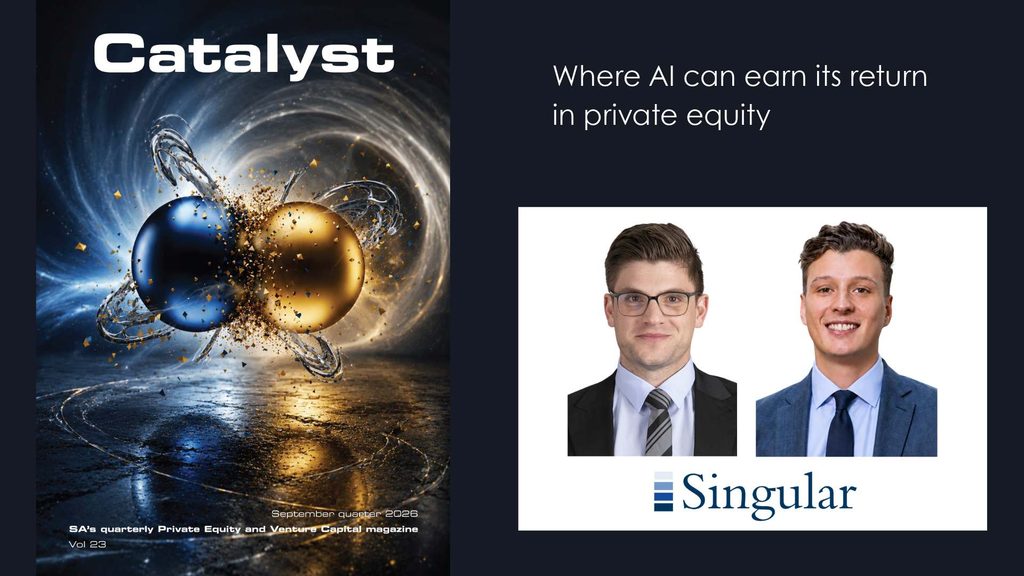
This article first appeared in Catalyst, DealMakers’ quarterly private equity publication.
DealMakers is SA’s M&A publication.
www.dealmakerssouthafrica.com