
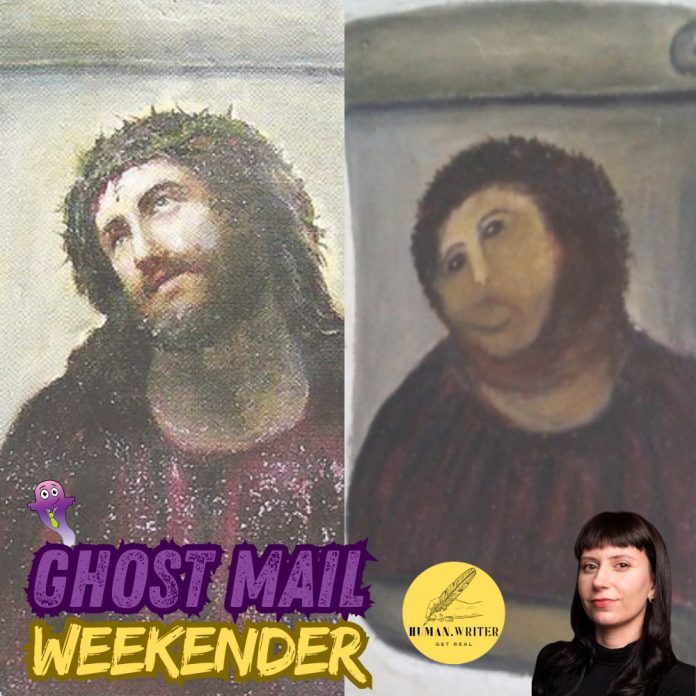
A failed restoration turned a forgotten church fresco into one of the internet’s most enduring visual jokes. What followed was an unexpected lesson in attention, economics, and how small towns make a profit from global ridicule.
You may have heard this story before: a well-meaning elderly woman in a small Spanish town tried to restore a faded fresco of Jesus on a church wall. Due to her lack of professional training, her efforts transformed the likeness of the Son of God into something that looked more like a startled monkey in a woolly jersey.
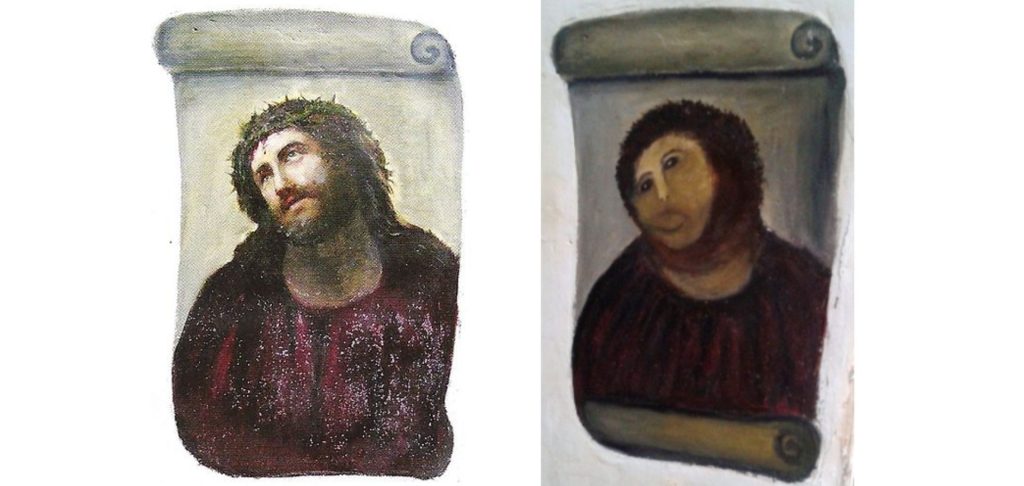
(Images: Wikipedia)
The internet did what it always does: it laughed, it shared, it exaggerated. Within days, a botched fresco in a tiny town had become one of the most recognisable images on the web.
That part of the story may be familiar. The real surprise, as it turns out, is just how much of an effect two minutes of internet fame can have on a small town’s economy.
How it all began
The Ecce Homo fresco in the Sanctuary of Mercy church in Borja, Spain, spent most of its life in relative obscurity. Painted around 1930 by Elías García Martínez (a professor at the School of Art of Zaragoza), it was a conventional portrait of Christ crowned with thorns, in the style commonly referred to as Ecce Homo, or “Behold, the man”. Martínez was not a resident of Borja, but frequented the town on his holidays and was therefore considered a parishioner of the church. He commented that his work was “the result of two hours of devotion to the Virgin of Mercy”.

But by 2012, the paint was flaking and the compassionate expression that Martínez had captured so well was quickly deteriorating. Martínez himself had passed away only four years after completing his painting, but his grandchildren still lived in the area and were aware that the painting was coming apart. In fact, one of his granddaughters had just made a donation towards its restoration when the priest told her that the painting had already been “fixed” for free.
The “fixer” in question was one Cecilia Giménez, an 81-year-old untrained amateur artist and parishioner of the church. She wasn’t an art restorer by any means, but she was someone who painted as a hobby and therefore knew how to hold a brush. Moved by the fate of the disintegrating painting, she decided to intervene.
Is that… a monkey?
The transformation was immediate and startling. The delicate features of Christ were replaced by something rounded, blurred, and oddly expressive. Cecilia’s intention was to stabilise and repair, not to reinvent. She worked in the open, during the day, and maintained that the local priest knew what she was doing. Her approach was practical rather than technical: she repainted sections of the face, allowing them to dry before continuing. At some point, she left the work unfinished and went on holiday for two weeks, assuming she would return and simply complete it.
Instead, photographs of the unfinished altered fresco began circulating online. The resemblance to a monkey was quickly noted, and with that came a new name: Ecce Mono, or “Behold, the monkey”.
News outlets picked it up during the quiet August news cycle and social media quickly amplified it. Within days, an obscure church in a small Spanish town had become an international punchline. Local authorities initially suspected vandalism, but when they realised the changes were the result of a parishioner’s restoration attempt, the reaction shifted from anger to uncertainty. The priest who greenlit the restoration started backtracking at pace, even considered covering the fresco to stop the ridicule.
For Giménez, the experience was painful. She insisted the work was unfinished and said the public reaction hurt deeply. Had she not gone on holiday, she argued, none of this would have happened. But by then, the image had escaped any possibility of correction.
Fame to fortune
As the laughter spread, something less obvious followed: interest. People began asking where Borja was. Then, they began going there.
Visitors arrived first out of curiosity, then out of fascination. They wanted to see the painting in person, to confirm it was real, to take photos, to stand in front of something they had only known as a meme. The church, faced with a sudden and steady stream of onlookers, eventually decided to charge a small entrance fee.
Crucially, the fresco was left exactly as it was. Rather than commissioning a professional re-restoration (or allowing Giménez to complete her work), the church preserved “Monkey Christ” behind protective glass. What had first been treated as an embarrassing mistake was now being treated as an asset worth managing.
Within a year, Borja had received around 40,000 Ecce Mono visitors, an extraordinary number for a town that previously welcomed only a fraction of that annually. Entrance fees and donations to the church generated more than €50,000 for local charities in the first year. Over time, visitor numbers continued to grow, and with them, the town’s visibility.
There’s always room for merch
As the influx continued, Borja adapted. Local businesses benefited from increased foot traffic, and some even started selling Ecco Mono merchandise. The church hired additional staff to manage visitors. Donations were used for practical community needs, including support for a home for retirees.
In 2016, an interpretation centre dedicated to the fresco opened, formalising its status as a cultural attraction. Modestly priced tickets generated steady income, some of which funded care for elderly residents and (ironically) maintenance of the church itself. What made the situation unusual was not just the money, but the source of it. This was not heritage tourism in the traditional sense. Visitors were not coming to admire technical mastery or historical importance in the same way that they would admire the Sistine Chapel or the Eiffel Tower. They were coming because of a story rooted in error, humour, and the internet’s refusal to let a good meme go.
Over time, even Giménez’s relationship with the episode began to change. In the immediate aftermath, the attention had been bruising: she spoke openly about how painful it was to see her work mocked around the world, especially given that the restoration had been unfinished and undertaken in good faith. But as the years passed and the tone around the fresco softened, so did her own view of what had happened.
Giménez wanted a cut
That shift in perspective led Giménez to make a more complicated claim. As merchandise featuring the now-famous image began to generate revenue, she sought a share of the profits, arguing that her intervention was the reason the painting had become valuable in the first place. She said she wanted her portion of the income to go toward muscular dystrophy charities, a cause close to home since her son suffered from the condition.
The request was not without controversy. Questions of authorship, consent, and artistic ownership quickly surfaced. The original fresco had been painted by Elías García Martínez decades earlier; the church owned the wall; the town now benefited from the attention; and Giménez had, quite literally, changed the face of the work. Untangling who was entitled to what proved difficult enough that the town’s mayor eventually stepped in to mediate, but after a lot of to and fro, Giménez was eventually awarded 49% of the merchandising profit. She died recently at the ripe age of 94, having achieved the unlikely feat of worldwide fame in the final decade of her life.
Banking on blunder
Today, this ill-fated fresco adorns the same wall it always has, but its value no longer lies in artistic merit alone (or, one could argue, in artistic merit whatsoever). Ecce Mono isn’t really a story about art gone wrong. It’s about how institutions respond when an accident turns into an asset – and how, in some cases, the most rational move isn’t to fix the mistake, but to learn how to monetise it.
About the author: Dominique Olivier

Dominique Olivier is the founder of human.writer, where she uses her love of storytelling and ideation to help brands solve problems.
She is a weekly columnist in Ghost Mail and collaborates with The Finance Ghost on Ghost Mail Weekender, a Sunday publication designed to help you be more interesting. She now also writes a regular column for Daily Maverick.
Dominique can be reached on LinkedIn here.


Great article. Well done.
Art is perhaps a fragile concept. In more ways than one.
Super article, thanks Dominique.