
BHP raises $4.3 billion through a streaming agreement (JSE: BHG)
And no – this has nothing to do with Netflix
BHP has completed a silver streaming transaction with Wheaton Precious Metals. This is a funding mechanism that is quite common in the mining industry. Through this deal, BHP has raised a casual $4.3 billion from Wheaton!
What does Wheaton get in return? BHP will need to deliver the equivalent of 33.75% of the silver produced by Antamina until 100 million ounces have been delivered. This will then reduce to 22.5% of silver production over the remaining life of the mine. To make it more confusing, this takes the form of metal credits rather than physical delivery of silver!
What’s in it for Wheaton? They lock in long-term exposure to silver at a discounted price to the current spot price. For the economics to make sense for them, they need to be bullish enough on silver to believe that the up-front payment of $4.3 billion is a small price to pay for the benefit of receiving discounted silver in future.
Wheaton’s entire business model is built around precious metal streaming transactions, focusing primarily on gold and silver.
Interesting, right?

Eastern Platinum expects to achieve break-even again in the first half of 2026 (JSE: EPS)
There were still substantial losses in 2025
Eastern Platinum has released its results for the year ended December 2025. Revenue fell 1.4% for the year and mining operating income increased by $0.9 million to $1.7 million. Technically that means mining operating income more than doubled, but we are working with small numbers here.
The group operating loss was $21.6 million in FY25 vs. $12.7 million the year before. That’s unfortunately not such a small number!
The net loss attributable to equity shareholders was $18.4 million vs. $12.8 million in 2024.
Although a non-cash impairment of the Mareesburg Project is part of the pressure on the numbers here, Eastern Platinum remains in a working capital deficit. Current liabilities are $56.9 million higher than current assets!
The company is kept alive by the support of its major shareholder. This is only happening because of the potential at the Crocodile River Mine, where production tonnages are increasing.
They are aiming for 40,000 tonnes per month in the first half of 2026. If they can get that right, they will break even again.
Exxaro has a new long-term deal with Eskom (JSE: EXX)
This supports the R5.2 billion expansion project at Matla Colliery
Exxaro announced a new long-term coal supply agreement with Eskom that will run from 2026 until 2043. They really aren’t joking when they say “long-term” with this one!
This seems to be the norm for them, as the previous contract ran from 1983 until 2023. This also shows us that it took a few years to get a new contract in place.
Exxaro will supply 9.3 million tonnes of coal per annum from the Matla Colliery to the Matla Power Station. The Matla Colliery locked in a renewed mining right and water-use licence in 2025.
Importantly, there’s a R5.2 billion expansion project at Matla to extend the life-of-mine. This contract with Eskom provides the economic underpin of that expansion.
MTN has introduced local ownership into the fintech business in Ghana (JSE: MTN)
Localisation requirements are typical in Africa
MTN announced that its subsidiary in Ghana (officially called MTN Scancom) has separated its mobile money business into a new company called MobileMoney Fintech (MMFL).
Under a law introduced in Ghana in 2019, there needs to be some local ownership of that business. This transaction achieves compliance with that law, as MMFL is owned by a subsidiary of MTN and The MTN Ghana Fintech Trust. You can think of it a bit like a B-BBEE deal.
Frustratingly, the announcement doesn’t indicate the percentage in MMFL that is held by the trust.
Nu-World flags a strong uptick in HEPS (JSE: NWL)
Full details will become available in the next few days
Nu-World has released a trading statement dealing with the six months to 28 February 2026. It’s good news for investors, with HEPS expected to increase by between 28% and 32%.
This implies a range for interim HEPS of between 224.5 and 231.5 cents. The share price closed at R28.00 before the long weeked. Remember that you need to work with annual HEPS to work out a P/E multiple, not interim HEPS. You can either annualise the interim HEPS by doubling it (a very simplistic approach), or you can take the more accurate approach of isolating the HEPS for the second half of the prior year and adding it to the first half of this year (a “last twelve months” approach that allows for seasonality).
What you’ll find is that Nu-World tends to trade in the mid-single digit P/E range. This is typical of JSE small caps.
Detailed results will be released on 9 April.
The IDC becomes a shareholder at Orion Minerals’ Prieska Project (JSE: ORN)
The deal is structured as a loan conversion
Orion Minerals announced that the IDC will convert its convertible loan facility into equity in PCZM HoldCo, the subsidiary that holds the flagship Prieska Project.
These types of structures are common in junior mining and riskier assets. Essentially, the IDC protected its downside risk by initially providing a secured loan, but retained some upside exposure through the option to convert it into equity.
When you are providing the money, you can (and should) have your cake and eat it!
Following the conversion, the IDC will hold 23.8% in PCZM HoldCo, which is an effective interest of 16.7% in PCZM. There will still be a loan of R272.4 million, but it will no longer be a secured loan.
The remaining unsecured loan is an important nuance to this deal, as it means that IDC moves down the pecking order if anything goes wrong. Glencore (JSE: GLN) and Triple Flag are the secured funders of the project.
Another way to think of it is that the IDC has seen enough to be willing to align itself more closely to the position that Orion Minerals shareholders are in. That’s good news for investors.
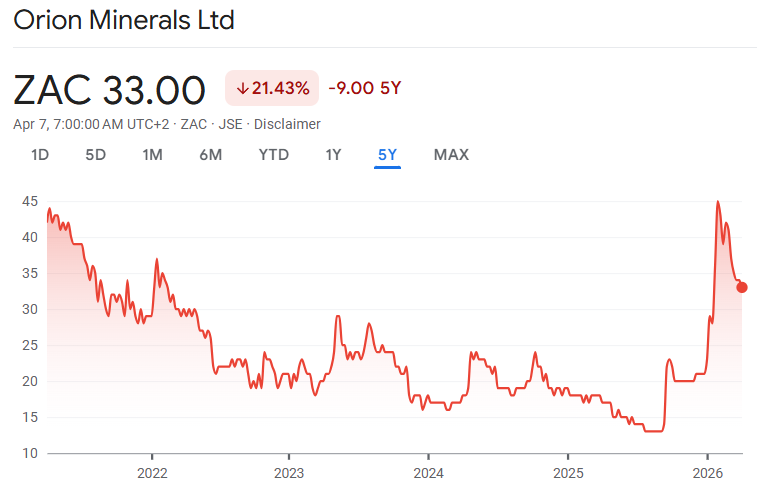
Here’s the Orion Minerals share price over the past 5 years:
How do you generally feel about investing in junior mining assets?
Nibbles:
- Director dealings:
- The CEO of Standard Bank (JSE: SBK) received share awards and sold the whole lot. The value of the shares net of tax (i.e. the portion that would’ve been “easy” to keep) was R9.65 million.
- Two directors of major subsidiaries of AVI (JSE: AVI) received share awards and sold the whole lot for nearly R4 million.
- A non-executive director of Thungela (JSE: THA) sold shares worth nearly R3.5 million.
- A prescribed officer of Nedbank (JSE: NED) sold shares worth R2.3 million.
- A prescribed officer of Sibanye-Stillwater (JSE: SSW) bought shares worth R590k.
- Sasol (JSE: SOL) had strong demand for notes issued by its US-based subsidiary. They offered $750 million in notes due in 2033, offering a coupon (payment) of 8.75% of the face value of the notes. The demand for the notes was $2.8 billion, more than 3.7x oversubscribed.
- Africa Bitcoin Corporation (JSE: BAC) announced that the proposed sub-division of the share capital was approved by shareholders. They will execute a three-for-one share split. Will this improve liquidity in the shares? Only time will tell.
- Trustco (JSE: TTO) is suspended from trading as they haven’t released financials for the years ending August 2024 and 2025. This is due to changes in the rules around audits of Namibian companies listed on the JSE (of which Trustco is the only current example). Trustco is in the process of appointing Nexia SAB&T as group auditor for the JSE-compliant auditor, along with a Namibian-registered audit firm to comply with the Namibian Companies Act.
- aReit Prop (JSE: APO) is still trying to finalise the financials for the years ended December 2023 and December 2024. They are also looking to appoint new auditors. This company really has been a disastrous listing on our market.
- Efora Energy (JSE: EEL) has released a further cautionary announcement regarding negotiations that might have a material effect on the share price. I must point out that the stock is suspended from trading.
- The chairperson of the board of Sebata Holdings (JSE: SEB), Greg Morris, has resigned after 28 years with the company. His replacement hasn’t been announced yet.