
The Backrooms began as an anonymous 4chan post and became the most surprising horror movie hit of the year. To understand why an empty room terrifies us, we have to look at what’s hiding behind the wallpaper.
On May 12, 2019, an anonymous user started a thread on /x/, 4chan’s paranormal-themed board. For those who are unfamiliar with 4chan – it is an anonymous imageboard website, split into numerous “boards” where users discuss topics like video games, anime, cooking, and politics without registering accounts. The prompt on the thread asked users to “post disquieting images that just feel ‘off’. The thread was accompanied by the following photograph:
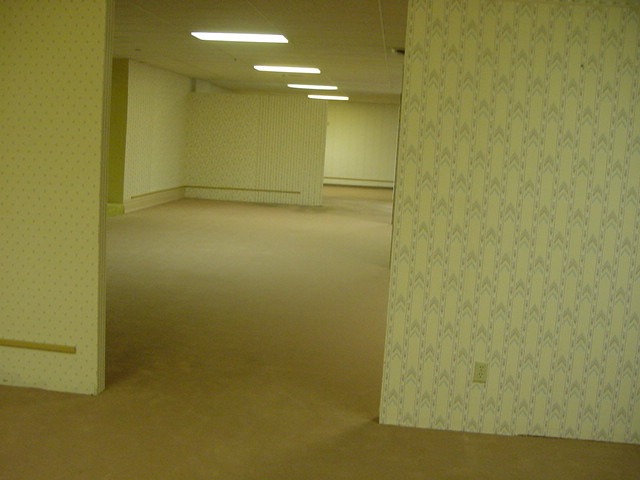
To you and me, this photo may look completely unremarkable: it’s just a subdivided room, wallpapered in yellow and lit by fluorescent lights. But to participants in the 4chan thread, it signalled something ominous. Before long, another anonymous user replied to the post with this:
“If you’re not careful and you noclip out of reality in the wrong areas, you’ll end up in the Backrooms, where it’s nothing but the stink of old moist carpet, the madness of mono-yellow, the endless background noise of fluorescent lights at maximum hum-buzz, and approximately six hundred million square miles of randomly segmented empty rooms to be trapped in. God save you if you hear something wandering around nearby, because it sure as hell has heard you.” – Anonymous, 4chan (May 13, 2019)
That raises the hair on the back of your neck a little bit, doesn’t it? And in case you’re wondering, to “noclip out of reality” in an internet idiom for falling through a glitch in the physical world.
The combination of the photograph (which was eventually traced back to a nondescript furniture store in Oshkosh, Wisconsin, captured mid-renovation), the creepy thread post and the name “The Backrooms” was all it took for the internet to create a brand new genre of horror.
If the term sounds vaguely familiar to you, that may be because you heard about the Backrooms film that recently landed in local cinemas. Or maybe you’ve even seen the trailer:
The making of the movie itself is a great story. It is the directorial debut of 20-year-old Kane Parsons, who first started making amateur Backrooms-themed horror shorts for his YouTube channel in 2022. What started as a hobby has now led to Parsons becoming the youngest director in history to top the box office with a $118 million global opening.
There’s a lot we could dig into here: the scaling of ideas on message boards like 4chan into the stuff of urban legends, or the strange pathways that some images follow once they’ve been posted online, or even the chutzpah of Kane Parsons as he shepherded his content from small screen to big screen. So many tempting threads to pull, but alas, so little time.
So let’s move on to the main question that the Backrooms phenomenon forces into the open: why are we so afraid of empty rooms?
The threat of an empty space
To understand how a room full of nothing became a horror movie antagonist, we need to understand two much older ideas: the liminal space, and the uncanny valley.
In 1909, anthropologist Arnold van Gennep used the word “liminal” to describe a period of transition, specifically the in-between moments when a person moves from one societal identity to another. A newly engaged woman is an example of someone in a liminal state: no longer only her parents’ daughter, but also not yet someone’s wife.
Other thinkers and writers later stretched the idea of the liminal to cover spaces. Picture a school at dusk, after everyone has gone home. The desks stand ready, but there is no-one to teach. The classroom has a clear purpose that it cannot fulfil when it is empty; it is therefore a space in transition – a liminal space. The same goes for a shopping mall after hours or a deserted parking lot. These are spaces that are comfortable and familiar when full of people, yet distinctly foreign and unsettling when empty.
But why should emptiness make us nervous? If no-one is there, what exactly is the threat?
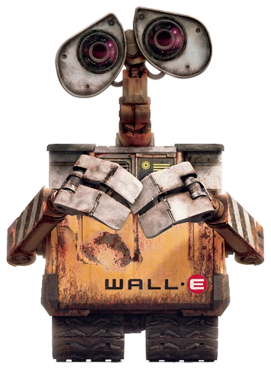
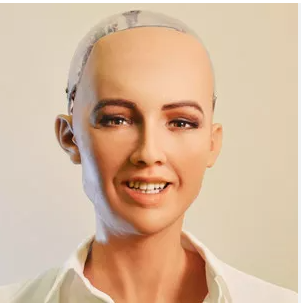
This is where the liminal meets the uncanny valley. In 1970, the roboticist Masahiro Mori observed that as machines are made to resemble humans, our affection for them rises – until a certain point, where it suddenly plunges into revulsion. A clearly mechanical robot (like WALL-E) is endearing, while a near-perfect replica that is somehow not quite right (like Sophia the robot) can be horrifying.
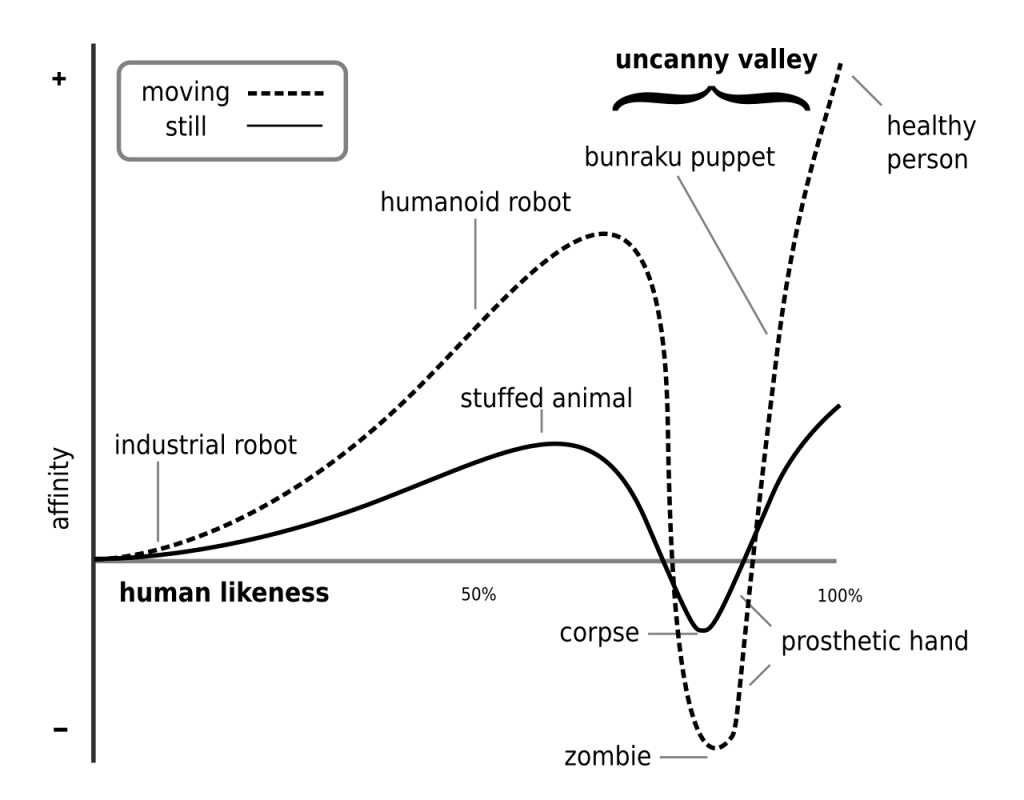
The almost-human disturbs us more than the obviously artificial, because it trips a primal alarm. As human beings, we are pattern-matchers, constantly predicting our surroundings. Our brains say: this is a face, so it will blink; this is a hallway, so people will walk down it. Both the liminal space and the uncanny valley object present a near-perfect match that fails on one variable, and that misfire registers as a threat instead of a neutral error. We feel unsettled because we have the sense that something is impersonating the familiar.
Maybe fear is warranted
There are the psychological reasons why we fear the Backrooms… and then there are, unfortunately, a few incidents that prove that perhaps our fear is sensible.
In 2017, the body of a 71-year-old man named Bernard Gore was discovered in the back passages of the Westfield Mall in Bondi, Australia. He was reported missing three weeks prior, when he had arranged to meet his wife and daughter at the mall but never showed up. It is believed that Mr. Gore accidentally entered the back passages of the mall through a door in a stairwell, and that he became so disoriented that he couldn’t find his way back out. The coroner’s report pointed to his cause of death as dehydration.
After the incident, Sunday Telegraph reporter Sarah Keoghan conducted a test of the enormous Westfield Mall’s back passages and maintenance tunnels, which she found confusing and exhausting. Ms Keoghan found there were only two points of escape – the roof carpark or the basement six flights down – and that no levels had emergency phones, clearly marked directions towards exits or maps. In total, the back passages of the mall were made up of 14 kilometres worth of emergency fire stairs, maintenance corridors, and utility accessways!
Mr. Gore wasn’t the first person to get lost in the Westfield Mall tunnels either. Earlier the same year, Loretta Feeney and her mother became trapped behind a locked door in a Westfield stairwell. They had apparently been looking for stairs as a nearby elevator was out of order. The door they entered through only had a warning that read “Do Not Obstruct”. When the door closed behind them, they realised that it had no handle on their side.
Fortunately, Ms. Feeney was able to get sporadic reception on her cellphone, which she used to phone centre management. From there, a security guard talked them through the maze of tunnels until they arrived at an exit. They got lucky. Mr. Gore, unfortunately, did not.
Behind the familiar
Here is the strange thing about the Backrooms. The subgenre was supposed to be a fantasy, a fictional dimension you fall into by “noclipping out of reality”, a place that exists only in grainy YouTube videos and the collective imagination of a 4chan thread. And yet the feeling it captured was real all along. Bernard Gore did not need to glitch through the walls of the world. He simply walked through the wrong door in a Bondi shopping centre.
That, perhaps, is why the Backrooms struck such a nerve that it travelled from an anonymous post to a $118 million opening weekend in the space of seven years. The name may be new, but the fear is very, very old. It’s the suspicion that the familiar, well-lit world is only a thin surface, and that behind it lies something endless, indifferent, and built without us in mind.
So the next time you find yourself alone in a space that should be full – an office after midnight, or a stairwell, or an empty parking lot – and you feel that small, ancient prickle at the back of your neck, don’t be too quick to dismiss it.
Some part of you has simply noticed where you really are.
About the author: Dominique Olivier

Dominique Olivier uses her love of storytelling and ideation to help brands solve problems.
Her first book, Lessons from Loss, has been published by Penguin Random House.
She is a weekly columnist in Ghost Mail and collaborates with The Finance Ghost on Ghost Mail Weekender, a Sunday publication designed to help you be more interesting.
You can learn more about her work at dominiqueolivier.com and she can be reached on LinkedIn here.


I feel for the family of Mr. Gore for such a tragic incident. My take is that the professionals behind the creation of Westfield Mall should take the bulk of the blame. There is no doubt in my mind and supported by the facts you alluded to here Dominique, that the backroom space at Westfield Mall is a death trap for the most vulnerable. It is our hope that sufficient compensation has been paid to the victim’s family from all involved- architects, engineers, centre managers right up to the government which approved and certified the mall as a safe place for shoppers.