
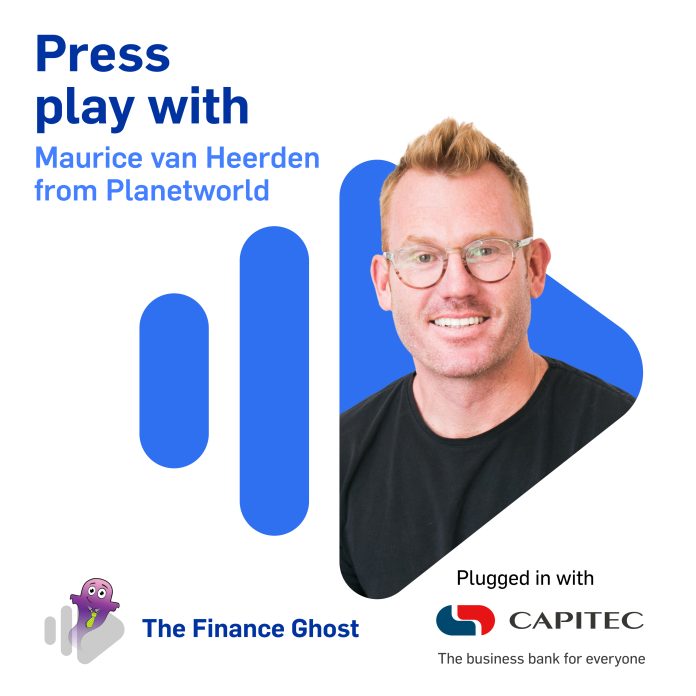
In Season 2 of this podcast, The Finance Ghost talks to South African entrepreneurs about the ideas, choices and turning points behind building a business from scratch.
Listen to the podcast:
From humble beginnings selling Bluetooth car kits to building Planetworld into a diversified importer and distributor of 78 global brands, Planetworld co-founder and CEO Maurice van Heerden shares a refreshingly honest view of what it takes to scale a business.
In this episode, Maurice shares why culture and curating a team of winners are key to thriving in South Africa’s tough market. While the product range varies from musical instruments and pro audio to smart home tech and consumer electronics, the foundation of this business is its people.

Episode 3 covers:
- How Planetworld grew from a small family business into a distributor across multiple industries
- Why focusing on what you can control is critical in volatile markets
- Building a culture that celebrates trying (and failing) rather than not trying at all
- The role of people, partnerships and saying ‘no’ in scaling a business
- Why most entrepreneurs underestimate the 20-year journey
- The power of understanding your client deeply and owning that relationship
- Expansion ambitions across Africa and beyond
- Lessons from Capitec, Netflix and other culture-driven success stories
- Why entrepreneurship isn’t for everyone
The Finance Ghost plugged in with Capitec is made possible by the support of Capitec Business. All the entrepreneurs featured on this podcast are clients of Capitec. Capitec is an authorised Financial Services Provider, FSP number 46669.
Read the transcript:
The Finance Ghost: Welcome to this episode of The Finance Ghost Plugged in with Capitec, where I get to chat to some really interesting South African business owners and understand more about their journey to get to where they are today.
In this episode, I am thoroughly looking forward to speaking to someone who is no stranger to the audio world and podcasting. It’s quite rare that I get to chat to someone who has a better microphone than me, better headphones than me and a lovely Shure background there.
That is Maurice Van Heerden, co-founder and CEO of Planet World. Maurice, thank you so much for doing this. I can’t wait to chat. I actually know a fair bit about this industry based on my upbringing and my dad having been in this industry forever.
So, lots and lots of cool nostalgic memories of going to music stores, helping to deliver stuff; really growing up in an entrepreneurial household in this space. Thank you for doing this. It’s great to have you.
Maurice Van Heerden: Thanks. Appreciate it. Yeah, it’s really great to be here and share our story and looking forward to a great conversation.
The Finance Ghost: Yeah, absolutely. So, let’s dive straight in. We are all very accustomed to hearing about how tough it is to grow a business in South Africa. As an importer and a distributor of products, as Planet World is, you really do have to deal with so much of the tricky stuff, right?
You’ve got to deal with the rand, which jumps around all over the place. It’s been better recently, but we all know how hard it’s been over the years. Delays at the ports, import tariffs. It’s really a Venn diagram of so many things that make it difficult in South Africa, and yet here you are.
I think just to set the scene, give us an overview of the Planet World business, so people know what you’ve built; and maybe just some more context to the journey over what is essentially two decades, right?
Maurice Van Heerden: 18 years ago I was a schoolteacher in the UK. My brother was working with a small business called Planet Electronics, and he convinced me to come back.
Collectively with my two brothers and my father, we bought the business. And at the time, they were selling Bluetooth car kits and parking sensors. That’s kind of where the journey started.
But today we’re a pretty significant importer across several different industries. We have roughly 200 staff across our different locations in the country (we have four). We supply roughly 3,000 customers on a monthly basis. And we do that across a bunch of different verticals.
So, the first is the one that you’re close to, which is musical instruments. We have a big portfolio of musical instruments that we supply across music stores. We then also have a pro audio division, which is essentially any large-format sound.
So, if you think of the sound that goes into a stadium, into a concert arena, into a house of worship, or into the education sector, into schools and so on, any large gathering of people, the audio and heavy equipment required for those is what we import and distribute.
We also have a residential business. If you think of any high-end home audio, home automation and lighting and security, we have a business that services those needs.
And then we have a very strong retail business where we have recently mostly focused on audio, but we’re also starting to focus increasingly on consumer electronics, especially smart products around smart cleaning and so on that we import and distribute to retailers across the country.
And then lastly, we’ve got an automotive business. The automotive business is actually how we started. Back in 2008, we started importing infotainment systems for vehicles, and that’s really how the business got on its feet.
Today we’re the largest importer of car audio. We import six or seven leading international brands and distribute those across retailers and fitment centres and dealerships in the country. We’re very diversified, and we work through a lot of complexity.
But I suppose to your point, to give you a very simple answer of how we deal with the complexity, and certainly the outside influences, is that I really just don’t care. I don’t really think about it.
All sorts of things like currency fluctuations and import tariffs and duties are totally out of our control. And so, as a business, we try and focus on the things that we can control. We are all subject to this, and all the competition that we have in the market are all subject to the same challenges, and they’re totally out of our control. So, wasting any of our time being concerned about them seems like a waste of time to me.
The things that we can control, of course, are great customer service. We’ve got 3,000 customers that buy from us on a monthly basis. And these are businesses, so they require our products and services to survive. We take the customer experience really seriously.
We also take our people really seriously. And we try and create an environment that’s fun and challenging and exciting, where people really belong and feel like they’re achieving something.
And then, of course, we have great relationships with suppliers, and we manage those closely, and we work very closely with our suppliers to develop the South African market.
And so those are things within our control, and that’s kind of what we focus on.
We also really cherry-pick the brands that we work with. So, we’re very fortunate to be in a position that we are a desired distributor by international suppliers. We say no a lot more often than we say yes.
In order for us to take on a product, we need to really love the product. Our values need to align with the supplier. We need to feel that the product really is leading in its market and that they’re really progressive and building a great business we can piggyback off.
And, of course, that our values align as a business, that we know this is a partner for the long term, and we enter into that partnership with the best potential outcomes for both them and for us. Those are the things that we can focus on. And that’s really what our energy goes into.
The Finance Ghost: Love it. There’s so much cool stuff in there. This is exactly why entrepreneurship is so exciting, right? Because when you go and read about the biggest companies in South Africa, they will so often blame the economy for slow growth.
And half of it is true, because it is very hard to grow at that size if the economy is not in your favour. But some of it is just a cop-out by listed company executives, as opposed to people who need to eat what they kill, right? Like entrepreneurs. That’s part of why entrepreneurs are just so great.
And it’s exactly as you’ve described it there. It’s focusing on what you can control, not being hamstrung by all of the external reasons why something won’t work. Obviously, you have to be careful. There’s no point in running into a burning building and thinking that it’s going to work out well. But if you just do the right stuff over time, then you’ll get there as you’ve done, which is fantastic.
It’s two decades almost – about 18 years I think you said. And it is amazing to me how often I’ve seen it in my advisory career. Even now speaking to entrepreneurs, two decades seems to be the amount of time it takes for a business to really become a settled thing of value, that can exist beyond the original founder.
It seems to take that long. I’m not sure what it is about that length of time. I’m only in year six of The Finance Ghost. So, I don’t know yet. But if you think back on your two-decade journey, what do you think it is that makes it take that long?
And maybe as part of that, you can also just speak to the people around you. You’ve spoken about this team of winners, but it sounds like there are other execs involved, there are co-founders. What does that journey really look like for you?
Maurice Van Heerden: This is by no means a one-man enterprise. As I mentioned, we’re a team of roughly 200 people. We’ve got an executive team; we’ve got quite an extensive management team.
I do think, and I can only speak for my instance, the reality is when you start the business, you’re typically naive and quite stupid, to be totally honest. You don’t really know the levers that you can pull to make your business successful. You screw it up a lot. And I could tell you countless stories of things that I’ve screwed up, but it’s part of the journey.
Something that’s potentially a personality trait, not something that I think you necessarily can learn (maybe you can, but in my experience, you either have this in your personality, or you don’t), is to not have this fear of failing. And by failing, I don’t mean mass failure and the entire business closes, and you have to sell your house and live on the street.
What I mean is trying things and then being so pessimistic that you want certainty of the outcome. And so in fact, what you don’t do is try. You rather just kind of stay within your safety net.
I think that’s a personality trait that’s consistent with entrepreneurs in general – they’re not afraid to try.
In fact, we’ve got an internal culture document. One of the things about maturing over time is that in the early days, I never even thought about culture, what kind of business we wanted to be and how we wanted people to perceive us. And if we as a business took a look in the mirror, what did we want to see? I never even thought about that. It didn’t even cross my mind.
But one of the things that we have now, we’ve got like a Planetworld standards document. And one of the standards is that we celebrate failure. And hidden in that sentence is that what we are really hard on is not trying. Never in this team at Planetworld are people punished for failure. Where people are taken to task is when they don’t try.
And so, I’d much rather have a team of people that are constantly pushing the edge and trying new things and trying to approach problem-solving in a unique and different way and screwing it up. I’d much rather have that than a team of people that are hiding behind a computer and not trying to solve the complex problems, because the reality is somebody else is going to solve them and then you’re stuck behind.
But this all sounds like wisdom now, but it has taken 20 years to get to the point where I and my executive team and management team are very, very clear about these things. And we’ve got a very clear culture and dynamic and way that we work that really works within our industry and within our business.
When you’re young or when you’re just starting, it’s very difficult to know those things. To some degree, that’s where people will lean on mentors or their formal education for guidance. But in reality, the real world is a lot more complex, and it’s a lot more challenging and difficult. And you will have to take on challenges that no university can prepare you for.
And I think this inherent non-fear of failure is probably the strongest quality that you can have.
To speak to your point of the 20 years, as you mature as a business, you start to figure out what you’re really good at and what you’re not so good at. And you start to lean into the things that you’re really, really good at. And me as a leader in the business, it’s also very important for me to know what I’m not good at.
There are certain things that I’m good at, but there’s a hell of a lot that I’m really, really not good at. And over time, I’ve managed to bring people in not only as management and as executives, but also as owners in the business who are really, really good at the things that I’m not good at.
I’m a big-thinking guy. I love risk, love the next big opportunity. I’m hugely optimistic about the world around me, and I see success everywhere. But unfortunately, life doesn’t work like that. So, I need people around me that will also just ground me and give me the realities and lean into the facts and the data so that I can make strong decisions for the business.
And I’ve been very lucky that I’ve got a team of absolute rock stars around me. We all complement one another, but inherently we all have this same very ambitious drive to win.
That’s really what the foundation of this business is. Whether we sold toilet paper or musical instruments, we would be successful at it because of our drive and our culture and the way that we work.
The Finance Ghost: Again, so much wisdom in there, which is fantastic. I love that reference to fear of failure. And like you say, it’s not enormous, life-changing, life-ruining failure, like I’ve lost everything. Everyone should be fearful of that, clearly. But I do agree with you that if you are a risk-taking person, you’ve just got a way better chance of cracking it as an entrepreneur.
And there’s nothing wrong with this, but if your idea of success is to go and have this very long career in one place and you kind of work your way up the ladder and everything – sometimes I’m jealous of those people because it strikes me as a simpler life. Look, I’m sure you’ve had these moments as well where you look at what you’re doing, you’re like, why am I like this? Why is this inside me? You know? [Laughs].
Maurice Van Heerden: It’s also a very boring life, in my opinion. I agree with you. Some people find comfort in predictability and security.
The first thing I say to any senior person that’s coming into our business, and sometimes it scares very talented people off. But I always say, if you’re joining Planetworld because you’re looking for job security, please don’t come.
And I say that because we’re not the type of business that offers job security. What we offer is a lot of freedom to solve very complex challenges in your own way and to be super creative about how you do it. That’s what we offer. So, when you work here, you’ll be very challenged.
You will get a lot of freedom, be given a lot of responsibility, and of course with that, some expectation. And if that excites you, then brilliant.
But it doesn’t excite everybody. Then I always say, well, I’m sure you could find a job at ABSA because you probably work there for 30 years and do well, climb the corporate ladder slowly. This is not that kind of place. And I don’t think any entrepreneurial, truly entrepreneurial environment is like that. I just don’t think it works.
The Finance Ghost: No, absolutely. Look, just to be clear, you know, the reference to ABSA there is not because of who’s sponsoring this podcast. It’s really just corporates that have that slightly older-school culture. And it is like job security, safety. There are a lot of people who crave that. To be honest, I think most people crave that.
And it’s really just this crazy few who want to go out there and disrupt and do these things. And maybe that’s why you bank with Capitec hey? Because that DNA is firmly there, based on the experience I’ve had.
Maurice Van Heerden: We do an annual management get-together. And in that get-together, we look at the year ahead and some of what our big audacious goals are. And last year I actually presented the Capitec story as part of our executive session.
I’d been at a talk at Capitec a few months before. Then I was absolutely blown away by the way that they’ve managed to build this business of enormous scale, yet retain this loose entrepreneurial style, which is very, very uncommon, and especially in banks.
Banks by their very nature are quite rigid. They’re complex businesses. Yet Capitec was this extremely entrepreneurial start-up kind of environment, but in a very significant big bank. And they’ve since extended that into business banking. Obviously we bank with them and very proud to be banking with them.
But another good example would be Netflix, which also retains – a lot of our culture stuff is really just plagiarised from Netflix. You can build significant businesses that perform by all the measures that you would be expected to and yet retain this very loose entrepreneurial style of doing business, where you’ve got great people that are all working towards a common cause.
And because you’ve got great people, you don’t have to create a thousand rules to protect yourself from the stupid people [laughs] because you don’t have any. You’ve got real talent in your business that’s super ambitious. And that’s very much something that we’ve tried to imitate.
The Finance Ghost: Oh, I love that. That’s very, very good. I actually have TJ Strydom’s book on Capitec on my desk. And I always remind myself what I took from that book was if you just focus on the thing you’re really good at and you focus long term on it, you can do exceptionally well.
Every entrepreneur at some point doubts themselves and goes, “Oh, I need to do 100 other things. Maybe I should go into this or go into that.” – or it’s a slow month or whatever. You’ve just got to keep that true north.
Yours sounds like culture, actually, above all else. I was going to ask you with all these product categories and your finger in so many pies and yes, audio is the thing that just brings it all together.
What actually brings it all together maybe is just the culture, actually. Maybe that’s what makes Planetworld so interesting. You could almost sell anything. As you say, look, you’re selling cool stuff. I mean, let’s call a spade a spade. Musical instruments, audio, those epic home systems. Very fun products.
But it’s the culture, right? That’s actually what ties it all together. It’s not the product range.
Maurice Van Heerden: I believe so. So early on it’s very difficult to establish yourself as a recognised distributor in South Africa. Especially when you don’t have large amounts of capital behind you, which we didn’t have. I was a schoolteacher and my brother was a waiter.
So, it takes a lot of time and a lot of hard work to get going. But once you have a little bit of a name for yourself, you just need that one product that retailers like, or the one product that has quite a lot of demand in the market that kind of sets you off on a journey.
But now we distribute 78 global brands. I would be very surprised if there are any distributors in the country that do more than that. And the thing that allows us to deal with the complexity and allows us to deal with all the different industries, is that our culture remains the same throughout, and they are also very different industries.
You come from a musical instruments background. That’s guys with ponytails and Led Zeppelin T-shirts; relaxed. And there’s a certain way that they communicate with each other. There’s a whole vibe about that industry.
The Finance Ghost: In my dad’s case, it was an Afro and Led Zeppelin T-shirt straight out of the 70s. It’s amazing. Those photos make me happy.
Maurice Van Heerden: I can see where the afro comes from! [laughs] So that’s one industry. But on the other side we do pro AV business, so we basically service corporate South Africa with all of their boardroom solutions, video conferencing equipment and so on. And that’s stiff. I always say that’s pointy shoes and button-up shirts.
We at Planetworld maintain this – we’ve got a very casual, loose style. When somebody from our business turns up, it’ll likely be in a cool, unique-design Planetworld T-shirt and jeans and a pair of Jordans or something. They will be a highly competent person that’s genuinely interested in delivering the best value for you as humanly possible.
A high level of integrity – they’re not there to siphon money off you. They’re there to give you the best possible solution that we can give. But they are going to be very ambitious. They’re going to push you to be ambitious about your project and your plan. That’s what translates across all the industries.
Industries that are typically one way or another way. What people really care about is doing business with people that are honest and truly want what’s best for them. Doing it to a high degree, and a high standard, and knowing that when the proverbial hits the fan, I’ve got somebody that’s going to support me and have my back.
That’s the culture that we drive throughout the business. And I think we could sell toilet paper, cosmetics, I think we could sell anything because that universal truth is true, no matter what it is that we’re selling.
The Finance Ghost: Yeah, it’s so interesting. And the route to market here is also fascinating because you spoke earlier about your dealer base. Very important to you. That’s how you get these products out broadly. You’d never have the capital to go and open all of those places yourself. It just wouldn’t make sense.
But you’ve also got these experience centres, which is obviously where you have invested. So, from the outside looking in, my guess would be that there are certain products that you need people to see and touch, in an environment that is more controlled, hence the experience centres.
And then there’s other products where people can see and touch them adequately in a music store or in a car audio store or whatever the case may be. Is that how you choose what gets an experience centre and what doesn’t?
Maurice Van Heerden: We have two different methodologies at play. One is our retail business, where we supply hundreds of retailers around the country with equipment. And so, the retailer is the showroom.
We create a beautiful point of sale or demonstration within a retail store. And they, of course, have feet walking through there throughout the week. And people get to experience our products in the way that they should. That is by far the easier way.
The second part of our business we call project-based business. So, it’s relatively long-pipeline business. And a good example would be if you were building a home and you know that you want a relatively high level of AV equipment throughout the home, and you want it to disappear into the home (so you don’t want freestanding speakers and things all around the house).
So now it becomes a project. And so, at the stage when your architect’s designing the home, he needs to meet with somebody to go and design all of these elements into his drawings. And that’s really where the journey starts on a project like that.
But in order to do that, the end user or the homeowner needs to see, well, what’s the finished picture going to be if I invest all this money? And that’s quite difficult to showcase.
So, what we’ve done is we’ve created these experience centres where we basically tell the story. We become your imagination of what is possible in your home, at your church, at your school, in your boardroom, and we sort of paint that whole story.
And at the point at which the end consumer and the architect want to start looking at what’s available, they would then come to our offices and get a full demonstration from very entry-level equipment all the way up to the ultimate experience. And that’s why we created these facilities.
They’re hugely expensive, they’re difficult to manage. If you looked at them purely on a P&L, you would tell me I’m crazy. The intended consequence, is, of course, to create more business. The unintended consequence is that customers love spending time in our offices because they’re beautiful, they’ve got all this equipment.
And we increasingly get businesses that genuinely just want to do business with us because they just love our facilities and our approach and that we’ve got this incredible showroom that absolutely blows them away. And on the first interaction they go, “Wow. I just – I’ve never seen anything like this. I want to be part of this”.
And that’s the intangible benefit of building these facilities. I would say the last thing is that it really inspires our teams because it keeps them on the cutting edge of what is possible in these different environments. And also, they’re super proud of what we build and how we execute from an experience level.
So, there’s a lot of financial reasons to do it, but solely those don’t entirely make sense. There are also just cultural reasons to do it. It really entrenches you in these industries and they’ve been hugely successful for us. And in fact, we start our next renovation in our showroom on Monday. So here we go again.
The Finance Ghost: So, Maurice, you’ve shared so many excellent, excellent stories here and insights into how to actually build a business like this. I love the point on culture, and building this culture of winners, I think that comes through 100%, and the business is a winner. So clearly it works.
But it’s all about the future, right? I think any entrepreneur tends to focus on the future rather than where we’ve come from. Very few entrepreneurs I meet sit there and pat themselves on the back for what they’ve done. They’re always looking ahead. It’s just what makes us entrepreneurs.
So, as you look ahead over the next few years, what is the next big step for the business? What is going to make a really big difference to the extent, obviously, you’re willing to talk about it publicly. What’s the big dream here?
Maurice Van Heerden: I’m 42, I’m very early in my career and very, very excited about the future for the business. At the position we are in now, we’re really like a 100-metre athlete who’s prepared for the Olympics and the tournament’s now starting.
We’re well conditioned, we’re in fantastic shape. Our diet’s right, our mindset is right, and really, we’re ready to sort of jump and go and win the opportunity that we see in the market for sure. We’re very, very good at telling brand stories. What we’ve done particularly in our retail business is we’ve become very, very good at speaking to high-income groups.
So, if you think across our brand portfolio, we distribute a brand called Sonos, which eight years ago nobody really knew what it was. Today it’s by far the largest premium audio brand in the country.
Through that process, we know where those high-end consumers shop, we know what their activity online is, we know what kind of influencers and advocates they follow. We know so much about that consumer, and so really our sort of next five years is about owning that customer to an extent.
So, the products and services that these customers, medium- to high-net-worth income homes require, is really the gap that we want to fill. And so, we’re constantly looking for international brands that appeal to these customers, and we know exactly how to take those brands to market. So that’s one end that we’re very focused on.
We’ve recently launched a consumer electronics brand called Roborock, which is a premium floor-care business, totally out of our audio wheelhouse. But they’re the largest manufacturer of robotic vacuum cleaners in the world. And it’s been an enormous success.
And the reason it’s been an enormous success is because we know exactly how to reach the customer in a way that they are comfortable, and they trust our communications and so on. And so, we’re looking to add more product to that portfolio.
And really the only guiding principle for us is that it needs to appeal to a mid- to high-end type of customer. And two is it needs to be really technology driven.
So, we’re really, really interested in robotics, we’re interested in AI, we’re interested in products that are saving people time, making life easier and that are sexy.
And the second thing I will say is that across our project-based business is that we’ve got very big ambitions to expand into Africa. So, we do quite a lot of business, probably 5% of our revenue to 8% of our revenue, is in Africa now. We want that to be 50% over the next five years. And Africa is a difficult place to do business, right?
It’s difficult for South Africans to do business in Africa, but it’s particularly difficult for the US or the East to do business in Africa. So, we want to be that gateway of taking brands into Africa as these markets are developing and growing, that we really establish ourselves at the forefront of bringing technology into particularly Sub-Saharan Africa.
The Finance Ghost: I love that, Maurice. Well done. That’s a really cool strategy. And a lot of the people listening to this podcast and reading Ghost Mail would definitely be in your high-income category where they’ve got some pretty cool setups at home.
So I would encourage you, if you are listening to this, it’s time to, shall we say, upgrade your leisure space. Go and check out planetworld.co.za, reach out. Check out the experience centre. It sounds very, very cool.
And Maurice, from my side, just congratulations and thank you for sharing such an upbeat description of what it’s like to actually build something like this over 20 years. It’s very clear that you have had, and are still having a lot of fun and, like you say, you’re still early in the journey.
So, I’m slightly jealous of the people who get to work with you because I think it sounds like a very cool culture and those cultures are hard to find.
And all the best. It’ll be very nice to actually just stay in touch and see how the thing progresses because I think it’s going to go very far. So well done.
Maurice Van Heerden: Awesome, Ghost. I appreciate it. It was a real pleasure.