
In this edition of Ghost Bites:
- Kumba: a victim of the rand (and several other things)
- A big step forward for Nedbank in East Africa
- Reinet’s underperformance vs. British American Tobacco is incredible to witness
- Sasol’s business performance metrics for FY26 look encouraging
Kumba: a victim of the rand (and several other things) (JSE: KIO)
Cyclical stocks are no joke
Kumba Iron Ore has released a trading statement for the six months to June 2026. Production dipped by 3% in an environment of heavy rainfall. The impact on sales was less significant, with sales volumes only down by 1%.
The rand was actually the bigger issue, as our impossible-to-kill currency gained 11% against the US dollar. When combined with a slightly lower realised free-on-board export iron ore price (measured in USD), Kumba faced a world in which the rand price of its products was considerably lower.
There’s one more thing we need to talk about in terms of year-on-year comparability: a payment received from Transnet in the prior period that didn’t repeat in this period.
Add it all up and you get a decrease of between 30% and 35% in EBITDA. Kumba goes on to point out that 96% of the decline in EBITDA is thanks to the rand and the Transnet payment, rather than the dip in production and sales.
Either way, shareholders will have to stomach a decrease in HEPS of between 39% and 43%.

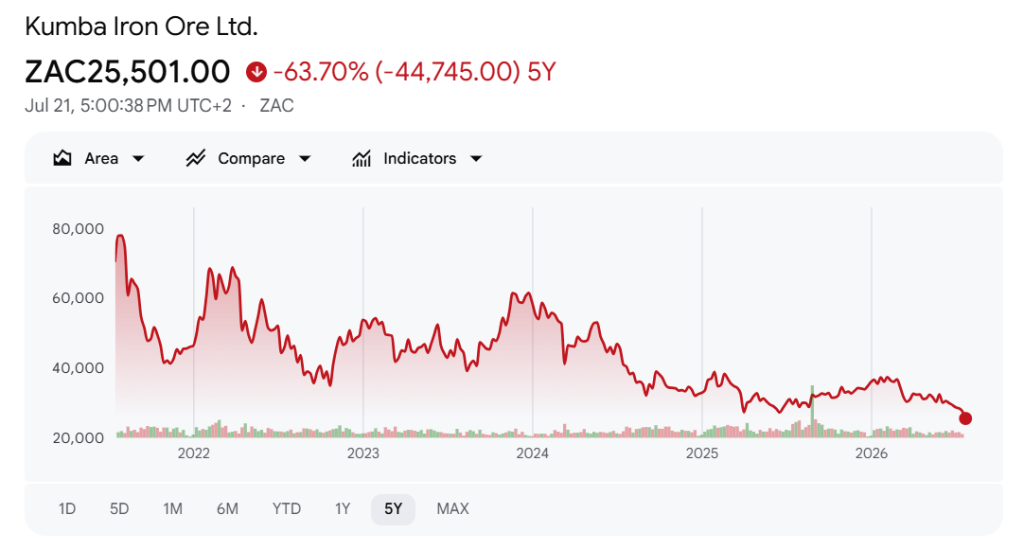
Ghost Bite: The share price has fallen 21% in the past year. Let this be a lesson to those who chase dividend yield, with the total return at negative 13% over 12 months. A juicy trailing dividend yield means very little in a cyclical downturn. The picture doesn’t improve over a longer period, either:
A big step forward for Nedbank in East Africa (JSE: NED)
Will this bring them a taste of the success enjoyed by the likes of Standard Bank (JSE: SBK) on the continent?
For many years, Nedbank’s strategy in Africa was half-pregnant with only a significant minority stake in Ecobank. It’s hard enough to achieve cooperation and integration between companies when you have 100% stakes. It’s nearly impossible when you only have one seat at a long table.
As Standard Bank’s share price left Nedbank for dead, and with arch-rival Absa (JSE: ABG) active in Africa as well, Nedbank opted to sell the stake in Ecobank at the end of 2025. This paved the way for Nedbank to announce an offer to acquire a controlling stake in Kenyan bank NCBA in January 2026.
They certainly didn’t waste any time, did they?
The results of that offer have now been finalised, with Nedbank getting the desired 66% stake in NCBA. This was achieved by allowing NCBA shareholders to sell 66% of their shares. Excess applications were also allowed, an important mechanism to make up for any shortfall (not every shareholder will want to sell 66%, while others may want to sell 100%).
In the end, holders of 79.90% of NCBA shares tendered their shares in the offer. Bears may argue that this points to an overpriced offer. Bulls will be happy to see Nedbank getting a slice of the action in Africa.
Ghost Bite: Nedbank’s total return over 3 years is 56%. Absa has achieved 63% over that period. Both pale in comparison to African champion Standard Bank and its total return of 113%!
Reinet’s underperformance vs. British American Tobacco is incredible to witness (JSE: RNI)
With 81.3% of the NAV sitting in cash, I can’t see that gap closing anytime soon
Reinet has released the net asset value (NAV) of the underlying fund as at June 2026. Although this isn’t a perfect indication of the group NAV, it usually gives us a strong indication as to the direction of the move.
There’s nothing exciting to report here, with the NAV decreasing by 0.1% between March 2026 and June 2026. But we do need to adjust this for share buybacks of €14 during the quarter.
To do this, we look at NAV per share, which increased by 0.2%. It’s still a bleak number, particularly relative to the solid uptick in hard currency AUM at the likes of Ninety One (JSE: NY1 | JSE: N91) over the same period. Investors must be asking some hard questions about Reinet’s global asset allocation.
Speaking of that allocation, a whopping 81.3% of the NAV is sitting in cash and liquid funds. Almost all the deployed capital is sitting in unlisted investments in the form of private equity funds.
Here’s the thing that really stings for Reinet: the relative underperformance vs. British American Tobacco (JSE: BTI), the asset they sold in late 2024 / early 2025. Between November 2024 and today, British American Tobacco’s share price has jumped from roughly R620 to R1,015 – a gain of 65%. Over the same period, Reinet has gone from around R485 to R437, a decline of approximately 10%.
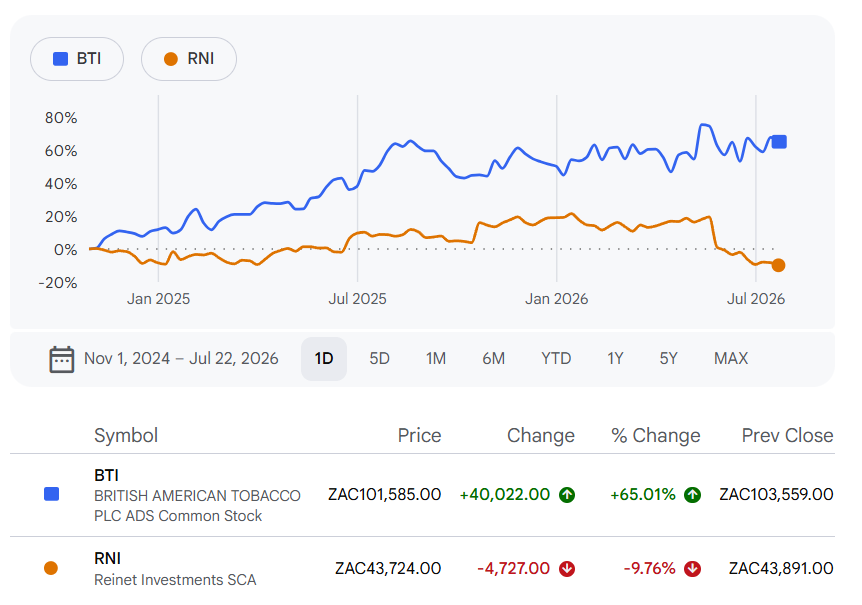
I wouldn’t own British American Tobacco myself for ethical reasons, but they’ve got to be kicking themselves over at Reinet. This is a really unpleasant chart to look at when you were the team that chose to sell the blue line!
Ghost Bite: It’s going to take more than just a few share repurchases to close this gap. Reinet either needs to execute massive repurchases (unlikely), or they need to show the market that they are willing to take a risk on major transactions. As dry powder (cash available for deals) goes, Reinet is sitting on a warehouse full of the stuff. He’s not known as “Rupert the Bear” for nothing…
Sasol’s business performance metrics for FY26 look encouraging (JSE: SOL)
There’s positivity across the board
Sasol has released its business performance metrics for the year ended June 2026. This serves as a helpful precursor to the detailed financial results that are due for release on 1 September.
Overall, FY26 metrics were either in line with or exceeded guidance, with the exception of net working capital that struggled from various temporary factors.
The first highlight is that Secunda Operations achieved its highest annual production in the past five years, coming in 8% ahead of FY25. It also beat market guidance. The destoning project has really paid off for them.
Liquid fuels sales volumes were 13% higher year-on-year, with a positive move in refining margins as well. There wasn’t a strong finish to the year in this business though, with Q4 impacted by fuel price volatility and higher imports. Q4 volumes were down 7% sequentially (i.e. vs. Q3).
Chemicals Africa achieved volumes at the higher end of market guidance for the quarter. Revenue was up 18% sequentially, boosted by the average basket price being 23% higher.
International Chemicals enjoyed stable production and higher prices in America in the final quarter. On a full-year basis, it certainly helps that sales revenue was up 13% despite a 5% decrease in the average sales price. In Eurasia, revenue increased 7% for the year despite a dip in volumes, with a 13% increase in prices pulling them into the green. Thanks to these factors, adjusted EBITDA in International Chemicals is expected to exceed the market guidance range.
There are a number of projects underway in the group, ranging from renewable energy through to paraffin production in Italy and specialty alumina in Germany.
Ghost Bite: Sasol has returned 111% in the past 12 months, most of which has happened during the period of conflict in Iran. As a reminder of how cyclical the business is, the returns are negative on both a 3- and 5-year basis!
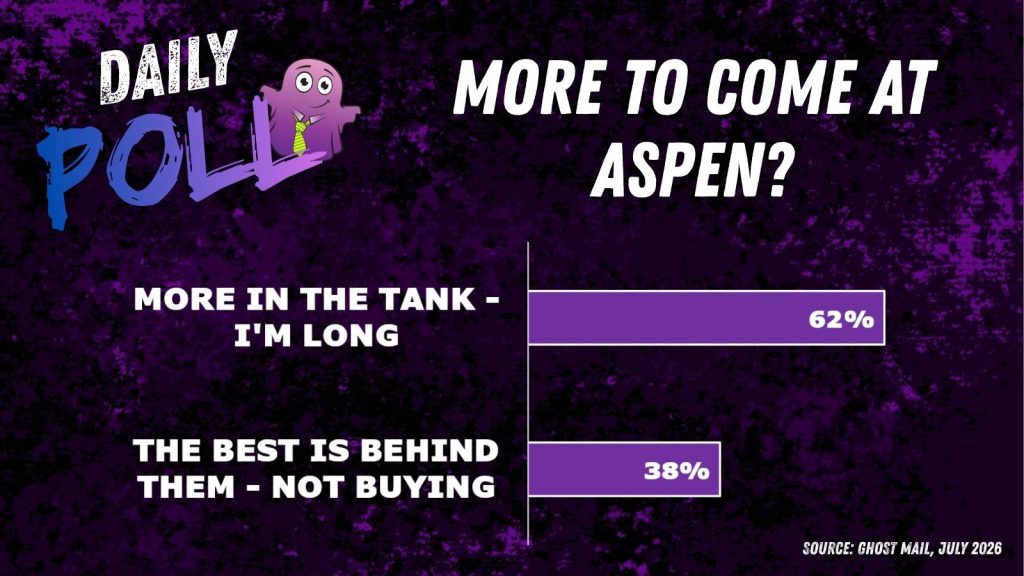
Results of previous poll:
Nibbles:
- Delta Property Fund (JSE: DLT) is making further progress with its balance sheet. They’ve agreed to sell a property in Hatfield to a student accommodation investor for R35 million. This is an office property with a vacancy rate of 39%, so it’s not rocket science to figure out what its future probably holds. The valuation as at February 2026 was R45.9 million, so Delta is getting out at a 24% discount to the book value. With Delta trading at a price/NAV multiple of just 0.11x, even a sale at a 24% discount to book can create value! In other disposal news, the transfers of In2Fruit and 88 Fields Street have been completed, with the net proceeds used to settle debt.
- Copper 360 (JSE: CPR) announced that the Rietberg Mine has moved beyond the halfway mark (in terms of depth) in its underground development. They expect to intersect ore within the next 90 days. This would mark the transition from waste development into on-ore development and in-situ production build-up (for those of you who enjoy the more technical terms in mining). Here’s the bit that anyone can understand: this ore supply, if successful, would fully utilise the company’s installed processing capacity.
- ASP Isotopes (JSE: ISO) is back to using SENS as a glorified PR platform. The latest announcement is that Quantum Leap Energy (the subsidiary being dressed up for IPO) has signed a research agreement in Texas regarding high-purity uranium hexaflouride. This sounds very fancy, but this is also just business as usual for the group. In the absence of any financial information, why is this announcement on SENS?
- Randgold & Exploration (JSE: RNG) announced the appointment of Allan Groll to the board. He comes with many years of property experience and is also currently an executive director at Trematon (JSE: TMT). When companies make unusual director appointments, it’s worth looking deeper if you’re involved here. Randgold is essentially a litigation-focused company at the moment, so I would put this in the special situations bucket where you need to look at the recoverability of the claim.
- Southern Sun (JSE: SSU) has repurchased 3% of shares outstanding since the AGM held in September 2025. The repurchases have achieved an average price of R9.94. The current share price is R10.00.