
A convicted criminal, a Frenchman itching for a duel and a mechanic who kept getting lost all set off to drive around the world in 1908. And yet it was the newspapers that came out as the real winners.
The date was the 12th of February, 1908. The weather in Times Square was bitingly cold. The crowd that had gathered was 250,000 strong.
At the centre of it all, six cars stood idling, waiting for the mayor to fire the starting gun. The mayor, as it turned out, was running late. After 15 minutes of waiting, a man named Colgate Hoyt stepped in and fired the shot himself, and the cars roared off up Broadway.
The race that started on this wintry day in New York would become one of the most extraordinary motoring events of its era. It lasted 169 days and covered roughly 16,700 km of driving, crossing landscapes that were not only covered in snow but, for the most part, almost completely free of roads. And in case you forgot, the cars participating in this marathon effort looked like this:
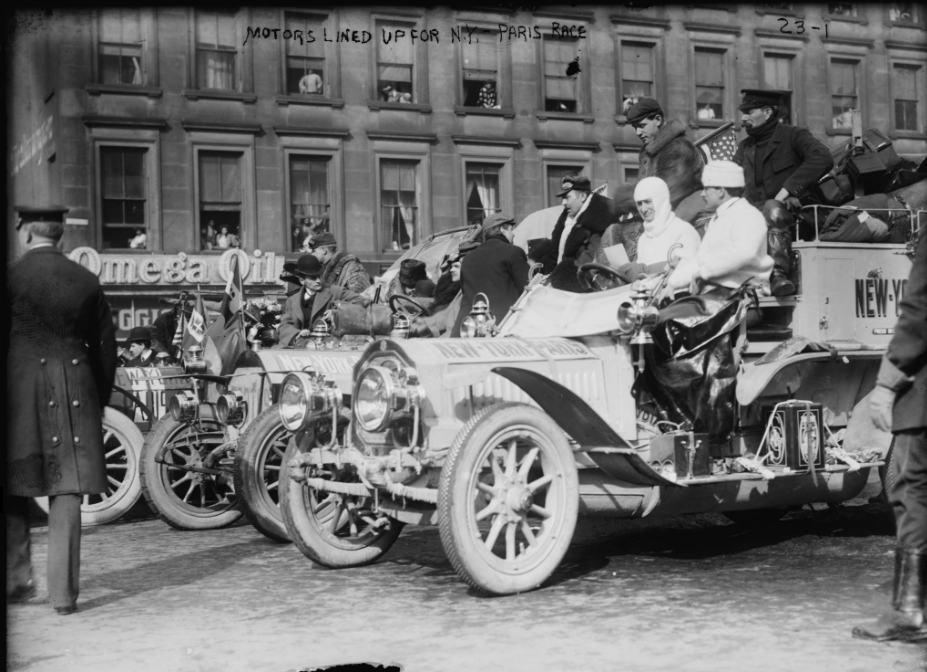
Source: Wikimedia Commons
It was an ambitious concept from the start. And of course, almost none of it would go according to plan.

How we got here: Peking to Paris
To understand how anyone thought this was a good idea, we need to rewind a year.
On 31 January 1907, the French newspaper Le Matin printed a challenge on its front page: would anyone be willing to drive from Peking to Paris that summer? The paper’s reasoning was that it was time to prove a man with a car could “do anything and go anywhere”. Around 40 teams put their hands up. But only five actually shipped their cars to China.
The route ran east to west, from Peking (now Beijing) to Paris, through Mongolia, Siberia and Russia. On 10 June 1907, eleven men in five cars set off from the French embassy in Peking with nearly 15,000 km of desert, mountain passes and mostly theoretical roads ahead of them.
The line-up was eclectic, to put it kindly. There was a hulking 40-horsepower Itala driven by Italian aristocrat Prince Scipione Borghese, a pair of little French De Dion-Boutons, a Dutch Spyker, and a tiny six-horsepower Contal tricycle piloted by a Frenchman named Auguste Pons.
The prince won comfortably, arriving in Paris on 10 August despite the small matter of his Itala falling through a bridge at one point along the way.
Behind him, Charles Godard in the Spyker was on course for second place, which is quite the achievement for a man who had entered without ever having driven a car, who had no money, who had borrowed his vehicle and who had to beg other teams for fuel. But just outside Berlin, German authorities had him arrested over a fraud conviction dating back to his time in China. He was sentenced to 18 months in prison, and a replacement driver took the Spyker on to Paris. One later account suggests that Le Matin may have welcomed the arrest because it gave the French cars a better chance of finishing ahead of him. It’s a good story, but the theory remains speculative.
Two months, five cars, one arrest and one collapsed bridge. Naturally, Le Matin decided the race deserved a sequel, and that it should be twice as long.
Who stood to gain?
It’s worth asking who this kind of event was actually for, because it wasn’t really the drivers.
The newspapers organising and promoting the 1908 race – the New York Times and Le Matin – had the most to win. A race across the world is essentially a serialised story with built-in cliffhangers, and readers had to buy each day’s paper to find out what happened next. The New York Times covered the race on its front page every day for almost half a year, with reporters travelling alongside the teams and sending back dispatches from the road.
The car manufacturers had a lot to win, too – but they also had a lot to lose. In 1908, cars were still expensive, temperamental novelties prone to breakdowns and punctures. A car that survived a trip around the world was the best advertisement money could buy. A car that broke down in a snowdrift in front of the world’s press was quite the opposite.
Meet the teams
Italy entered a Brixia-Züst, a name helpfully shortened so the team could adopt the motto “Paris or Züst”. Behind the wheel was Emilio Sirtori, joined by mechanic Henri Haaga and 21-year-old journalist and poet Antonio Scarfoglio.
Germany sent a Protos, sponsored by the newspaper Zeitung am Mittag. It was captained by Lieutenant Hans Koeppen, who had taken leave from the Prussian army for the occasion. Rumour has it that the good Lieutenant was hoping a race win would earn him the Kaiser’s favour and, by extension, a promotion.
France sent in three cars. The De Dion-Bouton, driven by known eccentric G. Bourcier de St Chaffray, was the pre-race favourite. The Motobloc was captained by none other than Charles Godard, who had managed to make it out of his 18-month prison sentence in time for another race, somehow. And the little Sizaire-Naudin was driven by – you guessed it – Auguste Pons.
The United States almost didn’t enter at all. Until three days before the start, there was no American car in the race. Better-established manufacturers, including Buffalo’s Pierce-Arrow, declined to risk their reputations. But Edwin Ross Thomas, whose E.R. Thomas Motor Company saw an opportunity for publicity, decided to take the plunge.
Legend has it that President Theodore Roosevelt leaned on Thomas to enter, as he was unwilling to watch European cars cross America unchallenged. With three days to go before the starting gun was fired, a 60-horsepower Thomas Flyer was pulled off the showroom floor. Montague Roberts would drive, with the company’s chief road tester, George Schuster, as mechanic. For now.
Mud, snow and a little light cheating
The race lost its first car almost immediately. Pons and the Sizaire-Naudin made it about 155 km before a broken differential ended their race. They never even made it out of the state of New York.
The others ploughed west through the snow, sometimes measuring progress in metres rather than kilometres. The Thomas Flyer reached San Francisco first, 41 days after leaving New York, with the Züst roughly 1,450 km behind.
Not everyone stuck to the road. After the Protos broke down in the American West, Koeppen loaded it onto a train to Seattle. In case you were wondering, yes, that’s cheating. Godard tried something similar with the Motobloc, abandoning the plan only after a photographer caught him at it. The car’s owners soon cabled him to quit, sell the car and come home. Godard didn’t finish the race, but at least he didn’t get arrested this time around. The Italians, meanwhile, accused the Americans of driving on railway lines and hitching a ride on a trolley car.
Then the route itself fell apart. The Thomas Flyer was the first to reach Seattle, where – perfectly legally, this time – it was loaded onto a steamer and shipped north to Valdez, Alaska. From there, the plan was to drive to the Bering Strait, which everyone had cheerfully assumed would be frozen solid enough to serve as an 80 km ice bridge to Asia.
Nobody got close enough to find out if that was the case. The way between Valdez and the Strait turned out to be some 1,600 km of winter trails buried under snow, and the car never made it past the wharf. Organisers scrapped the Alaska leg entirely and redirected the race through Japan to Vladivostok, on Russia’s east coast. The Americans were given a 15-day allowance for their pointless detour, while the Germans were penalised for their train journey.
Vladivostok is where the De Dion’s race ended. The drama had actually started on US soil, where the De Dion captain, G. Bourcier de St Chaffray, had such a bad argument with his teammate that the two agreed to settle it with a duel. Before anyone could find pistols, St Chaffray fired him from the team. The teammate promptly defected to the American team.
Once in Russia, St Chaffray summoned Schuster to his quarters, announced that there was no fuel to be had, and offered his own supply to whichever car would give him a seat – just not the German one, as it wouldn’t look well for a Frenchman to ride on a German machine. The Italians, who were given the same deal, walked out in disgust. St Chaffray eventually signed his fuel over to them anyway, but they didn’t let him aboard. By then, his sponsor, the Marquis de Dion, had decided he was finished. Nobody recorded exactly why, though it isn’t hard to guess.
Russian officials, meanwhile, advised the remaining drivers to give up and put their cars on the Trans-Siberian Railway, warning of “Chinese brigands, Manchurian tigers, fever, plague, pestilence, famine”. The racers said “noted” and drove on anyway.
Siberia was mud, more mud and very little fuel. By now, the Flyer’s original crew had long since been reshuffled, and Schuster, the only American who’d been aboard the car since Times Square, was at the wheel. He got lost repeatedly; one wrong turn alone cost him 15 hours. From there it was on to Moscow, St Petersburg, Berlin and, finally, Paris.
And the winner is…
At 6.15pm on 26 July 1908, Koeppen’s German Protos team rolled into Paris, first across the line by four days.
The Thomas Flyer arrived on 30 July, 169 days after leaving Times Square. Its triumphant entry was briefly interrupted by a gendarme, who unceremoniously stopped the car for not having a working headlight. A passing cyclist solved the problem by donating the lamp off his bicycle.
The Americans had been given a 15-day allowance for attempting the Alaska route, while the Germans were docked 15 days for taking the train. That 30-day swing was enough to make the Thomas Flyer the winner by 26 days. The Züst eventually made it to Paris on 17 September.
So, after all that, who really came out on top?
Not E.R. Thomas, as it turns out. The Flyer’s victory briefly boosted sales, but not by enough. Schuster went back to the Buffalo factory, where he’d been promised a job for as long as the company existed (a guarantee that turned out to be worth rather less than it sounded). The company went into receivership in 1912, and at the auction, the car that had driven around the world was sold off as lot 1829, the “Famous New York to Paris Racer”. Decades later it was restored, with Schuster’s help, to the condition it had rolled into Paris in, and it now sits in the National Automobile Museum in Reno, Nevada.
The newspapers, needless to say, did just fine. As it turns out, it pays quite well to make your own news.
Le Matin had set out to prove that a man with a car could go anywhere. What 1908 actually proved is that he could, provided he also had a steamship, a stretch of railway line, a shovel, five and a half months and a stranger willing to lend him a bicycle lamp. The cars were ready. The world just hadn’t built the roads yet.
The infrastructure has since caught up, and so has the technology. Today, you can drive from Cape Town to Johannesburg in less than 24 hours, with the air conditioner on and your favourite music playing. Next time you do, spare a thought for poor George Schuster in 1908, somewhere in Siberia, up to his axles in mud and lost again.
About the author: Dominique Olivier


Dominique Olivier uses her love of storytelling and ideation to help brands solve problems.
Her first book, Lessons from Loss, has been published by Penguin Random House.
She is a weekly columnist in Ghost Mail and collaborates with The Finance Ghost on Ghost Mail Weekender, a Sunday publication designed to help you be more interesting.
You can learn more about her work at dominiqueolivier.com and she can be reached on LinkedIn here.