Araxi investors have been reminded of the lumpiness in the business
Jubilee Metals is ramping up the Molefe Mine
Araxi investors have been reminded of the lumpiness in the business (JSE: AXX)
The growth story has suffered a wobbly
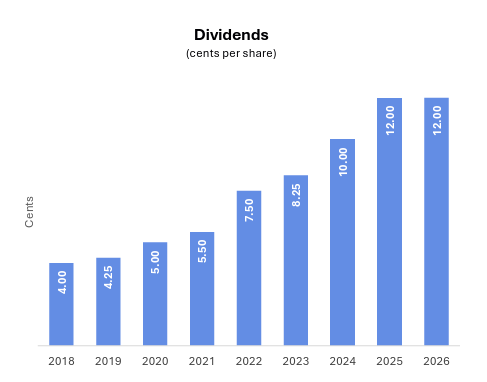
It’s rare to see a single chart doing a great job of explaining the underlying theme in a set of numbers. But I think this one is rather effective:
As you can see, the year ended March 2026 won’t go down as the happiest time in Araxi’s journey.
The period shows us an important risk in the business: the dependence on microchips in payment terminals. As anyone following the tech industry will know, microchips are becoming an increasingly rare and expensive commodity thanks to insatiable demand from the AI sector. This led to a delay in the delivery of a substantial customer order, with revenue from the sale of terminals dropping from R308 million to R230 million.
Another source of lumpy revenue is software licence fees. There was a once-off fee of R42 million in the base period, so this line item fell from R118.5 million to just under R77 million.
Together with general economic headwinds, these issues led to a 6.8% decline in group revenue. EBITDA fell by 16.4% and EBITDA margin contracted by 270 basis points to 24.0%. HEPS was down by a nasty 18.2%.
As a consolation prize, the dividend per share was kept steady at 12 cents per share, as you saw in the chart above. HEPS was 14.37 cents in this period, so there’s not much more wriggle room in that payout ratio.
This is a textbook example of the “stickiness” of dividends and how management teams would rather sell their first-born children than cut the dividend.
Araxi also presents a set of “underlying” numbers that make several adjustments. Other than splitting out that lumpy software fee, they also take out restructuring costs in the Software division, reverse transaction costs for the Pay@ deal and make other fair value and classification adjustments.
If you’re willing to go with that view, then revenue was down 3.6%, but EBITDA was up 5.9% as the margin expanded by 220 basis points. HEPS was up 10.1% through this lens. But don’t get too excited: this “growth” is because the base period looks far less demanding after these adjustments, rather than because FY26 is suddenly excellent. In fact, adjusted HEPS is 14.03 cents on this basis vs 14.37 cents as reported!
If you look through all the noise, there are a couple of highlights worth noting. The first is that despite the delay in terminal deliveries, the number of terminals in the hands of customers has increased by 5.4%. The second highlight I would consider is that the Software division saw a 77% increase in underlying EBITDA thanks to restructuring initiatives.
Still, this isn’t the set of numbers that investors wanted to see as the foundation for the Pay@ deal, in which Araxi has taken a considerable risk on a major acquisition. They’ve acquired an 80% stake for a meaty R1 billion, funded by R200 million of existing cash reserves and R800 million in senior debt. This takes them to a net debt to EBITDA ratio of 1.6x after the closing of the deal.
On a pro-forma basis, the contribution of the Payments division increases from 56% of group revenue to 66%. EBITDA moves up from 93% to 90%. The Pay@ deal takes them much deeper into the fintech and payments infrastructure in South Africa.
Given the complexities of the Software space at the moment, you really have to wonder why they don’t dispose of that business. It’s an even smaller contributor than before, yet it remains capable of dishing up headaches and distracting management. Even with all the work they’ve put in, the “underlying revenue” in Software was down 1.5% year-on-year!
There’s an interesting trend that comes through in the analyst presentation, which was also visible at the Altron (JSE: AEL) Capital Markets Day that I watched online. POS devices (payment terminals) are becoming more than just payment acceptance tools. They now include value-added services like inventory apps, which allow small merchants to track stock on their payment machines. With 64% of revenue in the Payments business being of a recurring nature, it’s critical that Araxi retains customers through delivering innovation.
Ghost Bite: This is a new era for Araxi. Instead of running a fortress balance sheet, they are now in a position where financial leverage can work against them in a weak period. Payment terminal delivery delays may be out of their control, but it’s a reminder of the layers of risk faced by the business during this AI supply crunch. This is going to be an interesting story to watch!
Jubilee Metals is ramping up the Molefe Mine (JSE: JBL)
Will investors like the “hub-and-spoke” development model?
Jubilee Metals released an operational update regarding the Molefe Mine in Zambia. This asset is key to the group’s mine-to-metals copper strategy.
After the successful expansion of Pit 2, run-of-mine deliveries to Sable refinery have recommenced. The targets move up quite quickly, from 6,000tpm in June to 10,000tpm by October 2026.
They are working on the integration of Pits 2 and 3 into a single enlarged open-pit operation. Once this is complete, they should be delivering more than 30,000tpm each quarter, an enormous jump from the previous level of 12,000tpm per quarter.
They describe their strategy in Zambia as being to mine while they explore, which means growing the production and resource base simultaneously. This means on-site ore sorting, processing capabilities and of course the Sable refinery as part of the value chain. They also describe it as a “hub-and-spoke” development model.
Ghost Bite: The share price moved slightly higher on this news, but remains 26% down year-to-date.
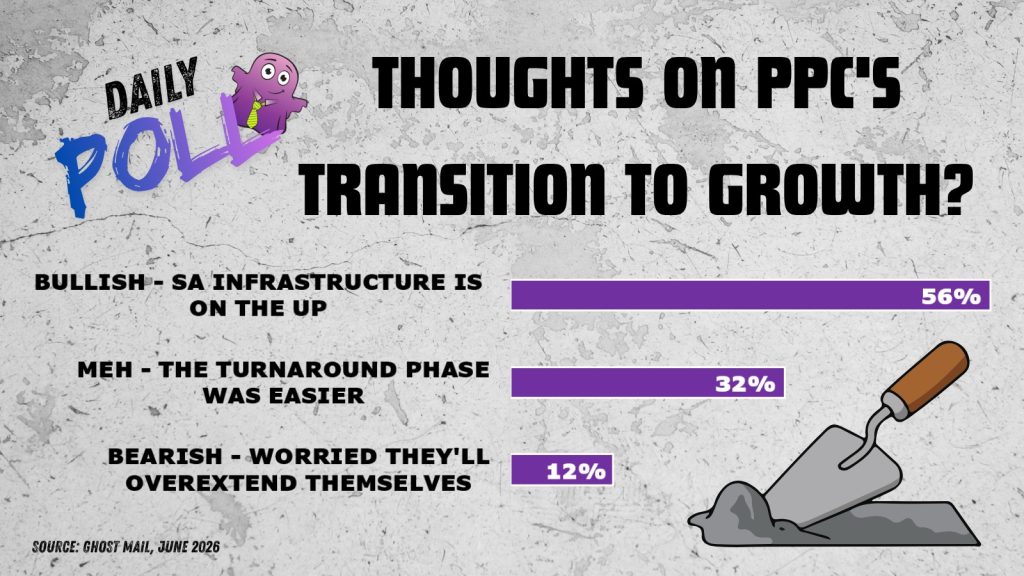
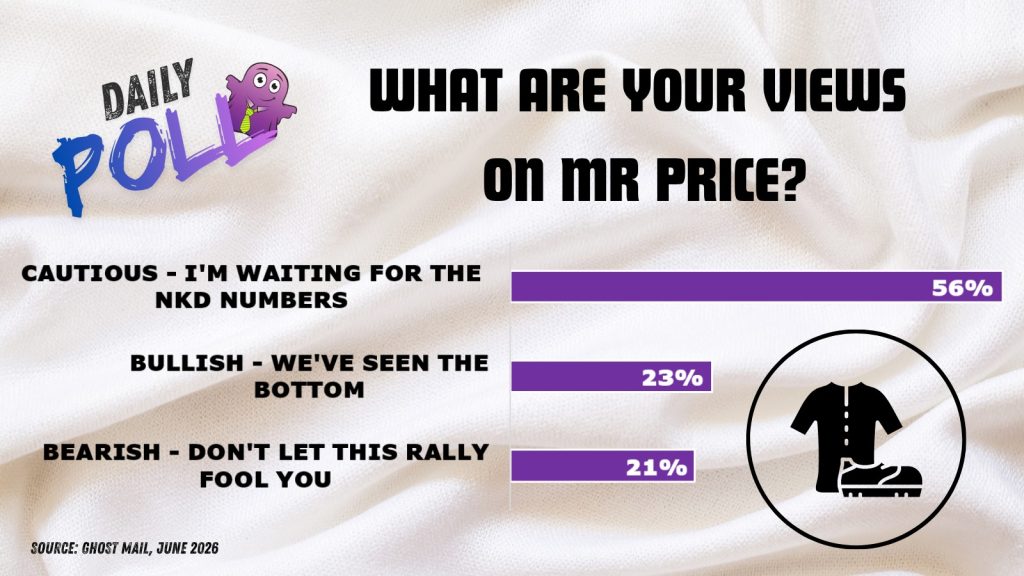
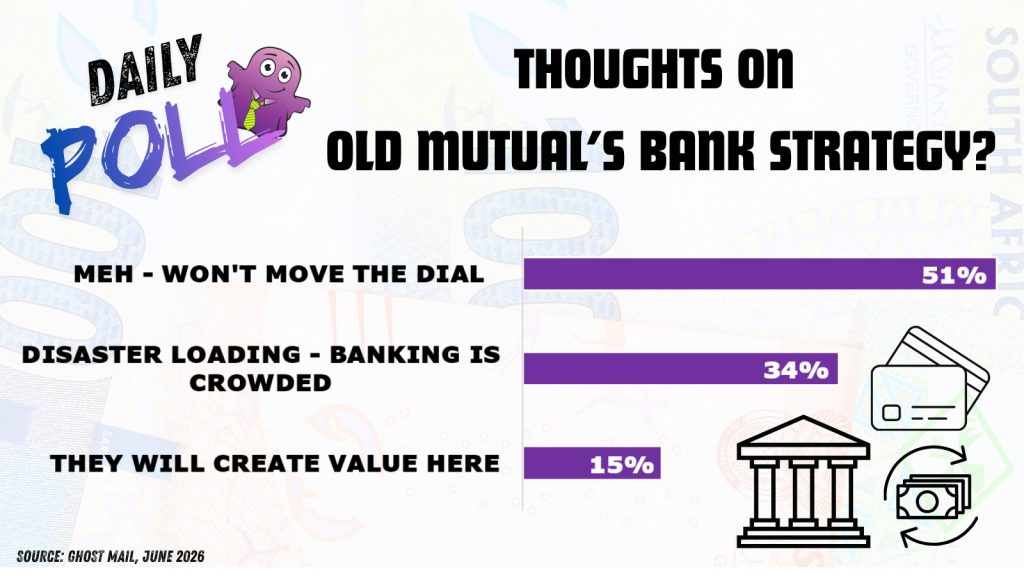
Results of previous poll:
Nibbles:
Director dealings:
The financial director of eMedia Holdings (JSE: EMN) bought shares worth R681k. To add to this bullish signal, a handful of other senior execs also bought shares worth around R750k in aggregate.
An associate of a director of Kumba Iron Ore (JSE: KIO) sold shares worth R85k.
It’s hardly worth mentioning, but an associate of a director of Finbond (JSE: FGL) bought shares worth R734. And no, there isn’t a “k” missing on the end.
Brikor (JSE: BIK) released a trading statement dealing with the results for the year ended February 2026. They’ve swung into a loss-making position, with a headline loss per share of between 1.0 cents and 1.2 cents vs. positive HEPS of 0.5 cents in the prior period.
Wendy Luhabe will resign as the Chairperson of the Pepkor (JSE: PPH) board, a position she has held since December 2020. Ian Kirk (the Lead Independent Director) will serve as the Chairperson until a replacement is named.
I’m not close to the details on this one at all, but those of you closely following Eastern Platinum (JSE: EPS) will be interested to learn that the Supreme Court of British Columbia has struck out all three claims against the company being made by a particular entity.
In this episode of Ghost Stories, The Finance Ghost sits down with Investec’s Brian McMillan, fresh off collecting the “Best Issuer in Africa” award in Stockholm on behalf of the Investec Structured Products team. The team’s product innovation and ability to earn a place for structured products in modern portfolios is being increasingly recognised.
The latest such product example is the Investec Nasdaq 100 Geared Growth structure. With much debate around the market valuations in this tech-heavy index, this structure is designed to appeal to investors who are finding it difficult to balance the desire to get involved against the risk of being late to the party.
Through a combination of 1.25x geared upside (with a cap) and partial downside protection (a drop of up to 40%), the Investec Nasdaq 100 Geared Growth structure creates a fascinating risk-return profile.
Key topics covered:
The choice of the Nasdaq 100 index at this stage in the cycle
The underlying themes in this index across AI and valuations, including reference to the bull and bear cases
How geared upside (1.25x) with a 60% cap works
The downside protection mechanism
Rand-denominated exposure and removing USD currency risk
The Flexible Investment Note structure and reinvestment mechanics
Liquidity via the JSE listing and daily pricing
An understanding of the underlying credit risk
Fees and why returns are quoted net of costs
Minimum investment and access via advisors, stockbrokers and EasyEquities
You can find all the information you need on the Investec website at this link.
The Finance Ghost: Welcome to this episode of the Ghost Stories podcast. I always thoroughly enjoy recording with the Investec Structured Products team, because not only do they bring a lot of cool stuff to the show and some very clever thinking, but also just a fun team, I must say.
Brian, we’ve had some excellent chats pre-show here about your recent trip to Europe, and I’m going to mention why you were there because it’s relevant. You were accepting an award on behalf of Investec Structured Products, from Structured Product Intelligence for the Best Issuer in Africa.
Well done. That’s all I can say, really. You guys have won a lot of awards. Are you bored of winning now, or is it still exciting?
Brian McMillan: Still exciting, especially if they have them in exotic places like Stockholm, which I’d never been to before, which was very nice. They look at volumes and they look at innovation. So, it’s not just who sells the most structured products, but it’s around the innovation and what we bring to the market.
The Finance Ghost: Absolutely. Well done. And we are here today to talk about something else that you are bringing to the market, and that is related to the Nasdaq 100.
So, the official name is called the Investec Nasdaq 100 Geared Growth. And as always with your products, the name tells us a little bit about what’s in there, and we’ll obviously dig into that. But the elevator pitch is that it’s geared upside with a cap, as well as downside protection to a point.
Interesting payoff profile, it does very cool things in the middle, for want of a better description, within a reasonable range of possible returns.
You have to give up something on the extreme up and the extreme down, and then you get some interesting outcomes in the middle. That’s the wonder of structured products, right? It’s a set of trade-offs all the time, something that you guys are very used to structuring and doing.
Let’s just start with the underlying index. The clue is in the name, right? The Nasdaq 100. The Nasdaq has very much been the talk of the town.
We had the software-as-a-service, or SaaS, era about 10 years ago maybe, where those companies were suddenly just coming through. It was cloud and now it’s AI infrastructure.
Whatever’s going on in the world seems to happen in the Nasdaq 100. It is a very exciting index.
But what made you choose it now for the latest Investec structured product? Because one thing I’ve learned about you: the timing is never an accident when it comes to these things. You pick these indices at a particular time for a particular reason.
Brian McMillan: The Nasdaq has been something, and it is the first time that we’re using the Nasdaq 100 as an underlying to our structured product. It’s obviously very topical because it’s very tech heavy. About 66% of the index is in technology.
There’s been a lot of talk about AI. Is it a bubble? Is it worth investing in? Where the structured product comes in is, because it offers downside protection, it’s actually something where, if people are looking at that particular market and maybe perhaps have missed out a little bit – is that something that will allow them to go into the Nasdaq knowing that if there is a correction on the downside, they’ve got the protection, but also gives them that upside in a geared fashion to catch up? And that’s really the reason why we chose the Nasdaq.
We’ve done so in rands. So, the thinking there, again, is that we’re quite bullish on the rand against the US dollar from that point of view. We’re happy to put out a product that is priced completely in rand and therefore only checks the percentage move of the Nasdaq.
So, it doesn’t count the US dollar move; it counts the percentage move of the Nasdaq over that three-year, eight-month period.
The Finance Ghost: Yeah, that’s very important, Brian. Because normally when investing offshore, you obviously have to take into account the way the currency is going to move and the underlying assets.
So, in this case you’re basically taking the currency out of it, if I understand it correctly, and you’re just testing based on how the Nasdaq itself moves.
Brian McMillan: Yes.
The Finance Ghost: Maybe just talking a little bit more about that index and where it is at the moment, I suppose, versus historical norms.
There’s a lot of chatter in the market about the valuations of these things. We’ve got the SpaceX IPO coming now. There’s some interesting commentary on that as well.
It feels like a time where just taking, in my opinion, just going and buying the Nasdaq 100 without any protection, genuinely does feel like quite a risky play. I had to figure out what to do with my tax-free savings recently.
It’s hard to justify ploughing it into something like the Nasdaq 100 at the current level without any protection, honestly. So, I guess that’s part of what’s informing this, right? You’re probably getting that kind of feedback from your clients as well.
Brian McMillan: They want to be involved, but they are scared: “Are we late to the party?”
Interestingly, those tech P/E multiples have actually experienced one of their largest corrections over the last decade. So, the software stocks, you saw them come down.
And then on a forward basis, it’s actually not that expensive. It’s slightly above its average. The forward P/E is around 27 times. And that is because of this expected earnings growth coming through.
So the semiconductor stocks, all of those in there, have this really high expected earnings growth. That’s why we’re looking at the PEG ratio, which is the P/E over expected earnings growth. And those are actually at historical lows.
So, there is upside potential in these. They’re not massively overvalued.
And if we can offer upside on that – geared format, admittedly to a cap – it’s 1.25 times geared to a cap of 60%. So, we’ve given it space to run on the upside, and if it does go 60% over the next three years and eight months, you’ll get a 75% return.
But then we’ve also been a little bit more circumspect around the downside, where we are offering protection.
The index at the end of the three years and eight months would have to fall by more than 40% before you actually have a loss, giving it more downside protection and then giving it the ability to run on the upside as well.
The Finance Ghost: It is super interesting, Brian. And I know from the brochure on this particular product (and because I could just go do the math, but it’s easy to read it from the brochure), if you do get the maximum return of 75%, then your guys’ calculations are telling us that that is a compound annual growth rate of 16.6% per annum.
So that’s effectively the maximum that someone can get from this product, as I understand it.
And one thing I would say there, Brian, is that expecting more than 16.6% per annum from where the Nasdaq is right now – even taking into account what you’re saying about valuations and whatever – feels spicy. 16.6% – someone would probably take that right now, over the next three years, eight months. That would be my view at least. Obviously each person must form their own view, but that’s a pretty strong return, assuming that people get it.
Again, I just want to be clear, that is the maximum upside. It is by no means the guaranteed return or that you will get that. It is the maximum you can get from this product.
Brian McMillan: That’s correct. That’s double what you would get in interest rate markets. So, from that point of view, we’re giving you the opportunity to earn up to double what interest rates would be around about now.
To take part in this growth potential of the Nasdaq – you’re getting in there, you’re getting the software, you’re getting the hardware, the chip manufacturers, and then of course the AI. And nobody knows where that’s going to come out.
We’ve seen releases over the last year or two. Every time one of the major AI providers brings out a new model, it’s very exciting. The market runs ahead, there’s definitely potential there. We don’t know where it’s going to go.
It’s also, as I say, it’s not too expensive. And one of the things I would say, we don’t think that this is a bubble in the traditional sense of the word, in that none of these companies that are building these AI models are actually borrowing to do so.
All that capex is being funded out of earnings at the moment, so nobody’s borrowing to pay those. So, while a lot of people seem to think just because the index has gone up so much that it could be in bubble territory, we’re not seeing that in terms of use of debt, which is traditionally where a bubble comes from.
The Finance Ghost: You certainly raised one of the bull cases there. They are funding it through – often advertising revenue, actually, if you look at the hyperscalers – or corporates paying them subscriptions, and that kind of thing, depending which hyperscaler you look at.
The bears will argue that a lot of this capex spend is being funded by investment from the providers of the product, creating this kind of circular reference inside the Nasdaq. It’s what’s making this so interesting, right, is that there are good bullish arguments, good bearish arguments as well?
My personal view is that AI is a complete change to the way we work. I don’t think this is just a hype story. I’m using AI more and more all the time. There are things that it’s really bad at, but there are things that it absolutely changes your life on.
And if you figure out those life-changing pieces and you use it to supercharge your work, then it makes a pretty serious difference.
I keep writing in Ghost Mail and elsewhere that you really need to be playing around with AI if you’re not doing it already. It is very, very important to do so. What that means from an investment perspective, time will tell.
The other bear case is that a lot of these cyclical stocks are now behaving like structural stocks. If you look at the memory stocks and those kind of things, they look cheap. But is it really the case that there isn’t just going to be another cyclical story?
I don’t know. You don’t know. No one knows. And that’s the point, right? That’s why these structured products exist. Because the Nasdaq is an exciting place, but no one can be quite sure.
Brian McMillan: We looked at the Nasdaq over the last 25 years, actually a little bit longer, 26, 27 years ago, from the last dot-com bust. What’s interesting about that is there definitely was a bubble in 2000. Thereafter, the index did fall.
But interestingly, when we compare it against some of the other indices in 2008, it didn’t have losses of more than 30%, where a lot of the other indexes, in fact most of the other indices that we use, did.
So, we took a view to give a little bit more downside protection. And what that means is that the index would have to fall by more than 40% from current levels, in three years and eight months’ time before you actually have a loss.
We think that we’ve built in sufficient downside protection. We understand that when the market actually did have that dot-com bust, the maximum loss was significant. And over a three-year and eight-month period you could have lost up to 72%.
But I think it’s very different from pets.com and anything with a dot-com at the end of it was being listed. There was no revenue behind it. I think this current market that we’re in is very different from that dot-com bubble.
And just because it’s had a very strong run over the last couple of years doesn’t mean that it’s not on the back of real innovation and, as you said, real change to the way people work.
The Finance Ghost: Yeah, it’s a large part. I agree with that, honestly. It does feel like it’s not a silly thing. There’s a lot of interest in the space. I know a lot of business owners and corporates that are spending proper money on AI tokens.
It’s real; quite scary at times for the job market, but it’s real. And there’s going to be some things that happen, who knows, but it’s not going to go away. Of that I am pretty confident.
Brian McMillan: I urge people to go and get a paid version of one of these just to find out how easy it is to actually make use of the tools. I’m no spring chicken, but I’ve played around with it, and it’s very different from just asking ChatGPT what the best restaurant in town is.
It’s really got valuable tools that you can use and it’s very easy to use. You’re seeing the companies now piling into these models, making use of them and spending real money on it. I think there is some upside in that side.
The Finance Ghost: And I just want to confirm with you the downside test, the upside test, it’s a point test, right? It’s three years and eight months from now. We’re looking once, we’re looking at what the index did, and bam, there’s an outcome. It’s not tested throughout, right?
Brian McMillan: So, for all of our products over the last 15 years, when we do that, we don’t have what you call this continuous barrier, where a Covid-like event could knock you out and then three months later the index is back again.
We only look at whether you made a loss over the entire term. So only on the last day.
We do have some averaging. Averaging makes it a little bit safer in terms of: we don’t have one day where you have to check it on. We use the last three months so that we have a little bit of a spread. We use the average over those last three months as whether the index is down more than 40% or, in that case, at more than 60%.
The Finance Ghost: That makes a lot of sense. Let’s talk about the flexible investment note structure that this sits inside. So that note actually has a term of 20 years, but it’s not because this is a 20-year investment. This is three years and eight months.
My understanding is that there’s a way to then roll your exposure. At the end of this term, there’ll be a new structure that sits inside the investment note. And as an investor in the space, you could elect at that point to either participate in whatever that note is or to say, thank you very much, I want my money back. Is that an accurate understanding?
Brian McMillan: Yes, it is. That’s something that we’ve done for the last two years now. We issue a 20-year note. And the reasons around that are numerous. But what we have is that, thankfully, our issuances nowadays are very big.
We find that with using the flexible note, we don’t have the issue of having to expire a note, pay everyone their money back, and now the next one comes, can we get the money back from you again? From that point of view, it makes a lot of sense.
It allows people to remain invested if they wish to. So, we always make sure that everyone gets a chance to elect to remain invested for the next one. We make sure that they know what the risks are of the new one when this one expires.
And it doesn’t stop anyone from exiting should they want to. So there are a couple of advantages to it from that point of view.
The Finance Ghost: Yeah, it is a very interesting structure, and it certainly works really well based on your experience and actually some of the stuff I’ve heard in the market.
You guys do have a good reputation in the market, for what it’s worth. They seem to be popular with investors. So, to your point, some pretty big flows these days. You’ve had to adjust structures accordingly, right?
Brian McMillan: We’ve been lucky. I think it speaks to structured products themselves. There was a lot of skepticism initially in structured products. And when I say initially, I’m talking about over the last 20 years.
Things about would they pay off when they expire, how do they work, are there too many fees in them, are they quite opaque? And I think over the years we’ve dispelled a lot of those. People now know that when you invest in one of these, they do what they say up front.
If the index is geared 1.25 times, the index goes up 10%, you get a 12.5% return. If it goes up 20%, you get a 25% return. And people like that sort of thing.
And then it plays into people’s natural fear and greed side of investing. It takes away some of that fear because we have that downside protection. And then it allows the upside, and it allows people to remain invested longer as well.
A lot of people nowadays, they invest in something, it goes up 20%, they sell it, and it runs another 20, and they go, “I should have stayed in that. I shouldn’t be trading these things”.
We keep people invested in the market where, over the last 15, 16 years, it’s been the place to be.
The Finance Ghost: Speaking of staying invested: liquidity is something we always talk about on these. But let’s do it again if there’s any new listeners who aren’t familiar.
Life does happen: to what extent is there a liquidity option before the end of the three years and eight months? And how does that work?
Brian McMillan: That was one of the first things that we had to address because structured products were this point-to-point, you bought it, three years and eight months later, you could sell it.
Nowadays we list all of our structures on the JSE or in Dublin. This particular one’s listed on the JSE. And when we do that we provide a daily price for these. The daily price means that we will buy back any of the structured products that we’ve got out in the market at fair market value with a 1% bid-to-mid spread.
We have that in there, and it’s available on a daily basis. So they become very much like shares. You can sell them should you need to.
I think the only thing to note is obviously that the capital protection is only available at the end of the term. So, if we found, for example, that the index was down 20% after one year, that’s not to say that you could sell out and you would get back your full capital. It’s only at the end of the term.
But similarly, if the index is up 20%, you would see a gain, but you wouldn’t necessarily see the geared upside because we make use of options in these, and those options only bring the full value of the gearing in towards the end of the period. But you can trade them quite freely from that point of view.
The Finance Ghost: Let’s also just talk about underlying credit risk. I know that’s one of the other things with structured products that people quite correctly ask about.
Because at the end of the day there are a lot of underlying derivatives and other structures in place to make this thing pay off the way it does. So what is the underlying credit risk that an investor would be taking in this product?
Brian McMillan: The investor takes credit risk to Investec Bank Limited, and we are the issuer. That’s an important thing.
You wouldn’t buy a structured product issued by Brian McMillan because you don’t know he’s going to be around in three years and eight months to give you the money back. So the issuer is the most important credit risk. And as you mentioned, Investec Bank in South Africa has a very good name. So that’s the first credit risk you take.
We then add a credit risk of Barclays PLC onto this. And the reason is, we actually get quite a big pickup in being able to give more gearing by adding this extra credit risk of Barclays.
But when we look at Barclays as credit risk, and this is senior unsecured Barclays risk, that’s one of the G-SIB banks in the world, which is basically the globally important banks around the world. So they’re seen as almost too big to fail. They have to hold extra capital.
So, we can offer more gearing by adding Barclays, and we don’t think it adds a lot more risk from that point of view. Who is going to pay you back and when is what you should be asking when you’re buying a structured product. And we believe Investec and Barclays are decent names that you can rely on from that point of view.
The Finance Ghost: And so, in terms of actually practically investing in this thing, Brian, can you just take us through minimum investment amount and how investors actually go about getting access to this product?
And if I could maybe ask you to just confirm from an EasyEquities perspective (because a lot of listeners are obviously on that platform), is it possible as well? Because I know historically a lot of the Investec products have been available through EasyEquities. It is something that people can do?
Brian McMillan: Yes.So from that point of view you can speak to your advisor, your IFA or your stockbroker. Most advisors and stockbrokers we know in the market, we go and market to them directly.
The closing date is the 10th of July, and we will trade this on the 15th of July. You have to have a stockbroking account, which you fund. You put the money in. It’s R100,000 minimum investment. Although people like EasyEquities will allow you to invest in lower amounts.
We ask that EasyEquities, for example, give us a minimum of R100,000 and they can split it up however they wish. It is available on that platform, and we have had some talks with them recently to make sure that all the products are on that platform.
But as I said, any stockbroker in South Africa should be able to advise you on this, as will most independent financial advisors out there in the market.
The Finance Ghost: So, Brian, we’ve dealt with what this investment actually is, the sort of risks that investors would be taking, credit risk, liquidity and the minimums and all of that kind of thing.
Last question is of course an important one. People are always quite correctly focused on fees. So, in terms of this product, I know historically from conversations, typically the returns that you’re giving here are net of fees. Same story here, or how should investors be thinking about the fees in this?
Brian McMillan: Same again. And as you mentioned earlier, structured products have changed over the years. One of the things that initially people were sceptical about was hidden fees within it. All the fees and costs have been worked into the product. So, we pay the advisor the fee.
But your return that we’ve been talking about, the 1.25 geared to a cap of 60%, that would be net of any fees. So, if you buy it at R100,000 and it goes up and you make a 25% return, you’ll get R125,000 back, net of all fees in that.
The Finance Ghost: Perfect, Brian. Thank you so much. We’ll make sure that the show notes have got the link to the right place on the Investec website for potential investors and those who are curious to just go and find out more.
I can’t stress this enough, please speak to your financial advisor. Do not treat this podcast as me saying, “Oh, this is a great idea” or giving it any kind of green tick. You need to go and obviously look at this for yourself.
This is really just to help you with your research process. And you can go and listen to some of the previous Ghost Stories featuring members of the Investec Structured Products team if you want to just hear some consistency in how they do things.
A lot of those products would have closed now, obviously, but you can still go learn some more about how this stuff works.
Brian, good luck with this raise. Thanks, as always, for bringing it to the Ghost Mail audience. I think it’s as interesting as it always is. Wishing you all the best with a successful raise on this one.
Brian McMillan: Thanks, Ghost.
This podcast is for informational purposes only and does not constitute advice. You must speak to your independent financial advisor before investing in any product, and especially this one. Investec Corporate and Institutional Banking is a division of Investec Bank Ltd, an authorised financial services provider, a registered credit provider, an authorised over the counter derivatives provider and a member of the JSE. Ts and Cs apply to this product and you should refer to the Investec website for full details.
In this episode of the Ghost Stories podcast, we welcome Old Mutual Investment Group to the platform for the first time. The Finance Ghost sits down with Maahir Jakoet, lead manager of the Old Mutual Global Islamic Equity Fund, to look back on a decade of top quartile performance.
As part of Old Mutual Investment Group’s Championing the Unseen campaign, this podcast lifts the lid on how Shari’ah-compliant investing can deliver unexpected outperformance vs. traditional funds. A constrained investment universe with tight rules can create a powerful framework for risk management and long-term returns. The result? A portfolio that has historically delivered lower drawdowns, faster recoveries and a compelling growth tilt, all while staying firmly within clearly defined guardrails.
In this episode:
What Shari’ah compliance really means in practice and how the rules are applied
The positive impact on portfolio risk and drawdowns of excluding highly leveraged businesses
How the fund performed through the GFC, COVID and rate shocks
The structural tilt towards tech, healthcare and capital-light businesses – and away from banks
Sources of outperformance over the past decade
When the strategy is likely to underperform (and why that’s okay)
How a rules-based, systematic process helps remove emotional decision-making
The role of Sortino ratios, factor scoring and portfolio construction discipline
What differentiates this fund from passive Shari’ah ETFs
Transcript:
The Finance Ghost: Welcome to this episode of the Ghost Stories podcast. It’s the first in a partnership with Old Mutual Investment Group, something I’m very much looking forward to. There is a lot to learn from the smart people who run these funds and who participate in the markets at an institutional and professional level.
And to do that with us here today, we have Maahir Jakoet. He is the lead manager of the Old Mutual Global Islamic Equity Fund, which is now celebrating its 10-year anniversary. So very cool; that’s a nice track record. And that’s obviously going to give us some fantastic data to look at.
Old Mutual Investment Group is championing the unseen at the moment. It’s a campaign that they are running. It’s more than just a cute tagline. They really do want to try to lift the lid on some of the more unusual elements of the markets.
Something that I would agree is unseen is the appeal of these Shari’ah-compliant funds, not just to an audience who needs them for obvious reasons (those who need to follow this mandate) but actually to anyone who might be interested in the way these funds actually work.
And that’s because of the way they operate, because of the underlying nature of the portfolios, what Shari’ah compliance means in practice. We’re going to dig into all of that today.
So, Maahir, thank you so much for being on the show, and I firmly look forward to learning from you.
Maahir Jakoet: Awesome, man. Great to be here.
The Finance Ghost: Let’s start then with what makes a Shari’ah mandate different. I think we must absolutely cover the basics here, because there are specific rules that you have to follow, right?
What does that mean, practically? And what are you not allowed to own in the fund?
Maahir Jakoet: I think that’s a great place to start.
Often, people want to look at the Environmental, Social and Governance (ESG) angle, but it’s actually very different. There are definitely overlaps, but Shari’ah is rules based (instead of being score-based, where there are some inconsistencies).
There are two vital steps that investors need to understand.
The one is the core business activity screen. Core is what you’re making your revenue from, broadly speaking. We cannot own companies where the bulk of the revenue comes from alcohol, tobacco, gambling, conventional financial services such as banks and insurers, weapons manufacturing, adult entertainment, etc. So that really covers that list.
Just to note, banks are a big one, because if you look at the MSCI World Index and you look at financials, whether it’s in that index or a different index, it’s roughly between 18% to 22%.
At a starting point, when you’re removing financials, it upweights something else. Keep that in mind.
And then there’s the second test, which is actually a mathematical test. It’s a quantitative financial ratio screening test. There are four, but the important one is the debt ratio, and that is 33% debt to asset value, or market capitalisation.
Now, if you think about that, again, besides the conventional banks, when you take that out, you delever your universe by that rule. And that’s really the big one. So there are other rules, but that is definitely the most important one.
The Finance Ghost: Yeah, fascinating. And you’ve talked there about “core” business, so I just want to maybe confirm something there. And the “bulk” of revenue.
So, for example, if a company is making, I don’t know, 5% of its money from something that is impermissible, that would technically be okay from a screening perspective, provided it also meets the quantitative debt screen, right?
Just to be clear, it’s quite a practical test. It’s where do you make “most” of your money, right?
Maahir Jakoet: Yes. Well picked up – that’s what we call non-permissible income. And that essentially would have to be removed. And that’s a ratio, perhaps, that I didn’t mention that is in the quantitative screen as well. That’s a max of 5% of what we call non-permissible income. So it shouldn’t breach that, correct.
The Finance Ghost: Okay, interesting. It really is a fascinating world. I personally do actually find it very interesting. But more than that, I find it particularly interesting to see how this affects the underlying shape of the portfolio. And you’ve already made some great points there.
Stuff like banks are a big part of the indices, and this fund would be extremely underweight banks, if any at all actually – probably basically none – versus your traditional indices, which would have lots of banks.
And it really does take out both sides of the coin, right? Because you take out the stuff that has high amounts of leverage as well. You mentioned the 33% debt-to-asset value or market cap test there.
Now, in a crisis period, that’s interesting, right? Because it means that when things are bad, number one, you’re not sitting with exposure to banks, I guess, which would normally suffer a lot of credit losses. And number two, you’re not sitting with exposure to companies that have a lot of debt on the balance sheet and might be at risk of handing the keys over to the bank.
What does this mean from a crisis perspective, a risk management perspective? Does this fund tend to be more resilient in a downturn?
Maahir Jakoet: I think I want to talk about that to the numbers. I’ve given you the rules, and now it’s very easy to implement and say, “Okay, well, let’s put that to the test”.
So, what are we observing?
Largely, we’re observing lower volatility because of interest rates that can fluctuate, shallower drawdowns, and faster recoveries. Now, when I say fast recovery, you’ll say, “Well, is that recovery back to zero, or is it peak to trough?” And we can talk about that.
But then let’s look at the actual crisis period. So the one we all know, and I’m sure your investors are a sophisticated audience, so they would have lived through the Global Financial Crisis (GFC), which is the 2008–2009 crisis.
You mentioned credit. So let’s see what happened at that time. Is it a credit event, is it a liquidity event? Because that can be very different.
The MSCI World fell through that time roughly about 54% peak to trough, right? Islamic indices didn’t fall as much. So why is that?
There’s a credit event happening. There’s higher leverage obviously, and you’ve taken the financials out. Okay, so that universe then does much better.
But what happened then in COVID? There was a sharp drawdown, but that was actually a liquidity event, not a credit event.
But again, if we just look at that crisis period, Islamic indices again fell less, right? Slower to zero, but faster to the peak. Now you need to say, “Okay, well, now we’re also talking about recovery”, but that recovery is not to zero, it’s actually to the COVID peak.
And why was that? And that essentially was because when you take out financials, I mentioned that some other sector is going to be upweighted. Given the debt ratio, you have asset-light businesses, right? And then tech was soaring, and because of that upweighting in tech, you found that it recovered a lot better.
And then in 2022, there was the rate shock. Again, rates, there – you’re linking that to interest rates. There’s a credit event, so mildly better in terms of a drawdown. And when I say drawdown, we’re losing less.
And then also, if we look at the 2026 Middle East conflict, of course, there are high-quality, de-levered energy exposures which would have benefited.
But overall, I’ve mentioned four crises. We were really better in all of them.
It’s a higher rates play, but it has a meaningful benefit. So when rates are higher, or there are significant drawdowns, the fact that your opportunity set to choose from has been de-levered is definitely a meaningful benefit.
The Finance Ghost: Super interesting, right? Maybe just one point to understand a little bit more on that.
So when you say they did better, are we talking 5%? Is it 10%? Is it 25%? Not necessarily the numbers offhand for each crisis, but just the factor by which you are protected, I guess, by being in one of these funds from a typical crisis, as we’ve seen over almost 20 years now, shockingly! The GFC was almost 20 years ago. I feel very old now.
But what sort of outperformance are we seeing by this fund in those periods?
Maahir Jakoet: You’re looking at about – in the GFC, I mentioned the 54%, and then like-for-like, comparing apples to apples, you would have seen the MSCI World Islamic at 42%.
So both draw down, but 54% versus 42%. It can be meaningful because then after that, especially when I spoke about recoveries, you compound off a higher base, right? So that can be really meaningful.
The Finance Ghost: Yeah, it makes sense. You’re never going to have complete protection here because, at the end of the day, you’re still owning broad market stocks. But that is a pretty meaningful buffer. It kind of shows you how much trouble companies get themselves into when they have too much debt.
And it’s interesting, because it also feels like what people might not expect, right? I think a lot of investors who don’t need to follow Shari’ah principles would go with the conventional wisdom of, “Oh, the sin stocks are very defensive, and you want to own tobacco and alcohol in a time of need, in a time when the market is really tough”, etc.
And maybe there’s some truth to that, although I have my own views on that, particularly where we are now with how much health focus the world has.
But it feels like, and it sounds like, all the other things you’re owning instead, and you’re upweighting instead, more than make up for the fact that maybe you’re losing out on one or two defensive stocks. Because you’ve got high-quality balance sheets in there and, like you say, capital-light businesses. I think that’s a really important point, right?
Maahir Jakoet: Absolutely.
The Finance Ghost: Let’s maybe have a look then at global equity performance, because I’m aware that there’s been some pretty strong outcomes by this fund, versus what I would call your traditional funds or your non-Shari’ah-compliant funds.
Let’s maybe talk a little bit about not just your global performance here, but also just performance attribution in terms of sectors.
You’ve already given us a clue in that you’ve held a lot of capital-light, techie kind of things. But where is that outperformance coming from?
Maahir Jakoet: If we can just focus first on the fund performance relative to the conventional. We’ve compared apples with apples in terms of index to index; same provider, same Shari’ah board. You’re just using the rules.
How does that look in a drawdown? How does that then recover?
Let’s focus on the fund. And if you look at our fund relative to that same MSCI World conventional benchmark, then you can see that, over three years, over five years, over 10 years, we’ve outperformed that benchmark.
And then just in terms of understanding the drivers, of course, yes, you said I mentioned the tech angle, but essentially the last decade has been a structural overweight to information technology.
That was definitely the largest contributor, but also, that would have been upweighted in your opportunity set.
The other interesting one was healthcare. One of the biggest contributors after tech, in absolute terms, came from Novo Nordisk and Eli Lilly.
You’ve got this quality company that’s making bucket loads of money, and it’s come off – GLP-1 drugs, competition is coming in, and that’s always going to happen. And the big lesson there is that nothing lasts forever.
But we had a phenomenal run with holding Novo. And just a little bit about Novo Nordisk: they control diabetes and weight-loss medication together with Eli Lilly.
And if we just think about that growth theme. If I asked you, Ghost, is diabetes going to go away? Trends of convenience and what we’re eating and what we’re putting in our bodies, just that alone should make you think “Wow, there’s a theme there”.
The Finance Ghost: And it actually captures the other side of the sin stocks, right? It’s actually the health trend – you’re on the right side of it.
Maahir Jakoet: Exactly.
The Finance Ghost: As opposed to on the wrong side of it.
Maahir Jakoet: Yeah, so from a quality point of view, and you and I perhaps define quality differently. Just from a profitability point of view, a debt point of view, where the metrics on return on equity (ROE), return on invested capital sit: these are quality businesses.
And then value, well, we can question what is expensive and what is cheap, but there’s also a good growth theme. And that’s really how we make money for investors, by looking at those components. Interestingly, after tech, it was definitely healthcare.
The Finance Ghost: And bringing up return on equity is interesting, because that’s obviously one of the metrics that CFOs love to juice up, by putting more debt on the balance sheet, right? The more financial leverage you use, technically, the better your ROE will be in the good times. Not in the bad times – it’ll go the other way very quickly.
But to your point, you can own businesses that have a very strong ROE even without debt, because the underlying business is that quality, kind of growth metric. It’s like extracting that final bit of juice from that lemon that you’ve squeezed over your fish. That’s value investing, right? It’s how much juice is still left in that lemon.
Whereas with higher-quality stocks, it’s not like that. It’s the whole plate. They have a big growth story ahead of them. And so would it be fair to say that, because of the rules in this fund, it has a little bit of a growth slant more than a value slant? Would that be a fair statement?
Maahir Jakoet: Absolutely. But then, if you have that advantage of growth, then look for the underappreciated quality within that opportunity set. And actually, then you get a trifecta in terms of what you’re trying to do.
We were talking about performance and comparison against peers or benchmarks. It’s not that the fund was a one-hit wonder, and I think that’s very important, because sometimes in a year you can have exceptional outperformance.
Yes, while our mandate is a developed market mandate, if you look over a one-year period where emerging markets (EM) actually did very well, you would have seen funds or benchmarks that have EM in them, actually did slightly better.
But over the very long term, if we’re looking three years, five years, and of course, you mentioned our 10-year anniversary, then we stack up incredibly well.
So it’s not that in one year we shot the lights out, and now that’s coming through. That’s very important to understand. It’s rules-based. The way we make money in terms of portfolio construction as well: we’re going to put certain constraints that are more rules-based than narratives-based, if that makes sense.
The Finance Ghost: The rules-based stuff also does sometimes help with managing human emotion, right? When you’re managing the fund, you can’t break the rule.
Maahir Jakoet: Absolutely.
The Finance Ghost: You can’t be tempted to say, “Oh, I like this fund or this company – it has a lot of debt, or it does something that is, let me use the word, a little bit “naughty” from a Shari’ah perspective, something impermissible”.
You can’t do it because you have to operate within the guardrails.
And that’s not a bad thing. It’s almost like a hybrid approach of a little bit of how ETFs work and then how active management works. And we’ll get to just now what differentiates this fund within the Shari’ah umbrella.
But just before we get to that, something I do want to understand as well: where is the bulk of the equity exposure sitting in this fund?
Maahir Jakoet: In terms of domestic equity, we’ve got no South African equities in this fund. This is a pure global fund. And it’s also global developed markets.
From a sector point of view, predominantly US. And then you have Europe, a big part of it is Europe as well.
Interestingly, depending on if you’re a benchmark-cognisant manager, Korea is actually different if you’ve chosen MSCI as a provider or S&P as a provider. S&P believe that Korea is actually a developed market, whereas MSCI actually buckets that into emerging markets.
So that’s the one play that is on the edge. Is it a classification thing? Maybe. But actually, if you do bucket that as EM, then that’s where we’re getting a little bit of EM exposure. The companies and Korea have done exceptionally well over the one-year period.
The Finance Ghost: Yeah, that’s very interesting. And what does it look like in terms of US versus Europe versus some of the benchmarks? I’m guessing that the US stocks, which are very cash-flush, are probably going to get on the correct side of your debt screen more easily than some of the European names that haven’t necessarily had a few years of rapid growth. I mean, there are exceptions, obviously. Novo Nordisk is a perfect example.
But generally speaking, is there quite a US upweight here?
Maahir Jakoet: Absolutely. So in the fund itself, we are underweight the US, but that’s a diversification and risk management story.
The absolute amount within the opportunity set? You’re looking at about 68% US, so let’s call it 70% to round that up, and then the balance would be Europe and other developed markets.
The Finance Ghost: We’ll dig in a little bit more just now on some of the other differentiating points here.
But I do want to touch on one last question around Shari’ah funds more generically. Maybe you can speak about this one as well: the concept, the stream that people would be choosing to swim in here.
We’ve heard about the protection on the way down in a crisis. There’s a good argument to be made that you’ll get a more buffered approach here, and you’ll be compounding off a better level going forward. Fair enough.
You’ve got solid upside from the tech sector, so when that’s doing well, you do very well, and that makes sense.
When other sectors with low financial leverage are performing, that also helps, obviously.
So there will be times where this fund does underperform, though, obviously. Otherwise, it would be the perfect solution to invest in, right? Which nothing is.
Under what conditions would you expect to underperform traditional equity funds, if you are following a Shari’ah rules-based approach?
Maahir Jakoet: Definitely, in a bull market, this fund would have a bit of a headwind, and specifically in financial-led rallies. So absolutely. When you see a decline in interest rates, and inflation isn’t there, and then suddenly there’s free money on the table, and you’ve got this sharp uptick, right?
And while you mentioned the growth part of it, I don’t think there’s enough growth there, and then we tend to lag.
But Ghost, I can tell you one thing from my experience in managing money – if somebody else is giving you 22% and I’m giving you 20%, I won’t even hear from you. The phones don’t ring in the office. Everyone’s happy.
It’s really on the downside, when something happens, that people start asking: “How much exposure do you have to this?” That is when people start panicking.
2020 – even though it was a liquidity sell-off – what happens is that the market tends to look for more safe haven, more quality, and that’s why you get the high-leverage companies selling also.
So I think that was a bit of a nuance, because everything else I mentioned was really linked to credit and to interest rates.
I cannot sit here and say that this is, what do they say, “a fund for all seasons”.
The Finance Ghost: Yes [Laughs].
Maahir Jakoet: I absolutely want to partake on the upside on an absolute level, but definitely on the downside, I think that’s the protection you want.
And the perfect investment is giving somebody great returns with zero risk. But that really isn’t out there, I would say, or definitely not out there in some equity product.
That’s exactly what we’re trying to do – give the clients the best return, but rules-based. Not just from how we make money for investors, but also at the outset with the Shari’ah-compliant rules.
The Finance Ghost: Yeah, it makes sense. It’s really looking to give people the best possible reward-to-risk ratio at the end of the day. There are lots of clever metrics that you guys use in your fund management careers to measure that stuff. And that really is the fundamental point of investing, and there’s a lot of portfolio management theory around that stuff.
So maybe for some of our listeners who are more familiar with some of this thinking, what ratio do you focus on in this regard, and how do you go about achieving that efficient relationship between risk and reward for your investors?
Maahir Jakoet: Very good question. And that’s more on the portfolio construction side. We manage the fund systematically, but it’s an actively managed fund. It’s not an index fund.
And our process is that, when constructing a portfolio, what we’ve learned is that actually we want to cap the downside risk. We’ve spoken a lot about that. We want to give the best return, but at a given level of risk.
So we use a Sortino ratio within our model, and our research is really based on that over the very long term, and how that looks: the best Sortino ratio for the factors or characteristics that we’re looking for within a company.
Characteristics in terms of the underlying: what’s in the value bucket, what’s in the quality bucket, what’s in the growth bucket, and what’s in the momentum bucket.
But essentially, we want the best Sortino ratio over the very long term, and then we weight it in a proprietary method with the short-term signals and the long-term signals. That’s partly why we’ve done better in the crisis periods, among other things.
The Finance Ghost: Yeah, I mean, you mentioned earlier, you know, your phone doesn’t ring if you slightly underperform on the way up, and there’s a lot of truth in that. People are risk-averse. They’re loss-averse. They don’t want to lose their money. They don’t mind not necessarily making quite as much in a good time, but they get very concerned when the world is on fire. That is an interesting point.
One last point around how some of this rules-based stuff translates into what you actually buy. And I was just thinking while you were talking about energy stocks earlier. Is there some risk that you end up buying them at the top of the cycle when they are super cash-flush and they don’t have much debt and that debt ratio looks like they’ve made all their money?
Because obviously that’s the one thing with energy stocks, is you want to be a little bit countercyclical, and sometimes that means you need to buy them when they are horrible [laughs]. And horrible can sometimes mean the debt ratio is not where you want it to be.
So, just curious there: how does that practically work in your life?
Maahir Jakoet: Again, I’m not going to sit here and say we get everything right, but I think it’s very important for you to understand: if I scored every company with a score, and it had a value score, and it had a growth score, and it had a quality score. Profitability, your return metrics, your debt levels would be in your quality score.
Let’s say we have our scores. What happens in a scenario like that?
Let’s just actually work through that scenario. What happens to that score, that quality score? Well, the company becomes more profitable. The debt levels may be higher, so you’re getting a slight penalisation in your score from how much your debt is weighted in that score.
But essentially, the company’s still printing a helluva lot of cash and actually is doing well, so quality? Great. But actually, in value, if you’ve got forecasted value metrics there, while this price has run, that’s a deterioration in value, right? That’s a deterioration in value. This thing’s becoming more expensive. So it either gets to its target price, or it actually goes way beyond its target price. So that’s a deterioration.
Then, on the growth side, well, how much more can this company grow? And again, that’s where your forecast is actually very important, and the metrics and the data that you use. So maybe it’s at its peak.
So you mentioned peak. So actually then, think we’re at the top of the cycle. There’s a deterioration in your growth score as well. That means two out of the three scores have actually deteriorated, which means that your overall score has deteriorated.
So actually, it might still be a hold, but we’re probably going to take some cream off the top.
The Finance Ghost: Maahir, exactly. That’s where you earn your active management fees at the end of the day, as you’re making those sort of calls, you’re doing those scorecards.
And that’s actually a lovely way to start to bring this home then for my final question.
We’ve focus so much on the Shari’ah umbrella, which is the umbrella you’re standing under. It’s the one you have to stand under.
But you can make a lot more decisions than that. You can choose what you’re wearing underneath that umbrella; that’s how you manage the fund is all those other little decisions.
So, what differentiates you and the way you manage this fund, from other Shari’ah-compliant investments? I guess at one extreme you’d have a rules-based ETF, which is just following a Shari’ah-compliant index, and then you’ve got the decisions that you can make to differentiate.
Maahir Jakoet: Because we are quantitative in nature and we’re a systematic fund, the process is always evolving. Evolving for the better. Because sometimes in this industry, you get bucketed: are you a value, or are you a growth manager? Are you a quality manager?
In a systematic style, there are new signals that have better signs, and we can track those, and we can add signals, and we can remove signals. From a process point of view, that’s really our edge. That’s on more of the bottom-up signal generation.
And then there’s the portfolio construction, where we have our constraints, we have our TE bands, we have our sector bands, we have our country limits.
It’s more rules than narrative, and that keeps us out of the noise. And most importantly, it works, and it’s delivered over the long term.
So again, not a one-trick pony. It’s been done well for a very long time, and we’ve got the track record to prove that.
The Finance Ghost: So, Maahir, thank you so much. We’ve really dug into detail around how these rules work, what makes these funds really interesting.
I think for anyone to consider as part of their portfolio, obviously all the usual stuff applies. Speak to your financial advisor, do the research, go and check out the Old Mutual Global Islamic Equity Fund on the Old Mutual Investment Group website. I will make sure that the links are available in the show notes and wherever you will find this podcast.
More than that, Maahir, just thank you for really lifting the lid on how this thing works. It’s championing the unseen, and I think it’s been a really cool way to see how you actually do what you do. Particularly some of that stuff around the ratios you use, the factors, the way you score things.
Thank you very much. I hope you’ve enjoyed this as well, and all the best with managing the fund in a market that is always interesting. I always want to say “these interesting markets,” but they’re always interesting. So good luck with that.
Maahir Jakoet: Absolutely. Thanks so much. It was a pleasure.
Old Mutual Investment Group (Pty) Ltd is an authorised financial services provider, FSP 604. The contents of this podcast and, to the extent applicable, the comments by presenters do not constitute advice as defined in FAIS. Although due care has been taken in recording this podcast, Old Mutual Investment Group does not warrant the accuracy of the information contained herein and therefore does not accept any liability in respect of any loss you may suffer as a result of your reliance thereon. Past performance is not necessarily a guide to future investment performance. For more information, visit www.oldmutualinvest.com/institutional
Omnia’s Agriculture business boosted group margins
PPC’s wonderful turnaround continues
Sygnia’s growth path is a reminder of how the right strategy can win
Omnia’s Agriculture business boosted group margins (JSE: OMN)
The broader continent offers exciting opportunities in this space
Omnia is an excellent example of operating leverage: the process of turning modest revenue growth into excellent growth in profits. Revenue for the year ended March 2026 was up 6%, yet EBITDA jumped by 21% and HEPS was good for a 21% increase as well.
South African businesses have become masters of operating leverage over the past decade. I sometimes catch myself imagining how well they might do if we experienced proper economic growth!
The net cash position is largely flat year-on-year, so the group is in a sound financial position. This has facilitated an 18% increase in the ordinary dividend, as well as another special dividend of 280 cents (vs. 275 cents in the previous period).
It can’t all be good news, of course. Omnia is still fighting with SARS over a tax assessment dealing with the 2014 to 2016 tax years. This is a prime example of how SARS will bring up a painful past even more effectively than your ex-lover. They are in Alternative Dispute Resolution proceedings that are at an advanced stage.
Digging into the segmentals, we begin with the Agriculture segment as the largest. With revenue moving through the R13 billion milestone, it’s great to see revenue up 13% and operating profit up 28%. Operating profit margin increased to 9.6%. The operations in Rest of Africa drove the performance here, with South Africa and the international business as more of a mixed bag.
In Mining, revenue was up 8% to R9.8 billion. Operating profit could only manage a 1% increase though, so margin dipped to 11.7%. With exposure to multiple commodities and countries, the performance in this segment is always a game of give-and-take.
In Chemicals, revenue increased 38% to R1.3 billion. Operating profit remains marginal at best, with profit of just R4 million at a paltry margin of 0.3%. This is a particularly difficult space.
It’s clear that it was the Agriculture segment that did the heavy lifting in this period. Thankfully, it’s also the segment with the biggest muscles, so that worked out well for shareholders.
Ghost Bite: Omnia is up 44% in the past 12 months. If you include the dividend, then the total return is 56%. The P/E multiple of 12.4x shows that local investors are feeling more comfortable about buying “real economy” stocks at double-digit P/Es.
PPC’s wonderful turnaround continues (JSE: PPC)
Soon, we can safely refer to it as a growth strategy instead
PPC’s strategy is called Awaken the Giant, which I’ve always felt is a lot juicier than the typical corporate wording you’ll see out there around “optimise” and “grow”. Putting a great tagline on a turnaround strategy is a good idea.
The giant has been slow to get out of bed on the revenue line, but much of that is outside of PPC’s control. Infrastructure investment remains fast asleep in South Africa, so PPC’s revenue growth of 3.9% in the year ended March 2026 is a decent outcome in that context.
The real value unlock is happening further down, with EBITDA up by an impressive 31% for the year. EBITDA margin has moved from 12.3% in FY24, to 16.1% in FY25, and now 20.3% in FY26.
HEPS as reported is up by 25% for the year to 50 cents. If you exclude the forex losses on the hedge for the RK3 project, HEPS would be up 45% to 58 cents.
The ordinary dividend is up by 71.6% to 30.2 cents, reflecting the combination of higher profitability and reduced financial risk on the balance sheet.
Looking at the segmentals, you’ll soon see that Zimbabwe is strongest on top line growth, but the South African business has a strong EBITDA trajectory.
In South Africa, PPC could only manage revenue growth of 1.8% thanks to volumes growth of 1.3%. EBITDA was up by 28% if you exclude the impact of the sale of a non-core property, with margin up 320 basis points to 16.9%.
In Zimbabwe, cement volumes were up significantly. An 18.2% increase in volumes was partially offset by currency translation effects into rand, so revenue as reported was up 14.3%. In USD terms, it was up 20.5%.
EBITDA margin in Zimbabwe came under pressure, with a 30 basis points decline to 26.9%. In H2, that margin was much better at 30.9%. The margin pressure means that EBITDA grew by 13%, below the rate of revenue growth but still an impressive number.
As long-standing PPC investors will know, none of this matters if you can’t translate the earnings into cash flow. Thankfully, the net cash inflow in South Africa was up 26% to R1.04 billion. In Zimbabwe, it was up by 124% to $37.6 million!
What’s next for PPC? Well, FY28 will be a big financial year, as this is the planned completion period for the new integrated plant in the Western Cape. Given the extent of development in the province, having more cement production capacity nearby makes sense. They need a solid period of execution in FY27 as they transition into this growth phase.
In a leadership update, the company previously announced that CFO Brenda Berlin will be retiring at the end of June 2026. They haven’t announced her replacement yet, but the process is described as being well advanced.
Ghost Bite: PPC is an incredible self-help story. Next time you see a management team throw their hands up in the air and blame the economy for their woes, just think about what PPC has achieved in the past few years.
Sygnia’s growth path is a reminder of how the right strategy can win (JSE: SYG)
It’slovely to see another period of net inflows from retail investors
Sygnia is an excellent example of a company that has carved a growth path in a tricky industry. South Africa’s savings culture is infamous, yet Sygnia has found a way to grow to over R460 billion in assets under management and administration (up 13.6% in the six months to March 2026).
This underlying growth in the business has pushed revenue up by 24.3%. It’s pretty hard for things to go wrong from there, although HEPS growth of 22.0% is a reminder that there isn’t as much leverage in this business model as investors would like. The interim dividend is up by 24.5%.
As a sign of the times, the CEO’s letter in the results includes this line at the bottom: “This overview was written without assistance from ChatGPT or any other large language model.”
Respect. AI is an important assistant, but should never be a replacement for the brain. Great writing by a human still beats anything that the LLMs can do.
The irony, of course, is that AI has defined this period in the markets. Sygnia’s funds that are focused on tech have enjoyed strong popularity with retail investors. The retail business has been an important growth engine for Sygnia, with assets under management up from R78.7 billion to R91.6 billion. This included net inflows of R1.9 billion.
Ghost Bite: Increasing the market awareness and understanding of retail investors is the purpose of my work in Ghost Mail. When I see stats like these at Sygnia, I’m reminded of how important this is.
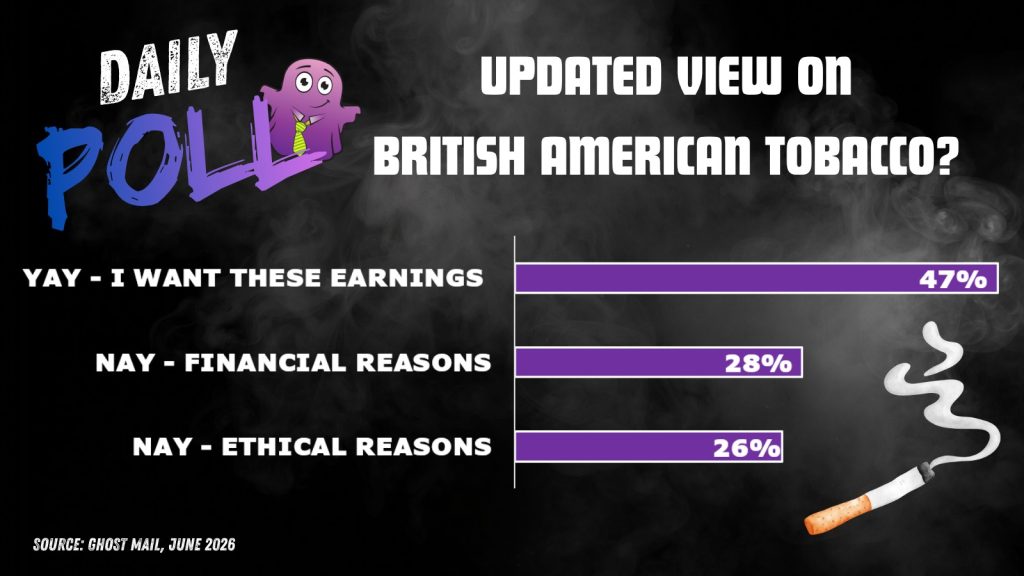
Results of previous poll:
Nibbles:
Director dealings:
A related party of a senior exec at British American Tobacco (JSE: BTI) bought shares worth around R340k.
The COO of Metair (JSE: MTA) bought shares worth R200k.
The CEO of Libstar (JSE: LBR) bought shares worth R24.5k.
Spear REIT (JSE: SEA) announced that holders of 48.79% of shares in issue elected the dividend reinvestment alternative. This allowed Spear to retain equity of R107.6 million. One way to think of this is as a mini-rights issue, in this case priced at just over R13.00 per share (the spot price is R13.30).
At Oasis Crescent Property Fund (JSE: OAS), holders of 64.3% of units in issue elected to reinvest their distribution. The fund therefore issued new units to the value of R24.5 million.
Tharisa (JSE: THA) has launched an ADR programme, which means they want to give US-based investors a way to invest in the company in the over-the-counter (OTC) market in the US. If the programme is successful, this can do good things for liquidity in the stock. Importantly, this doesn’t mean that any new shares have been issued. This is purely a US-based structure that provides market access to the existing base of shares.
Altron (JSE: AEL) announced that SARB approval for the special dividend has been received. The payment date is 22 June.
For those keeping track, Mustek (JSE: MST) has confirmed that Novus (JSE: NVS) has a 41.85% stake in the company.
Bidcorp (JSE: BID) has successfully renewed its €300 million revolving credit facility. There are a number of banks in the lending syndicate. Bidcorp is an exceptional global business, so I’m sure they had little or no trouble in these negotiations. The renewal has a tenure of 3 years, with an option to extend for a further 2 years.
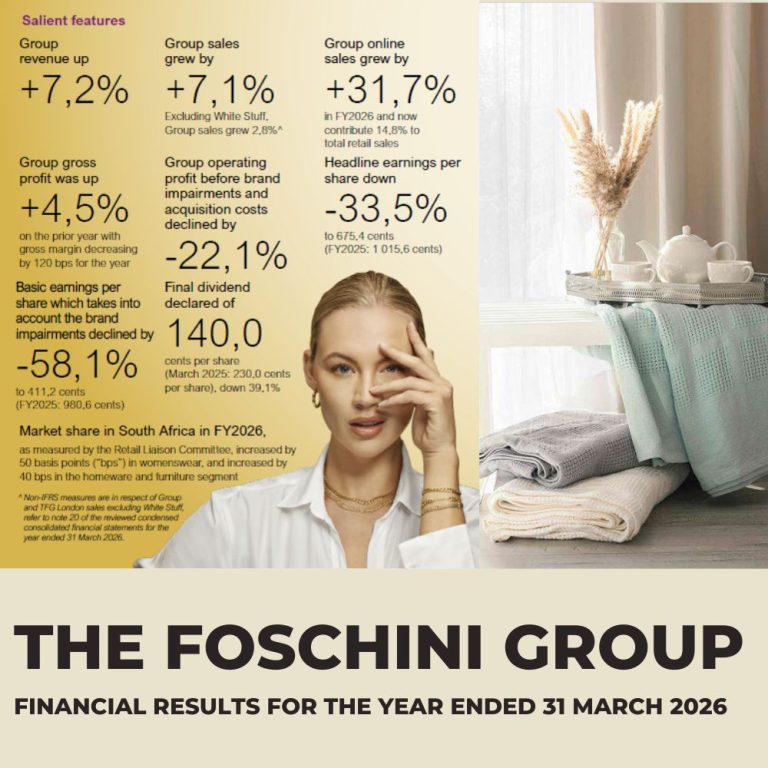
The Foschini Group financials for the year ended March 2026
“Disappointing results against a difficult macro and consumer backdrop.”
Anthony Thunström – Chief Executive
Group performance was adversely affected by a weaker second half, as trading conditions deteriorated across all operating regions.
The impact of softer peak season demand and lower gross margins resulted in negative operating leverage.
The Group recognised non-cash impairment charges against the Phase Eight brand in the UK, and the Tarocash and yd. brands in Australia reflecting the revised long-term cash flow expectations for these businesses.
Selected salient features:
Group revenue up 7.2%
Group sales up 7.1% (excluding White Stuff, up 2.8%)
Group online sales up 31.7%
Group gross profit up 4.5% (gross margin down 120 basis points)
Headline earnings per share down 33.5%
Key focus areas:
Leverage Bash and fulfilment leadership to make our business more capital light and efficient
Close underperforming and marginal stores and sharpen our brand portfolio
Enhance our Fintech and credit capabilities
Reduce complexity in our operating model and structurally lower our cost of doing business
Note: The Foschini Group values the Ghost Mail audience and the company has placed its earnings here accordingly. This article reflects the views of the company. For the views of The Finance Ghost, refer to the section in Ghost Bites dealing with these results.
PS: I’ve launched my YouTube channel! Check it out here and please consider subscribing.
The Foschini Group hasn’t stabilised yet (JSE: TFG)
Negative operating leverage continues to plague shareholders
The Foschini Group is in a tough spot. Shareholders don’t get the warm and fuzzies when they read things like “trading conditions deteriorated across all operating regions” and see references to negative operating leverage.
Group sales may have been up by 7.1% for the year ended March 2026, but the acquisition of White Stuff is heavily skewing this metric. The underlying reality is that group sales were up just 2.8% excluding that acquisition. Combined with a substantial gross margin contraction of 120 basis points, profitability never stood a chance.
HEPS is down 33.5% and the final dividend is down 39.1%. It’s not difficult to see why the share price is down 56% in the past 12 months.
The business in South Africa isn’t the worst of the issues, as TFG managed to increase market share in key areas like womenswear (up 50 basis points).
But even in the home market, there’s a worrying trend underneath the sales growth for the year of 5.0% (like-for-like up 3.5%). H1 growth was 5.3%, while H2 was only 4.7%. The only category that accelerated in H2 vs. H1 was jewellery, which contributes just 3.7% of TFG Africa’s sales. Weak momentum into the end of a period always spooks the market.
The Bash platform remains the bright spot, with online sales up 49.2%. Most importantly, they are achieving a structurally equivalent gross margin to the bricks-and-mortar business. Such is the growth differential that online sales reached 10% of group sales in the fourth quarter of the year.
Given the current state of play in the broader TFG financials, the capex-light nature of Bash makes it a highly attractive growth engine.
It’s also worth noting that credit sales growth of 4.6% was conservative vs. total growth. Credit sales contributed 25.8% to TFG Africa sales.
The much bigger issue in TFG Africa lies one level down in the gross margin. A contraction of 100 basis points to 41.6% isn’t what investors want to see in TFG’s core market.
The pain in gross margin means that TFG Africa didn’t get anywhere near covering the percentage increase in operating expenses. The resultant negative operating leverage took segmental EBIT down by 14.7%!
This all looks like a picnic in the sunshine compared to TFG London. Sales excluding White Stuff were flat for the year in local currency. White Stuff itself achieved growth of 4.3%, so the recent acquisition is doing better than the rest of the business. But that clearly isn’t saying much.
In an inflationary environment, flat sales can only end in tears. Sure enough, TFG London’s segmental EBIT fell by a nasty 65.4% (excluding the impact of White Stuff). That’s a proper mess.
TFG Australia is also quite the horror show. Sales were down 1.5% for the year and 3.4% on a like-for-like basis (both in local currency). The momentum tells an even uglier story, as the H1 sales decline of 0.5% worsened to an H2 decline of 2.4%. As you’ve probably guessed by now, segmental EBIT at TFG Australia also headed firmly in the wrong direction, down by 27.2%.
Early trading activity for the new financial year doesn’t look much better. Sales in TFG Africa were up by just 2.2% for the 9 weeks to 30 May 2026. TFG London was up 1.7% and TFG Australia fell by 2.3%, both in local currency.
Gross margin is up by 80 basis points in TFG Africa, 130 basis points in TFG London and 100 basis points in TFG Australia. Talk about small mercies.
Net debt to EBITDA has increased from 0.99x to 1.44x, driven by a small increase in net debt and a sharp drop in EBITDA. Return on capital employed has dropped from 14.8% to 10.9%. Things need to turn the corner – and quickly.
Ghost Bite: The Foschini Group is facing a crisis, evidenced by the interventions ranging from headcount reductions through to capex decreases and tighter lending books. They are talking about optimising the store footprint and reviewing marginal brands. In summary, they need to stabilise before they can possibly hope to grow again.
Mr Price enjoyed a partial share price recovery (JSE: MRP)
There’s still a long way to go to the pre-NKD share price
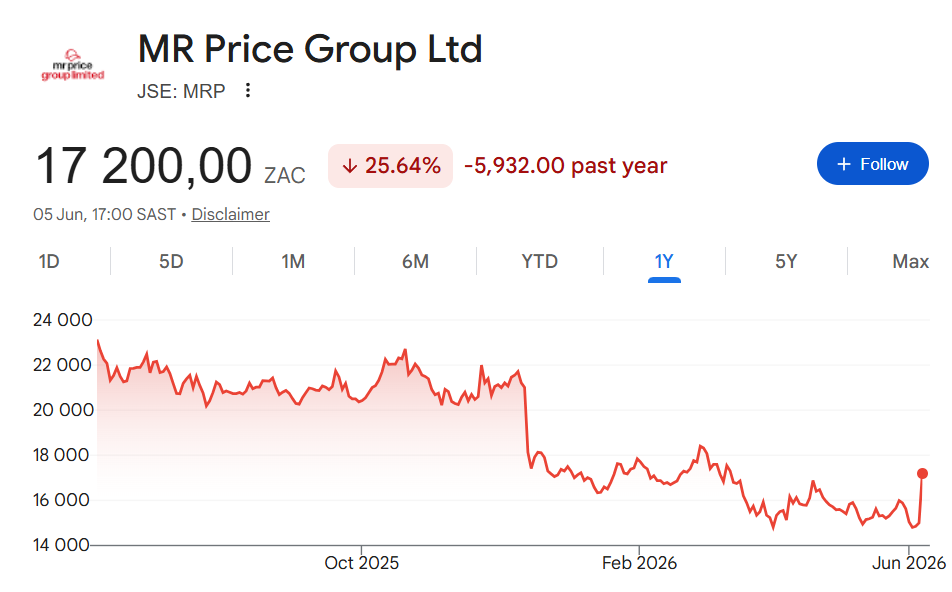
Mr Price closed 15% higher on Friday after releasing results for the 52 weeks to 28 March 2026. This doesn’t repair the damage of the NKD transaction, but it does take them to a flat year-to-date performance:
The costs related to the NKD transaction (R217 million) significantly impacted the period. HEPS as reported was up by just 2.1% for the year. Mr Price’s normalised view of HEPS (which strips out the once-off costs) reflects HEPS growth of 7.7%.
Retail sales growth of 4.3% was slightly ahead of the broader sector. But with weighted average space growth of 3.6%, there’s very little underlying organic growth to feel good about. Comparable store sales growth was just 1.1%, with group volumes up 0.5%.
To be fair, the second half of the year was up against a very tough base period with high growth. Despite this, they managed 3.3% revenue growth in H2. I believe that this would’ve been one of the catalysts for the positive share price move.
The other major highlight was in gross margin, which expanded by 70 basis points to 41.2%. That’s an impressive outcome in a difficult market, with a highlight being Mr Price Sport’s margin expansion of 110 basis points.
The group generated a 42.0% margin on merchandise and only 20.7% on telecoms, so keep an eye on the mix effect on gross margin. There’s a structural gap in the economics of these different categories.
Although there was pressure on operating costs (particularly occupancy costs and utilities), Mr Price still managed to increase normalised margin by 50 basis points to 14.7%. Normalised operating profit growth was 8%.
The group story is thus one of surprising H2 sales growth, accompanied by margin expansion in the numbers that suggests a strong foundation in the local business. This is, after all, why I bought shares in Mr Price in the first place (before the NKD madness).
Mr Price remains well off the pace from an online perspective, with online sales growth of just 4.9% (only slightly ahead of in-store growth of 4.4%). They seem unbothered by the omnichannel opportunity, despite 55% of online orders being collected in store.
An exception to this approach is Yuppiechef, which started life an an online store and then went the omnichannel route. This has been a helpful growth engine for Mr Price, with double-digit sales growth and an expanded footprint of 25 stores.
Another useful growth engine is telecoms, now up to 86 standalone stores alongside the 482 store-in-store concepts. Gross margin in this segment may be dilutive vs. the rest of the group, but it’s a great underpin that builds some resilience into the model.
The focus on cash sales remains, up 4.4% and contributing 89.4% of group sales. Credit sales increased by just 3.5%.
In terms of outlook, the group acknowledges that the introduction of debt for the NKD deal has taken them to a place where they need to focus on the balance sheet. The FY27 capex expectation is R1.1 billion in South Africa, which would be roughly in line with FY26. This will be accompanied by €24 million in Europe as NKD expands.
NKD was included in the group from 31 March 2026, so the next set of numbers will include the European acquisition that broke the trust between management and the market.
Ghost Bite: Given the market response to these numbers, a small amount of that trust might be coming back. The real test is whether some positive momentum will stick.
Results of previous poll:
Nibbles:
Director dealings:
A director of MTN (JSE: MTN) sold shares worth over R19 million. That’s a substantial disposal.
A director of AVI (JSE: AVI) received shares awards, and sold the whole lot worth R4.7 million.
Aside from a restructure of shares from his personal name into that of an associated entity, the CEO of Pan African Resources (JSE: PAN) also entered into a long CFD contract over shares worth nearly R2.5 million.
Des de Beer has bought another R1.4 million worth of shares in Lighthouse Properties (JSE: LTE). If history repeats itself, you’ll soon see why I mention de Beer by name here. Chances are, he’ll be buying a lot of shares…
A director of PSG Financial Services (JSE: KST) bought shares worth R439k. For whatever reason, there were identically-sized purchases of shares by three other directors of major subsidiaries, all at an identical price. Odd.
The family trust of a director of CMH (JSE: CMH) bought shares worth R95.4k,
Novus (JSE: NVS) has acquired a further R16.3 million worth of shares in Mustek (JSE: MST). This takes them from a direct stake of 39.96% to 41.85%. Together with concert parties, they now hold 62.14% in Mustek.
Hudaco (JSE: HDC) announced a small related party deal in which an operating subsidiary (Ambro Steel) has renewed its lease of a building that is 82% owned by the CEO of Hudaco. Ambro Steel has been in these premises since before Hudaco acquired the company in 2008. To protect shareholders from the obvious conflict of interest, the independent directors considered the terms of the lease renewal without the influence of the CEO in the process.
The Backrooms began as an anonymous 4chan post and became the most surprising horror movie hit of the year. To understand why an empty room terrifies us, we have to look at what’s hiding behind the wallpaper.
On May 12, 2019, an anonymous user started a thread on /x/, 4chan’s paranormal-themed board. For those who are unfamiliar with 4chan – it is an anonymous imageboard website, split into numerous “boards” where users discuss topics like video games, anime, cooking, and politics without registering accounts. The prompt on the thread asked users to “post disquieting images that just feel ‘off’. The thread was accompanied by the following photograph:
To you and me, this photo may look completely unremarkable: it’s just a subdivided room, wallpapered in yellow and lit by fluorescent lights. But to participants in the 4chan thread, it signalled something ominous. Before long, another anonymous user replied to the post with this:
“If you’re not careful and you noclip out of reality in the wrong areas, you’ll end up in the Backrooms, where it’s nothing but the stink of old moist carpet, the madness of mono-yellow, the endless background noise of fluorescent lights at maximum hum-buzz, and approximately six hundred million square miles of randomly segmented empty rooms to be trapped in. God save you if you hear something wandering around nearby, because it sure as hell has heard you.” – Anonymous, 4chan (May 13, 2019)
That raises the hair on the back of your neck a little bit, doesn’t it? And in case you’re wondering, to “noclip out of reality” in an internet idiom for falling through a glitch in the physical world.
The combination of the photograph (which was eventually traced back to a nondescript furniture store in Oshkosh, Wisconsin, captured mid-renovation), the creepy thread post and the name “The Backrooms” was all it took for the internet to create a brand new genre of horror.
If the term sounds vaguely familiar to you, that may be because you heard about the Backrooms film that recently landed in local cinemas. Or maybe you’ve even seen the trailer:
The making of the movie itself is a great story. It is the directorial debut of 20-year-old Kane Parsons, who first started making amateur Backrooms-themed horror shorts for his YouTube channel in 2022. What started as a hobby has now led to Parsons becoming the youngest director in history to top the box office with a $118 million global opening.
There’s a lot we could dig into here: the scaling of ideas on message boards like 4chan into the stuff of urban legends, or the strange pathways that some images follow once they’ve been posted online, or even the chutzpah of Kane Parsons as he shepherded his content from small screen to big screen. So many tempting threads to pull, but alas, so little time.
So let’s move on to the main question that the Backrooms phenomenon forces into the open: why are we so afraid of empty rooms?
The threat of an empty space
To understand how a room full of nothing became a horror movie antagonist, we need to understand two much older ideas: the liminal space, and the uncanny valley.
In 1909, anthropologist Arnold van Gennep used the word “liminal” to describe a period of transition, specifically the in-between moments when a person moves from one societal identity to another. A newly engaged woman is an example of someone in a liminal state: no longer only her parents’ daughter, but also not yet someone’s wife.
Other thinkers and writers later stretched the idea of the liminal to cover spaces. Picture a school at dusk, after everyone has gone home. The desks stand ready, but there is no-one to teach. The classroom has a clear purpose that it cannot fulfil when it is empty; it is therefore a space in transition – a liminal space. The same goes for a shopping mall after hours or a deserted parking lot. These are spaces that are comfortable and familiar when full of people, yet distinctly foreign and unsettling when empty.
But why should emptiness make us nervous? If no-one is there, what exactly is the threat?
This is where the liminal meets the uncanny valley. In 1970, the roboticist Masahiro Mori observed that as machines are made to resemble humans, our affection for them rises – until a certain point, where it suddenly plunges into revulsion. A clearly mechanical robot (like WALL-E) is endearing, while a near-perfect replica that is somehow not quite right (like Sophia the robot) can be horrifying.
The almost-human disturbs us more than the obviously artificial, because it trips a primal alarm. As human beings, we are pattern-matchers, constantly predicting our surroundings. Our brains say: this is a face, so it will blink; this is a hallway, so people will walk down it. Both the liminal space and the uncanny valley object present a near-perfect match that fails on one variable, and that misfire registers as a threat instead of a neutral error. We feel unsettled because we have the sense that something is impersonating the familiar.
Maybe fear is warranted
There are the psychological reasons why we fear the Backrooms… and then there are, unfortunately, a few incidents that prove that perhaps our fear is sensible.
In 2017, the body of a 71-year-old man named Bernard Gore was discovered in the back passages of the Westfield Mall in Bondi, Australia. He was reported missing three weeks prior, when he had arranged to meet his wife and daughter at the mall but never showed up. It is believed that Mr. Gore accidentally entered the back passages of the mall through a door in a stairwell, and that he became so disoriented that he couldn’t find his way back out. The coroner’s report pointed to his cause of death as dehydration.
After the incident, Sunday Telegraph reporter Sarah Keoghan conducted a test of the enormous Westfield Mall’s back passages and maintenance tunnels, which she found confusing and exhausting. Ms Keoghan found there were only two points of escape – the roof carpark or the basement six flights down – and that no levels had emergency phones, clearly marked directions towards exits or maps. In total, the back passages of the mall were made up of 14 kilometres worth of emergency fire stairs, maintenance corridors, and utility accessways!
Mr. Gore wasn’t the first person to get lost in the Westfield Mall tunnels either. Earlier the same year, Loretta Feeney and her mother became trapped behind a locked door in a Westfield stairwell. They had apparently been looking for stairs as a nearby elevator was out of order. The door they entered through only had a warning that read “Do Not Obstruct”. When the door closed behind them, they realised that it had no handle on their side.
Fortunately, Ms. Feeney was able to get sporadic reception on her cellphone, which she used to phone centre management. From there, a security guard talked them through the maze of tunnels until they arrived at an exit. They got lucky. Mr. Gore, unfortunately, did not.
Behind the familiar
Here is the strange thing about the Backrooms. The subgenre was supposed to be a fantasy, a fictional dimension you fall into by “noclipping out of reality”, a place that exists only in grainy YouTube videos and the collective imagination of a 4chan thread. And yet the feeling it captured was real all along. Bernard Gore did not need to glitch through the walls of the world. He simply walked through the wrong door in a Bondi shopping centre.
That, perhaps, is why the Backrooms struck such a nerve that it travelled from an anonymous post to a $118 million opening weekend in the space of seven years. The name may be new, but the fear is very, very old. It’s the suspicion that the familiar, well-lit world is only a thin surface, and that behind it lies something endless, indifferent, and built without us in mind.
So the next time you find yourself alone in a space that should be full – an office after midnight, or a stairwell, or an empty parking lot – and you feel that small, ancient prickle at the back of your neck, don’t be too quick to dismiss it.
Some part of you has simply noticed where you really are.
About the author: Dominique Olivier
Dominique Olivier uses her love of storytelling and ideation to help brands solve problems.
Her first book, Lessons from Loss, has been published by Penguin Random House.
She is a weekly columnist in Ghost Mail and collaborates with The Finance Ghost on Ghost Mail Weekender, a Sunday publication designed to help you be more interesting.
Jubilee Metals is successfully through its maintenance shutdown
Some bright spots at Old Mutual, but still sideways overalls
Wesizwe Platinum announces job losses at Bakubung Minerals
Jubilee Metals is successfully through its maintenance shutdown (JSE: JBL)
There must be an audible sigh of relief at junior miners when these processes go well
Jubilee Metals has released an operational update on the Roan concentrator. This is a critical part of their value chain, as Roan processes third-party run-of-mine copper ore into copper concentrates for further processing at the Sable refinery. Roan also produces high-grade sulphide concentrate for direct sale into the market.
The most recent major step at Roan was the commissioning of the expanded copper concentrate dewatering circuit. They then moved into an annual maintenance shutdown in May 2026. This was successful, as operations have been resumed at full capacity.
Jubilee also took advantage of the maintenance period to make improvements to the copper oxide flotation circuit. This should improve copper recoveries and partially offset inflationary pressures in fuel and chemical costs. Interestingly, acid consumption and transport costs contribute approximately 20% and 16% of monthly expenses respectively.
Ghost Bite: Despite copper being such a global focus area, Jubilee’s share price is down 38% in the past year. I don’t have the technical skillset to get involved in junior mining stocks, but that does seem odd.
Some bright spots at Old Mutual, but still sideways overall (JSE: OMU)
The bank remains an enigma for me
Old Mutual has released a voluntary operating update for the quarter ended March 2026. The “results from operations” number of R2.5 billion represents a pretty flat performance. The group has also noted that shareholder investment returns were significantly lower in this quarter due to market volatility.
So, not a fantastic outcome at group level, but what if we dig deeper?
Life APE sales were up by an impressive 28%, but there’s lumpiness in this number that needs to be considered. Excluding one large risk deal in Old Mutual Corporate, the growth rate was 15%. Still, that’s a strong number, with Old Mutual highlighting positive momentum across most of its clusters.
Old Mutual Investments has enjoyed “exceptional flows” according to the announcement. They are putting a lot of effort into marketing that business.
At Old Mutual group level though, there were net client cash outflows of R3.2 billion (better than the outflow of R5.4 billion in the prior period, but still a concern).
In terms of margin, it’s good to see value of new business margin up at 1.6% (vs. 1.2% previously). The aforementioned large risk deal was a positive contributor here, as was the margin improvement in the Wealth Management business. Old Mutual has cautioned that the margin will normalise over the remainder of the year.
On the insurance side, Old Mutual Insure reported a strong net underwriting margin that was ahead of the medium-term range of 5% to 8%. Gross written premiums were up 4% in this business. Alongside the strong margins, this bodes well for the financial performance.
Gross loans and advances were up by just 1% year-on-year, so Old Mutual has plenty of work to do in deploying assets. They are busy integrating Old Mutual Finance and OM Bank, with lending activities at the bank expected to launch in the second half of the year. I still don’t understand what their key differentiator is, especially since we already have a green bank!
To be fair, one of their strategic priorities is to “establish the right to win for OM Bank”, so at least we are talking the same language here. I just don’t see what that right to win will be. Thanks to existing products being migrated into the bank, they have 473,000 customers. The real test is whether they can cross-sell transactional products into a base of money market and savings account customers.
The balance sheet is in good shape, with the regulatory solvency ratio within the target range. This means that Old Mutual had no problems in executing a R3 billion share buyback.
Ghost Bite: Old Mutual’s share price has been under pressure this year, down 14% since the start of 2026. On a mid-single digit P/E, the market clearly doesn’t believe that Old Mutual is capable of meaningful growth. It’s up to the company to prove the market wrong!
Wesizwe Platinum announces job losses at Bakubung Minerals (JSE: WEZ)
Nearly 500jobs will be affected
Wesizwe Platinum announced that Bakubung Minerals will be entering into a s189 process to restructure its operations. When you see the term “s189”, you know that some people are going to lose their jobs.
Sure enough, with the company moving from a 1 Mtpa production strategy to a 3.5 Mtpa operation, they need to pursue a single-stage ramp-up. That might sound like more jobs would be needed, but it’s quite the opposite.
To reduce expenses and sustain the numbers in their business plan, Bakubung’s restructure will affect 497 employees out of the total headcount of 706 employees.
As a precaution during the process, Bakubung will implement a temporary operational shutdown for three weeks in June.
Ghost Bite: I’ve had a front-row seat to a retrenchment process in a corporate and I can tell you that it isn’t fun. Given the history of our mining sector in South Africa, the stakes are even higher here. I don’t envy anyone involved in this process.
Results of previous poll:
Nibbles:
Director dealings:
The company secretary of AVI (JSE: AVI) received share options and sold the whole lot worth R2.6 million.
Adrian Saville was recently appointed to the board of 4Sight Holdings (JSE: 4SI), bringing plenty of experience and a strong reputation to the company. He’s now thrown some money behind it as well, buying shares worth R248k. If you’re keen to learn more about this company, check out the recent Unlock the Stock webinar with management here.
An entity associated with Africa Bitcoin Corporation (JSE: BAC) CEO Warren Wheatley bought ordinary shares in the company worth R25k.
Nictus (JSE: NCS) is one of the more obscure names on the JSE, with a market cap of just R150 million. This furniture and financial services business has released a trading statement dealing with the year ended March 2026. HEPS is up by between 74.28% and 94.28%, a rather incredible jump! Detailed results are due at the end of June.
There’s finally a changing of the guard at Combined Motor Holdings (JSE: CMH). You’ll struggle to find a board anywhere on the JSE with this many directors who have been there for so long. Having been appointed to the board in 1986 (two years before I was born!), Stuart Jackson is now retiring as CFO. He will remain a director and will be available to assist newly appointed CFO Priya Govind. Govind was appointed to the board in June 2025 as CFO-designate.
Orion Minerals (JSE: ORN) has completed the raise of $15.4 million (around R181 million). They even managed to pay an advisor in shares instead of cash, so that’s a further boost. There’s all to play for now, with the share price up 73% in the past 12 months as the market has felt more confident about the company’s ability to raise funding and develop its projects.
Good news for shareholders in Deneb (JSE: DNB): the sale of the Deneb House property in Observatory for R120 million has been approved by the Competition Commission. The deal is now unconditional, with transfer expected by the end of July 2026.
Aimia (JSE: AII) is ready to get going on its share buyback programme, or its “normal course issuer bid” as per the fancy terminology on the Toronto Stock Exchange (TSX). There are a bunch of other interesting rules actually, like a maximum daily limit of 25% of average daily trade. In addition, Aimia can execute one block purchase per week.
Copper 360 (JSE: CPR) has announced the appointment of Malande Tonjeni as independent director and chair of the audit and risk committee. Beverly Bouwer has been appointed as lead independent director. This company has so much work to do. They nee to repair their image with investors who have watched the share price collapse.
Sebata Holdings (JSE: SEB) released a trading statement dealing with the year ended March 2025. HEPS swung wildly from a loss of 102.20 cents to a profit of between 90.66 cents and 110.66 cents. And no, your eyes are not deceiving you – they really are this far behind on their financial reporting. That’s why the stock is suspended from trading.
China remains South Africa’s largest trading partner, but the landscape of global trade is evolving. As compliance requirements tighten, supply chains face new pressures, and geopolitical tensions reshape trade flows, businesses must navigate an increasingly complex relationship with the world’s second-largest economy.
In this episode of No Ordinary Wednesday, Investec Treasury Economist Tertia Jacobs and Head of Supply Chain Dylan Govender look at the forces reshaping Sino-South Africa trade and explore what these changes mean for local businesses and the broader economy.
Listen to the full conversation to find out more. Read more on www.investec.com/now
Please scroll down for the transcript if you wish to read instead of listen.
Hosted by seasoned broadcaster, Jeremy Maggs, the No Ordinary Wednesday podcast unpacks the latest economic, business and political news in South Africa, with an all-star cast of investment and wealth managers, economists and financial planners from Investec. Listen in every second Wednesday for an in-depth look at what’s moving markets, shaping the economy, and changing the game for your wallet and your business.
Also on Apple Podcasts, Spotify and YouTube:
Transcript:
JM: Jeremy Maggs- No Ordinary Wednesday host TJ: Tertia Jacobs- Treasure Economist, Investec DG: Dylan Govender- Head of supply chain, Investec
00:00: Introduction:
Jeremy: China buys more South African goods than any other country in the world. It’s also the source of a massive share of the products that South Africans use every single day, from infrastructure equipment and industrial inputs to your television and fridge. But as global trade becomes more fragmented, regulated, and politically sensitive, the relationship is evolving.
New compliance measures coming into effect in about four months’ time will shift part of South Africa’s import control process directly into China itself. Now, this new legislation introduces new operational realities for importers and raising broader questions about supply chain resilience, dependency, and trade risk.
Then there’s the landmark China trade scheme. So what does the modern China-South Africa trade relationship really look like? Where are the vulnerabilities, and are South African businesses prepared for a more complex import environment? Hello and welcome. This is No Ordinary Wednesday. It’s our in-depth look at what is driving markets, shaping the economy, and changing the game.
I’m Jeremy Maggs. And in this episode, I’m joined by Investec’s Tertia Jacobs, treasury economist, and Dylan Govender, who’s head of supply chain.
01:21: The evolution of SA-Sino trade relations
Tertia, let’s start this important conversation with you then. And China remains South Africa’s single largest trading partner, but the relationship has evolved significantly over the past decade.
So how would you characterize the current economic relationship between the two countries today, and just how dependent is South Africa on China?
TJ: Hi, Jeremy. These are very important dynamics that are playing out. So, as you noted, China is South Africa’s largest trading partner, with bilateral trade of about 640 billion rand in ’25.
I would just like to add that South Africa’s trade is quite diversified with the rest of the world as well. For example, with Germany, bilateral trade is nearly 300 billion rand, with the US 280 billion rand, and 140 with the UK and Japan respectively.
But now the trade relationship with South Africa is highly asymmetric.
And what do we mean with that? South Africa primarily exports raw materials and mineral ores while importing high value-added goods, as you mentioned in your introduction. So, what’s also been playing out is that this asymmetrical balance has actually contributed to a persistent and widening bilateral trade deficit of nearly 200 billion rand in 2025.
02:38: Will the zero-tarrif trade deal change this asymmetry?
JM: So Tertia, a follow-up. And how will the new China trade scheme that came into effect last month shift that dynamic?
TJ: So this is actually quite important in the global context of changing trade dynamics. So, this scheme is a non-reciprocal zero tariff treatment for goods exported from not only South Africa but from Africa.
And remember, it’s a temporary arrangement, and it will only be for two years, ending April 2028. So, pending that will be the conclusion of the China-African Economic Partnership Agreement, right? So, we’re watching that. So now the big question is, will it make a difference? So, there are two things I’d like to note.
Firstly, it’s important to be aware that tariffs are subject to tariff rate quotas. So, whereas China has become one of the world’s most open economies in terms of exports, foreign firms often face greater challenges accessing China’s domestic market than Chinese firms accessing foreign markets. However, the issue is quite nuanced and varies significantly by sector in terms of the geopolitical dynamics as well. So, China’s growth model has also become increasingly reliant on exports as domestic demand has struggled to absorb the excess industrial capacity in the economy.
So, there’s also been growing concerns among trading partners regarding unfair competition and the potential dumping of excess production into global markets at prices that domestic producers often struggle to match. Now, as a result, a growing number of countries, including South Africa, right, have responded with anti-dumping measures and tariffs to protect strategic industries as well as domestic manufacturing capacity.
And the second point is, and this is actually got to do with South Africa itself, we have neglected our manufacturing sector in the context of power shortages, state corruption, policy uncertainty, and we’ve had an average growth rate of only 1% over the past decade. So, while South Africa’s industrial base remains very large in the context of Africa, Morocco has now overtaken South Africa as the continent’s most industrialized economy in 2025.
So, that is something that we must monitor because our industrial sector have become quite uncompetitive. So, to the extent that we can take advantage of this, there are a number of headwinds, and I’d say over the short term, we’ll continue to focus on raw material exports, but there is longer term opportunities if we increase investment in our manufacturing sector.
05:13: New China export rules could impact SA exporters during busiest season
JM: All right, Dylan, let me come to you now. And as we’ve heard, Tertia has outlined the evolving macro relationship, but you’re seeing where these shifts become operational reality for businesses. I wonder if you can give us a high-level overview of what the new China import rules are, and from a supply chain perspective, what changes materially for South African importers.
DG: Yes, Jeremy. From the 20th of September 2026, affected products from China will need a certificate of conformity before shipment. This ensures that the goods comply with SABS regulations in terms of how they’ve been manufactured. If you take toys, for example, they don’t contain lead-based paints. So, the enforcement is there to protect the consumer at the end of the day and ensure that products are manufactured to a certain level of compliance.
The drastic shift is in terms of how this is going to be enforced. It’s a fundamental change for how goods are brought into the country. Previously, these were based on random detentions. Remember, the SABS standards have always been there in terms of compliance. It’s just how it’s been enacted. It’s been previously on a random basis where a container will be detained, and the quality will be checked.
Now it’s been linked to the South African Revenue Services in terms of the tariff heading that’s declared. If you’re bringing toys in, for example, it’s going be read cleared by SARS, and SARS is going call for the query documents. Once the query documents are provided, if you do not have the certificate of conformity, it’s going lead to detention of goods, and it’s going lead to massive storage costs.
And obviously, you’ve got that working capital that’s tied up there because you can’t resell those goods until you get final release of it
06:40: How SA is walking the tightrope of politics and trade
JM: So Tertia, we’re operating in a far more fragmented global trade environment right now with tariff tensions and geopolitical competition all reshaping global commerce.
So how exposed is South Africa to that changing global trade order through its relationship with China?
TJ: That’s very interesting dynamic, and I think there’s two issues here. The first is South Africa’s export basket, and the second one, the emergence of new trade relationships. So with regards to our own trade relationships, we remain quite vulnerable to the extent that trade with the United States has become less favorable because of the tariffs, and export performance is not as strong as it previously was.
However, very interesting is that there has not been a material collapse in export revenues, and that’s largely because South Africa’s export market basket remains heavily concentrated in commodities rather than manufactured goods. So key exports such as gold, platinum group metals, and other mineral ores, which we touched on earlier, are generally less affected by bilateral trade disputes and tariff negotiations, and that provides a degree of insulation from the current wave of trade fragmentation.
And then the second issue here is, and I think this is more indirect, but it may become more pertinent over the medium to longer term, and that is that there’s an emergence of new trade relationships and preferential trade arrangements as countries increasingly seek to diversify away from traditional trading partners and build more resilient chains.
You know, as geopolitical fragmentation intensifies, countries are actively pursuing new alliances and trade agreements aimed at securing trusted and mutually beneficial market access. So, South Africa then risks being sidelined if we do not actively search for new trading partners or to deepen trade relationships as these trade networks are evolving.
So, I’d say the greatest risk from trade fragmentation, industrial policy, and strategic competition tend to arise in sectors characterized by high value-added manufacturing and advanced technological production. So that is where South Africa is not a top performer, but it’s very important that we start strengthening trade relationships with more countries.
09:08: The added complexity of BRICS
JM: So Tertia, what role then does BRICS have to play in all of this?
TJ: Yeah, that’s also a very interesting dynamic. So, one of the challenges facing BRICS is that its expansion, remember more members were added on top of the existing five members, has made the grouping more economically and politically diverse, making it increasingly difficult to establish a coherent strategic direction.
For example, the recent Middle East conflict highlighted these tensions with the latest BRICS meeting unable to issue a unified communique because members could not reach a consensus. So, it reinforces an important point. BRICS is not a homogenous anti-Western or anti-dollar bloc. Its members have very different economic interests, security relationships, and geopolitical priorities.
For example, some of the newer members, including India, Egypt, and Saudi Arabia, maintains very close relationships with America.
10:04: PROMO BREAK: Investec Minds: Insights from former CEOs that shaped corporate SA JM: All right, we’re going to continue this conversation in just a moment, but first I would like to tell you about Investec Minds. It’s a new podcast series that has launched on Investec Focus Radio SA, and on the show, equity analysts from Investec Corporate and Investment Banking interview former chief executive officers that helped define some of South Africa’s biggest industries, from banking to mining, retail, and telcos.
To make sure that you don’t miss it, follow Investec Focus Radio SA wherever you get your podcasts.
10:36: South Africa must diversify imports of finished goods
Now, let’s get back to the discussion. Dylan Govender, back to you then. And there’s often a perception, I think, that South Africa benefits enormously from its relationship with China. But I guess dependency can cut both ways.
So where do you see the biggest shifts in the relationship from a South African perspective?
DG: Jeremy, from South Africa’s perspective, the relationship with China remains hugely important. But the conversation is increasingly shifting from cost and efficiency to resilience, compliance, and strategic risk management.
If you take the Pre-Verification of Conformity, PVOC program, South African businesses are heavily dependent on China for finished goods. Like Tertia touched on, South Africa still exports predominantly raw materials while importing higher valued manufactured goods. So, Jeremy, the new trade compliance highlights the risk of relying too heavily on a single sourcing market.
Businesses are increasingly evaluating alternative suppliers, secondary sourcing locations, and inventory strategies to reduce disruptions, risk, and logistics bottlenecks. The major risk here is, is China and South Africa ready for this partnership in terms of the compliance program?
There’s one authority in China that’s been nominated to handle all these inspections and issue all these certificates.
Now, if you look at the volume that’s moving from China to South Africa and a go live readiness date of the 20th of September, is there enough capacity resources to cater for the date that’s around the corner? And that’s what we at Investec are trying to lobby with the industry to apply for the extension.
We 100% for the compliance we agree that products should be manufactured to a certain standard, and we want protect the consumer. We want be compliant, but we don’t want to have to deal with these bottlenecks and the level of non-compliance and the additional charges that’s going be faced by our clients just because of a readiness date around the corner.
12:16: Investec wants the deadline of compliance to be extended
JM: And Dylan, do you think there’s a high likelihood this date is going to be shifted out?
DG: We are lobbying as Investec together with the industry to have this date moved out simply because we, we do not see our importers being ready to be 100% compliance. There’s massive factors to be considered. The first thing is the Chinese authority, do they have enough capacity to process?
The secondary thing is the South African Revenue Services, they’re gonna be enforcing this. Do they have the capacity to process all these manual queries that’s gonna be coming about? Remember, any delays in supply chain is gonna cost us fundamentally. Also, the rollout date is towards a peak time in the year.
During the course of end of September, October is your peak season where majority of your imports are coming in, and that’s for your Black Friday and your Christmas sales. We don’t want our, our clients, our importers, to be affected by this and have lack of visibility of goods on the shelf
13:01: Impact of China’s slowing economy on South Africa
JM: Tertia, back to you.
And China’s own economy is slowing structurally, particularly in property and industrial activity. So, what then does a weaker Chinese growth environment mean for South Africa’s economy, its fiscal position, and its currency outlook?
TJ: That’s also very interesting and very important dynamic, Jeremy. I think the way that we look at it is not necessarily a sharp slowdown in the Chinese economy, it’s more a question of the transformation of the Chinese economy.
You know, as countries become wealthier, they typically transition from manufacturing-led growth, and that is why we said earlier on that China is a massive exporter because it’s got a lot of excess production capacity and not enough domestic demand to absorb it. So, it’s very important for them to boost consumer spending, but also transition to more a services-orientated economy.
For example, the UK, the US, and Japan all followed this path, right? So, China’s likely to face similar pressures as labor cost rise and also as demographics deteriorate. So, this demographic challenge of China is going to reinforce this longer-term trend. Um, it’s an aging population, it’s a shrinking workforce, and that translates into a weaker property sector that impacts the growth over time.
And what we’ve also seen in China is that they’re not pro-immigration, right? So, China appears to be responding through automation, robotics, and technological upgrading, which may support productivity but is unlikely to offset these demographic headwinds. So that’s one of the big dynamics that’s unfolding.
Now, for South Africa, this matters less because a less industrial and infrastructure-intensive Chinese economy would likely generate slower growth and demand for commodities, right, such as iron ore and manganese and chrome. But these changes, very importantly, tend to unfold very gradually rather than abruptly.
So, it’s something that we need to monitor, and I think it brings us back to the earlier point. It’s very important that South Africa re-industrializes.
15:13 Businesses need sufficient working capital to get through the delays
JM: Dylan, we often talk about supply chain resilience in abstract terms, but practically, what happens to a business when goods are delayed at origin or arrive without the correct certification?
DG: Jeremy, the biggest risk here is any delay is gonna cause a corruption in your working capital cycle. Whether it be at origin or at destination, your goods could be tied up for additional seven to 10 days. That’s less time for you to get the goods on the shelf and convert that into a cash cycle for your business.
So, it’s imperative that you are walking the journey with the right trade financier to ensure that your working capital cycle is met and matched correctly.
15:50 The nature of Sino-SA relations over the next 5 years
JM: All right, as we come to the end of this episode of No Ordinary Wednesday, I’m going to ask you both to do some forecasting, maybe over the next five years.
Do you think that the China-South Africa trade relationship becomes deeper and more strategic, or maybe more cautious and fragmented?
TJ: Jeremy, good question, but I’d like to make it a little bit nuanced, if it’s okay. So, I think firstly with regards to China and South Africa, I think the path is to set us up for a stronger relationship.
South Africa sees China as an ally, politically and economically, so we would be looking for opportunities to strengthen that.
But the next important dynamic is we must also ask what is in the interest of South Africa, and I think that point has to do with many of South Africa’s future growth opportunities are likely to be found within Africa itself.
That’s a key reason why South Africa has been a strong supporter of the African Continental Free Trade Area. Many advanced economies also face aging populations and slower growth, and Africa remains one of the fewer regimes with strong population growth, urbanization, and rising consumer demand. So unlike trade with China, which is heavily commodity-based, African markets offer greater opportunities for higher value-added exports, including manufactured goods, food products, financial services, and telecommunications.
JM: And Dylan, any thoughts on this?
DG: Yeah, good question, Jeremy, and you know, Tertia touched on a lot already, but it’s a very exciting relationship. I mean, right now with the free trade agreement between China and South Africa, China has opened the doors to duty-free trade in terms of goods being imported.
So, you can imagine what that’s gonna do for our agricultural sector, for example, in terms of fresh produce that’s moving into China. It could be a massive opportunity, and I think the two-year trial could lead to much bigger things in the future.
17:40: Outro, thanks and disclaimer JM: And that brings this episode of No Ordinary Wednesday to a close. My thanks to both Tertia Jacobs, treasury economist, and Dylan Govender, who’s head of supply chain at Investec.
And remember, a new episode of the series drops every two weeks. To ensure that you don’t miss out, all you need to do is search for Investec Focus Radio SA wherever you get your podcasts and hit the follow button. Until next time, goodbye from me, Jeremy Maggs, and the entire Focus Radio team.
Disclaimer: The views expressed are those of the contributors at the time of publication and do not necessarily represent the views of the firm and should not be taken as advice or recommendations. Investec Limited and subsidiaries, authorized financial service providers, registered credit providers, and long-term insurer.
Fairvest upgrades full year guidance (JSE: FTA | JSE: FTB)
The interim period has been kind to the property fund
Fairvest’s results for the six months to March 2026 reflect 12.3% growth in the distribution per B share. The dual-share structure is allowing the B shareholders to enjoy double-digit growth despite the tricky environment. This is because the A shares are capped to the lower of CPI or 5% growth, with the B shares then carrying the variability in earnings.
For the full year, Fairvest expects the B shareholders to enjoy distribution per share growth of between 11% and 13% (an upgrade vs. previous guidance of 9% to 11%).
Underpinning this interim result is like-for-like net property income growth of 8.0%, along with positive rental reversions of 5.7% (rare in this environment – especially for such a diversified fund with 130 properties across multiple types).
The loan-to-value ratio of 26.6% tells us that the balance sheet is in good shape. This is also supportive of distributions going forwards, especially with interest rates heading higher and putting funds with more leverage under pressure.
Ghost Bite: A property fund upgrading its guidance in this environment is a nice surprise. The B shares are up 36% in the past year, delivering fantastic returns to those willing to carry more risk!
Ninety One returns to net positive flows (JSE: NY1 | JSE: N91)
The market movements were also in their favour
Ninety One’s assets under management (AUM) may have increased by 31% for the year ended March 2026, but there’s a big chunk from the Sanlam (JSE: SLM) take-on that we need to adjust for. If you remove that £18.3 billion from the numbers, then you’ll find that the rest of the AUM grew by 17.4%.
That’s still an impressive outcome, but it’s always worth looking at whether this is primarily due to market movements or net inflows. The former is largely outside of Ninety One’s control, while the latter is a direct measure of marketing and distribution strength.
In this period, they achieved net inflows of £2.8 billion. That’s an excellent swing from net outflows of -£4.9 billion in the prior period. Market and forex movements of £19.9 billion did the rest of the work (vs. £9.7 billion in the base period).
As a quick note on the shape of the AUM, only 29% sits in pure equity portfolios. The largest allocation is actually fixed income funds (38%), followed by multi-asset funds (32%). Alternatives now represent a significant 18% of total AUM.
The geographical split is also fascinating. Africa is the largest region at 44% in terms of where clients sit. Next up we find Asia Pacific at 35%, mainly because of clients in the Middle East. The UK is all the way down as 12%, below both Europe (20%) and the Americas (17%).
This should add up to an exciting performance, but HEPS was only up by 2% as reported. There are various reasons for this, including the shares issued to Sanlam in the active asset management transaction that gave AUM such a boost.
Ninety One also reports adjusted earnings per share growth of 12%, with one of the longest list of adjustments I’ve ever seen. To their credit, at least they disclose them on a line-by-line basis in the SENS, which is more than we can say for most companies.
To give some credence to the adjusted growth percentage, the dividend per share is 10% higher.
Ghost Bite: A return to net positive flows is a very important sign here. The next period’s results will hopefully show the true benefit of the Sanlam deal and the resultant scale.
Putprop invests in Kramerville (JSE: PPR)
They aren’t wasting any time in recycling their capital
Property fund Putprop has been busy lately. After announcing a couple of property disposals, they’ve now told the market about the acquisition of a property in Kramerville for R124.5 million.
This is a multi-tenant retail centre that currently houses design and décor retailers. It generated profit after tax of R10.2 million for the year ended February 2026.
This is an after-tax yield of 8.2%. Importantly, this isn’t directly comparable to the net operating income (NOI) yield that property funds would usually disclose, as NOI is typically gross of tax.
Before making any major conclusions on this deal, it would be best to wait for the circular to shareholders. As Putprop is a small fund, this is a Category 1 transaction.
Ghost Bite: It’s been years since I was in Kramerville, but it’s probably one of the more interesting areas in Joburg from a property perspective.
Results of previous poll:
Nibbles:
Director dealings:
Des de Beer is back on the bid at Lighthouse Properties (JSE: LTE), picking up R4.1 million worth of shares.
The CFO of Altron (JSE: AEL) bought shares worth R1.6 million.
A non-executive director of Richemont (JSE: CFR) bought shares in the company worth R346k.
A non-executive director of Gold Fields (JSE: GFI) acquired shares worth just over R300k.
SPAR’s (JSE: SPP) public image took another knock from a Business Day article referencing a BDO report that alleges VAT fraud at a corporate-owned SPAR store. The report was done as part of a due diligence by Amaan Sayed on a potential acquisition of that store for R4 million (in case you’re wondering how much a small grocery store is worth). The announcement includes limited commentary about how SPAR is rejecting the claim of VAT fraud. There’s a whole lot of other stuff in there to try and discredit Sayed, including declined membership at the SPAR Guild and a note that there was a non-disclosure agreement related to the BDO report that has been breached. There are some pretty wild accusations going up and down, but one thing is clear: the relationship between SPAR and its independent retailers is extremely strained. Each time we see bad press around that situation, sentiment towards SPAR deteriorates.
ArcelorMittal (JSE: ACL) has renewed the cautionary announcement related to a potential transaction with the Industrial Development Corporation. This has been going on for quite some time now. Importantly, ArcelorMittal notes that there has been some progress made on other critical interventions, like customs duties and other trade remedies, as well as the negotiations on reduced electricity tariffs.
The fight at RMB Holdings (JSE: RMH) is far from over. We now know that Breede Coalitions, an Albie Cilliers investment company, holds over 20% in RMB Holdings. It’s going to be very interesting to see how this plays out in future with a shareholder activist holding such a big stake.
Trematon (JSE: TMT) has achieved another step in its value unlock process. The company is selling a property in Noordhoek for just over R19 million. This land was being held in the Generation Education part of the business. Trematon is still in discussions to sell that education group, but this land would’ve been separate from the deal anyway. It tells you everything you need to know about the upper-LSM birth rate that a schools business is easier to sell without a land parcel for future expansion.
Shuka Minerals (JSE: SKA) has completed the second drill hole at the Kabwe Zinc Mine. As usual, most of the announcement is useful only to geologists and mining engineers who know what “mostly zinc silicate – probably willemite” means. For the rest of us, I’ll just refer to the CEO’s commentary about how drilling results continue to deliver “some amazing zinc grades” – that sounds promising. Separately, the company announced that it raised £150k through a share issuance to an African based mining investor that approached the company. They are also paying one of their consultants in shares rather than cash at the moment, which is very helpful for a junior mining company where cash is the most scarce resource of all.
If you’re a shareholder in Afine Investments (JSE: ANI), then be aware that the company is offering a dividend reinvestment alternative up to a maximum of 25% of each shareholder’s eligible shareholding. A circular has been distributed accordingly.
Shareholders in Datatec (JSE: DTC) should note that the company has released the circular dealing with the scrip dividend alternative. In such a case, the company issues new shares to shareholders in lieu of a cash dividend, which helps the company retain cash on the balance sheet.
We use cookies on our website to give you the most relevant experience by remembering your preferences and repeat visits. By clicking “Accept All”, you consent to the use of ALL the cookies. However, you may visit "Cookie Settings" to provide a controlled consent.
This website uses cookies to improve your experience while you navigate through the website. Out of these, the cookies that are categorized as necessary are stored on your browser as they are essential for the working of basic functionalities of the website. We also use third-party cookies that help us analyze and understand how you use this website. These cookies will be stored in your browser only with your consent. You also have the option to opt-out of these cookies. But opting out of some of these cookies may affect your browsing experience.
Necessary cookies are absolutely essential for the website to function properly. These cookies ensure basic functionalities and security features of the website, anonymously.
Cookie
Duration
Description
cookielawinfo-checkbox-analytics
11 months
This cookie is set by GDPR Cookie Consent plugin. The cookie is used to store the user consent for the cookies in the category "Analytics".
cookielawinfo-checkbox-functional
11 months
The cookie is set by GDPR cookie consent to record the user consent for the cookies in the category "Functional".
cookielawinfo-checkbox-necessary
11 months
This cookie is set by GDPR Cookie Consent plugin. The cookies is used to store the user consent for the cookies in the category "Necessary".
cookielawinfo-checkbox-others
11 months
This cookie is set by GDPR Cookie Consent plugin. The cookie is used to store the user consent for the cookies in the category "Other.
cookielawinfo-checkbox-performance
11 months
This cookie is set by GDPR Cookie Consent plugin. The cookie is used to store the user consent for the cookies in the category "Performance".
viewed_cookie_policy
11 months
The cookie is set by the GDPR Cookie Consent plugin and is used to store whether or not user has consented to the use of cookies. It does not store any personal data.
Functional cookies help to perform certain functionalities like sharing the content of the website on social media platforms, collect feedbacks, and other third-party features.
Performance cookies are used to understand and analyze the key performance indexes of the website which helps in delivering a better user experience for the visitors.
Analytical cookies are used to understand how visitors interact with the website. These cookies help provide information on metrics the number of visitors, bounce rate, traffic source, etc.
Advertisement cookies are used to provide visitors with relevant ads and marketing campaigns. These cookies track visitors across websites and collect information to provide customized ads.