
Anglo American gets the green light in Canada for the Teck Resources deal (JSE: AGL)
They’ve committed to significant capex in Canada over the next 15 years
Anglo American and Teck Resources have received regulatory approval from the Government of Canada for the merger that was announced in September. They manage to use the term “merger of equals” twice in the opening paragraph of the announcement!
As is typical in regulatory approvals of this nature, the parties had to give some investment commitments to the government to get it across the line. They’ve committed to at least C$4.5 billion over 5 years, with the plan being for more than C$10 billion over 15 years. The good news is that Canada and British Columbia are solid destinations for mining investment, so these commitments probably aren’t terribly different to what the companies would’ve planned to do anyway.
This means that regulatory approvals in Australia and Canada are now out of the way. There are various other global approvals required as well.
ASP Isotopes can implement the Renergen deal (JSE: ISO | JSE: REN)
All regulatory approvals have been received
ASP Isotopes is a busy group. In fact, they have announced so many major corporate actions and commercial milestones recently that you would be forgiven for forgetting about their Renergen deal.

The good news is that all required regulatory approvals have been received, with only the TRP Compliance Certificate as the final stamp needed in the process, so the company can shortly implement the deal that will see Renergen shareholders received 0.09196 new ASP Isotopes shares for each Renergen share.
Given all the progress made by ASP Isotopes in opening up the American market for isotopes, it feels logical that they would be the right party to commercialise Renergen’s helium. The truth of it is that this transaction most likely saved Renergen from financial failure, so this deal is definitely a net positive for South Africa in my books.
A production update from the Virginia Gas Project is expected to be released to the market at the end of January 2026.
And so the wage issues in the gold sector begin, with DRDGOLD first in line (JSE: DRD)
Let’s hope that this is solved timeously
DRDGOLD has unfortunately received 48 hours’ notice from NUM and AMCU regarding strike action scheduled for Thursday 18 December at the ERGO operations. The parties have been in wage negotiations since July 2025, successfully resolving 23 of the 25 demands tabled by the unions. Unsurprisingly, the two remaining issues are linked to wages and profit share.
UASA accepted the wage offer, but NUM and AMCU aren’t happy. Ergo’s offer is a guaranteed annual increases of between 6% and 7.5% for each of the next five years, which is well above inflation. There are also profit-based incentives on offer. NUM and AMCU want 12% across guaranteed increases and expected profit shares, bringing us neatly to the memories of when the unions absolutely crushed the mining sector. You don’t even have to go too far back to find such an example. Just look at Sibanye-Stillwater (JSE: SSW) a couple of years ago.
Do you know anyone who gets a pre-baked double-digit increase per year for five years? Me neither.
Sibanye played hardball with the unions and took a lot of pain along the way. What approach will DRDGOLD take? Only time will tell. One thing we know for sure is that strike action does no favours to the local mining industry, especially when the demands are unreasonable.
Jubilee Metals has bet the farm on copper (JSE: JBL)
Is regret around the exit from PGMs starting to set in yet?
In November, Jubilee Metals announced that the Competition Tribunal had given approval for the sale of the South African chrome and PGM operations. This is a transaction that would’ve made sense when it was initially envisaged, as PGMs weren’t doing particularly well. In contrast, all the focus at the mining giants has been on copper, so a push into becoming a pure-play copper company makes Jubilee a far more obvious acquisition target.
The latter part of that thesis remains intact. The former has changed dramatically, with PGMs now flying and all indications being that the metal has a decent future as regulators realise that not everyone wants an electric vehicle. In fact, the EU has just announced that they are dropping their silly ban on internal combustion engine cars from 2025, a sensible decision in the context of how good hybrid technology has become. And hybrids, of course, still need PGMs.
The unfortunate timing of the exit from PGMs means that Jubilee’s share price has had a horrible year (down 16%) that gets even worse when you compare it to mining peers. Shareholders are understandably frustrated, although they may end up smiling down the line if Jubilee can get the copper strategy to work. Given the level of international activity we’ve seen around copper, it’s hard not to think about the potential acquirers out there.
The latest from the company is the release of results for the year ended June 2025. Chrome and PGMs were still in these numbers, with the disposal anticipated to be concluded in December. The focus is on copper as the continuing operations, with chrome and PGMs shown separately as a disposal group held for sale.
To give you a sense of what to expect in the numbers, most of the commentary around copper actually focuses on the performance in Q1 2026 i.e. the months after the June period. The company wants you to rather pay attention to the significant improvements made since June (copper production up 65% sequentially i.e. vs. Q4’25), particularly as the underlying projects have a strong development flavour to them. There are also important sales of non-core waste assets and copper bearing material that should be recognised in FY 26 for a total of $17.9 million.
As for FY25 though, copper revenue fell by 17.9% to $15.2 million due to lower copper production during a period of significant capex. The 35.4% drop in production led to an 81.1% increase in the cost per ounce to produce copper, so you won’t be surprised to learn that the company suffered a headline loss of 0.62 US cents vs. positive HEPS of 0.08 US cents in the comparable period.
Guidance for FY26 is copper sales of 4,500 – 5,100 tonnes, with rain as a major variable. Even at the low end of guidance, that’s more than double the FY25 amount of 2,211 tonnes.
Those wanting a speculative play heading into 2026 might want to dig a bit further here! It has all the makings of a “market apathy” opportunity and a potentially much better year in FY26. It’s certainly high on the risk rating though, so deep research and appropriate caution would be required.
Nedbank is out of Ecobank (JSE: NED)
Nedbank now has even less exposure to Africa – and at a time when the continent is shining brightly
Hindsight is always perfect, so take that into account as you read about Nedbank’s decision to sell Ecobank at a time when Africa is doing so well. But even in the context of trying to give the benefit of the doubt, if you just look around the JSE at the names that have done really well this year (like the telcos), then you’ll see that growth in Africa is a big part of it. With the dollar continuing to give these frontier markets a pressure release, growth is being achieved without an associated collapse in their currencies.
So yes, hindsight and all that, but banks also have a lot of clever people around the table doing forecasts. What process could possibly have led to a bearish view on Africa in this environment? Nedbank makes the point that they’ve retained exposure to East Africa and of course SADC, but it’s minor compared to what the other legacy banks in South Africa are doing on the continent in pursuit of growth in countries where the juggernaut called Capitec (JSE: CPI) isn’t eating their lunch.
Macro and strategy concerns aside, the sale of the 21.2% stake in Ecobank has been completed. Regulatory approvals were received and the deal closed on 17 December. They offloaded it for approximately R1.7 billion, a small number in the context of the group market cap of R125 billion. Other important context is that the disposal proceeds are almost 3x the Transnet settlement amount of R600 million.
Due to accounting rules and the release of previously recognised foreign exchange losses and fair value moves, this is going to cause the release of a substantial negative amount through the income statement. It won’t affect HEPS and also won’t affect the net asset value (NAV) per share as these losses were previously recognised. It’s a left-pocket-to-right-pocket thing.
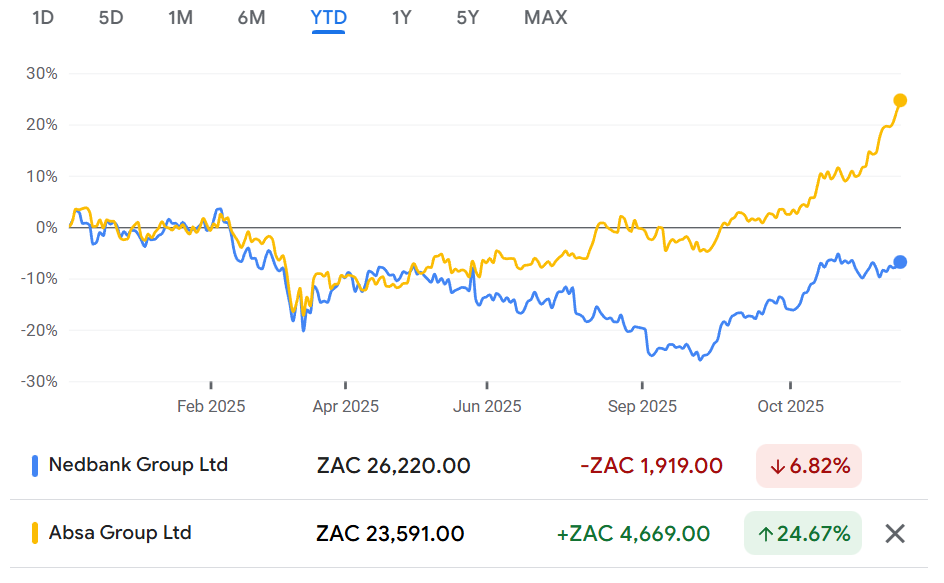
Nedbank’s clearest sector peer is Absa (JSE: ABG). The underperformance of Nedbank in the second half of 2025 has been severe:
Schroder European Real Estate’s Apeldoorn problem is here (JSE: SCD)
Their very large and important tenant has given notice
As I’ve written multiple times in the past year, I struggle to understand why any investor would shun the many excellent property companies on the JSE in favour of Schroder European Real Estate. Apart from uninspiring valuation trends in the underlying properties and a significant tax overhang as well, the recent results at Schroder made it clear that they are facing a huge risk at the Apeldoorn property based on a large tenant looking to exit the property.
The company has now announced that the tenant, Koninklijke KPN, has given notice. We are talking about a mixed-use office and data centre property in the Netherlands that contributes a whopping 19% of the company’s portfolio income and 6% of its value. The significant mismatch between income and value is because of the short remaining term on the lease and thus the modest value placed on the income stream. The lease termination is with effect from 31 December 2026.
This gives Schroder a year to figure out how to fill the space. It’s clearly not going to be simple, as they’ve even indicated that alternative uses like a medium-density residential development is an option.
They’ve owned this property since 2018. The unlevered total return is over 8% per annum over the 7 years. It’s now going to come down to whether they can actively manage the property and achieve a decent outcome. The management narrative is bearish, noting that the departure of the tenant is expected to negatively impact the future income profile.
The share price fell 7.5% in response to the news, which means it is down 11.5% year-to-date. That’s such a bad outcome vs. how the rest of the sector has done.
South32’s Mozal Aluminium is headed for care and maintenance (JSE: S32)
They cannot lock in an affordable electricity supply beyond March 2026
Energy costs are a huge factor in the mining industry, particularly when smelters are involved. If you’ve been following the local troubles at Merafe (JSE: MRF), then you’ll know that energy costs can push these smelters into positions where they are no longer economically viable. South32 is dealing with much the same issue at Mozal Aluminium, where they’ve been trying to negotiate a suitable energy package with the government of Mozambique, Hidroeléctrica de Cahora Bassa (HCB) and Eskom.
Alas, there’s no luck on this one. Mozal Aluminium will be placed on care and maintenance from 15 March 2026 and they haven’t procured any raw materials to operate beyond that date.
One of the problems has been a drought that put pressure on HCB’s supply. Perhaps some relief will come down the line and the parties will be able to reach an agreement.
For now though, there’s a huge impact on the employees, suppliers and other stakeholders in Mozal Aluminium. The once-off costs are expected to be $60 million and the annual care and maintenance costs are $5 million. This is the full cost, not South32’s 63.7% share. In case you’re wondering, the IDC is wearing 32.4% of the pan and the Mozambique government has 3.9%.
Production guidance up to March 2026 is unchanged. Importantly, the alumina supplied from Worsley Alumina to Mozal will be sold to third party customers instead.
Nibbles:
- Director dealings:
- An executive at Sirius Real Estate (JSE: SRE) sold shares worth R900k.
- A director of Huge Group (JSE: HUG) bought shares worth R32.5k.
- Here’s something unusual: the CEO of SPAR (JSE: SPP) has converted his unvested rights to a performance-related cash bonus into the equivalent value of SPAR ordinary shares that are committed in terms of the minimum shareholding requirements policy. The value is R3.7 million.
- Astoria (JSE: ARA) shareholders voted in favour of the delisting of the company and the repurchase of shares from those who won’t be following the company into the unlisted space. Holders of just over 60% of shares in issue have given an irrevocable undertaking to not accept the offer. The maximum acceptance condition for the offer (i.e. those taking it) was 42.5%, so they are okay from that perspective. Those who want to accept the offer of R8.15 per share must notify their brokers before 2nd January. Astoria will be delisted on 6th January. Remember, there’s also an unbundling of Goldrush (JSE: GRSP) shares to Astoria shareholders as part of this process.
- Famous Brands (JSE: FBR) has locked in debt funding of R1.675 billion through the process of refinancing loans with Nedbank. To give you a sense of how these things can be structured, the breakdown is as follows: R800 million in five-year term loans (half bullet and half amortising), R275 million as a one-year term loan, R500 million as a three-year revolving credit facility (with possible renewal for two further one-year periods) and R100 million as a general banking facility that is renewable annually. The funding is unsecured and on terms more favourable than the current facilities. A lot of thinking and complexity goes into these funding packages. To this day, lending packages carry the most complex legal agreements I’ve ever seen in my career!
- ArcelorMittal (JSE: ACL) has renewed the cautionary announcement related to ongoing discussions around the Longs business that is now in care and maintenance. They are having “engagements to explore alternative solutions” for the business, with the IDC still busy with their due diligence process based on recent announcements.
- Hulamin (JSE: HLM) has renewed the cautionary announcement that was first published in August and subsequently renewed in September and November. This relates to the potential disposal of Hulamin Extrusions. Negotiations are ongoing.
- NEPI Rockcastle (JSE: NRP) announced the appointment of Marius Barbu as COO to succeed Marek Noetzel who will be stepping into the CEO role after serving as COO. This is an internal promotion, as Barbu is Group Asset Management Director and therefore has plenty of experience with the portfolio.
- Trustco (JSE: TTO) has decided to suspend any further implementation of the LSH transaction. This deal goes back to January 2025 when shareholders approved the deal on the basis that there wouldn’t be a change in control of the company. The board has now suspended the implementation of the deal based on a need to assess whether the implementation would not in fact lead to a change in control.