
In this edition of Ghost Bites:
- ASP Isotopes is “at an inflection point” in its business
- Glencore made a killing in the six months to June
- Sasol’s second half saw earnings triple sequentially
- Sabvest keeps on delivering
- Super Group lives up to its name
ASP Isotopes is “at an inflection point” in its business (JSE: ISO)
All eyes are on helium
ASP Isotopes has been working the storytelling angle of its business with great enthusiasm. They held an investor event focused on the helium assets that they acquired in Renergen. They’ve also released a shareholder letter, as well as a presentation delivered at a conference.
As a general comment, I feel that the company releases too many SENS announcements of a non-financial nature. I get the need to keep investors interested while the company works towards properly monetising its technology, but eventually investors just switch off until there’s cash flow to talk about.
In the latest letter, the CEO notes that three of the business units “appear at an inflection point and are expected to make substantial contributions to achieving profitability in the near term.” Exciting, but still a leap of faith that South African investors aren’t famous for being willing to take!
To give you an idea of the rapid growth forecast, the PET Labs business is expected to make revenue of $14 million in FY26 (vs. $6 million in FY25). The long-term target is $50 – $100 million in EBITDA by 2031. Yes, that’s just five years away.
The group-level 2031 EBITDA target is between $330 million and $700 million. Forecasting risk? Very, very high. Potential upside? Also very high!

Over at Renergen, helium production is expected to begin before the end of September 2026. This will be a huge moment for the company and for South Africa. We can only hope that this happens, particularly as ASP goes into great detail on why helium shortages are becoming a global crisis and how Renergen’s production can help close that gap.
The Silicon-28 and Ytterbium-176 enrichment facilities are expected to ship initial product during the second half of 2026. This comes after many delays that the company has blamed on OEM equipment suppliers rather than the underlying technology developed by the company. This is genuinely cutting-edge science. If they had Iron Man hiding in a cupboard at that facility, it wouldn’t surprise anyone.
To try and achieve some earnings visibility, the company is negotiating various take-or-pay supply agreements with potential large global customers. When the word “potential” goes away, the share price trajectory will start turning.
The broader strategy to unlock value is to separately list the underlying subsidiaries that have different (but complementary) technologies. ASP will own majority stakes in these underlying subsidiaries. I must say, that sounds a lot like a scenario where a massive conglomerate discount will be applied to the holding company, but only time will tell.
In line with this strategy, they are currently working on a planned reverse merger between Renergen and Noble Africa, with ASP set to hold 89% of the combined company. They are also dressing up Quantum Leap Energy for a separate listing. As a new name in this story, ASP has set up Alpa Theranostics as a biotechnology company that will move into human clinical trials in the next 12 months.
I’ll end off on something I love: the PET Labs business provides treatments to children under the age of 18 free of charge. It’s hard not to applaud an initiative like this for childhood cancer and other horrors.
Ghost Bite: If the helium promises are kept, that really will be an inflection point for Renergen.
Glencore made a killing in the six months to June (JSE: GLN)
The company knows how to pounce on a disrupted energy market
Glencore has signed off on an extremely lucrative period. In a supply-constrained environment for global commodities thanks to the Iran conflict, the company was able to position its businesses in a way that worked out beautifully.
How beautifully, you ask? Well, with revenue up by 49%, you need to brace yourself for some impressive swings further down the income statement.
Group adjusted EBITDA increased by 86% to $10.1 billion. Within that number, the biggest excitement was the Marketing business, where adjusted EBIT jumped by 142%. This is where Glencore made the most of the supply chain disruptions and associated energy trading opportunities.
Just like the other major names in mining, Glencore is investing heavily in copper. This is part of why net capex on property, plant and equipment increased from $3.2 billion to $4.0 billion.
Cash profits were more than high enough to cover the uptick in capex. In fact, group net debt declined by $1 billion during the period. The net debt to adjusted EBITDA ratio sits at a comfortable 0.56x, down from 0.83x.
With the level of debt in the business in line with the self-inflicted cap of $10 billion, Glencore has enough confidence to pay a top-up special cash distribution of around $1 billion. They’ve also announced a new $500 million share buyback.
Looking ahead, Glencore expects continued strong cash generation in the second half of the year. Although it’s nearly impossible to estimate with any accuracy, they’ve guided 2026 adjusted EBITDA of $19.7 billion (up 46% vs. the prior year’s $13.5 billion).
The company plans to take this story to Australia, with a secondary listing on the ASX targeted for October 2026. There’s a vast pool of capital in that market that loves mining stocks.
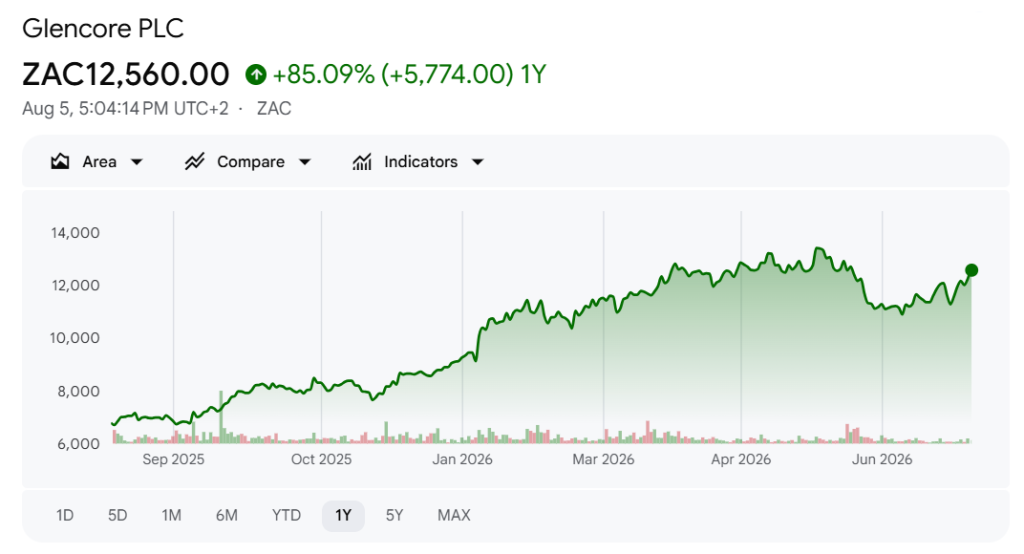
Ghost Bite: The share price is up 85% over 12 months. You may be tempted to think that most of that happened after the Iran conflict, but that’s actually not the case:
Sasol’s second half saw earnings triple sequentially (JSE: SOL)
They would’ve been a lot better if not for rand appreciation
Most of us want to see a strong rand, as it (usually) keeps fuel prices at bay and helps us afford those imported goodies that we all like. But exporters absolutely don’t want to see a strong rand. With much of South Africa’s industrial base focusing on export sales due to weak domestic demand, the change in trajectory of the USD/ZAR exchange rate has been a challenge.
Sasol is one such company, with the double-whammy impact of offshore earnings that need to be translated back to rand.
In a trading statement covering the year ended June 2026, Sasol confirmed that HEPS should increase by between 2% and 14% vs. the prior year. This isn’t nearly as exciting as the 12% to 20% increase in adjusted EBITDA, so there are clearly a number of important movements happening between EBITDA and HEPS.
Before we get to that, we can deal with the positive drivers of performance. As indicated in Sasol’s recent performance metrics release, the company enjoyed a 4% increase in sales volumes thanks to improved production. A 7% increase in the USD crude oil price also helped, as did a more than 100% increase in refining margins.
The 7% appreciation of the rand against the US dollar blunted these gains, as did substantial losses on monetary assets and liabilities. I’ll wait for the full numbers, but I suspect that’s why EBITDA looks so much better than HEPS, as those losses would be happening below the EBITDA line.
Impairments don’t affect HEPS, but they are worth digging into. Impairments were R16.8 billion in this period – lower than R20.7 billion in the prior year, but still an immense number. This includes costs capitalised to the Secunda liquid fuels refinery (still fully impaired), as well as impairments to the assets of the polyethylene business and the production sharing agreement in Mozambique.
Sasol has also warned shareholders that free cash flow won’t look as good as earnings. This is due to elevated levels of working capital, driven by the Middle East conflict (among other issues).
But here’s the point that you really need to keep in mind: HEPS was down 34% year-on-year at the halfway mark of the year. They generated R9.27 in the first six months of FY26. In the second half, they achieved between R26.73 and R30.73.
This means that HEPS tripled sequentially. That’s why the share price is up 73% year-to-date as a proxy for the oil price, even if you can’t see the growth coming through in full-year earnings.
Ghost Bite: The first half of the year is a cautionary tale for the Sasol bulls. The share price was down 1% on the day of this trading statement, so the market is clearly worried about the oil price running out of puff.
Sabvest keeps on delivering (JSE: SBP)
The market has reduced the discount per share to just 17%
As investment holding companies go, Sabvest has one of the best reputations on the JSE (if not the best reputation). They have an interesting, diversified portfolio of assets that you can’t get your hands on anywhere else. Most importantly, they have a great track record of value creation.
The team has done it again, with net asset value (NAV) for the six months to June 2026 expected to increase by between 18% and 24% over the past 12 months. Most of that move happened in the first six months though, as the NAV per share is only up by between 1.7% and 6.9% since December 2025.
The current share price is R139, which is a discount of only 17% to the mid-point of the guided NAV per share. When detailed results are released in mid-to-late August, investors will be able to decide if that’s reasonable or not.
Ghost Bite: Sabvest’s total return over the past year is nearly 50%. The market has reduced the discount to NAV to a level that you’ll rarely see in an investment holding company.
Super Group lives up to its name (JSE: SPG)
The trading statement for the year ended June 2026 looks great
Whenever I see a trading statement covering a 12-month period, I always look for the interim earnings to give more context. At Super Group, they grew HEPS from continuing operations by 28% in the six months to December 2025, so the first half of the year got them off to a fantastic start.
The second half was even better, as the year ended June 2026 is expected to reflect HEPS growth of between 33.6% and 40.9%. This is from continuing operations, an important lens to apply due to the disposal of SG Fleet.
They describe the period as being characterised by most of the businesses performing strongly and gaining market share. There are a number of difficult macroeconomic issues at play, but you would never guess it by looking at these numbers!
Ghost Bite: Results are due for release on 8 September. With the share price closing 5% higher on the day, the market is looking forward to them.
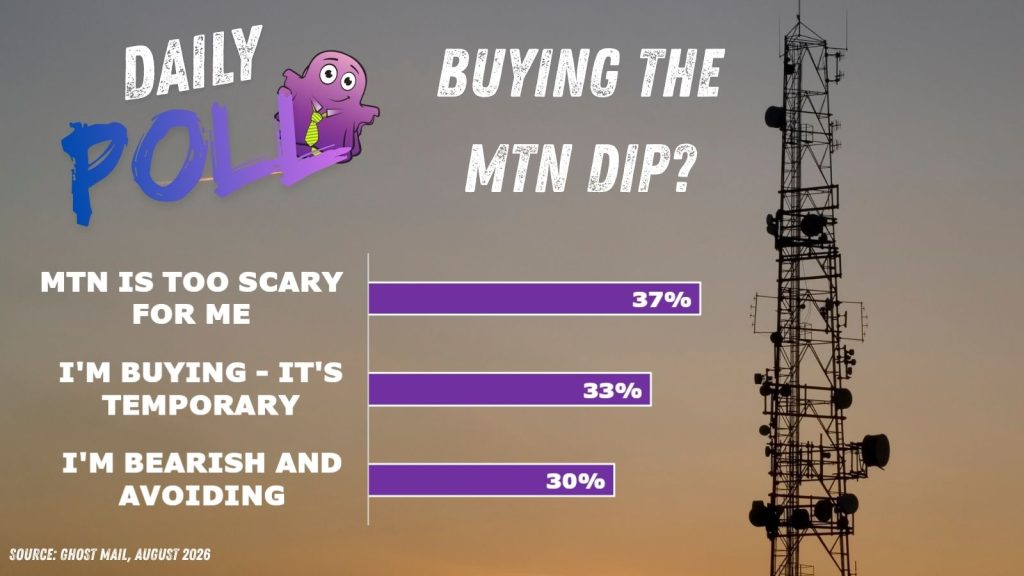
Results of MTN poll:
Nibbles:
- Director dealings:
- A director of Vunani (JSE: VUN) bought shares worth nearly R8.7 million in an off-market trade. The director in question is Marcel Golding, whose company Geomer Investments now has a 20.59% stake in Vunani.
- The CEO of Marshall Monteagle (JSE: MMP) bought shares in the company worth almost R1.8 million.
- An entity associated with the Deputy CEO of Octodec Investments (JSE: OCT) bought shares worth R73k.
- Nigerian energy company Oando (JSE: OAO) released results for the six months to June. Average production was within guidance and operating costs were down 18% on a per-unit basis, reflecting production efficiencies. Revenue increased by 20% and profit after tax was up 8%. A substantial increase in capex was driven by upstream drilling. There’s very little liquidity in this stock.
- Hosken Consolidated Investments (JSE: HCI) has confirmed that all conditions precedent for the Squirewood transaction with SACTWU have been fulfilled or waived. Squirewood also elected to exercise the Squirewood option, which means that SACTWU now holds only 2.25% in HCI. Squirewood is up to a 25.73% beneficial interest.
- The boardroom battle at Trustco (JSE: TTO) continues. The company has given notice of a general meeting to be held on 18th August. Riskowitz Capital Management has requisitioned this meeting under s189 of the Namibian Companies Act. The resolutions on the table are to remove current directors and replace them with five nominees put forward by Riskowitz. The name you’ll recognise among the nominees is Grant Pattison, who previously led Massmart and Edcon. He certainly knows his way around a turnaround story.
- When aReit (JSE: APO) listed, I really upset them by pointing out a number of flaws in their proposed valuation. But as bearish as I was, I didn’t foresee a world in which they would be unable to get audited financials right. They are still trying to get financials done for the years ending December 2023 and December 2024. There seems to be a highly technical application of IFRS here for a company that the directors describe as having four invoices per month for just four lease agreements. As I pointed out at the time of the listing, why on earth was this business model even listed in the first place? It’s been a messy situation that would’ve been avoided entirely by just staying private.