
In this edition of Ghost Bites:
- ASP Isotopes’ quarterly results show how early the company is on its journey
- HEPS falls sharply at RCL Foods
- Another blow for SPAR as the chairman and deputy chair step down
- Thungela banked excellent profit growth in H1
ASP Isotopes’ quarterly results show how early the company is on its journey (JSE: ISO)
The numbers need to look very different in the next few quarters
ASP Isotopes is firmly in storytelling mode. The company needs to be, as they need investors to keep believing in the technology being built.
The release of quarterly results provides this table as an elegant summary of the substantial gap between revenue and losses:

Yes, that’s a net loss for the quarter of $34 million vs. revenue of $5 million.
Now, these are early days in the group’s commercial journey. The segments aren’t operating anywhere near their full potential. As a sign of just how much still needs to happen here, one customer represented 10% of the company’s consolidated revenue over six months!
If ASP Isotopes achieves what it has promised investors, then the future will look very different. Investors don’t have to wait long to see whether management can deliver on promises, as ASP Isotopes has set itself at least two major targets for the second half of 2026. They’ve promised initial commercial shipments of enriched isotopes. They’ve also assured investors that production of helium by Renergen is around the corner.

The market isn’t exactly forming an orderly queue to buy the stock in anticipation:
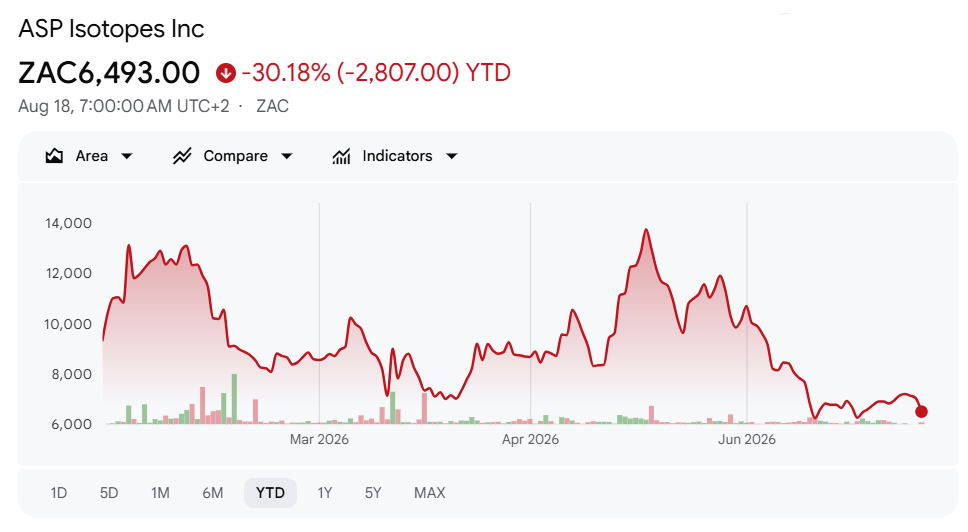
Either management is right, or the market is right. We will find out in the next few months.
HEPS falls sharply at RCL Foods (JSE: RCL)
The sugar and pet food segments have had a tough time
RCL Foods’ trading statement for the year ended June 2026 is a continuation of where the difficult interim period left off. It’s unfortunate that HEPS from total operations has dropped by between 30% and 35%.
There’s a nuance here around discontinued operations after the unbundling of the stake in Rainbow Chicken (JSE: RBO) and the disposal of Vector Logistics in the prior year. This adjustment is unlikely to materially change the picture.
It’s worth noting that HEPS from continuing operations (rather than total operations) for the six months to December 2025 was down by 30.6%, so the challenges have already been visible in the numbers.
The note on impairments gives us a clue about one of the pressure points. The Sunshine cash-generating unit was impaired due to difficulties in recovering volumes after the labour disruption at the Durban factory in December 2024. This is why earnings per share (rather than HEPS) is down by between 50% and 55%. Impairments aren’t cash losses, but they do indicate where value has been lost.
But the far bigger worry is the Sugar segment, which has been far from sweet due to deep sea imports assaulting the local industry. With tariffs proving to be ineffective, local industry market volumes fell by 10.3%.
This drove more local production into the lower-priced export market. Local industry exports may have been 48.3% higher, but international raw sugar prices were down by 22.6% – and that’s before we consider the effect of the stronger rand! The export market isn’t where RCL wants to play.
The current tariff is clearly not protecting local industry. But the counterargument is that food inflation must be kept as low as possible to assist marginalised South Africans. Do we prioritise local industry, or the cost of food for consumers?
These are complex matters with many factors that need to be weighed up by policymakers. You can be sure that a food producer is going to lobby for stronger tariffs to protect their business from imports. Government’s job is to find a balance. I will also say that the huge difference between local and international sugar prices means that serious questions need to be asked about the economic sustainability of our sugar industry in a global trade environment.
Moving on, the Pet Food segment was impacted by production issues related to food safety. Volumes fell by 20.5% as supply was constrained. There were also higher stock write-offs.
At least the Culinary and Baking segments provided “good performances” – but clearly not enough to offset these other issues.
Detailed results are due for release on 31 August.
Another blow for SPAR as the chairman and deputy chair step down (JSE: SPP)
I discussed this on the radio yesterday evening
Things are just going from bad to worse for SPAR. The shares have hit a new 52-week low in response to the news that Mike Bosman and Dr Shirley Zinn have resigned as chairman and deputy chair respectively.
The pressure of SPAR’s deteriorating relationship with its franchisees appears to have taken its toll. A lot of unpleasant things have been said publicly about SPAR’s management by franchisees, so I can believe that the behind-closed-doors activity must have felt threatening to these directors. The juice stopped being worth the squeeze for them.
Stephen Grootes invited me to discuss the broader SPAR issues with him on The Money Show on Monday evening. It was the lead segment, with roughly 8 minutes of insight into SPAR and the broader retail sector. Check it out below (it starts within the first minute of this podcast):
Thungela banked excellent profit growth in H1 (JSE: TGA)
But revenue wasn’t the main driver here
Thungela’s results for the six months to June 2026 cover a period in which coal prices finally turned the corner.
Energy security was a feature of this period due to the conflict in the Middle East, with benchmark coal prices responding accordingly. Some of this benefit was blunted by the rand’s appreciation against the US dollar, as shown beautifully in this excerpt from a slide in Thungela’s results presentation:
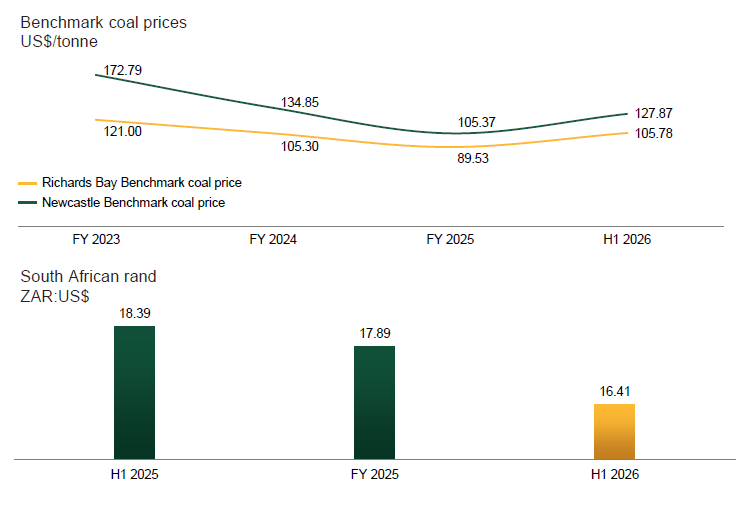
Although the rand negated much of the coal price move, Thungela did enjoy improved performance at Transnet Freight Rail as a boost for export volumes. Transnet’s annualised run rate has improved by 5.5%. I cannot stress enough how important it is to our resource-heavy economy that Transnet performs.
Despite the overall positivity, revenue only increased by 2%. Foreign exchange and domestic revenue pressure offset much of the benefit of strong export prices and volumes.
Things got a lot more exciting further down the income statement though, particularly with a much lower cost of production at Ensham in Australia due to higher volumes. This drove a 91% increase in group adjusted EBITDA and a 150% increase in HEPS.
Sustaining capital expenditure was flat for the year. Adjusted operating free cash flow jumped by 291%. This easily supported dividend per share growth of 175%.
Thungela is taking a cautious approach with guidance for the full year. Despite such a strong interim period, they’ve maintained their guidance across key metrics.
The market took a somewhat more bullish view, with the share price closing 10% higher on the day! It’s still only 11% up year-to-date though, having come off sharply from the peaks in March/April as conflict intensified in Iran.
Selected Nibbles:
- Notable director dealings:
- Two directors of Vunani (JSE: VUN) bought shares in off-market deals worth over R5.3 million in aggregate. This comes after recent buying activity by various executives. I’m not sure what’s going on at Vunani, but this level of buying is clearly bullish.
- Unsurprisingly, Balwin (JSE: BWN) shareholders gave the Bidco offer a resounding approval. Holders of 98.48% of shares present at the meeting voted in favour of the scheme.
- South Ocean Holdings (JSE: SOH) released a trading statement for the year ended June. HEPS has jumped from a loss of 9.31 cents to earnings of 8.02 cents.


If the directors at Vunani know something material that is not public and available to you as implied by the reporting of their dealings, wouldn’t that be insider trading?
Insider trading rules need to be carefully interpreted for company insiders. They ALWAYS know more than the market, as they are running the business every day. The test is whether they have material price-sensitive information (hence the need for cautionaries etc). But if they simply like what they are seeing, and they aren’t in a closed period (between a period end and the release of a report), then they are free to buy and sell provided they follow internal approvals. The alternative is untenable, as executives would never be allowed to trade in the company they are running. Hope that makes sense?
Just wanted to say thank you. Your work is brilliant, detailed analysis, and yet remarkably accessible.
The South Ocean turnaround also looks promising, but it would be interesting to understand whether the improvement reflects a sustainable recovery in earnings or a temporary change in trading conditions.