

The Warner Bros. Discovery bidding war through a South African lens
The recent bidding war for Warner Bros. Discovery (WBD) – which pitted Netflix against Paramount Skydance and ultimately produced a US$110,9bn deal – is an interesting case study in contested takeover dynamics. While it played out under US takeover rules, the structural and governance tensions at its core are strikingly relevant to South African corporates.
- The WBD bidding war – a chronological overview
WBD entered 2025 burdened by substantial legacy debt and declining television revenues. In June 2025, management announced plans to split the business into two entities. The announcement signalled, explicitly or not, that the company was “in play”.
Following the announcement, multiple parties – including Netflix and Paramount Skydance – submitted formal proposals. In October 2025, WBD confirmed it was reviewing unsolicited offers and subsequently entered into exclusive negotiations with Netflix, culminating in a definitive agreement in December 2025.
The agreement with Netflix seemed to have closed the door on Paramount and other bidders. It had not.
Paramount did not withdraw. Instead, it launched what effectively became a protracted hostile campaign. By January 2026, Paramount had launched a hostile tender offer to WBD shareholders at $30 per share (a premium of about 139% to the undisturbed Netflix share price). WBD’s board rejected this bid and reaffirmed its support for Netflix.

Facing mounting shareholder pressure and governance scrutiny regarding whether it had adequately discharged its fiduciary obligations, WBD’s board opened a seven-day negotiating window with Paramount in late February 2026. Paramount responded with its ninth revised offer: $31 per share, all-cash, for the entire company, with a ‘ticking fee’ of $650 million per quarter for closing delays beyond 31 December 2026. On 26 February 2026, the WBD board determined that Paramount’s revised $110,9bn offer constituted a “superior proposal”. Netflix declined to increase its bid and withdrew, leaving Paramount as the winning bidder.
- Lessons for SA target company Boards
Lesson 1: Early constitution of the Independent Board
South Africa’s Takeover Regulations mandate that an “Independent Board” – comprising directors who have no conflicting interests in relation to the transaction – be constituted in relation to “affected transactions” to evaluate bids and make recommendations to shareholders. Affected transactions include control transactions and disposals of all or a greater part of a regulated company’s assets or undertaking. Whilst every situation has its own unique considerations, constituting the Independent Board early, with genuinely independent and commercially astute directors, is critical. Its composition will be scrutinised by the Takeover Regulation Panel (“TRP”), which is the primary regulator for affected transactions. Appointing directors who have pre-existing relationships with a bidder, or who hold material equity interests that skew their incentives, will attract TRP scrutiny and undermine the legitimacy of its ultimate recommendation.
As a matter of practicality, when strategic interest from potential acquirers is first identified – even at preliminary, non-binding stages – the board should already be mapping conflicts and identifying the Independent Board designates.
Lesson 2: Engage the TRP proactively, not reactively
The TRP is not merely a box-ticking regulator. It has broad supervisory powers over affected transactions. Boards that engage proactively with the TRP – briefing it on process, seeking guidance on novel structural questions, and ensuring key approvals are lined up in advance of key decision points – are in a far stronger position than those who appear before it under fire.
Lesson 3: ‘No-Shop’ does not mean ‘No-Engage’
One of the clearest lessons from the WBD saga is the risk of a board appearing to be a passive gatekeeper for the preferred bidder, rather than an active steward of shareholder value. In the WBD deal, WBD had signed up to market standard “no-shop” undertakings (i.e. undertakings to negotiate exclusively with Netflix and not to actively solicit interest from third parties). WBD’s board, while within its contractual rights to rebuff Paramount’s early bids, faced legitimate criticism that it was slow to test the market properly.
Under South African law, this tension is resolved by statute: the board cannot, as a matter of law, prevent a bona fide competing bidder from accessing information or from putting its case to shareholders. A board that attempts to entrench a preferred deal by refusing to engage with a higher competing offer risks not only regulatory sanction from the TRP, but also personal liability exposure for its directors under the Companies Act.
The fiduciary duty is to the company and ultimately its shareholders – not to the preferred bidder, however well-negotiated the initial deal was.
Lesson 4: Structure deal protections to survive a superior offer landscape
South African target boards and their advisers should ensure that deal protection mechanisms are carefully calibrated:
•Rights to match should have reasonable exercise periods – long enough to allow a genuine response, short enough not to chill competing interest.
•Break fees should compensate the preferred bidder for its transaction costs without being so large as to deter third-party interest. The TRP will not generally permit break fees in excess of 1% of deal value.
•“Fiduciary-out” provisions must be expressly preserved – these allow the board to change its recommendation or terminate an agreed transaction if a superior proposal emerges, when sticking with the original deal would breach its fiduciary duties.
Lesson 5: Shareholder engagement is not optional
A recurring theme in the WBD saga was the voice of institutional shareholders.
South African institutional investors have become significantly more activist. In a contested takeover, boards that communicate early, transparently and substantively with their major institutional shareholders will be better positioned to maintain trust and manage the process effectively.
Lesson 6: Secure the regulatory pathway before recommending
Anti-trust clearance is a mandatory step for South African M&A above applicable thresholds. The South African competition authorities have demonstrated a willingness to impose merger-specific and other public interest conditions relating to employment, localisation and supplier development, amongst others. In evaluating competing offers, target companies must assess the likely regulatory pathway for each. A higher offer that faces greater competition or public interest risk may deliver less certain value than a lower-priced offer with a cleaner regulatory profile. In South Africa, the length of time it has historically taken to obtain regulatory approvals has effectively acted as an impediment to hostile transactions. Understanding this dynamic, and designing the transaction in a way that mitigates it, is therefore essential to potential bidders looking to launch deals on an unsolicited basis.
Sibonelo Mdluli is a Senior Transactor | RMB Corporate Finance
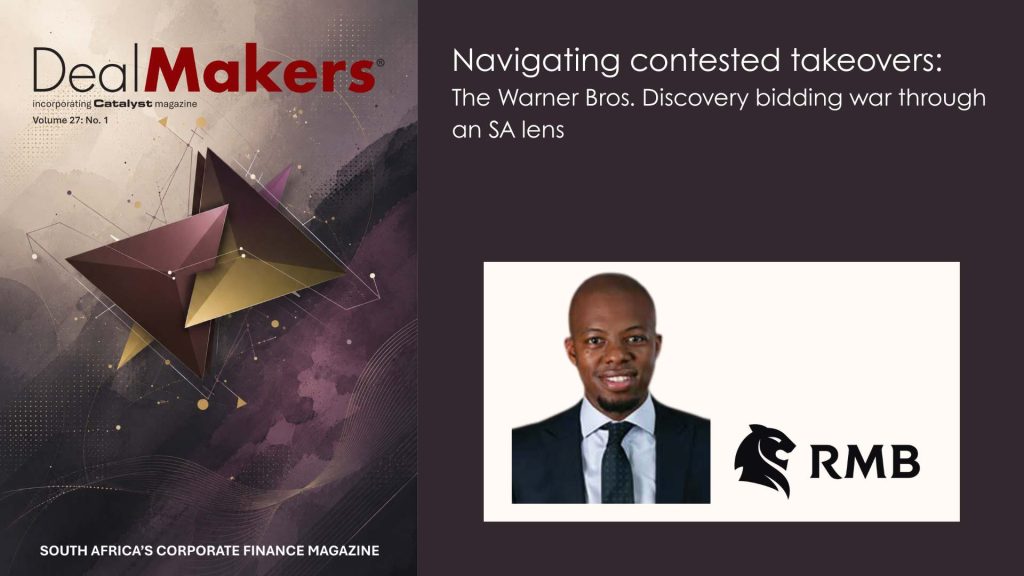
This article first appeared in DealMakers, SA’s quarterly M&A publication.
DealMakers is SA’s M&A publication.
www.dealmakerssouthafrica.com