
In Season 2 of this podcast, The Finance Ghost talks to South African entrepreneurs about the ideas, choices and turning points behind building a business from scratch.
Listen to the podcast:
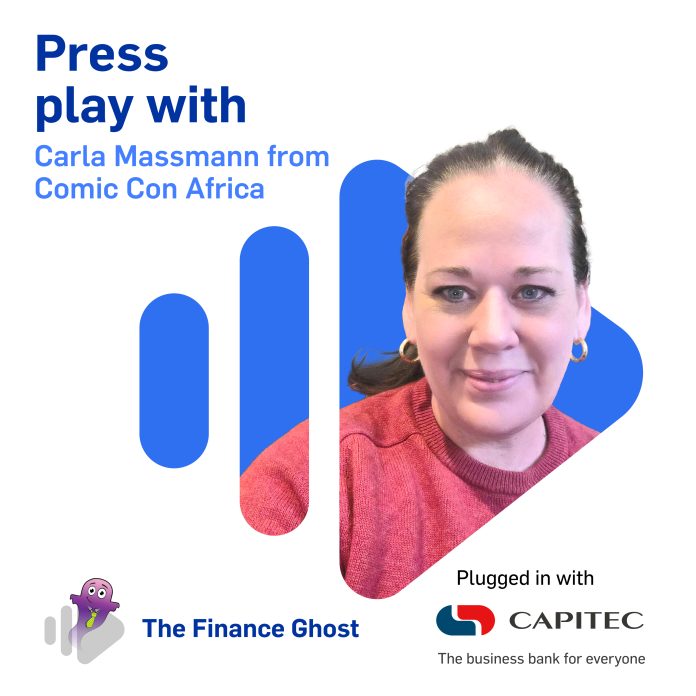
The Finance Ghost sits down with Comic Con Africa show director and Mogul Media founder Carla Massmann to explore the growth of the geek economy in South Africa.
From gaming, comics and collectables to cosplay, anime and pop culture, Comic Con Africa has become far more than an event. It’s a gathering place for people who share the same passions, a celebration of creativity and storytelling and a powerful reminder that everyone has an inner geek waiting to be discovered.
Carla shares her journey from launching Comic Con Africa in 2018, through the devastation of the pandemic, to building a profitable business that now attracts more than 70 000 visitors.
Along the way, she explains why community is at the heart of everything Comic Con does and why the future of the industry looks brighter than ever.
This is a story about entrepreneurship, adaptation and the power of helping people find where they belong.

Episode 4 covers:
- The rise of the geek economy and ‘kidulting’
- How Comic Con Africa became a runaway success
- Building a business through the pandemic
- Why community is at the heart of Comic Con
- Creating opportunities for artists, authors and small businesses
- The surprising economics of collectables and fandoms
- How brands can authentically engage with niche communities
The Finance Ghost plugged in with Capitec is made possible by the support of Capitec Business. All the entrepreneurs featured on this podcast are clients of Capitec. Capitec is an authorised Financial Services Provider, FSP number 46669.
Read the transcript:
The Finance Ghost: Welcome to this episode of The Finance Ghost plugged in with Capitec. I’ve got to say, I don’t have favourites in any particular season, but I am really looking forward to this one because we are going to be talking about something so fun today.
It’s the geek economy. It’s “kidulting”. That’s the fact that Lego’s business these days is as focused on adult sets as it is for kids. The world really has changed tremendously, actually, and there are a lot of reasons for it. Key demographic factors around millennials, especially Gen Zs, the way they are basically just living their lives at the moment.
And if there is a sector out there that has really been a net beneficiary of these trends, it would be the geek and nerd sector. I am a very proud participant. I do play Magic: The Gathering, and Warhammer, and I attended Comic Con recently, my first one, which was very cool.
So, what better way to understand more about this market than by speaking to Carla Massmann, who is the show director of Comic Con Africa? That’s both the Cape Town and Joburg shows.
And the founder of Mogul Media!
Very cool, Carla. That’s a fun job, although I have no doubt that it comes with all the same headaches as any other job. But we’ll dig into that, obviously.
Why you are here is that the show has of course been sponsored by Capitec this year. I think they did a fabulous job at the Cape Town one, and I’m sure the Joburg one will be just as awesome, if not bigger and better.
I’ve got to say, that Cape Town one was a proper vibe. You’ll be – just walking around and suddenly a stormtrooper will go past you on the escalator. My little one was blown away by all the Spider-Mans running around. It was brilliant. So, Carla, thank you for bringing the fun to our lives, and welcome to the show.
Carla Massmann: Thank you for having me, Ghost.
The Finance Ghost: So, I think let’s dig straight into what Comic Con just really means to that particular community. From the outside in – and maybe just from the inside in as well, now that I play these games – it’s really just great to see this community come together, just have a bit of fun. Life is very serious and I think a little bit of escapism is pretty important.
So, I’d love to hear it from you to kick us off: what Comic Con means to you. Because you must also be a lifelong geek. I can’t imagine that you’re involved in this unless you are firmly part of it?
Carla Massmann: So, if I have to be completely transparent, I’m actually not a lifelong geek. But I think that when I first started working for Comic Con, I soon very much realised that there’s an inner geek in everyone. I realised that my fascination back then with Batman and growing up to He-Man and Dragon Ball Z and being a longtime gamer, Comic Con made me realise that this passion was really all part of something so much bigger.
The Finance Ghost: Growing up with Dragon Ball Z and a longtime gamer and you start this with, “Well, I’m not sure I was a lifelong geek.”
Listen, I’ve got news for you…
Carla Massmann: I think that everyone finds that inner geek. “Okay, wait a minute. I AM a geek!” I think Comic Con brings that out in people.
I think a lot of people grow up not always being able to have the things they love in their mainstream lives, like school, our workplaces, social circles. That’s not somewhere where those superheroes and those comics and science fiction live.
And I think that that’s what Comic Con does. It becomes the place where those interests really become, that aren’t unusual in that room. They become the common language.
So, yeah, everyone’s got an inner geek in them, so they just don’t know it yet. And I guess that’s the fundamentals of the geek economy.
The Finance Ghost: Yeah, I love that. That’s brilliant.
Carla Massmann: After these years of working with Comic Con, I think that for me it’s really the celebration of creativity. Seeing local artists, writers, authors, all in the same space, celebrating work that’s inspired by the things they love.
And I think Comic Con holds a massive space.
It’s completely self-expressive, so with the cosplay, especially, showing that people can come out and become those characters, or their alter-egos. And in a very non-judgemental space, which is hard in this current day and age. I think that’s the most important part of Comic Con for me personally.
The Finance Ghost: Yeah, I don’t think you can rock up at work dressed as a stormtrooper unless you are working on the set of Star Wars, which must also be a pretty cool job. But we can only dream.
Yeah, it is a wonderful thing. Like you said, it’s creativity, I think that’s the key word here. And the other one that I always think of is just: storytelling. And in this, particularly in this AI era, I think storytelling is just so important. It’s creative storytelling. That’s really what Comic Con is all about.
And I think it’s a gift that you can just pass down. So, I recently got my kids into X-Men ’97, which is the one that I grew up watching. And it’s just so fun to sit and when your daily screen time is like 45 minutes or whatever of the thing that you grew up watching, you’re having as much fun as they are. That’s the truth of it. You’re almost asking for the screen time. It’s great.
Carla Massmann: Bringing families together [laughs].
The Finance Ghost: Yeah, absolutely. And what Comic Con does as an event is bring people together, families and otherwise. And as I understand it, it’s an international event that really got its South African leg a few years before the horrors of COVID (and we’ll talk about that just now).
But maybe in just those initial years, you can just give us a sense of how this thing kicked off; your involvement as well. What was the backstory for you becoming the show director of this thing?
Carla Massmann: RX Global is a global company, and its subsidiary is ReedPop. So ReedPop is one of the companies who runs the likes of New York Comic Con, C2E2, which is the Chicago con, MCM, which is your London con, etc.
So, RX Africa, who’s the South African business unit for RX Global, put a team together to research the viability of hosting a Comic Con in Africa.
With all the research that was done, it was evident that there was a market for it in South Africa. But I don’t think anyone expected how big that market really was.
So, at that stage, I was consulting into RX Global from more of a concept creation and strategy point of view. Probably one of my favourite parts of my whole career was delving into this community and going, “Oh my gosh, there’s this massive world and untouched market out there that no one’s aware of.”
So, in 2018, we launched Comic Con Africa in Johannesburg, expecting 15,000 visitors. To our surprise, we welcomed over 35,000 on the launch weekend. The venue was packed. The show sold out before the doors opened, and we were blown away.
At that point, the market and the target market of it was really unknown. Again, why I’m saying I loved this job element: digging into that market and going, “What makes this audience tick?”
After the first show, they asked me to step in as a show director, and we had to look at changing venues. We had to look at going bigger. Again, seeing numbers increase. We outgrew the next venue with over 50,000 visitors. So, we had to start scouting the next venue and started planning the 2020 show.
At the same time, we started exploring launching a show in Cape Town, but then the pandemic hit.
The Finance Ghost: Yeah, that’s something that even Spider-Man and “pick your favourite superhero” couldn’t do much about, unfortunately.
That must have been a very scary time, because “staying home and staying safe” as the famous quote went, is not the way to attract tens of thousands of people to an event, right?
Carla Massmann: 100%. Early 2020, I think if we all look back, it was still unknown. And I’ll never forget, it was early March. Within one week, we’d flown to Cape Town, we were scouting venues, we were having meetings; whilst cautiously watching these headlines and texting back and forth. And at that point, we were like, “Let’s not stress, this will blow over”.
And within 48 hours, I was getting on my flight back to Johannesburg, and we realised, okay, this isn’t going anywhere. So, we had to shift gears really, really quickly. Again, a really big challenge in my career, but all challenges I’m really grateful for.
And a week later, we came up with the idea of the Online Con. So, we were like, if the fans can’t come to Comic Con, we’re going to bring it to them. We worked crazy hours. We had to work in the lockdown hours. But next thing we knew, we were building a platform, an online platform; a space we hadn’t delved into in the events industry.
We were used to in-person and all of that. And we were kind of going, “How do we take Comic Con, put it online, and still do everything that a Comic Con offers?”
And we did. We had international guests dial in. We had exhibitors buy a page on it where they could still retail and promote their products. And the fans came and it worked and it was fun.
But it definitely wasn’t the same.
So, I think the pandemic continued, and for many in our events and entertainment industry, it was doomsday. It hit hard, and mostly for consumer shows, Comic Con being one of them that was on the hit list.
With a big global company like RX, it was just too risky to continue. We were living in a space where gatherings were up to 50, and then it slowly increased, but no one knew what was coming. So, it was very understandable that it was on the hit list.
And that’s kind of how Mogul was born. The core team that worked on Comic Con decided to start a company, Mogul Media, and take the risk, all of the risk.
We asked if we could continue running Comic Con under a licence agreement, which is super crazy, right? Because who takes on a massive festival in the middle of a pandemic, especially one that has these crazy restrictions on gatherings?
But I think we believed in it. We believed in the fans, we believed in the community. We knew that it was only the start and that there was something great here that we couldn’t let go of. And if we disappeared now, what would that do to the con?
So, in 2021, we found ourselves sitting in a dingy little office going, “Gulp, what now? Oh my gosh, we can’t even host an event.”
And I think the biggest thing for us then was realising again – and you’ll hear the word “community” thread so strongly through everything Comic Con – it was the community. And we were like, “We’ve just got to stay connected with the community and keep engaging with them 365 days of the year”. Especially at a time when everyone was feeling super alone, locked down by yourself.
So, we needed to be that brand that let the community feel connected. So, we threw ourselves into the online world, another challenge that we hadn’t explored. We hosted Twitch streams; we created content for YouTube. We hosted live online quizzes, which was awesome because we got to engage back and forth with the community.
And all of this while in the background, navigating the very grey waters of how to try and plan the next con. For the Cape Town launch, obviously this was all a big challenge. But again, we saw the opportunity – maybe this is a great way to go and test the market?
So, in ’21, we ran little pop-up cons around Cape Town at small venues. We kept the gatherings small, but that was a really nice way of intimately engaging with the community and seeing their interests. And it also gave us the data to know that there’s definitely a market out in Cape Town to launch Comic Con.
In all honesty, the pandemic was dreadful. Our industry got hit hard. It was adapt, or die. But I think we challenged ourselves and we went beyond the norms of planning and marketing a show and finding different revenue streams to keep going.
And then in 2022, we brought back the first In Real Life (IRL) con. And I don’t think we believed it. It was daunting. In all honesty, we couldn’t deal with the capacities, even though we were back in it now in a larger venue. It was insane. We may have underestimated the fact of how desperately people wanted to connect again and come together again.
So now, present day. I can proudly say that in the three years of Mogul running under licence, we’ve made the show profitable from its inception for the first time. We now have grown visitor numbers to over 70,000 for the Joburg show.
We launched Cape Town in 2023, which skyrocketed at the same pace. So, we’ve definitely seen a growth trajectory similar to the Joburg show.
And it took some serious guts to do what we did. We sacrificed a lot, but I think our belief in the show and the community was our biggest driver. And I strongly believe that if our main focus remains on the community and staying engaged with them and listening to them, then Comic Con will just keep growing.
I always say that Comic Con is for the fans, by the fans, because we take a lot of what they want, and every year we go, “Oh, they’re looking for this”. And we challenge ourselves to keep going.
The Finance Ghost: Such a great story. Well done. It’s just an enormous amount of guts. I think that’s the whole point. And people like to look at successful entrepreneurs and people who have built stuff, and it always looks easy when it’s going well. But along the way, there’s guaranteed to have been some or another huge, difficult decision, and usually a lot of them that needed to get made along the way. So well done.
And I guess what would have helped is as much as – and the pandemic was obviously terrible – but the geek industry and the people who are into the space who are, I think, creative by nature generally, they would have also kind of been okay from an income perspective (I would guess) over the pandemic, because everything was going digital, online, cloud. Lots of people who are into tech, design, all those sorts of areas; audio, video, that kind of stuff.
Now I think it’s tougher for them with what’s happening with AI. I think that’s caused a lot of disruption to that industry. But the pandemic period actually was probably quite good for the geek economy, and especially with people picking up hobbies while they were at home, right?
Carla Massmann: Definitely good for the geek economy. And I think a massive driver to the growth of Comic Con. Because if you think of it from a festival organiser or an event organiser, we never explored that online space.
Like you’re saying, when you look at the Comic Con audience, they massively live in that space. That’s where they constantly are. And we never push ourselves to go and engage with them in their kind of bubbles, if that makes sense. And Covid pushed us to do that.
So, I think it was probably. It sounds terrible, but the best thing that happened to us from a Comic Con point of view.
The Finance Ghost: Yeah, my business is a Covid baby. I don’t think I could have built it the way I did without people being at home, super interested in markets when interest rates were zero, and everyone was talking about investing.
At the end of the day, the lesson here is you’ve got to react to the era that you’re in. And sometimes it’s an era that will let you start something, and sometimes it’s not. So well done for adapting to the era you were in.
And let’s maybe then fast forward to 2026. You are winning awards. You’ve got a new and bigger venue coming in the CTICC, which I’m personally excited about. It was a little bit chaotic over the weekend and so full. It’s a sign of success, obviously, but I think more space is a good thing.
As I understand it, in Joburg, you are already at Nasrec, which is as big a venue as you can find!
Short of people building you a new venue, just how big can the show actually get? I mean, what is the future of this thing?
Carla Massmann: I think from a show’s growth point of view, I think it’s evident currently the emotional core isn’t the celebrity panels and the merchandise anymore. It’s the moment when they walk into Comic Con and they realise they’re surrounded by people that share the same enthusiasm without judgment.
I also think that’s a massive element missing in the world at the moment.
So, we can keep growing. We are offering that feeling, we are offering that happy, self-expressive, non-judgemental space. So, I think that’s a very big role and something we’ll focus on pushing out there so that it creates that space.
In that sense, I think Comic Con functions very much less like a convention or show. It’s more like this giant reunion of communities that mostly exist online like I’ve just mentioned, or are geographically scattered. And we see that; we see it yearly. We see them come together.
One of the drivers that push us as well is the emails we receive after the show of fans just going, “Oh my gosh, I finally met the friend I was talking to online all year. And I’d never met them in real life”. “Oh my gosh. I made friends, I met people that were like-minded”. That’s why we do what we do, in all honesty.
We’ve seen even just the person who never thought they were a geek, or just wanted to come and see what Comic Con is about. We’ve seen first-time visitors be converted to returning visitors.
So, it’s going to just snowball, I believe. It’s going to just keep getting bigger and bigger.
And then there’s the kidult, which we all know I think is becoming a big focus at the moment. But I think that element of nostalgia plays a really big role. You’re reconnecting with the stories and characters that matter to you at different stages in your life. And when we get to feel that feeling again and in a space that’s completely normal to feel, why not come to Comic Con?
It’s a no-brainer, really [Laughs].
The Finance Ghost: Yeah absolutely. It’s about helping people find their tribe, right? As the cliché goes. I think that’s very much what it comes down to
That’s why it’s great that Comic Con is so differentiated. Because I think for the people for whom it matters, it matters a lot.
And I can understand then how it just keeps attracting these sort of numbers. It’s going to be interesting to see just how big you can actually get it. You’ll have to get quite creative with either venues or… like you said, pop-ups, digital delivery.
It’s more of a lifestyle than an event, it sounds like?
Carla Massmann: We’re obviously aiming to push to one day be atbe at the numbers New York Comic Con or Chicago gets. New York Comic Con, you’re looking at 200,000 visitors per day over a four-day period. So that’s obviously our aim.
Chicago, we’re pretty close to. In fact, if you look at it from a global perspective, Comic Con Africa is growing faster than some of the global cons. So that’s also a really big sign for Africa and the continent.
They needed this. When I say they, it’s the communities, and they needed that platform.
Yeah, I’m excited to see the future.
The Finance Ghost: And the amount of work that must go into this is incredible. I mean, you’ve got Mogul Media as well, but this is your day job, right? This is what you’re spending most of your time on, I would imagine.
Carla Massmann: The amount of people that go, “But the show’s only in September”, or “The show’s only next year, April. What do you do?”. I don’t think many people understand the intricacies behind putting this together.
And there’s a whole different element. You’ve got to sell floor space for your revenue streams. You’ve got to find sponsorships and partners for revenue streams. There’s the ticket sales element. It’s a year-long plan, and the minute we just finished Cape Town, we go straight into planning for Cape Town ’27. It’s all the time. Yeah. Full-time for sure.
The Finance Ghost: Must feel like you’re just always planning a wedding. It’s that kind of vibe, right? When people are like, “I got married. It was so hectic”. Like that’s your life, but also much bigger and your life depends on it.
Carla Massmann: I look at family functions, and I go, goodness, I plan festivals for 70,000 people, but Christmas is a nightmare for me [Laughs].
The Finance Ghost: That’s fantastic. This plumber’s taps are firmly leaking here. That’s amazing.
Let’s maybe then just talk about some of the small business owners who also depend on Comic Con to reach this niche audience. Because that’s another part of the show, right?
It’s not just creating the space where people can come and feel like they can just be who and what they are. It’s also the artists who then depend on those people. And Artist Alley is a very interesting space that you’ve created. That was my first exposure to it, was this year. A really good friend of ours actually was one of your exhibitors at Artist Alley. So, we went along to support her as well, which was awesome.
How do you make sure that there’s room for these small creators among your bigger brands as well? Because that’s the really interesting thing with Comic Con. There are some really big brands there and you had automotive brands doing displays there with really cool art on the cars and anime. It’s amazing to see. And then all the way down to very small-scale artists.
Carla Massmann: We’ll talk to the bigger brands later. But I think it’s fundamental to know that Comic Con is built around those small businesses. Without them, I don’t think there’d be a Comic Con, just as much as the community. Especially within Artist Alley.
Artist Alley, for example, is the heartbeat of the con, not just locally, but globally. That’s how Comic Con happened. How they kind of just grew, was Artist Alley.
We have insane talent in this country and on the continent. I don’t think many people know that some of our local artists are actually creating work for the likes of DC and Marvel. Seeing that kind of talent come from home, it’s important to put them on a platform.
So, we ensure that we uplift that local talent, but also give the opportunity to any other artists to come and show and sell their work at Comic Con. We make sure the participation fee for Artist Alley is affordable, so that they get that ROI and leave with a profit line.
And besides Artist Alley, we also have a large number of small businesses in the country. Which, as you can imagine, especially in the space, there are not many pop culture brands or the big brands, or big brands within this area, that are based in South Africa. So, you do have the smaller businesses bringing that experience to the fans to life, here, locally.
They really do rely on Comic Con. They don’t have massive marketing budgets or the tools to promote themselves to get out there. So, we become that platform to ensure that their main target audience is directly brought to them. And once that visitor sees their work and has that tangible consumer experience with them, automatically afterwards they’ve got that consumer, and they’re engaging with them post the con.
We have packages like an emerging programme that we launched about two years ago, which was taking the smaller guys and going, let’s put you on the main show floor, instead of this little corner in the back there. You’re going to pay a little bit more, but we want to show you that by investing a bit more, you’re going to get a high return.
We’ve actually seen some of those businesses, over two-year period in that programme go from being on the show floor on the sides to being sent a prime position on the show floor. And their stands get bigger, and they’re investing back more into their business by their participation the following year.
So that’s also awesome to see: the small business slowly growing into a medium business and hopefully something even bigger.
The Finance Ghost: And you’ll find all sorts in Artist Alley. I mean, there are obviously a lot of illustrators, that’s as you would expect.
But there was even someone I saw in Cape Town, a self-published author with a whole range of fantasy novels and I was like, “That’s so cool, that’s so brave”. I mean, I’ve had a front row seat to how hard it is for someone to go and publish a book, get it out there, do the media tour, the whole story.
I think to self-publish fantasy in South Africa: just mad respect. Like really, really cool. We need more of that.
Carla Massmann: And I think that also adds to the element of the growth of the Con; it’s finding these areas. So, we noticed a lot more authors coming through in the Artist Alley section.
So, for example, the Joburg show, we launched a zone called Book Nook where now we have an author pavilion, and we fill that with about 20 local authors or publishers. And it is guys just creating their own books.
And the content stages we have at the show aren’t just to go watch fun and funny things. We’ve got industry experts on that stage. So, whether you’re a guest or whether you’re an exhibitor, you’re engaging with the right industry people to grow your business.
The Finance Ghost: Amazing. And then you’ve got the celebs, right. That’s a whole other angle to it. Do you find that that really is such a big drawcard?
For people who maybe aren’t familiar with Comic Con. when I say celeb, I’m not talking about Black Coffee DJing on the decks here. This is a different world. Maybe just give us an idea of some of the celebs you’ve had in years gone by?
Carla Massmann: We’ve got our pillars in Comic Con, which obviously is comics, tabletop gaming, gaming, etc. And they fill our film and series pillar. So, it’s an opportunity to bring that fan favourite from a series or movie.
I do think for us in South Africa, it’s one of the most challenging elements as a Con. I don’t think many people realise the dollar exchange rate impacts it greatly. And we pay in rands here, so bringing in the Keanu Reeves and that, which the fans keep asking for and get frustrated with us for, I don’t think they understand the bigger technicality behind it.
When it’s dollars, it’s a different ball game; but when we have to convert, it’s financially impossible. So, it is a very expensive festival to bring on, specifically because of the talent.
I think on your question on are they coming for the talent? A small percentage, I see. So, there are fans coming for the talent, but not as big as we expected. But again, a Comic Con is not a Comic Con without that kind of engagement or getting your photo op or getting something signed.
An interesting fact is, at the Cape Town show recently was the first time we brought Christopher Sabat, who is the voiceover artist for Dragon Ball Z. And he has been the most high-performing talent we’ve had at the show, versus someone from Supernatural or that kind of element.
So that was interesting to see, and I think that’s the element of your collector culture. Because, yes, you’re meeting the voiceover actor, but getting that collectible signed by him takes the value of that product up completely. So he did phenomenally.
In the space, we’ve realised that that kind of element, voiceover artists (especially in the anime space) are performing extremely well. And anyone who is going to tie it to something I can get signed. Your autograph, that’s going to kind of increase the value of your collectible. So, we’re relooking at that game a bit.
You do have the few who really do want those A-listers to come through. But at this point, unless we had to relook at models and charge R2,000 a ticket, we can bring an A-lister. But we also want to make sure that Comic Con stays accessible to everyone.
The Finance Ghost: Yeah, absolutely. I think that’s really important, actually. On the topic of how much tickets should cost, one thing about geeks is, on average, they’re pretty smart. And smart people, on average, I think, make more money than less smart people.
So, they’ve got money to go and buy these collectibles. And then if one is more desirable than another, there is a market for that. And it’s actually quite amazing to see just how that plays out.
If they’re not part of that community, they can’t understand. And it’s like, “But why would you pay X or Y for this or that?”
Everyone has their vices, and that happens to be what this community likes, and hence it has real value. If it’s signed, if it’s collectible, if it’s rare, if it’s interesting, it’s got that rarity value. Like anything in life, whether it’s a fancy handbag or a collectible car. Take your pick, right? It’s all the same.
Carla Massmann: I think collector culture is something that brands and the marketplace isn’t looking into in depth. It’s massive. It’s like you’re saying, whether it is a handbag or a sneaker, it’s not even just in the pop culture world. Everyone’s got that collector culture in their mind somehow. From our grannies collecting random cat ceramics [laughs]…
But the Comic Con community, yes, exactly what you’re saying, they’re smart people, they’ve got money. We’ve seen people drop R15k on a Batman statue. They’re doing it for a reason. They know that down the line this is going to be valuable.
And even from a simple Funko Pop – it’s about getting that right Funko Pop.
I say, I wasn’t a geek, but now I’m like, see someone opening the box of a Funko Pop? I’m like, “What are you doing?!” It’s not a toy. You got to package that and keep it safe.
And coming to Comic Con and getting it signed by an international, hey, even better. It’s like an investment cycle happening in front of you at a festival. It’s quite amazing.
The Finance Ghost: Yeah, it is quite something to see. It really is.
So, I think in bringing this podcast home, let’s then deal with how you bring in the big brands at Comic Con, which obviously make a huge difference to the economics.
You’ve referenced that you’ve managed to make the show profitable. And that might sound insane to people, like “How is it not profitable with tens of thousands of people coming?”
But the costs of running an event are obviously insane. I can well imagine.
And so having a sponsor like Capitec, who have made this podcast possible, and are the headline sponsor for Comic Con, it really helps keep it accessible for people.
But obviously it needs to be the right brands, right? They’ve got to integrate with the look and feel and the vibe. It’s important.
So how do you get that right? And not just Capitec, how do you get it right with the automotive brands where they’ve got Dragon Ball Z on the side? And you’re obviously giving these brands some advice on how to make this happen, right?
Carla Massmann: 100%. And you also become very strict. And sometimes it’s hard to turn money away, especially when you need the revenue to run a show. But I think, again, that’s where we win in the space, is that we don’t just take on anyone.
The Capitec partnership has given me the opportunity to push the limits. How do you take a financial institution and integrate it into this world and environment, a pop culture event?
And if I look back now, I think that Capitec was probably the best bank to go on this journey with. Just as we know that they strongly focus on community and fans and experience, that’s how we are.
We found that they’re supporting the creative industries, and their ethos strongly promotes accessibility to everyone. And they’ve taken that and they’re slowly threading that through the Con.
This was their first year, Cape Town, their first Con, which I think was an amazing experience for them and ourselves. So, we can see there’s going to be a beautiful journey moving forward.
But they’re also fan-focused and community-focused, and they want the brand to make the fans’ experience better. And I think that that is what’s so amazing about the partnership.
Look, I work with a lot of brands, so some of which, like I said, I’ve had to tell, “This isn’t going to work for you. You don’t belong in this space”.
Many come to me and want to participate. We have a massive market, we have the 18- to 35-year-old demographic, so that being our highest percentage of the visitors, we have the upcoming Gen Alphas, we’ve got Gen Zs, we’ve got millennials. It’s a market that many brands are trying to engage with.
But my strongest feedback to all of them is they can try come in, but if they don’t integrate into this audience and community in the way that shows that they genuinely understand them, they’re going to fail, and their ROI will be unattainable.
We’re looking for partners that don’t want to put their logo everywhere. They don’t want to just insert themselves. They’re going to have to put the work in and understand the audience, and they’re going to need to be open to stepping out of their comfort zone.
We can have tons of agencies coming, “But this is our strategy.” But if your strategy is not going to align with the Con and the audience, then let’s not take this conversation any further.
And Capitec gets that. They listen, they want to learn and they want to understand. And we really do work with them as a team. They want to be there for the community and the Comic Con fans. They take our guidance; they look at what are the issues at the Con that they can be the brand that steps in and fixes that.
For their first Comic Con Cape Town, for example, they worked with a local artist, which created the comic character, the Captain. And this also showed that they supported local artists, but they also showed up in an organic way.
It wasn’t a case of, smack some characters together. You mentioned earlier, AI is so disruptive – in this community, don’t even play the AI game, because… [Laughs].
The Finance Ghost: No, it’s a swear word, literally.
Carla Massmann: Yeah. So, they showed up organically and they’ve looked at benefits that uplift the visitor experience. We launched the Superfan Pass, which ticks all the boxes for a hardcore fan. So that was already a big step in the space.
And they offered 20% discounts to their clients. Again, making the con more accessible, no matter what your background is. I think I’m truly excited for this.
It’s a three-year partnership. I can see it’s going to grow and I think we’re going to make some magic together.
A big thing for us is it’s a partnership; it’s not a sponsorship. I can’t see it that way. It needs to be, “Let’s work together with your objectives as well as our objectives, and then it’s going to be successful”. And I think they’re the perfect match to be our captain.
The Finance Ghost: Yeah. Like, my own experience working with them certainly lines up. They really do just want to partner with the person, the personality, the platform, wherever it is they’re going, they respect what that thing is, and they don’t want to change it. They just want to be part of it, which is very cool.
Interestingly, that 18-to-35 demographic – I actually hate it, because I’m 38, so it makes me feel old – but I know that 18-to-35 is young, is what it is. Capitec has 54% market share in South Africa of that demographic. It’s remarkable. So, they are a young brand and a good fit for what’s going on, on that side. I really do like that.
Carla Massmann: We’ve something very exciting with them, coming up for the Joburg show that I think is going to blow the fans away, so I’m excited.
The Finance Ghost: Sounds excellent!
Well, Carla, you’ve got a big show to organise, so I’m going to let you go off and do that. Thank you so much for your time today. And to the listeners, go and check it out. What’s the worst that happens? You don’t have fun. Oh well, that can happen to you anytime.
The best that can happen is you go and really surprise yourself, and you actually have an awesome time. And maybe you develop an interest in something, or you find one of those pillars of Comic Con that appeals to you.
Because it is incredibly varied. There’s a huge difference between comics, tabletop gaming (which is what I particularly enjoy), gaming itself. These things are all actually very different worlds, and you’ll find all of them in one place.
Maybe something really appeals. Maybe you find your tribe in the process. So go and check it out.
Carla, thank you for your time. Good luck with the Joburg show. I hope to attend the Joburg one at some point, but I’ll definitely be at your bigger Cape Town show next year.
Carla Massmann: Thank you so much for having me. It was great chatting to you.