

As the curtain closed on 2025 and we headed into 2026, the sub-Saharan Africa (SSA) M&A landscape appears to be gearing up for a level of momentum not seen in several cycles.
For years, dealmakers in the region have navigated a thicket of macroeconomic headwinds, including currency volatility, high interest rates and benign economic growth, due to structural challenges such as electricity and water shortages, as well as rail and logistics failings. Encouragingly, the outlook for 2026 indicates a fundamental shift may be underway.
Underpinned by improving macro factors and the resilient performance of equity markets across key hubs such as Johannesburg, Nairobi and Lagos, 2026 is shaping up to be the year that cautious optimism finally translates into positive execution.
AN ERA OF INTRA-AFRICAN SCALE
One of the more important structural shifts is the maturing of regional integration efforts. The African Continental Free Trade Area (AfCFTA) is no longer just a diplomatic talking point; it is increasingly an impetus to dealmaking, as we face a world of uncertainty related to tariffs.
Historically, SSA has been criticised for its fragmented markets, resulting in frictional costs which often limited the scalability of investments. In 2026, however, we expect to see much improved volumes of cross-border M&A as both multinationals and regional champions look to augment their pan-African strategies. Businesses are looking beyond their domestic borders to unlock new consumer markets and achieve operational efficiencies in Africa that were previously impossible. This trend is particularly evident in the financial services, TMT, consumer goods and logistics sectors, where regional connectivity is the new benchmark for valuation.
GLOBAL APPETITES: GROWTH MEETS DIVERSIFICATION
While intra-African activity provides the engine, global capital continues to provide the fuel. The 2026 narrative for international investors is dual-focused. For developed market players (North America and Europe), the primary driver is growth. With traditional markets facing stagnation, SSA’s demographic dividend – a youthful, urbanising and increasing population – offers an attractive long-term growth profile that is hard to ignore.
Conversely, for emerging market investors, particularly from Asia and the Middle East, the focus is on strategic diversification and supply chain security. We are seeing more “South-South” tie-ups, where capital from the Gulf or India is being deployed into African healthcare, consumer goods companies, infrastructure and resources, treating the region as a vital node in the global trade architecture.
THE SECTORAL SPLIT: FROM DIGITAL DISRUPTION TO ENERGY TRANSITION
The deal flow of 2026 is likely to be dominated by two distinct “speeds” of investment:
1.The digital evolution: The fintech and technology sectors remain the darlings of the M&A world. However, the nature of these deals is evolving. We are moving away from speculative seed-stage investments toward mature consolidation. Established financial institutions are increasingly looking to acquire agile start-ups in digital payments and micro-lending. This is not just a grab for market share; it is a defensive and offensive move to ensure survival in a mobile-first economy.
2.The resource realignment: In the natural resources space, a “great restructuring” is underway. Global demand for critical minerals, including copper, lithium, nickel and cobalt, is driving aggressive M&A in the resources sector. The consolidation race amongst the large, multinational, diversified players looking to capture these scarce opportunities is on. Simultaneously, the energy transition is creating a bifurcated market in oil and gas: international majors are divesting mature onshore assets, creating space for ambitious “African independents”, while simultaneously pivoting their own African portfolios toward large-scale renewable energy and green hydrogen projects.
THE RISE OF THE INSTITUTIONAL “NEW GUARD”
The 2026 M&A ecosystem is also being professionalised by the growing influence of private capital. Private equity firms, family offices, and increasingly active sovereign wealth funds are increasingly stepping in where other forms of traditional financing may be sitting on the sidelines.
These institutional investors are bringing a long-term value creation mindset. They are attracted by assets that, due to recent currency adjustments, are currently undervalued relative to their intrinsic potential. Furthermore, 2026 is expected to be a bumper year for “secondary” sales—where one private equity firm sells to another—as funds look to return capital to limited partners following a period of holding-pattern stagnation. Their presence is mandating a higher standard of due diligence and governance, which in turn makes the entire market more attractive to risk-averse global players.
ESG CONSIDERATIONS FORM PART OF BUSINESS AS USUAL
If the last few years were about talking about ESG, 2026 will be about pricing it.
The hype around environmental, social and governance considerations has transitioned to being seen as a critical part of transaction evaluations, and is increasingly embedded in sourcing capital. Acquiring entities in 2026 will prioritise targets that can prove a net-positive impact, whether that’s through clean energy adoption, inclusive healthcare models, or sustainable agri-business practices.
NAVIGATING THE REGULATORY FRONTIER:
A HEIGHTENED ENFORCEMENT ERA
As we move into 2026, the regulatory landscape has become significantly more robust. Several critical developments in key SSA markets mean a heightened focus on anti-trust issues in M&A, as well as specific public interest factors that authorities must consider. This year, a deal’s success won’t just depend on its competitive impact, but on its contribution to environmental sustainability and its effect on small local businesses.
Furthermore, several governments across SSA are refining their local content requirements. In certain sectors, we are seeing a move away from generic ownership quotas towards more sophisticated value-retention models.
This requires acquirers to demonstrate, as part of their post deal plans, how they will integrate local suppliers and transfer technical expertise. Successful market participants in 2026 will be those who view regulatory diplomacy not as an administrative hurdle, but as a core component of their strategic value proposition.
CONCLUSION
As the year unfolds, the combination of the above factors suggests that SSA is not just open for business, but is ready for a period of significant corporate activity.
The 2026 M&A opportunity set in SSA represents one of the most compelling in the global landscape.
Krishna Nagar is head of Corporate Finance | RMB
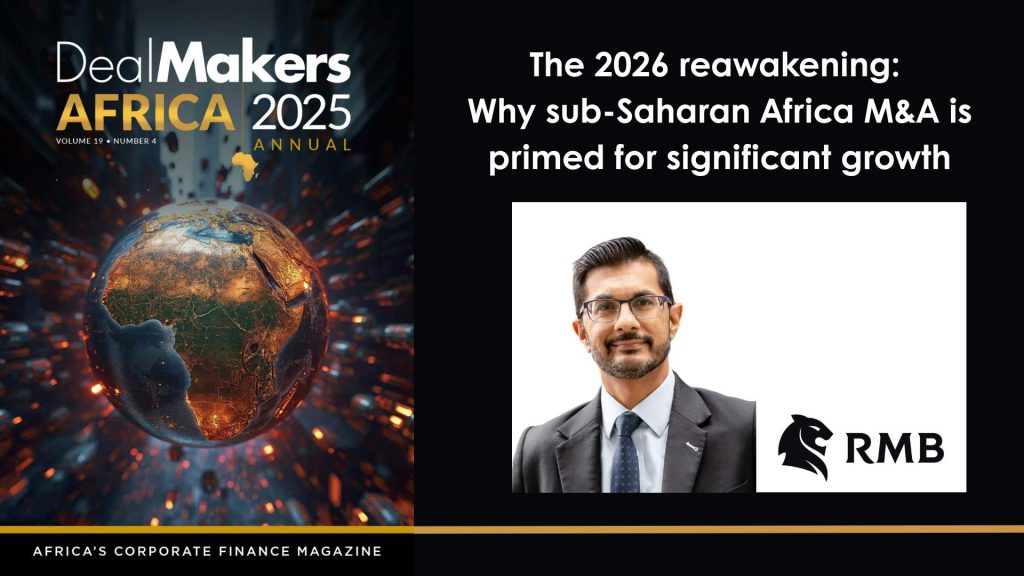
This article first appeared in DealMakers AFRICA, the continent’s quarterly M&A publication.
DealMakers AFRICA is a quarterly M&A publication
www.dealmakersafrica.com