

New: Ghost Bites on YouTube
Wish you could listen to Ghost Bites, not just read it? Subscribe to my YouTube channel and you’ll get regular highlights from Ghost Bites. It will always be on the website first, but I’ll do my best to release these daily or as close to daily as possible. I won’t be covering the Nibbles (including director dealings) in the video, so be sure to read as often as possible and to treat the audio as a backup!
In this edition of Ghost Bites:
- Hudaco’s consumer-related products segment boosted the interim period
- Signs of life at Optasia – but I’m waiting for detailed results
- Supermarket Income REIT refinances £445 million in debt
Hudaco’s consumer-related products segment boosted the interim period (JSE: HDC)
And they have some serious headaches in discontinued operations to deal with
Hudaco’s results for the six months ended May tell a very different story in continuing operations vs. total operations. They’ve had a tough time in a couple of their business units, as described in detail by the company in a recent trading update.
The continuing operations look good at least, with turnover up 9.5% and operating profit up 11.2%. This tells us that margins expanded, which is always an encouraging sign. The interim dividend was 10% higher, so they’ve just managed to achieve double-digit growth.
The group generated operating cash flow of R478 million before taxes and finance expenses. The net borrowings sit at R654 million. The balance sheet is in decent shape overall, with plenty of headroom in existing facilities. They are also looking to reduce their borrowings over the remainder of this year (subject to any potential acquisitions).
In the segmental split, we find consumer-related products contributing 45% of group operating profit. From continuing operations, sales were up 2.7% and operating profit increased by 8.8%, so this is where you’ll find the most impressive positive move in margin.

The engineering consumables segment contributed 55% of group operating profit. Acquisitions were the major source of growth here, as the industrial side of South Africa remains a tough place to play. Turnover was up 15.3% and operating profit increased 19.3%, so there was some margin uplift here as well. But on a like-for-like basis, without acquisitions, turnover was up just 2.4% and operating profit only increased by 2.1%, so the mix effect of acquisitions drove the margin uplift. This isn’t nearly as good as the consumer-related products division, where margin uplift was more sustainable in nature.
The discontinued operations are the alternative energy business (a load shedding casualty) and the battery bay management and battery service business within Eternity Technologies (affected by the market entry of a competitor). They will need to try and get out of these businesses with the minimal amount of pain.
Ghost Bite: In the difficult industrials sector, a strong balance sheet is critical. Aside from the resilience that it brings, it also allows companies to take advantage of market conditions by acquiring other businesses at good prices. Let’s see how Hudaco handles the second half of the year.
Signs of life at Optasia – but I’m waiting for detailed results (JSE: OPA)
The margin mix needs to be understood properly
Optasia has been under plenty of pressure recently, as the airtime credit offering was simply switched off in Nigeria and nobody really seemed to notice. That’s not exactly evidence of a strong moat.
But then we finally saw some insider buying from the CEO, as well as the founding director (who had sold a big chunk to FirstRand (JSE: FSR) this year). To add to the bullishness, we now have an interim trading update that tells a much glossier story around the company than the share price would suggest.
Investors will now need to consider the underlying growth vs. how vulnerable the airtime credit business model appears to be.
In the six months ended June, Optasia generated 72% of revenue from the micro-financing solutions (MFS) business. I don’t think this reflects the sustainable mix, as the disastrous period for the airtime credit business would’ve artificially boosted this contribution from MFS.
Still, there’s clearly some resilience here, as Optasia managed revenue growth of between 50% and 60% for the period. Adjusted EBITDA growth was between 40% and 50%, with some surprising margin pressure clearly coming through there. It gets worse further down, where net income grew by between 30% and 40%.
Don’t get me wrong – these are strong growth rates obviously. But is the mix effect of airtime credit vs. MFS driving this weaker margin performance? And what does that mean for the future? It’s hard to know for sure until we get the detailed results in September.
Also, don’t underestimate how risky the underlying markets are. Optasia’s recent geographical expansion includes South Sudan. This country is literally a humanitarian catastrophe. On the plus side, they also expanded into Gabon, which is one of the wealthier African countries on a GDP per capita basis.
For the year ending December 2026, the company has reaffirmed guidance for revenue and adjusted EBITDA growth of over 30%. This includes a “prudent” assumption around the recovery of volumes in Nigeria. Normalised net income is expected to grow by between 25% and 35%.
As you can see from the chart, the combination of insider buying and this update has injected some life into this broken post-IPO story:
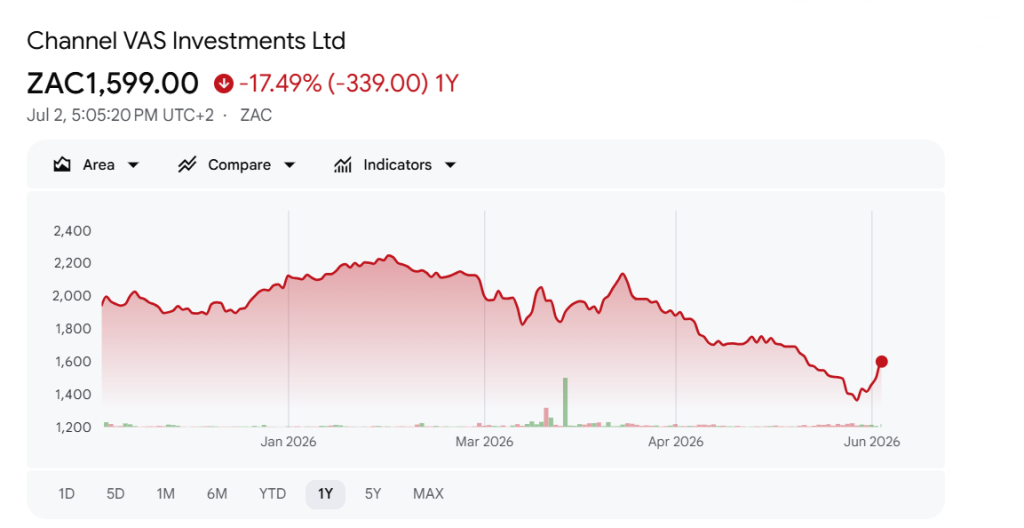
Ghost Bite: If nothing else, this is another reminder for those with trading portfolios that insider buying can be a strong signal. There’s a reason why I cover the director dealings every single day in Ghost Bites.
Supermarket Income REIT refinances £445 million in debt (JSE: SUPR)
This deals with all the facilities maturing in the next two years
At property companies, debt is a feature rather than a bug. They need debt in order to achieve decent return on equity for shareholders. The theory is that property is the ideal asset class to act as security for debt, making it easily available and a cost-effective source of finance.
Supermarket Income REIT (based in the UK) has refinanced £445 million in debt. This deals with four different facilities that were due to mature in the next two years. Rather than waiting until the last minute, companies will often refinance ahead of time.
A major strategic element of these refinancing transactions is the composition of the banking syndicate. Creating competitive tension among banks is one of the benefits of achieving scale. In addition to the four banks in the existing facilities, the company has now introduced two additional banking relationships.
Following this transaction, the company will have no debt maturing until 2028. The weighted average cost of debt is 4.4% and 98% of it is fixed or hedged. Compared to the replaced facilities, the new facilities deliver an annual interest cost saving of c.£0.3 million.
Separately, the company declared a quarterly dividend of 1.545 pence per ordinary share. The exchange rate for South African shareholders will be confirmed by 20 July.
Ghost Bite: As much as I love the intricate storytelling of equity, the world of corporate debt is also really interesting. I particularly enjoy all the different layers of a cake that make up a balance sheet, with a variety of debt structures that carry different costs and maturities.
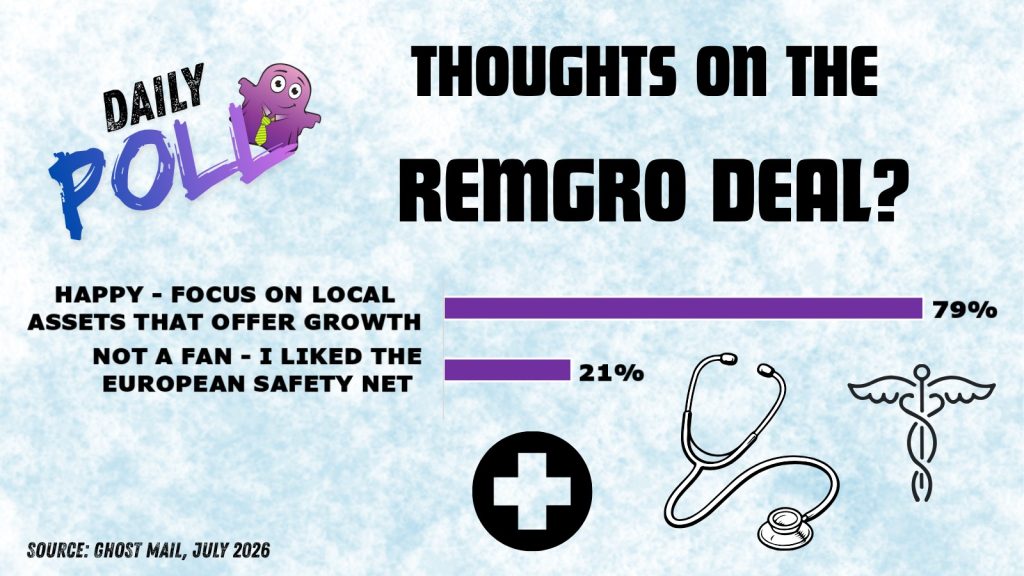
Results of previous poll:
Nibbles:
- Director dealings:
- Sean Riskowitz of Protea Asset Management bought shares in Finbond (JSE: FGL) worth R59k
- The CEO of Africa Bitcoin Corporation (JSE: BAC) has bought preferred C ordinary shares, which reference the ACOF business (JSE: BACC)
- Mantengu (JSE: MTU) has renewed the cautionary announcement regarding the potential reverse takeover transaction with Averi Finance. Mantengu has appointed legal advisors for the due diligence, as a transaction of this nature (a combination of assets from both companies) requires a two-way due diligence.
- I’m not sure what they are up to at Vunani (JSE: VUN), but they’ve appointed the ex-CEO of MTN Zambia to the board. The describe these ICT skills as “contributing significantly to the continued growth and strategic objectives of the company” – even though they don’t have any ICT assets. Interesting.
- Combined Motor Holdings (JSE: CMH) has renewed the cautionary related to the potential acquisition of properties owned by directors.
- Trustco (JSE: TTO) has updated the market on the timing to complete the Namibian and South African audits at subsidiary level. They expect this to be finalised in the fourth quarter of the year. Keep in mind that this relates to financials for the years ending August 2024 and August 2025, with the company suspended from trading and far behind on its financials.
- Sail Mining Group (JSE: SGP) has been suspended from trading since mid-2022. They are hellishly behind on financial reporting, with audits in progress for the 2022 to 2024 financial years. They are looking to delist the company anyway. I’ll be interested to see if an offer to shareholders can be approved without recent financial information to work from.