
In this edition of Ghost Bites:
- AngloGold’s profits soar, but watch out for inflation
- Someone needs to explain to Hulamin how trading statements work
- Impala Platinum has made a ton of money this year
- MC Mining prepares for a milestone quarter
- August 2026 will be absolutely critical for Orion Minerals
AngloGold’s profits soar, but watch out for inflation (JSE: ANG)
The gold price pulled them through in Q2
AngloGold’s second quarter is a useful reminder of why this saying exists: “It’s a gold mine!”
With the gold price remaining at juicy levels (up 35% year-on-year), the company grew Q2 2026 EBITDA by 46%.
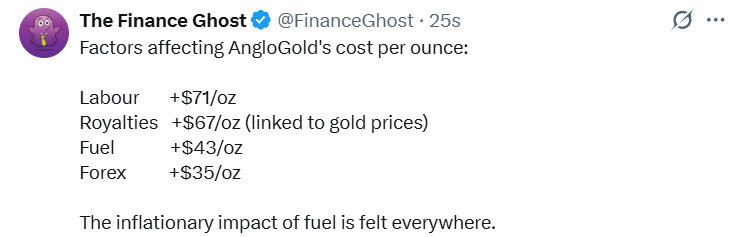
Now, you might be wondering why the EBITDA increase isn’t higher, as a period of such strong metal prices usually drives a considerably higher increase in earnings. You’ll find part of the answer in the total cash costs per ounce, which increased by 21% year-on-year. Although this increase is lower than the percentage increase in the gold price, it was high enough to take some of the shine off.
This was driven by a mix of factors including labour, royalties, fuel and forex. Here’s the breakdown, for those of you who don’t follow me on X:
Another factor that explains the gap between the gold price and EBITDA movements is the amount of gold sold. Aside from the sale of Serra Grande in December 2025, there was lower production at Obuasi due to a tragic fatality of a contractor. When combined with maintenance projects, this led to a decline in gold production of 7.5%.

Thankfully, the gold price did more than enough to offset the lower production and higher costs per ounce. When combined with other sources of leverage in the business, AngloGold experienced a 58% increase in HEPS.
The next thing you should ask yourself is: did this translate into cash returns for shareholders?
Free cash flow was up 36%, so the impact of capex is being felt. The company is investing heavily in the future, with non-sustaining capex doubling (from $108 million to $217 million). Sustaining capex was also up significantly ($332 million vs. $273 million in the comparable period).
A highlight for investors will be the sharp increase in the dividend. Year-to-date payments to shareholders (i.e. Q1 + Q2) came in at 188 US cents per share – more than double the 92.5 US cents in the comparable period. More cash will be raining down on investors, with a share buyback programme of $2 billion approved by shareholders in July.
This performance has given the company confidence to reaffirm the 2026 guidance, although the important caveat is that production is heavily weighted towards the second half of the year.
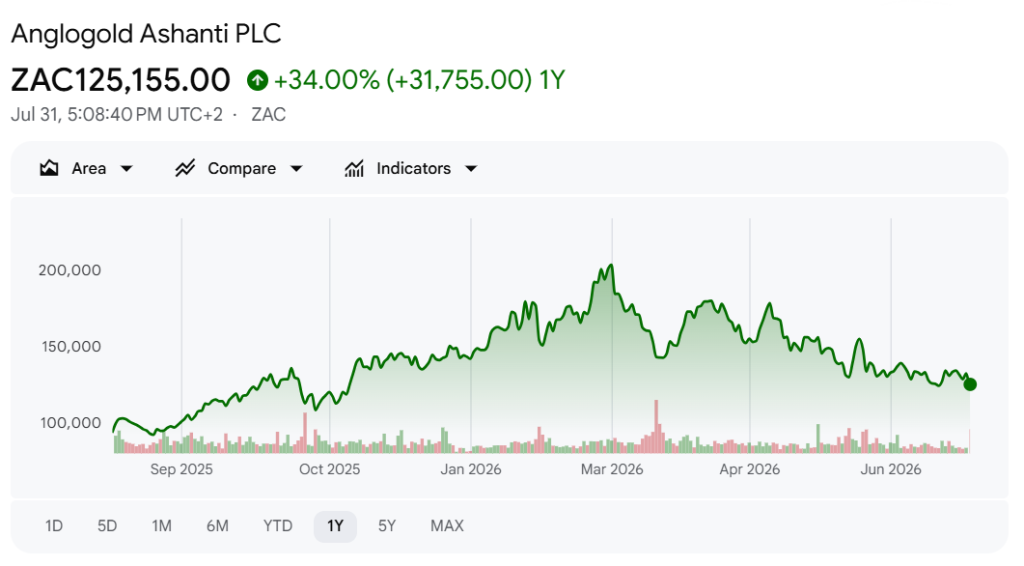
Ghost Bite: After a generational run, gold took a breather in early 2026. Even the yellow stuff can be the victim of a hype cycle! Here’s an indication of the volatility, with the 52-week low at R799.25 and the 52-week high all the way up at R2,146.73:
Someone needs to explain to Hulamin how trading statements work (JSE: HLM)
I somehow doubt they achieved incredible clarity on earnings in the space of a weekend
As part of my new approach to earnings season, I’m going to group updates together in a way that makes sense. Previously, I would’ve written about Hulamin’s trading statement (released on Friday) in this morning’s Ghost Bites. I would’ve ignored the freshly released results out on SENS this morning and only written about them tomorrow. This doesn’t feel like a good user experience for you.
Not that Hulamin seems too bothered about user experience, mind you. The point of a trading statement is to be an early warning system for investors when earnings will move by more than 20%. Best practice is definitely not to release a trading statement at 3pm on a Friday and then results at 7am on Monday!
It’s not like the 20% threshold was in any doubt. Reported HEPS increased from 15 cents per share to 79 cents per share. They’ve known about the 20% movement for a while now. This is an area of the rules where I feel that the JSE needs to show some teeth.
Before carrying on, normalised headline profit per share from continuing operations tells a very different story. This metric was down by 62%, coming in at 10 cents. The big difference here is the removal of metal price lag and any non-trading income or expenses.
For further context (and as we saw in the comparable period), there’s no interim dividend.
A mixed bag of operational results saw revenue from continuing operations increase by only 2%. The good news is that the commissioning and quality problems in the can business in the second half of 2025 have largely been resolved, with production ramping towards the upgraded plant’s design run-rate. The drag on performance was rolled products, down year-on-year but improving over the six months.
This suggests that some positive momentum could be carried into the second half of the year. Investors will certainly hope so!
It’s worth mentioning that Hulamin has been streamlining its group. The disposals of both Hulamin Extrusions and Hulamin Containers are now complete. The effective date on the Extrusions sale was 1 July 2026, so those proceeds will improve the balance sheet for the second half of the year.
Ghost Bite: The share price spiked on Friday afternoon, but I would wait for today’s trading before forming any conclusions. The stock has lost 22% of its value year-to-date.
Impala Platinum has made a ton of money this year (JSE: IMP)
But the share price chart suggests that the good times didn’t last long
Impala Platinum released a production update for the year ended June 2026. Production from managed operations increased by only 0.7%. 6E group production was up just 0.5%. This wasn’t exactly an exciting time for them in terms of this metric.
Things get a lot better when you look at refined 6E production though, with the South African processing assets achieving record milling rates at the base metal refinery. To achieve a 5% increase in this metric after such tepid growth in 6E production is really impressive.
Sales volumes increased by 4.2%. Not bad.
Thankfully, the PGM prices were a much more exciting story in this period. A strong rand couldn’t ruin this party, with sales revenue up by more than 50% on a per ounce basis.
With unit costs per ounce only up by 8%, it’s likely that HEPS has moved beautifully in the right direction. We will have to wait for the release of full financial results to know for sure.
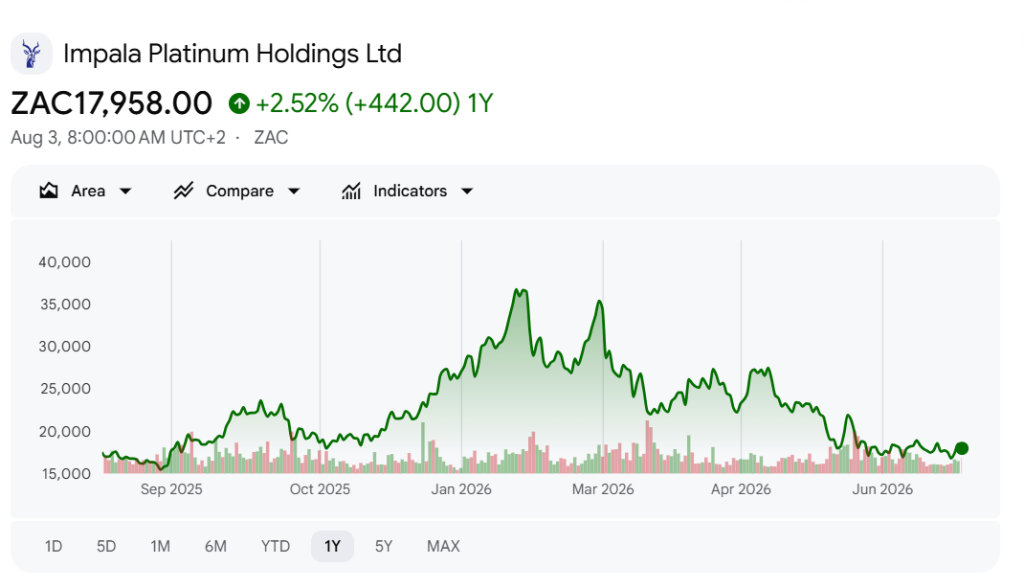
Ghost Bite: In the first half of the financial year, HEPS increased by 5x (from 206 cents per share to 1,035 cents per share). I can’t wait to see what the full year move looks like! But here’s the crazy thing about the mining sector: the share price is actually flat over 12 months:
MC Mining prepares for a milestone quarter (JSE: MCZ)
The Makhado project is making great progress
As all junior miners must do, MC Mining released a quarterly activities report.
This report comes after the news of the CEO stepping down after a long and successful period that included a rare thing in South Africa: the attraction of substantial foreign direct investment. Kinetic Development Group recently became the controlling shareholder in the company. They are making it possible for MC Mining to develop the flagship Makhado steelmaking hard coking coal (HCC) project.
It’s impossible to overstate the importance of this project to MC Mining. Makhado will be the largest HCC project in South Africa, with a life-of-mine of 28 years.
A number of important commissioning milestones were achieved in the latest quarter, but the next quarter is even more important. Performance testing is scheduled for August. If you listen carefully enough, you can almost hear the management team holding their breath!
It’s a very different story at Uitkomst Colliery, where operations are suspended due to cash losses. The company hasn’t made a final decision on the future of Uitkomst, but they have received a binding offer from a potential buyer for the asset. Kinetic Development Group may be funding the Makhado project, but I’m sure it wouldn’t hurt to just get the Uitkomst headache out of the way.
Ghost Bite: The share price is up 38% year-to-date, but it all happened right at the start of the year. Junior mining share prices tend to move based on operational milestones above all else. If testing in August is successful, that would be the likely next catalyst. Of course, if testing is unsuccessful, that would also be a catalyst – just in the wrong direction.
August 2026 will be absolutely critical for Orion Minerals (JSE: ORN)
It’s time for funds to flow from Glencore (JSE: GLN)
Investors in Orion Minerals are desperate for any news on the Glencore prepayment financing arrangement. When we recently hosted the company on Unlock the Stock, most of the Q&A related to getting this deal across the line. Management couldn’t give specifics of course, but this session is still well worth watching:
In addition to releasing a quarterly update, Orion has given the market something to chew on regarding the Glencore arrangement.
The SARB approval is now in place. The intercreditor agreement between Glencore and Triple Flag Precious Metals is in an “advanced form”. Based on my corporate finance experience, I can well imagine how complex that agreement is. Speaking of complicated legals, the offtake agreements with Glencore are also described as being in final form.
These agreements still need to be executed, but Orion expects tranche A of the financing to become unconditional by the end of August 2026. This will trigger the construction of the Uppers at the Prieska Copper Zinc Mine. Tranche B will come later, with Glencore needing to secure non-recourse funding from third parties to make that happen.
The other project in the group is the Okiep Copper Project, where they are busy with the optimisation of the Flat Mines 2025 Definitive Feasibility Study.
To support the group balance sheet, you may recall that Orion completed a capital raise of $15.4 million in June 2026.
Ghost Bite: The best way to think of Orion is to imagine yourself standing at a stove with two pots on the go. Okiep is simmering at the back on low heat, not getting much attention. The Prieska Copper Zinc Mine is in full view of everyone, right on the cusp of boiling over and needing to be carefully managed. But the Prieska pot is also where the tastiest food is being cooked, with hungry (and excited) investors waiting at the table. With the share price up 115% in the past year, there’s already been much activity in anticipation of this dish. All eyes will be on the Glencore money flowing by the end of August.
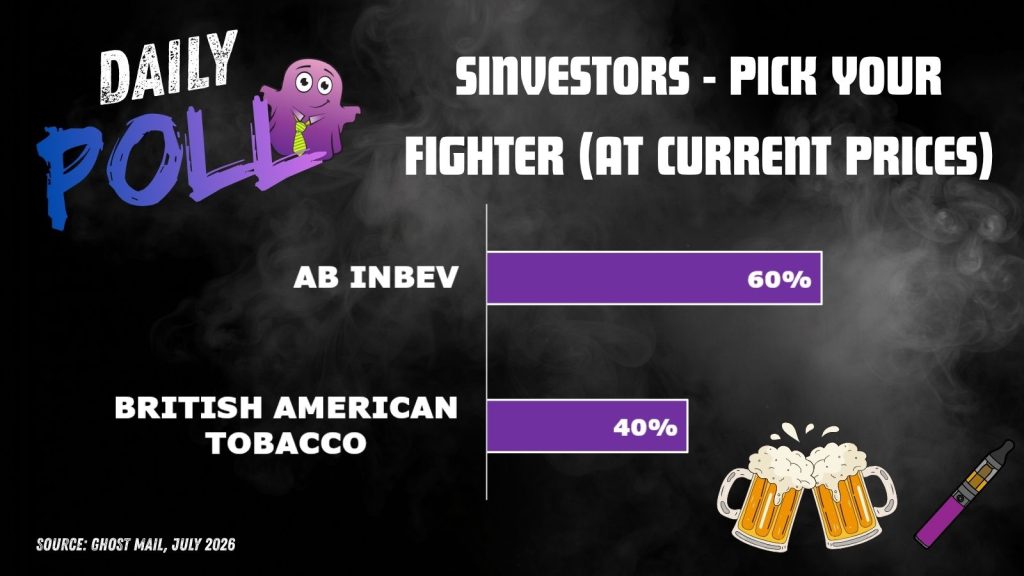
Results of previous poll:
Nibbles:
- Director dealings:
- For whatever reason, the CEO of Argent Industrial (JSE: ART) bought and sold roughly 40,000 shares (worth R1.6 million) from 28 to 30 July. There’s no explanation given in the SENS for this strange behaviour.
- The CEO of Marshall Monteagle (JSE: MMP) bought shares worth R627k.
- A non-executive director of Shaftesbury (JSE: SHC) bought shares worth R567k.
- When Copper 360 (JSE: CPR) listed, I remember joking about the stock ticker CPR. My hope was that investors in this junior mining asset wouldn’t need to be resuscitated. Alas, with the share price down 88% over 3 years, my joke was horrendously on point. The latest from the company is an update of a technical accounting nature, with a restatement of the results for the year ended February 2026. Things always seem to get worse, with the headline loss per share corrected from -19.46 cents to -27.36 cents. It’s thankfully for non-cash reasons related to the recapitalisation and debt restructuring transaction.
- There’s bad news from Wesizwe Platinum (JSE: WEZ), with the Bakubung Platinum Mine suspending operations after a s189 consultation process with employees became heated. Our mining industry’s history of violence around wages and job security remains a far-too-vivid memory. I hope this is resolved as quickly as possible.
- Oando (JSE: OAO) caught up on two sets of quarterly results. They released numbers for the three months to March 2026 and the three months to June 2026. In the March quarter, revenue was up by 6%, but profit fell by a nasty 67%. The three months to June was as excellent as I would’ve expected from this energy company during a fuel price spike, with revenue up by roughly 36%. This helped them swing from losses in the comparable quarter to profits in this quarter. There’s almost no liquidity in this stock on the JSE.
- After further purchases of shares, Novus (JSE: NVS) now has a direct stake of 50.79% in Mustek (JSE: MST). The indirect stake is 71.08%.
- Labat Africa (JSE: LAB) continues to create more questions than answers about its investment case. The latest update is that Alpvest Equities has a 12.6% stake in Labat.
- Sebata Holdings (JSE: SEB) has renewed the cautionary announcement related to negotiations with a third party for the potential disposal of certain assets.
- African Dawn Capital (JSE: ADW) has been suspended from trading since July 2025. This is because the results for the year ended February 2025 are still outstanding. They are obviously very far behind now, although they expect to catch up on everything by the end of August 2026.