
In this edition of Ghost Bites:
- Datatec expands further in the US
- Signs of life at Metair as multiple restructuring efforts take hold
- Telkom’s first quarter is a strong foundation for the rest of the year
Datatec expands further in the US (JSE: DTC)
Cybersecurity is a juicy area at the moment
Datatec is a local company with an excellent global strategy. This is one of very few examples of South African companies that have successfully expanded offshore.
This strategy still has plenty of runway, evidenced by the announcement of a new acquisition in the US.
Datatec’s subsidiary, Logicalis USA, has acquired 100% of the share capital of Loial, a cybersecurity and managed services company operating in New Mexico. This expands the Southwest team in the US.
The deal is too small to be categorised, so no further details are given around numbers etc. When it comes to the US though, even a regional specialist can be a business of significant scale.
Ghost Bite: Datatec’s total return over three years is 181%. They know what they are doing when it comes to offshore deals.

Signs of life at Metair as multiple restructuring efforts take hold (JSE: MTA)
AutoZone has also achieved some profitable months
I regularly refer to Metair as the unluckiest company on the market.
They are trying to navigate the disruption of their OEM automotive manufacturer base by Chinese brands. They are dealing with huge fines in Europe that deal with issues from a time before they even owned their battery assets in that region. Heck, they’ve even had to survive floods at a major local customer!
The company deserves a break. Truly. If the latest trading statement is anything to go by, they might finally be getting it!
If you aren’t familiar with the company, the main thing to remember about Metair is that they are primarily focused on new car manufacturing in South Africa. They have other businesses and they are pushing harder into aftermarket parts, but that’s still the main focus of the business.
Now, bulls might be tempted to point to the strong growth in new car sales in South Africa as a source of revenue, as the company supplies manufacturers like Ford and Toyota with components for local manufacturing. But the problem is that the growth is coming from Chinese and Indian brands that are manufactured elsewhere. This was one of the major talking points when we hosted Metair on Unlock the Stock a few months ago:
In terms of export sales, local manufacturers are also struggling due to the impact of those new brands in export markets. Export sales fell by a nasty 7.8% year-on-year. Overall, local industry production was flat, with domestic sales helping to offset the export impact.
For Metair specifically, lower volumes from one customer were offset by growth in other customers. Revenue and EBIT increased marginally, with the latter benefitting from efficiency initiatives and the inclusion of Hesto for the full six months of the interim period.
If we dig deeper, the OEM revenue (including Hesto) increased by between 3% and 6%. EBIT margin came in slightly ahead of the prior period’s 7%. Hesto’s revenue is expected to decline by 15% to 20%, with EBIT margin expected to dip by between 1% and 2% due to lower volumes.
Then, in Aftermarket Parts and Retail Africa, revenue is expected to increase by between 5% and 7%. AutoZone is making progress on its turnaround, but First Battery is struggling. AutoZone was still loss-making for this period overall, but became profitable from May onwards (six months behind the initial plan). Rombat (the European battery business) is expected to manage steady EBIT, despite revenue decreasing by 20% to 25%.
We then move on to the balance sheet, where the extent of debt has historically driven many a sleepless night for both Metair and its bankers.
In May, Standard Bank approved a refinancing of the debt package within the South African subsidiaries (excluding Hesto). The term of the R3.3 billion in debt has been extended to five years. As leverage comes down, the interest rate will also ratchet lower.
This is one of the snowball effects in a turnaround story where debt is involved. As debt comes down, financial risk reduces and the cost of debt comes down as well. This has a significant positive effect on interest costs in years to come.
Overall, they expect HEPS from total operations for the six months to June to have increased by between 7% and 15% for the period. From continuing operations (which excludes Dynamic Batteries and First Battery Industrial division), HEPS increased by between 3% and 11%.
The HEPS from continuing operations range is between 70 cents and 75 cents, putting the share price on a P/E multiple of roughly 6.8x.
Despite an underlying feeling of improvement, there’s still never a dull moment at Metair. Due to restructuring activities at First Battery, NUMSA implemented a strike from 6 July until 23 July. That obviously isn’t captured in the numbers for the period ended June.
And although the €20.2 million fine in Europe has been fully provided for by Rombat, they are still appealing the fine. My understanding is that instalments become payable in the meantime anyway. It seems like a long shot that they will have any success in squashing it.
Ghost Bite: This is the most promising update I’ve seen from Metair in a very long time.
Telkom’s first quarter is a strong foundation for the rest of the year (JSE: TKG)
The prepaid and data growth engines are firing on all cylinders
Telkom has released a promising set of numbers for the quarter ended June 2026. There are some impressive growth engines powering this story, although group revenue growth remained modest at 2.6%
Within that number, we find a winner like group data revenue (up 8.8% and now contributing 62.4% of total revenue). Fibre-related revenue was up 4.0% and mobile data revenue rose by 11.4%.
Another critical area is prepaid service revenue growth of 9.1%. The prepaid market has been a competitive bloodbath recently, with Telkom giving the leading players a lot to think about in their home market. Total service revenue in Telkom Mobile grew by 6.4%.
The story gets more interesting when you consider profitability. Group EBITDA increased by 10% and EBITDA margin expanded by 180 basis points to 27.7%. Double-digit growth in EBITDA is impressive in a South African telcos market that is largely seen as being mature.
Telkom Mobile deserves another mention here for its performance in a competitive market, with EBITDA margin expanding by 270 basis points to 29.1%!
There’s also good news for free cash flow, with group capex down 19.4%. Capex intensity (capex as a percentage of revenue) improved from 10.2% to 8.0%. Achieving revenue growth with less capex means that there’s more cash flow for shareholders. Be warned though: Telkom has indicated that capex spend will be ramped up for the remainder of the year. They expect intensity to run between 12% and 15%.
It can’t all be good news, of course. BCX remains a difficult story with ongoing revenue pressure. Cybersecurity and cloud services might be on the up, but the legacy areas of BCX have dragged revenue down by 10.9%. Due to management initiatives, EBITDA still managed to increase by 2.6%. EBITDA margin remains painfully low at just 7.5%.
A lesser known fact about Telkom is that it’s lucrative to be their conveyancing attorneys. The group sold a whopping 100 properties during the quarter, with a further 105 properties in the conveyancing process! We are talking about R464 million in properties overall.
Looking ahead, Telkom will continue to find pockets of growth in the Telkom Mobile business. They are targeting underindexed and underserved regions, with service revenue expected to grow by mid-single digits. Having just grown the prepaid subscriber base by an impressive 7.1%, this is a strategy that is clearly working.
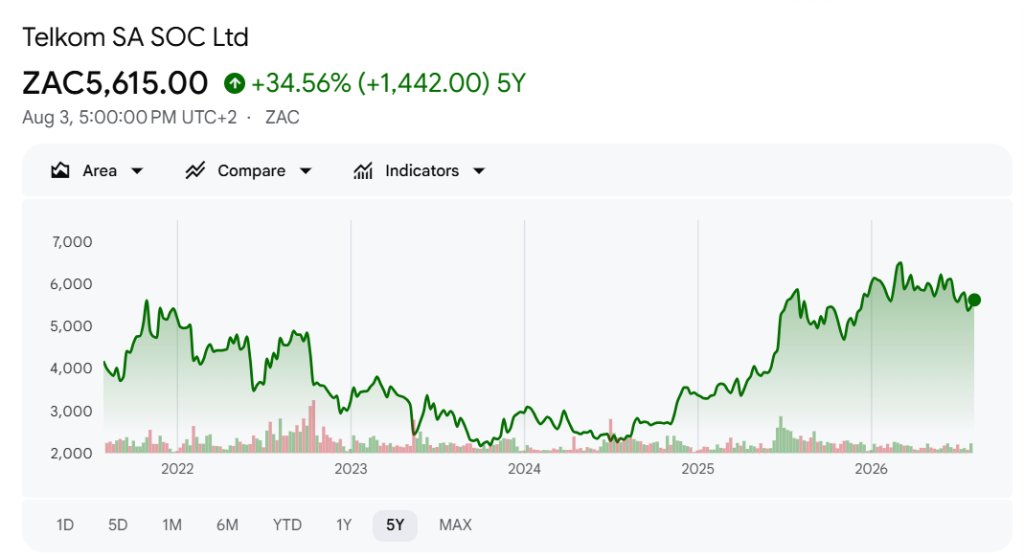
Ghost Bite: Despite all this progress, Telkom’s share price is down 4.7% over 12 months. The big money in this turnaround was made in early 2025, with the earnings now growing into their new boots.
Nibbles:
- Director dealings:
- A non-executive director of British American Tobacco (JSE: BTI) bought shares worth £247.5k (around R5.5 million)
- The company secretary of Vodacom (JSE: VOD) sold shares worth R1.5 million.
- A senior exec at Sirius Real Estate (JSE: SRE) and a closely associated person received shares worth £30.8k as part of the company’s dividend reinvestment plan.
- A non-independent, non-executive director of Southern Palladium (JSE: SDL) bought 20,000 shares in an off-market deal with a family member. In theory that’s fine, but not if the correct process isn’t followed to get clearance for the transaction during a closed period. The director was suitably rapped over the knuckles.
- Lesaka Technologies (JSE: LSK) shareholders have approved the grant of stock options to Executive Chairman, Ali Mazanderani. This is part of the broader efforts by the company to retain Mazanderani’s services for the next few years. The options cover 1 million shares at an exercise price of $5 per share. The current share price is R79, so these options are out-of-the-money on day 1 (as they should be). They vest in April 2028 and would be exercisable after April 2029. This gives him a few years to play a role in making these options as valuable as possible. The idea is obviously to align the execs with shareholders as far as possible.
- Mfundo Nkuhlu is retiring from his position as COO of Nedbank (JSE: NED), having been with the bank since April 2004. That’s a 22-year innings that certainly deserves a proper farewell party! Interestingly, Nedbank will not replace him. Instead, the COO role will be discontinued and the responsibilities will be reallocated within the existing group exco structure.