
Ghost Mail is a daily dose of analysis on JSE-listed company news. If you’re craving a proper financial lens on local company performance, view the recent newsletters and sign up here>>>
Making the most of a tough period
When AVI (JSE: AVI) and Bidcorp (JSE: BID) released operating updates on the same day, I couldn’t resist digging into both. There’s always a lot to learn from consumer-focused companies, with both of these names operating further up the value chain than retailers. Well, for the most part at least – AVI for some reason is still trying to compete in fashion retail.
Why? I really don’t know. We may as well start there.
Flat revenue and restructuring at AVI
At AVI’s AGM, the chairman of the board gave an update on recent trading. Revenue growth seems to be hard to come by, with revenue for the four months to October being flat vs. the prior period.
The Snackworks business achieved an increase in revenue. Entyce (the beverages) saw revenue drop thanks to price competitiveness in the creamer category. At I&J, revenue grew based on stronger export sales volumes and higher selling prices to try and offset the impact of higher fuel prices.
Then we get to the stuff that I believe AVI shouldn’t own: the fashion businesses. The announcement talks about a constrained consumer environment with “sustained deep discounting” by fashion retailers and competitors in personal care.

But the recent reports from major players like Truworths (JSE: TRU) and The Foschini Group (JSE: TFG) are telling a different story, with those companies opting to protect gross margin rather than fight for every rand of sales.
There are many other players in the market of course, so the comments made by AVI may well relate to a broader competitor suite that isn’t captured by the aforementioned listed companies. Either way, apparel is a competitive bloodbath that feels far less attractive than AVI’s other operations.
How did AVI’s businesses in this space perform? We don’t know, as the announcement focuses on this random statistic: lay-by units at SPITZ have increased by 7% year-on-year.
Is that an indication of better revenue, or just an example of a company cherry-picking a specific metric? It sounds too granular to be the former.
There’s also information on gross margin, with a small decline driven primarily by once-off restructuring costs at Entyce and Snackworks. In a manufacturing company, the way that cost accounting is applied leads to many overheads and other costs landing in cost of sales. This is why something that sounds like a traditional operating cost can impact gross margin.
Restructuring initiatives tend to come with long payback periods. This one is no different, with AVI guiding a payback of under 18 months on these initiatives.
The restructuring costs were largely offset by margin improvements across most categories, with creamers as the exception based on the level of competition.
Moving to operating costs, AVI has highlighted a “tightly managed” cost base that ended approximately in line with the previous year. That’s impressive when you consider the inflationary pressure from fuel prices. Fuel directly impacts distribution costs and indirectly impacts many other cost lines.
One of the factors that helped offset the fuel issue was favourable foreign exchange revaluations. The company also highlights the benefits of restructuring initiatives coming through.
Add it all together and we find that operating profit was better than the prior year if you exclude the impact of the restructuring costs, although we don’t know yet to what extent. If you include those costs, you’ll find that operating profit decreased marginally on a reported basis.
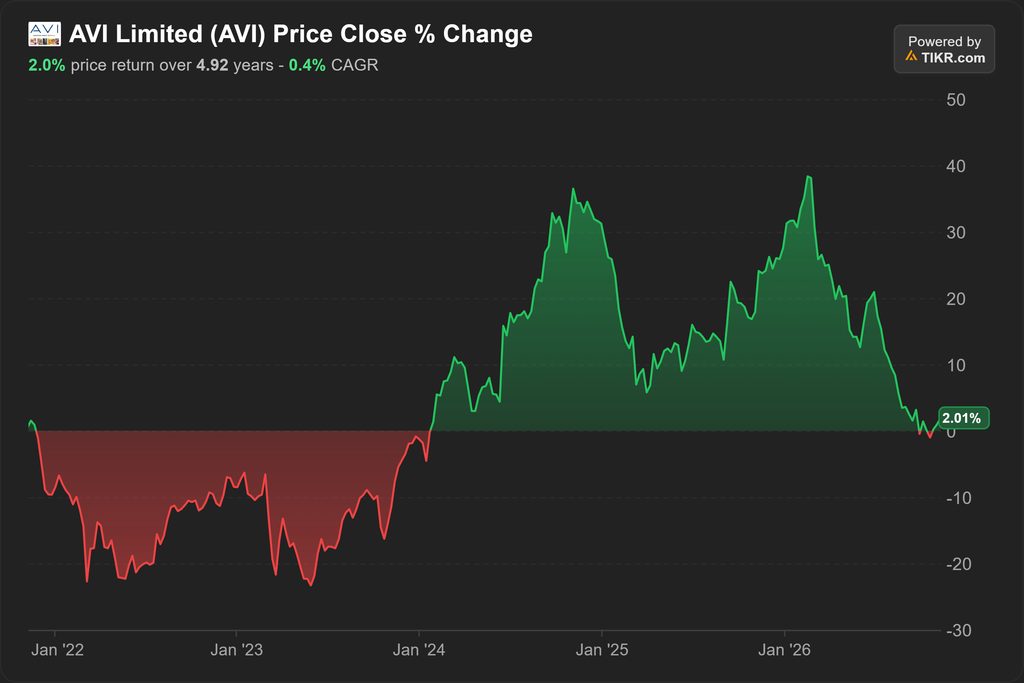
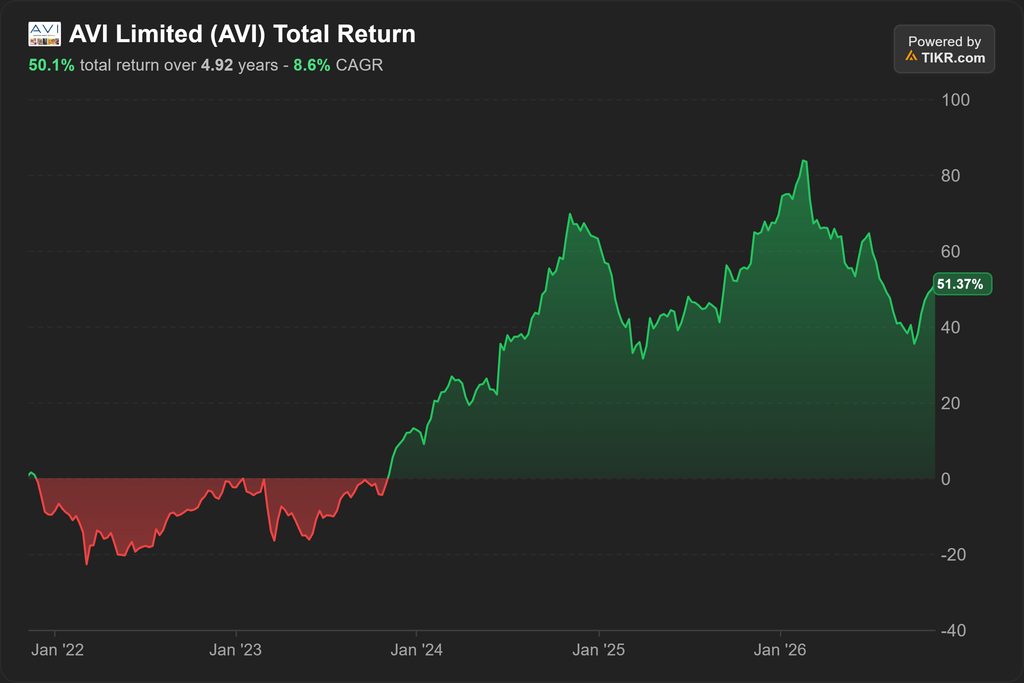
The share price has been anything but flat, though. AVI is down 19% over 12 months. If you include the juicy dividend (the stock currently trades on a yield of 7.9%), then the total return is negative 9.4%.
The far more interesting chart is over five years, showing that investors have only had dividends to show for their efforts.
Here’s the price chart without dividends:
And here it is with dividends included:
Bidcorp is running on a currency treadmill
We then get to Bidcorp, which operates in a different part of the value chain. Instead of manufacturing food, Bidcorp is all about distributing it to restaurants, hospitality and other businesses that need a wide variety of ingredients and related products.
It’s a strong business model that has little or no key customer dependency. The group is also highly diversified from a geographical perspective, with South Africa typically contributing around 5% of the group’s revenue.
In the four months to October 2026, the company had to navigate a period that was defined by high fuel prices and extreme consumer pressure. You wouldn’t say it by looking at the numbers though, with group revenue up by 2.4% and trading profit increasing 8.2% in constant currency.
Gross profit margin increased from 24.0% to 25.0%, helping to explain the leverage seen between revenue and trading profit. EBITDA margin (ignoring IFRS 16 leases, i.e. done the right way) increased from 6.1% to 6.6%.
The stronger rand over the period means that the reported numbers aren’t as impressive. Revenue is down by 4.3% as reported, while trading profit only increased by 1.6%.
HEPS increased by 10% in constant currency and 3.2% in rand terms. Under these circumstances, that feels impressive.
As someone who worked in corporate advisory a decade ago when everyone was trying to get their money out of South Africa, it’s incredible to witness a time where global diversification negatively impacts the reported results, rather than boosts them!
The momentum over the period is something to watch. Bidcorp notes favourable summer conditions in Europe during July and August, with activity levels slowing in September and October. There’s obviously a seasonal element to this as usual, but there’s also the negative economic environment to watch out for.
If the company is lucky – in fact, if all of us are lucky – then the recent drop in the fuel price will filter down directly into stronger demand. Consumers would definitely rather be visiting their favourite restaurant than getting bliksemed by the petrol price.
Digging into the geographical split where there are many other words for bliksem, we start with Australasia. Their cricket is dicey these days, but the Aussies achieved revenue and trading profit growth for the period. The recent positive trend in margin has continued, with New Zealand showing a similar trajectory.
In Europe, where they aren’t as good as we are at rugby, revenue increased by 2% despite the impact of food deflation of 1% by the end of September. Margins were strong, especially in Eastern Europe, with trading profit up by 6% for Europe as a whole.
In the UK, where I genuinely can’t remember when last I saw something positive about the country on social media, Bidcorp somehow overcame a weak market to post revenue growth of 3% and trading profit growth in excess of 10% (both in constant currency of course). The announcement highlights a million challenges in that market, yet here we are with positive numbers. Impressive.
Now for another surprise: the Emerging Markets business only managed flat revenue growth, despite being in regions that would traditionally be seen as high growth opportunities. Margins tell a very different story though, with trading profit up 14% in this segment. There are numerous regions represented in this part of the business (including South Africa), but the one that stood out for me is Greater China, described as “remaining challenging” with sales under pressure.
Looking at the cash generation, average working capital days sat at nine days for this quarter, approximately two days better than the comparable prior period. Bidcorp typically absorbs working capital in the first half of the year and releases it in the second half, so a free cash outflow is normal at this point in the cycle.
Net capital investment (including acquisitions) was R1.3 billion, or roughly half of the levels in the comparable period. The company also repurchased shares worth R292 million since July 2026.
The balance sheet is described as being “conservatively geared” overall, with Bidcorp working on the refinancing of loans maturing in FY27.
This gives the group a strong foundation for M&A activity. Bidcorp is known for doing bolt-on deals on an ongoing basis, with five such transactions concluded since June 2026. The company uses this to plug gaps and take advantage of in-country opportunities, a bit like building a house from Lego. The most significant acquisition in this period was in the Pacific Islands.
Looking ahead, the group describes the November trading conditions as being in line with expectations. Importantly, there’s an expectation that food inflation will begin to come through. The company doesn’t speak much about the fuel price, but my view is that a drop in fuel prices could be a strong catalyst for growth in the coming months, even if some food inflation does come through.
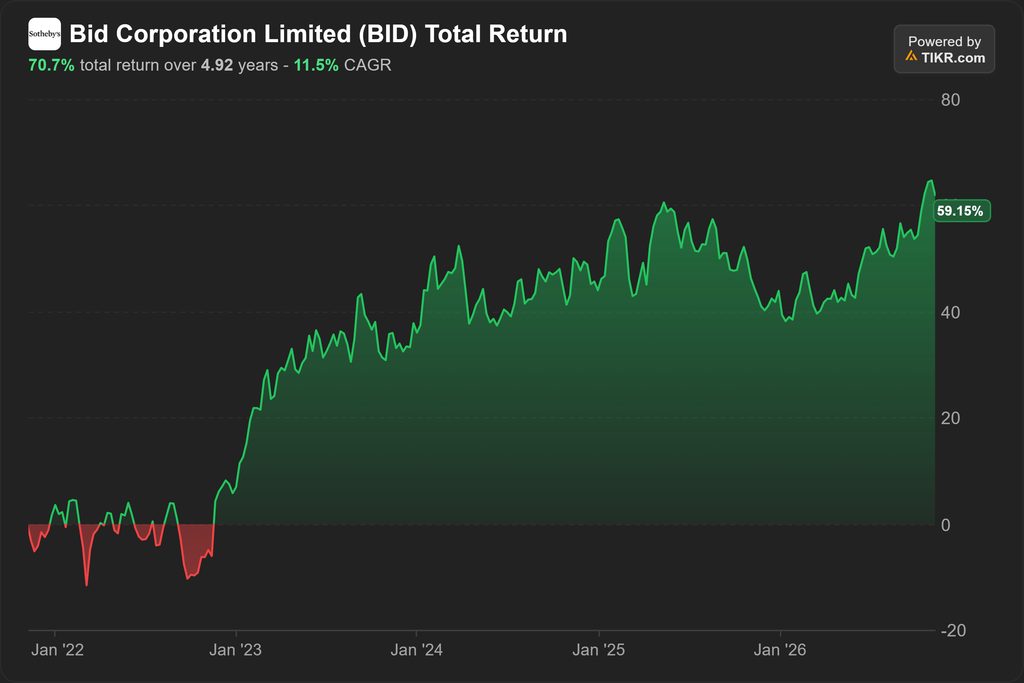
Bidcorp can’t do anything about the rand though, with the strength of our currency taking some of the shine off the JSE-listed rand hedges.
For consistency, here’s the five-year chart based on only the share price movement:
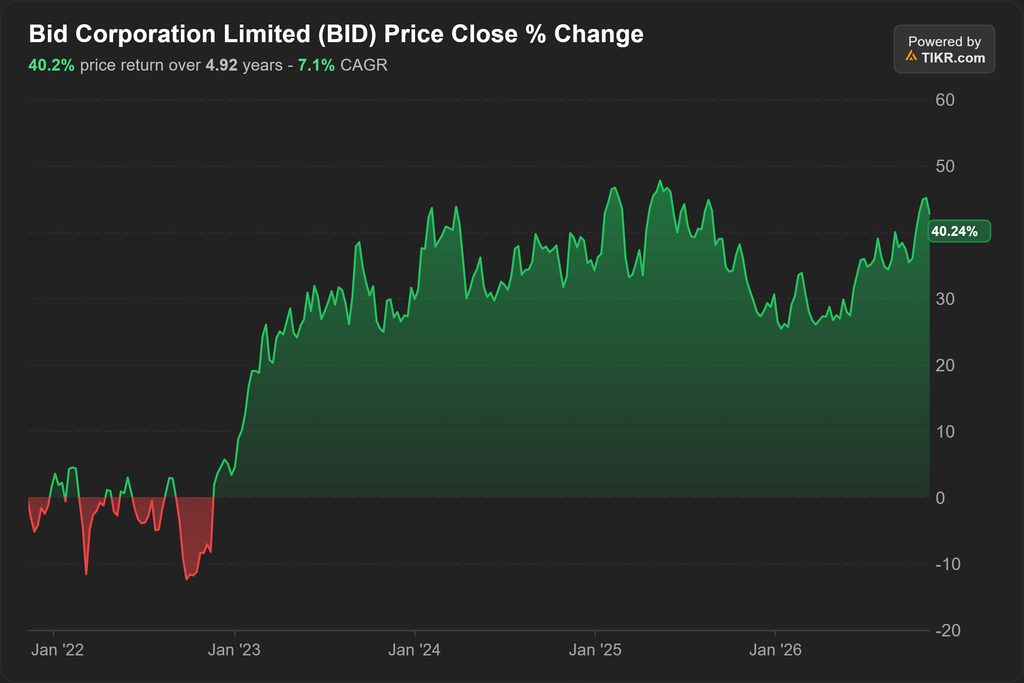
And here’s the total return:
Keen for another opinion on Bidcorp? The team from Aylett & Co. really likes Bidcorp. Justin Ritchie and Jan Nel were on a recent Magic Markets podcast to explain exactly why:
Remember to always do your own research on these companies. Past performance is no indication of future performance. This article is for informational purposes only and should never be seen as financial advice or an endorsement of these companies.