

Ghost Mail is a daily dose of analysis on JSE-listed company news. If you’re craving a proper financial lens on local company performance, view the recent newsletters and sign up here>>>
Most investors know that Richemont is one of the most globally recognisable businesses on the JSE. The Rupert family has built an empire with a leading position in the luxury goods industry.
The group owns leading luxury brands like Cartier, IWC and Panerai, along with plenty of others that I have no idea how to pronounce.
My theory is simple: if I can’t say it, I probably can’t afford it.
There’s a corollary that goes like this: if Richemont owns it, I definitely can’t afford it.
But for all the glitz and glamour, Richemont’s share price is down nearly 6% over 12 months. Owning the stock over that period hasn’t gotten anyone any closer to buying a watch (sorry, a timepiece…) that can cost the same as a family home.

Even if we give Richemont more of a chance to look good by extending this analysis to five years and including dividends for a total return view, we still only find a compound annual growth rate (CAGR) of 6.5%:
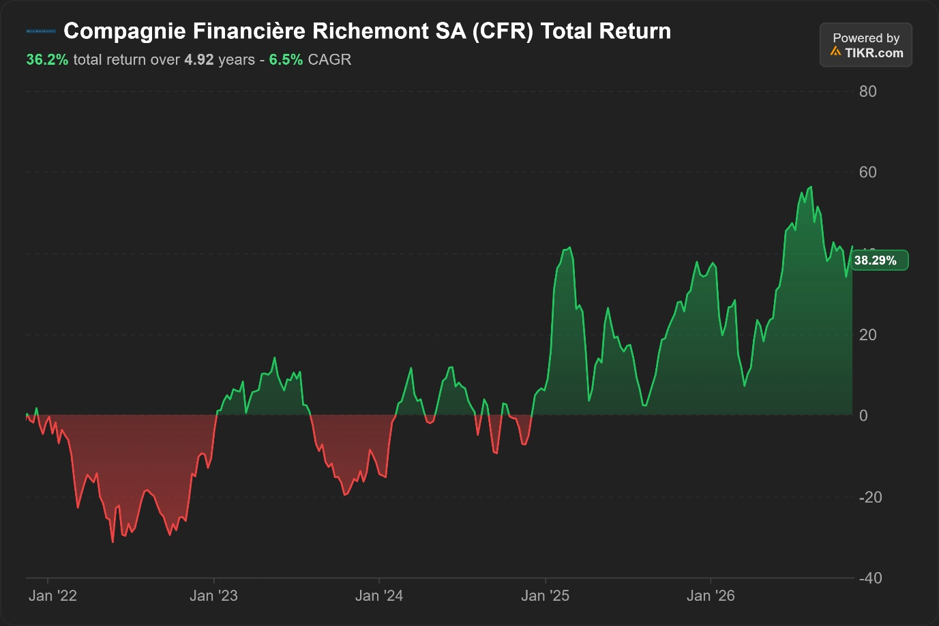
This begs the question: is it all show and no go for this iconic company?
And as we will see later, what on earth are they planning to do with all their money?
An acceleration in sales growth
The six months to September 2026 provide an encouraging data point: sales growth of 17% (in constant currency) is the best we’ve seen in any interim period over the past five years. It’s a substantial acceleration from the 10% growth we saw in the prior period.
If we look at gross margin, we find that even Richemont isn’t immune from the impact of higher input prices. It seems as though the super-wealthy also have limits to what they will pay for things!
Gross margin of 66.5% is higher than 65.3% in the prior period, but well down on the levels above 68% that we saw a few years ago.
Operating margin has increased from 22.2% to 25.5% over the past year, so there’s leverage further down the income statement. The quick way to see this is by comparing the increase in gross margin (just 20 basis points) to the jump in operating margin (330 basis points).
The results make the point several times that Richemont is achieving strong growth off a well-controlled cost base.
The combination of high sales growth and much stronger operating margins has led to a 41.9% jump in HEPS. But you would never say it by looking at the share price over the past 12 months!
Specialist Watchmakers: tastes like chicken
Richemont will sell you all kinds of sparkly and expensive things, but they really want to sell you jewellery.
I know this from looking at the operating margins, with the Jewellery Maisons (35.3%) sitting in a different postal code to Specialist Watchmakers (8.8%). The messy Other segment (which still includes iconic brands like Montblanc) has reported yet another small loss.
The Jewellery Maisons segment doesn’t just lead the way in terms of margin. It’s also by far the largest segment, with sales of €9.1 billion in this period vs. €1.7 billion at Specialist Watchmakers and €1.4 billion in Other.
Perhaps if they give Other a French-sounding name (Google tells me that Autre could work), the performance will improve?
Credit where credit is due for the Specialist Watchmakers segment: operating margin was just 3.2% in the prior period, so the latest level of 8.8% is a serious upswing.
This is a scenario that won’t be unfamiliar to investors in poultry businesses: when margins are thin, even a modest increase in sales on a fixed operating cost base can do remarkable things for the bottom of the income statement.
I’ve probably just been added to a no-fly list in Switzerland for comparing the watch business to a chicken business.
Tourism is a critical driver of growth
If you’ve travelled overseas, you’ll know that airports in major global cities are filled with luxury stores. After all, how better to pass the time between flights than by dropping a fortune on something special?
The strategy works, as evidenced by the tourism boom in Japan contributing to sales growth in that region of 30% – by far the best-performing segment in this period when viewed through a growth lens. At the other end of the spectrum, Middle East & Africa fell by 2% as conflict in the region led to a loss of tourism and a negative performance in the UAE.
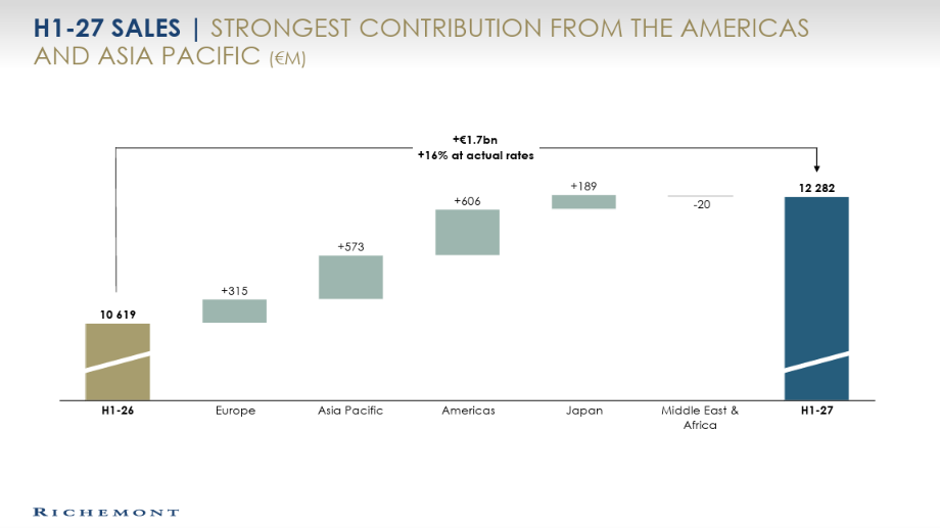
Japan remains quite small though, so the behemoths like the Americas (up 23%) and Asia Pacific (up 16%) matter a lot more. Europe is also important, with growth of 13% in that region. Europe’s economy might be struggling right now, but the rich don’t seem too bothered.
Sometimes, numbers really are just better to see on a chart. This waterfall chart is a really helpful look at the incremental regional sales picture:
A controlled experience
There’s one more way I want to cover the performance in this period: a view of Richemont split by sales channel. The debate around Direct-to-Consumer (D2C) vs. Wholesale has been raging at numerous retail brands in the past few years. Richemont is no different, other than a reference to Direct-to-Client instead.
I guess that being in this LSM elevates you to client status.
Richemont needs to ensure that people are given an experience that aligns with the ethos of the underlying brand. You can’t be selling this stuff in a dark corner of a department store. This is why the Direct-to-Client channel contributed 78% of sales in this period, while Wholesale contributed 22%.
Within Direct-to-Client, we find the Retail and Online segments. Retail grew by 20% and Online was up 17%. This is much better than the 7% growth in Wholesale.
Once again, it’s the Jewellery Maisons that seem to be doing all the work, with Direct-to-Client responsible for over 80% of sales in this segment. This must be one of the reasons why the operating profit looks so different to the other segments.
At Specialist Watchmakers, 60% of sales are in the Direct-to-Client channel. The Other segment achieves more than 55% of sales via this channel.
What are they doing with all this cash
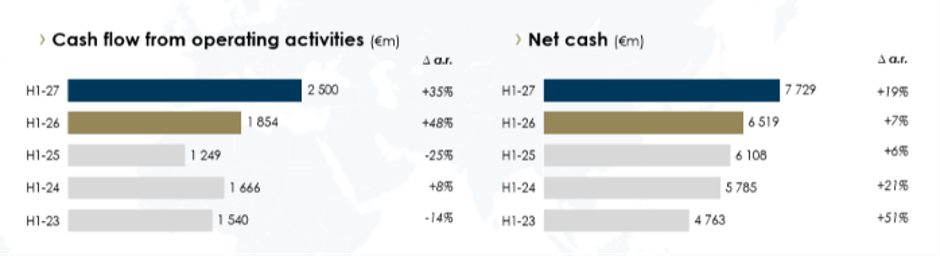
Finally, we get to the cash. There’s a lot of it.
Having just achieved the best cash flow from operating activities that we’ve seen in the past five interim periods, Richemont’s net cash balance has ballooned. These charts from the investor presentation make that pretty clear:
Will we at some point see Richemont pull the trigger on a substantial merger? There are various press reports online about Richemont potentially joining the consortium to buy De Beers, a move that would make sense given that mined diamonds are now only relevant in the luxury space.
But even that transaction surely wouldn’t make much of a dent in this cash balance.
Sitting with billions on the balance sheet doesn’t do wonders for return on capital metrics. This probably isn’t helping the share price either.
With €7.7 billion in net cash tucked away in the mountain, it’s less Rupert the Bear and more Rupert the Dragon right now, à la Tolkien.
Everything you read in Ghost Mail is for informational purposes only and is never financial advice. You should always speak to your financial advisory. Where I disclose a position, this is for transparency purposes and should never be seen as an implied recommendation. This article is not an endorsement of the company.
Keen to get JSE-listed company insights in your inbox every morning? Sign up to Ghost Mail here:


Could a Chinese jeweler be on the acquisition books? Thinking Laopu Gold . . .