
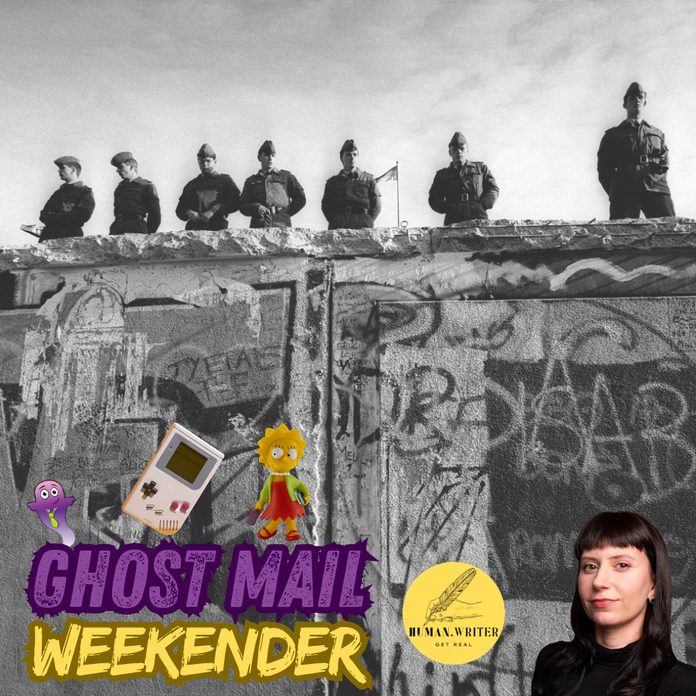
Why some years seem to have all the history, and why your brain is (mostly) wrong about it.
Do you ever have that feeling that you’re living through a year that will make up a fat chapter of a history book one day?
2026 has certainly been one of those. It feels like we barely get time to discuss one headline before the next one arrives.
We’ve had the partial closing of the Strait of Hormuz and the even more partial release of the Epstein files. Elon Musk became the world’s first trillionaire after SpaceX’s record-breaking IPO. We also saw the first crewed flight to the Moon since 1972, the wedding of the world’s most famous pop star and a 42,300-word encyclical from Pope Leo XIV warning us all about the dangers of AI.
Earlier this month, American voters handed the Democrats both houses of Congress in the midterm elections. They also voted in favour of restricting data-centre development in 40 of 41 local ballot measures. Tech stocks promptly took a beating.
And just when it seemed the year couldn’t possibly dish up any more surprises (it is November, after all), Nvidia CEO Jensen Huang introduced us all to the term “honeypot” after admitting to an affair with a businesswoman whom US officials believe might be a Chinese spy.
If this really is the start of the AI downturn, I think we can all agree that nobody saw it coming quite like this.
So, will our grandchildren read about 2026 in history books as the year American politics turned and the AI bubble burst? Maybe. Or maybe we’re just standing too close to the picture to see it all clearly.
One way to find out is to look at a year that’s had a few decades to settle. Every so often, someone on the internet rediscovers 1989 and declares it the most important year in modern history. Do they have a point?
1989 in a nutshell
On 9 November 1989, East German official Günter Schabowski was handed a note about relaxed travel rules that he hadn’t properly read. When a journalist at a live press conference asked when the rules would take effect, he shuffled his papers and announced that, as far as he knew, they applied immediately.
They weren’t supposed to, but by then it didn’t matter.
Within hours, crowds had gathered at the Berlin Wall, overwhelmed guards opened the gates, and East Germans crossed freely into West Germany for the first time in nearly three decades. It was probably the most consequential “um, I think so?” in modern history.
Closer to home, 1989 was the beginning of the end of Apartheid. In January, P.W. Botha had a stroke that led to his resignation as leader of the National Party, and in August he stepped down as State President too. F.W. de Klerk took over and within just six months, Nelson Mandela walked out of Victor Verster Prison.
In March, a British computer scientist at CERN named Tim Berners-Lee handed his boss a proposal for a system to help researchers share information. His manager scribbled “vague but exciting” across the cover.
That vague but exciting document became the blueprint for the World Wide Web.
That same month, twelve European Community nations agreed to ban the production of ozone-destroying CFCs by the end of the century. That agreement helped accelerate international efforts to phase out ozone-depleting chemicals. Along with the Montreal Protocol and subsequent global commitments, it set the ozone layer on a path to recovery, protecting future generations from increasing exposure to ultraviolet radiation.
In February, the first operational Block II satellite went into orbit. It would eventually form part of the 24-satellite constellation that made modern GPS navigation possible.
Not all of 1989’s headlines were happy ones.
In February, Iran’s Ayatollah Khomeini issued a fatwa calling for the death of British author Salman Rushdie over his novel The Satanic Verses, an extraordinary move that also led Iran to cut diplomatic ties with the UK. Khomeini died that June, but had already insisted that the fatwa could not be rescinded, even if Rushdie repented.
It was never formally withdrawn by Iranian authorities, and its consequences played out for decades. In 1991, the book’s Japanese translator was murdered and its Italian translator was stabbed. Two years later, its Norwegian publisher survived being shot. In 2022, more than 33 years after it was issued, Rushdie was stabbed on stage in New York. He survived but lost sight in one eye.
In April of 1989, the death of reform-minded Chinese leader Hu Yaobang sparked mass pro-democracy protests in Beijing’s Tiananmen Square. In June, the government sent in troops and tanks, killing somewhere between several hundred and several thousand people. Nobody knows for sure, because China has never released a full account. The following day, a photographer captured the now-famous image of Tank Man standing in front of a column of tanks.
In August, Lyle and Erik Menendez shot and killed their parents in their Beverly Hills home, launching one of the most watched and, decades later, most re-litigated criminal cases in American history.
Then there was everything else.
In March, two electrochemists announced they had achieved cold fusion, essentially nuclear fusion at room temperature, promising cheap, clean, limitless energy. Labs around the world failed to replicate their results, and cold fusion has been a cautionary tale in science ever since.
In April, Nintendo released the Game Boy in Japan. On paper it was underwhelming, with a murky green screen and technology that was already dated, but it was cheap, ran for hours on AA batteries and came bundled with Tetris in many markets. It went on to sell more than 100 million units.
In July, a sitcom about nothing called The Seinfeld Chronicles premiered in the US after testing so badly it nearly didn’t make it past the pilot. It dropped Chronicles from the name and went on to become a smash success.
And in December, a cartoon family with yellow skin and overbites made its full-length debut with “Simpsons Roasting on an Open Fire”. Almost 37 years later, it’s still going.
That’s a lot for one year. So what made 1989 so special?
Blame your brain
Possibly less than you’d think. What’s going on here is something psychologists call the clustering illusion.
The clustering illusion is our tendency to see meaningful patterns, like streaks or “hot” spells, in data that is actually random. We expect randomness to look evenly spread out, but it rarely does.
Real randomness is lumpy.
Flip a coin 20 times and there’s roughly a three-in-four chance you’ll get at least one run of four or more consecutive heads or tails. That run will look suspiciously like the coin is on a streak. But it isn’t. That’s just what random looks like.
My favourite example comes from London during the Second World War.
As German V-1 flying bombs rained down on the city, Londoners became convinced that certain neighbourhoods were being deliberately targeted while others were being spared. After the war, a statistician named R.D. Clarke divided a map of south London into hundreds of small squares and counted the hits in each one. The pattern of hits matched what you’d expect from bombs falling at random almost perfectly.
The clusters were real, in the sense that some areas really did get hit more often. But they meant nothing.
Bad luck comes in clumps too.
Why 1989 looks so crowded
So what does a wartime bomb map have to do with Seinfeld?
Think of each year as one of the squares on Clarke’s map. Every single year, things happen. Wars start and end, leaders rise and fall, inventions launch and TV shows premiere. Pick almost any year, look it up, and you’ll find a list that seems remarkable when you read it all in one go. Try it with the Wikipedia pages for 1969, or 1991, or 2001. It’s oddly addictive.
A few things make 1989 look more special than it probably was.
The first is that a year is an arbitrary unit. Calendars divide time into neat 12-month chunks, but history doesn’t work that way. When we group events by year, we create connections that don’t really exist. The release of the Game Boy and the fall of the Berlin Wall have nothing in common except the year in which they happened.
On 14 February 1989, the first GPS satellite was launched and Ayatollah Khomeini issued his fatwa against Salman Rushdie. Same day, completely unrelated events, tied together only by the human-made construct of time.
The second is hindsight. At the time, most of these events probably didn’t look like landmarks. Seinfeld was technically a flop and Berners-Lee’s proposal was “vague but exciting” to exactly one person. We only see them as important now because of what came after.
The third is that we tend to remember the hits. Every year is full of things that seemed important and went nowhere, but nobody writes viral posts about those. Including, I might add, cold fusion.
Not every cluster is an illusion
That said, 1989 is a tricky example, because some of these events really are connected. The fall of the Berlin Wall was one domino in a chain of revolutions that swept through Poland, Hungary, Czechoslovakia and beyond that year, each one informing the next. Hu Yaobang’s death didn’t just happen to come before Tiananmen Square; it lit the fuse. And Botha’s stroke set off the leadership change that cleared the path to Mandela’s release and, eventually, South Africa’s first democratic election.
So the clustering illusion doesn’t mean patterns are never real. It means a pattern on its own isn’t proof. Sometimes a cluster of bombs is bad luck, and sometimes it’s a target. Sometimes a coin lands heads four times in a row by chance, and sometimes the coin is rigged. The only way to tell the difference is to look for a cause, not just a clump.
This brings us back to 2026. Some of this year’s headlines may well be linked. The data-centre votes and the tech selloff, for one, seem to be. Others are probably just the universe flipping a coin and coming up heads a few times in a row.
Ask me again in 2056 and I’ll tell you which was which.