PBT Holdings proposes a new Black Economic Empowerment partnership to support long-term growth and client retention
A new R50 million investment in PBT’s core operations, the repurchase of approximately 14% of its shares and a simpler Group structure will help secure stable, long-term majority Black Ownership.
Note: this article has been provided by PBT Holdings and does not include any views by The Finance Ghost
PBT Holdings Limited (“PBT” or “the Company”, and together with its subsidiaries, “the Group”) today announced a proposed transaction designed to protect an important commercial advantage: stable majority Black Ownership. The transaction combines a simpler operating structure, a R50 million investment by TheIntrepid, PBT’s long-term BEE partner, together with participating members of management, and the repurchase and cancellation of approximately 13.8 million PBT shares.
Transaction at a glance
The BEE Partnership will invest R50 million of its own capital in PBT Innovation, an unlisted subsidiary of PBT, locked in for at least eight years.
Approximately 13.8 million PBT shares, or 14% of issued shares, will be repurchased at R7.50 per share and cancelled.
Transaction rationale
The transaction addresses two strategic priorities. It aligns PBT’s legal structure with the way its businesses operate and establishes a stable, long-term majority Black-owned group. The Board believes both changes will strengthen PBT’s ability to serve clients, pursue new mandates and allocate capital across existing and future specialist technology businesses. PBT has evolved from a single technology business into a group of specialist brands. Aligning the corporate structure with that operating model will give each brand a clearer home, improve accountability and create a simpler platform for future growth.
“For PBT, stable majority Black ownership is directly linked to our ability to compete, retain clients and grow. This transaction will help secure our majority Black-owned status, bring R50 million of partner capital into the operating business and align participating management with long-term performance of the business”
Elizna Read, Chief Executive Officer of PBT Holdings
How the transaction works
First, PBT will consolidate its operating businesses under PBT Innovation Proprietary Limited (“PBT Innovation”), with each of its three core brands, PBT Technology Services, PBT Insurance Technologies and CyberPro Consulting, held in a dedicated pillar.
Existing intercompany loans of approximately R625 million will be refinanced through preference shares issued by PBT Innovation to PBT. This gives the BEE investor a clear operating-company investment while PBT retains the preference-share claim.
Following the internal reorganisation, TheIntrepid PBT Innovation Partnership (the “BEE Partnership”), comprising TheIntrepid, PBT’s long-standing BEE partner, and participating members of PBT management, will subscribe for newly issued ordinary shares representing 30% of PBT Innovation after the subscription. The subscription was priced by applying a reference price of R7.50 to each PBT share in issue, an 8.7% premium to the 30-day volume-weighted average price, and deducting the approximately R625 million preference-share funding owed by PBT Innovation to PBT.
The BEE Partnership will invest R50 million of its own capital in PBT Innovation. This gives the investor meaningful capital at risk and links participating management’s economic interest directly to the long-term performance of the Group’s operating businesses.
From the fifth anniversary until the eighth anniversary of the subscription, the BEE Partnership may require PBT to acquire its PBT Innovation shares in exchange for newly issued PBT shares. The number of shares will be determined using the valuation formula described in the SENS announcement and shareholder circular and will be capped. Any PBT shares received before the eighth anniversary will remain locked in until at least that anniversary.
PBT will use the R50 million subscription proceeds, together with available cash resources, to repurchase approximately 13.8 million PBT shares from existing, predominantly Black shareholders, including certain related parties. The repurchase price is R7.50 per share, the same reference price used for the subscription valuation.
The repurchased shares, representing approximately 14% of PBT’s issued shares, will be cancelled and are expected to largely offset the dilution arising from the transaction.
The Board believes any short-term dilution is outweighed by the expected long-term commercial benefits: protecting PBT’s majority Black Ownership position, supporting client retention and new business development, and aligning participating management with the performance of the operating businesses.
Commercial importance of majority Black Ownership
Majority Black Ownership is a commercial priority for PBT.
Approximately 72% of the Group’s clients operate in financial services, where procurement policies often favour majority Black-Owned service providers. A stable ownership position therefore supports PBT’s ability to retain important client relationships and compete for new work.
Based on information available to the Company under the Modified Flow-Through Principle as at 28 August 2026, approximately 55.0 million Black-owned shares, representing 55.7% of PBT’s issued shares, can be sold freely or will become freely tradable within the next two years. The transaction is designed to replace part of this potentially mobile shareholding with a committed ownership structure secured for at least eight years.
Approvals and next steps
The transaction remains subject to shareholder, regulatory and JSE approvals and other applicable conditions. PBT will publish a shareholder circular containing the full terms and notice of the general meeting in due course. In the interim, please refer to the SENS for more information regarding the transaction.
PBT Holdings is a JSE-listed technology group delivering data and analytics, software engineering and healthcare administration services in South Africa and the United Kingdom. Its three core brands are PBT Technology Services, PBT Insurance Technologies and CyberPro Consulting.
TheIntrepid is a majority Black-Owned and controlled South African alternative investment firm. Its team combines experience across private equity, venture capital, listed markets and principal investing, taking a hands-on approach to supporting scalable businesses and longterm value creation. TheIntrepid has been a long-term shareholder and strategic partner to PBT since 2021.
When creative entrepreneurs address wants rather than needs, capitalism can become a lot more colourful
Some businesses don’t need to be explained. A bakery sells bread because people are hungry. A plumber fixes pipes because people would rather not have water on their floor. You never have to look at these kinds of businesses and ask why they exist, because the obvious problem existed first and then the business arrived to solve it. The logic highway is unobstructed.
And then there are businesses that make you stop and read the description of a product or service twice. Those ones where a challenge seems to have been invented purely so that someone could charge to solve it. These kinds of businesses prompt the same two questions every time: how is this even a thing, and how on earth is someone making money from it?
The short answer is capitalism, and the levels of creativity it can inspire in people who need money to survive (aka all of us).
Some people collect sightings of rare birds. I prefer to collect sightings of strange businesses. I’ll share a few of my favourites with you in this article – but first I want to explain why we live in a world where these businesses have an opportunity to exist at all.
What happens when we run out of things to need
In 1998, two writers named Joseph Pine and James Gilmore published an idea in the Harvard Business Review (later expanded into a book) that gives us a useful way to think about economic history. They argued that economies climb a kind of ladder over time, and that each rung sells something less tangible than the one below it.
The bottom rung of the ladder represents commodities, the raw materials of an agrarian economy – things like grain and coffee beans and timber. The next rung up is goods – the physical products that the industrial age learned to manufacture at scale. Above that sits services, where you pay someone to do something for you rather than buying a thing outright. And at the very top sits the experience economy, where what you are really paying for is how something makes you feel, and the memory you walk away with.
Their favourite illustration is the birthday cake. First we had the agrarian version, where you bought flour and eggs and butter as commodities and baked the thing yourself. Then the industrial version, where you bought a boxed cake mix that only required you to add water and stir. Then the service version, where a bakery made the cake for you. And finally the experience version, where you outsource the whole party to a venue that charges a premium and the cake becomes an add-on.
Same occasion, climbing abstraction (and price).
When mass production arrived in the late 19th and early 20th centuries, factories could suddenly make far more of everything than anyone actually needed. The economist Thorstein Veblen (who later lent his name to Veblen goods) was among the first to notice the problem this created for business: how do you stop production from outrunning what the market can profitably absorb?
The scarce resource was no longer the goods, but the desire to buy them.
Welcome to a world in which entrepreneurs create demand rather than address it.
Glitterbombing: revenge, packaged and posted
In January 2015, a 22-year-old Australian named Mathew Carpenter set up a website called Ship Your Enemies Glitter. The pitch was exactly as advertised: you supplied $10 and the address of someone you disliked, and the site posted them a normal-looking envelope designed to spill glitter everywhere the moment it was opened.
Carpenter’s inspiration for this was the glitter-dusted cards that he received from family and friends on his birthday every year. He hated the way that fallen glitter would work itself into every corner and crevice and become impossible to remove, and he wanted the rest of the world to share his pain.
Carpenter’s site reportedly drew over a million visits and was mentioned across social media hundreds of thousands of times within its first day. It promptly buckled under the traffic. Carpenter, apparently horrified by his own success, publicly begged people to stop buying “this horrible glitter product”, and put the business up for sale on the auction site Flippa. It sold within weeks, reportedly for around $85,000.
The idea was so simple and so impossible to protect that it spawned a small ecosystem of imitators who will gladly package and sell irritation on your behalf. The original site is still trading today under new ownership and still describing itself as the first of its kind.
Rent-a-Mourner: grief, by the hour
In January 2012, a man named Ian Robertson set up a company in Braintree, Essex, called Rent-a-Mourner. For a fee of around £45, the company would send professional actors to attend a funeral and behave as though they had known the deceased, filling out a thin crowd and lifting the apparent popularity of the person being buried.
The actors were thoroughly briefed beforehand. They were given the story of the deceased, including their achievements and their failures, so they could move among the real mourners and talk with confidence about a person they had never met. Robertson was upfront that the idea was borrowed rather than invented, pointing to long-standing traditions of paid mourning in China and the Middle East, where hired grievers have been part of funeral custom for a very long time. Modern capitalism is often based on taking old ideas to new places.
Within its first year, the company reported taking more than fifty bookings and turning down around sixty more because the funerals were too far away.
Rent-a-Mourner closed in March 2019. The stated reason was not lack of demand – which the company said had actually been climbing – but the difficulty of scaling a business like this across an entire country while keeping prices low. The idea outlived the company, though, and professional mourning in Britain continued afterward on a more informal, freelance footing.
Digital detox: paying to be separated from the thing you bought
The concept of digital detox didn’t exist when Pine and Gilmore were writing their economic ladder. If it did, they probably would have added a special rung for it, maybe after experiences.
The final rung would represent the antidote to everything the previous economy sold you. Even deprivation can be sold.
A digital detox is a retreat where you hand over your phone and/or your laptop and spend a stretch of time deliberately unplugged, usually somewhere green and quiet, and for a hefty fee. The emblem of the movement was Camp Grounded, which was founded by Levi Felix through his company Digital Detox in California in 2013.
Felix wound up in hospital after a period of high-stress overwork. He took time off to travel and recover, and came back convinced that other people needed permission to switch off too. Camp Grounded was the realisation of his vision. It was built to look like the summer camp of your childhood, with a strict no-phones policy, no work talk, no real names, and activities ranging from archery to typewriter workshops to bonfire singalongs. Reports from the mid-2010s put the price of a weekend at $570. Campers came from dozens of states and several countries to pay to have their phones taken away.
The original Camp Grounded went quiet after its founder died. In the meantime, the industry it represented became huge. The wider digital-detox tourism market is now measured in the billions of dollars, with forecasters projecting rapid growth over the coming decade, though the exact figures vary enormously between market-research firms and are best treated as ballpark rather than gospel. An entire, well-funded industry now exists to sell you the experience of spending a few days away from the products that another industry worked very hard to make irresistible.
When life is good, businesses get weird
Revenge pranks by mail, hired grief, a paid holiday from your own phone. None of these businesses sound like they should be able to pay a living wage, nevermind spawn an industry.
But look again at the ladder from the beginning of this piece and they seem less absurd. We live in a system based around the need for endless growth. Having satisfied our genuine needs and then our comfortable wants, entrepreneurs keep climbing into thinner and stranger air. We start to redesign the leftovers of human experience into neatly tiered packages.
Seen that way, Rent-a-Mourner or the digital detox aren’t silly glitches in capitalism. This is capitalism and human creativity doing exactly what it was built to do, having evolved with our shift from needs to wants.
What will the top rung of the ladder dish up next?
About the author: Dominique Olivier
Dominique Olivier uses her love of storytelling and ideation to help brands solve problems.
Her first book, Lessons from Loss, has been published by Penguin Random House.
She is a weekly columnist in Ghost Mail and collaborates with The Finance Ghost on Ghost Mail Weekender, a Sunday publication designed to help you be more interesting.
Shoprite announced a strategic move to acquire 100% of Vida e Caffè, South Africa’s largest speciality coffee chain. The transaction, executed via a share-purchase agreement, is part of a broader corporate expansion strategy valued at approximately R1 billion, which also includes Shoprite acquiring a majority stake in the technology and payments firm R&A Cellular. The acquisition remains subject to standard regulatory approvals and is projected to become fully effective during Shoprite’s 2027 financial year.
Discovery’s wholly owned subsidiary, Vitality Group International (VGI), acquired 100% of US-based healthcare services company Icario Holdco. The acquisition strengthens VGI’s position in the government-sponsored health plan market, expanding its scale, member engagement capabilities, product offering and cross-sell opportunities. Financial details were undisclosed.
Nedbank has received approval from the Central Bank of Kenya to acquire c.66% of NCBA Group from NCBA shareholders on a pro-rated basis. The offer remains subject to the fulfilment or waiver of certain conditions specified in the Offer Document.
Unlisted Companies
Mamor Capital Ventures, a black women-led early-stage growth venture capital fund, has reached a R300 million first close for Fund 1. The Public Investment Corporation is the fund’s anchor investor with further commitments from the High Impact Seed Fund of Funds managed by the SA SME Fund, the Technology Innovation Agency and the Small Enterprise Development and Finance Agency. The fund invests in South Africa businesses that are using technology to widen economic participation.
Subsequent to the company’s financial year-end, Bidvest has sold 19,618,825 Adcock Ingram shares and a portion of its investment in Strait Access Technologies. The Group’s shareholding in Adcock dropped from 64.25% to 51%. The R1,8 billion proceeds from the disposals was used to further reduce debt.
A condition precedent to the completion of the merger of Anglo American and Teck Resources was that Anglo declare a special dividend on its ordinary shares in the amount of c.US$4,5 billion. Under the terms of the agreement, the special dividend was to be paid within 30 days of the merger’s effective date, but the parties have now agreed it will be paid within 45 days of the effective date.
Shuka Minerals agreed to the assignment of c.£800,000 of its Gathoni Muchai Investments (GMI) Convertible Loan to four local strategic investors. The restructuring reduces the company’s immediate debt burden and brings in long-term capital backing for its flagship asset. The investors have elected to convert the £796,439 loan into to 19,910,977 new ordinary shares at a conversion price of £0.04 per share – reflecting a 20% premium over the closing price of £0.034 per share on 28 August 2026. RAB Capital has also indicated its intention to convert the £400,000 loan into to 10,491,200 new ordinary shares at a conversion price of £0.04 per share. Following these transactions the outstanding GMI loan will be reduced to £160,000.
Capitec will take a secondary listing on A2X on 7 September 2026. The additional listing is expected to broaden investor access to Capitec’s ordinary shares and also improve the liquidity of the company’s stock.
Cilo Cybin warned shareholders in mid-August that it would not be able to publish its audited annual financial statements for the year ended 31 March 2026 by 28 August. This week the company again reassured its stakeholders that the delay was administrative and technical in nature and not the result of any material issues identified in relation to the company’s financial position.
This week the following companies announced the repurchase of shares:
South32’s extended repurchase programme commenced in September 2026. The company will in total acquire up to 4,49 billion shares with a proposed buyback end date of 10 September 2027. This week the company repurchased 790,096 shares for an aggregate A$4,09 million.
Aimia repurchased and settled for cancellation a total of 97,150 of its common shares in the month of August 2026. The shares were repurchased at an average price of $2.72 per share for a total settlement of $264,322.
Aspen Pharmacare has repurchased 13,3 million shares at an average price of R148.17 per share for a total R1,98 billion. The shares were acquired over the period 29 May to 31 August 2026.
Reinet Investments commenced its proposed 7th share buyback programme, for up to an aggregate maximum amount of €250 million subject to a maximum of 8 million ordinary shares over a period commencing 18 August 2026 and ending on 15 December 2026 at the latest. The shares will not be cancelled. During the period 24 to 28 August 2026, the company repurchased 588,086 shares for an aggregate R255,64 million.
In June 2026, Greencoat Renewables announced its intention to commence a second tranche of the repurchase programme to return a further €25 million of capital to shareholders. The second tranche repurchase will be complete by end-December 2026. This week 385,438 shares were repurchased for an aggregate €303,697.
Bytes Technology announced in May 2026 its intention to implement a new share repurchase programme to purchase the company’s shares for an aggregate value of up to £25,0 million. This week the company repurchased 250,000 shares at an average price per share of £4.16 for an aggregate £1,04 million.
British American Tobacco has again extended its share buyback to end on 12 October 2026. All shares repurchased will be cancelled. Over the period 24 to 28 August 2026, the company repurchased a further 555,000 shares at an average price of £41.60 per share for an aggregate £23,08 million.
Anheuser-Busch InBev’s US$6 billion share buy-back programme continues. The shares acquired will be kept as treasury shares to fulfil future share delivery commitments under the group’s stock ownership plans. Over the period 24 to 28 August 2026, the group repurchased 753,175 shares for €51,16 million.
During the period 24to 28 August 2026, Prosus repurchased a further 1,874,394 Prosus shares for an aggregate €71,03 million and Naspers, a further 647,039 Naspers shares for a total consideration of R498,67 million.
Two companies issued profit warnings this week: Bell Equipment and Old Mutual.
Two companies announced, renewed or withdrew cautionary notices: Crookes Brothers and ArcelorMittal South Africa.
French digital health insurer, Alan, has acquired Tanel, a Dakar-based health technology company, in its first expansion into Africa. Tanel operates in Senegal and Côte d’Ivoire, serving about 70,000 members across more than 400 companies and connecting them to over 1,200 pharmacies and healthcare providers. Terms of the acquisition were not disclosed.
Jordan-based edtech Abwaab has acquired the Egyptian education technology startup Eduact for an undisclosed amount. Eduact provides software-as-a-service tools for independent educators and small learning centres. Its platform allows users to manage video content, grading and payments while connecting workflows across physical and online learning. Abwaab plans to integrate Eduact’s technology into its wider platform and use its regional reach to expand the product to more teachers and learning centres in Egypt and other markets.
WIOCC Group, a leading carrier-neutral digital infrastructure platform operating across Africa, announced the signing of a Shareholder Subscription Agreement with Africa Finance Corporation (AFC) and Vision International Investment Company (Vision Invest), through which the two investors will make a combined US$300 million investment in the company.
Dutch family-backed impact investor, DOB Equity has invested in Uganda’s Irrisol Engineering, a water infrastructure company providing safe, reliable and affordable water to underserved rural and peri-urban communities in Uganda through solar-powered water systems. The size of the investment was not disclosed.
All On through its Demand Aggregation for Renewable Energy Technology programme and Energise Africa have invested US$4 million in Maskh Nigeria to develop solar-powered mini-grids in 19 communities across Jigawa and Bauchi states in northern Nigeria. The investment will finance electricity connections for households, businesses, public institutions, and other productive-use customers that do not have dependable power and is expected to reach almost 100,000 people.
Egypt-based edtech startup 3C Coding School has raised US$3 million in a seed round led by MRG Economic Group, with participation from investor Amr Saad and a group of strategic angel investors. The funding will be used to enter the Saudi Arabian market, strengthening 3C’s technology infrastructure and accelerating the development and deployment of its AI-powered personalised learning platform.
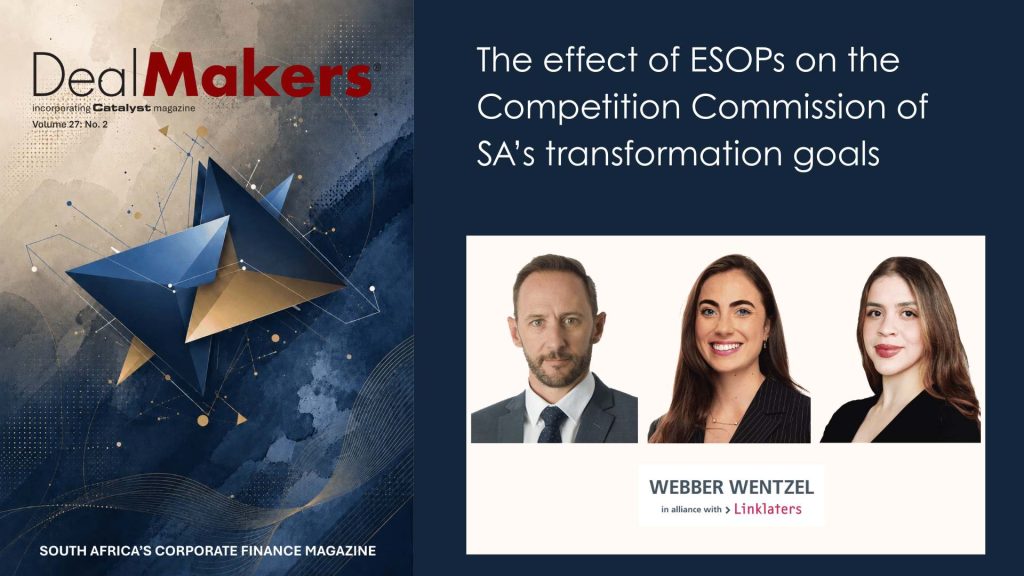
The Competition Commission (Commission) recently published its impact study titled “Employee Share Ownership Plans (ESOPs): An Analysis of Key Design Principles to Create Value for Beneficiaries and Firms” (Study). The Study is a notable development for dealmakers navigating South Africa’s merger control landscape. Conducted pursuant to section 21A of the Competition Act, 1998 (as amended) (the Act), the Study evaluates the effectiveness of employee stock ownership plans (ESOPs) as an ownership remedy imposed by the Commission as a merger condition to several transactions where it considered that the merger did not sufficiently promote a greater spread of ownership by historically disadvantaged persons (HDPs) and workers, as contemplated in section 12A(3)(e) of the Act. The Study signals the Commission’s increasing focus on the quality and effectiveness of ESOPs as a public interest remedy, and merging parties should take careful note of its findings.
The Study’s findings and recommendations offer parties a clearer framework for understanding the Commission’s standards of effective and sustainable ESOPs, and for designing any contemplated or mandated ESOP accordingly.
The Study sampled 15 ESOPs across various sectors, which were implemented between 2019 and 2023. The Study takes an honest and granular look at whether mandated ESOPs are delivering value to the HDPs and workers they are meant to benefit.
Following the 2019 amendments to the Act, the Commission has increasingly sought to address ownership and control as a public interest consideration in merger transactions. Where the Commission finds that a merger does not promote a greater spread of ownership, it may impose ownership remedies, including the establishment of an ESOP by one of the merging parties or the merged entity. Under the Commission’s non-binding Revised Public Interest Guidelines, an ESOP should hold between 5% and 10% of the equity in a merging party or the merged entity, and should represent a broad base of workers.
The debt problem: A critical design flaw
The Study’s most important findings concern the financing of ESOPs and the implications for their beneficiaries (employees). Most ESOPs in the Study were funded through debt, predominantly in the form of Notional Vendor Finance (NVF) provided by the merger parties to the ESOP vehicle (usually a Trust). In practice, interest has been levied on the NVF debt, leaving ESOPs reliant on discretionary dividend declarations to service the debt.
The Study highlights that charging interest on ESOP debt has a materially adverse effect on beneficiaries. In the absence of dividend declarations by an organisation, the outstanding debt owed by ESOPs compounds over time. Even where dividends are declared, they may be insufficient to meet the annual interest obligation in full, leaving the underlying capital amount effectively undiminished. The cumulative effect of these interest charges is to entrench and increase the debt burden, potentially rendering the ESOP structure unviable in the long term.
Based on the Study’s funding models (which assume a starting debt of R500 000 and specified dividend inputs) where interest is charged on the debt, the outstanding debt increases over time. In the Study’s base scenario, the debt increased by 24% over a 10-year period, with dividends mainly used to pay interest rather than reduce the capital amount. In contrast, where no interest is charged, the debt decreased by 66% over the same period. The Commission is, therefore, concerned that beneficiaries may not receive meaningful financial value from ESOPs, and may instead remain trapped in perpetual debt. It is important to note, however, that beneficiaries or employees do not incur personal debt under NVF schemes. Rather, the debt is owed by the ESOP vehicle to the lender, with the practical consequences that beneficiaries may rarely receive any financial flow-through benefits, as any dividends declared by the parties may only accrue to servicing debt.
The Study further illustrates that dividend distributions are far from assured. Of the 12 ESOPs that were operational by 2024, only half received a dividend payment that year. By 2025, seven out of 15 ESOPs received dividends. In 2025, dividend payouts to beneficiaries ranged between R360 and R4,734, a modest return for what is intended to be a transformative ownership intervention.
Design principles: the devil in the detail
Beyond financing, the Study reveals considerable gaps in the Commission’s current ESOP template and makes various recommendations to address them. These are grouped into three categories: 1. First, funding: the Study recommends that interest should not be charged on NVF debt, as it is unwarranted and renders ESOPs financially unsustainable. In addition, discounts on the share price – including minority discounts, marketability discounts, lock-in discounts, and B-BBEE points discounts – should be offered to ESOPs, consistent with typical commercial share sales, in order to reduce the debt burden significantly.
2. Second, ESOP design: the Study proposes a revised and expanded mandatory design template. This includes specified implementation timelines, the ESOP structure (trust or company) and shareholding percentage, a requirement that workers should not be required to pay to participate, specified funding models and trickle dividend distribution, governance structures that ensure worker board representation through beneficiary-nominated trustees, qualifying criteria for beneficiaries and “bad leaver” provisions (resignations and dismissals), specified benefits (dividends and/or capital gains), compulsory training for beneficiaries and trustees at no cost to workers, dispute resolution mechanisms for fee-related disputes, and robust monitoring conditions.
3. Third, worker consultation: the Study identifies design principles that should be determined in consultation with workers, worker forums, or trade unions (with professional advice made available at no cost to workers where required). These include the duration of the scheme, trickle dividend ratios, the class of shares allocated, placement of the ESOP at holding or subsidiary level, and alternative debt reduction mechanisms where the ESOP still carries outstanding debt.
What the commission recommends and what dealmakers should do now
The Study signals an important shift in the Commission’s approach to ESOPs imposed as merger conditions. ESOP structures offered by merging parties to address ownership (or other public interest concerns) can no longer be a box-ticking exercise. A poorly designed scheme risks worker dissatisfaction, regulatory scrutiny, and reputational harm. Although the Study’s recommendations are not binding, the Commission is likely to place increasing emphasis on features such as interest-free NVF financing, appropriate share price discounts, meaningful governance, and worker consultation in ESOPs proposed as part of merger conditions. In particular, the expanded mandatory design template will likely inform the Commission’s assessment of any contemplated ESOP from the outset.
Merging parties may be expected to consult with workers, worker forums, or trade unions prior to notifying the merger, using the pre-notification merger guidelines as a framework. These evolving expectations will inevitably have some practical challenges in their implementation. For example, the Study does not address how an ESOP should be funded where merging parties are unwilling or unable to provide interest-free NVF. In such circumstances, the alternative may be for the ESOP to acquire shares via a third-party financial institution, which would certainly require an interest component.
Merging parties and their advisors should be mindful of these evolving expectations when structuring transactions that are likely to attract public interest scrutiny under the Act.
Shawn van der Meulen is a Partner, Gina Lodolo a Senior Associate and Nicole Araujo an Associate | Webber Wentzel
This article first appeared in DealMakers, SA’s quarterly M&A publication.
Private credit has become one of the fastest-growing asset classes globally, attracting institutional investors seeking higher yields, diversification and greater protection from public market volatility. While headlines in the United States and elsewhere have increasingly focused on concerns around overheating markets and deteriorating lending standards, South Africa presents a different picture. The local market remains relatively young, conservatively underwritten, and characterised by genuine funding gaps, rather than excess capital.
The question facing South African institutional investors is, therefore, no longer whether private credit deserves a place in diversified portfolios. Instead, it is how investors can access the asset class in a way that balances return potential with governance, transparency and appropriate liquidity.
Access challenges
For many years, access has been one of private credit’s greatest challenges. Most investments have been made through closed-end unlisted funds that require long lock-up periods and offer limited redemption opportunities. While these structures are well suited to the long-term nature of private lending, they have also limited participation by investors who require greater certainty around governance, reporting and portfolio construction.
This has created an interesting paradox. Institutional investors increasingly recognise the role private credit can play in enhancing portfolio returns and supporting the real economy, yet practical considerations around liquidity, regulatory treatment and operational complexity have often slowed allocations.
One of the most significant funding gaps exists within the so-called ‘missing middle’ – established small and medium-sized businesses that have outgrown microfinance but remain underserved by standardised bank lending. These businesses are often profitable, employ substantial numbers of people and have strong growth prospects, yet struggle to obtain funding tailored to their needs. The funding gap in this segment of the market is estimated at R350bn.
Traditional banks continue to play an indispensable role in the financial system, but their lending models are necessarily standardised and subject to regulatory capital requirements. Many growing businesses require greater flexibility, faster decision-making, and financing structures that better reflect their cash-flow cycles. Private credit managers have increasingly stepped into this space, complementing rather than replacing the banking sector by providing customised lending solutions where conventional finance may be less effective.
The South African difference
Importantly, this is not a new phenomenon. South African private credit managers have been financing businesses for decades, building expertise across sectors ranging from trade finance and property development to renewable energy and specialist non-bank lending. Unlike some developed markets, South Africa has largely avoided the widespread use of ‘covenant-lite’ loans that have attracted criticism overseas. Instead, lenders have generally maintained disciplined underwriting standards, conservative leverage levels and comprehensive security packages designed to protect investor capital throughout economic cycles.
Strong underwriting remains the cornerstone of successful private credit investing.
Experienced managers typically undertake extensive stress testing of borrowers’ projected cash flows, assessing their ability to service debt under varying economic conditions, including changes in interest rates, inflation and growth assumptions. Lending decisions are supported by robust credit committees, contractual reporting requirements and carefully negotiated covenants that provide early warning indicators should business performance deteriorate. Diversification across sectors and borrowers further helps reduce concentration risk within portfolios.
Innovation in structuring
Yet even with these strengths, one issue has continued to constrain broader institutional adoption: the way private credit is packaged for investors.
Historically, private credit investments have largely been accessed through traditional private market fund structures. While entirely appropriate for many investors, these vehicles can create operational challenges for institutions that manage liabilities, require predictable cash flows or operate within specific regulatory frameworks.
This has prompted growing interest in whether the benefits of private credit can be combined with some of the characteristics investors associate with traditional, listed fixed-income instruments. One example of this evolution is the recently-launched Creation Yield Fund, which combines privately originated debt with a listed note structure on the Cape Town Stock Exchange. The innovation is not in changing the fundamentals of private credit, but in changing how institutional investors gain exposure to the asset class. Uniquely, by combining the governance and oversight features traditionally associated with private market funds with the accessibility of a listed fixed-income instrument, the structure seeks to provide greater transparency, contractual income payments and, over time, improved tradability, while remaining focused on the underlying discipline of private credit investing.
Portfolio construction
This evolution also has important implications for portfolio construction. Listed debt instruments can fit more naturally within institutional fixed-income allocations, while predictable contractual cash flows make it easier for investors to match assets against future liabilities. In South Africa, listed structures may also provide a more straightforward route for retirement funds seeking private credit exposure within existing regulatory frameworks. As market participation grows and secondary market activity develops over time, these structures could begin occupying an intermediate position between traditional listed bonds and fully illiquid private market funds.
None of this eliminates the inherent characteristics of private credit. The underlying loans remain long-term investments, and secondary market liquidity will inevitably depend on investor participation. However, providing investors with greater optionality represents an important step in broadening access without fundamentally changing the nature of the asset class.
Looking ahead, South Africa’s private credit market appears well positioned for continued growth.
Innovations such as the Creation Yield Fund suggest that the next phase of South Africa’s private credit market may not be driven solely by increasing allocations to the asset class, but also by improving the structures through which capital is deployed. If institutional investors can access private credit through vehicles that offer stronger governance, greater transparency and portfolio characteristics that are familiar to fixed-income investors, the asset class is likely to become an increasingly mainstream component of long-term institutional portfolios.
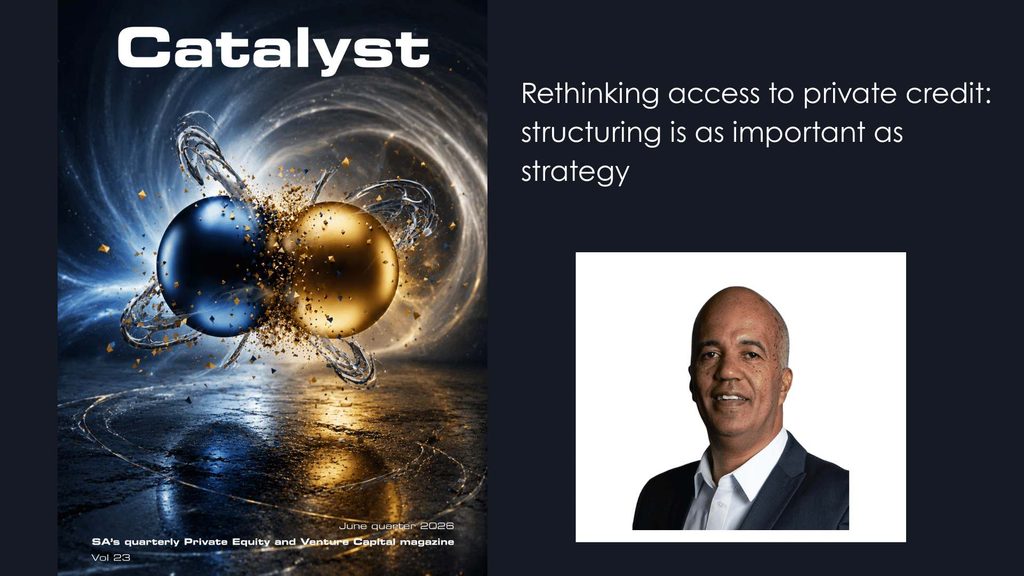
Kasief Isaacs is the CEO | Creation Capital
This article first appeared in Catalyst, DealMakers’ quarterly private equity publication.
In this episode of Ghost Stories, The Finance Ghost is joined by Colleen Wagner, CFO of Satrix, to unpack the concept of decision fatigue and why it so often causes long-term financial goals to fall to the bottom of the priority list.
The conversation also explores the disproportionate burden many women carry in managing households and caregiving responsibilities, and how this translates into retirement outcomes. Colleen shares practical strategies for breaking the cycle, including automation, goal-setting and simplifying investment decisions.
The episode is ultimately a reminder that successful retirement planning doesn’t require perfection or expertise. Instead, it needs consistent, manageable actions that can quietly work in the background while life carries on.
In this episode:
What decision fatigue is and why modern life makes it so difficult to focus on long-term financial goals.
The link between mental load, caregiving responsibilities and poorer retirement outcomes for women.
Why small, consistent actions can be more effective than attempting a complete financial overhaul.
The role of financial advisors in reducing uncertainty and creating structure around major financial decisions.
How ETFs and automated investing can help simplify wealth creation and reduce investment-related stress.
The Finance Ghost: Welcome to this episode of the Ghost Stories podcast. Today we are talking about decision fatigue. This feels very personal right now as someone who is tired, I’ve got to tell you.
Day-to-day demands of school WhatsApp groups and apps, endless emails, the always-online expectations of work, that friend group you keep meaning to reply to (frankly, that friend you keep meaning to reply to) and that message from your mom you haven’t gotten to in two days as well.
Now, layer on everything from what clothes to wear through to remembering to wish someone happy birthday and, frankly, you have a brain that is being assaulted from all angles at the moment, no matter how smart or how professional you are or what fancy job you’re in. In fact, I think if you’re in one of those jobs, it’s even worse.
To further set the scene and bring us lots of insight into this topic, I’m welcoming a new voice from Satrix, which is very exciting: Colleen Wagner, the CFO of Satrix. She’s joining me to talk today about this concept of decision fatigue and how it affects our retirement savings.
I’m going to quote a stat here that Colleen shared with me ahead of this. It’s from the DebtBusters Money-Stress Tracker in 2026 – women reported their highest financial stress levels in five years (so, that is since, basically, the middle of COVID), with close to three out of four women reporting financial stress.
Now, we’ve been celebrating the women in our lives this month, but they are going through a lot. I really am not sure that it’s much easier for men either these days, especially ones with kids, because they’ve taken on much more of a role with the kids than in generations gone by.
It’s a wild time to be an adult, Colleen, so thank you for taking time out of your stressful schedule to do the show with me. It’s lovely to have you here.
Colleen Wagner: Thank you for having me, Ghost, and I couldn’t agree more. It is a wild time to be an adult.
The Finance Ghost: No, it really is. It’s not called ‘adulting’ for nothing, as a terrifying verb. As a starting point, please walk us through how these multiple roles we play in our daily lives directly lead to this concept of ‘decision fatigue’ that you’ve brought to the fore.
Colleen Wagner: I think an important starting point is that decision-making doesn’t happen in isolation. It accumulates throughout the day. Most of us are making countless micro-decisions before we even get to the bigger financial decisions that require proper thought and attention.
And the decisions that you’re making relate to family logistics, school admin, work priorities, household finances, caregiving responsibilities, and of course, social commitments, and everything else that sits in the background of your daily life.
The mental load is not only about doing the tasks. It’s also about remembering what needs to happen for all of those decisions – anticipating what could go wrong, planning around everybody else’s needs, and being the co-ordinator for all the moving parts. This is mentally exhausting.
Even when others can’t see what you’re doing, there’s this constant stream happening in the background of your life, so by the time you get to your long-term financial decisions, there’s no bandwidth left for that.
Things like retirement planning, increasing contributions, reviewing investments – they fall by the wayside because it feels like it’s not as urgent as your current day-to-day decisions. And when you do get to those decisions, it’s not that you make bad decisions, it’s just that your decision is delayed.
The Finance Ghost: Yeah, it’s a funny thing, right? I think back to being a teenager and all I wanted was a smartphone. Now, at the ripe old age of 38, all I want to do is be able to get rid of my smartphone. Sheer bliss for me would be to just get rid of my phone for a week and not have it actually bother anyone. And it’s because we are just assaulted by all these things, right?
As you said there: co-ordinating all the moving parts. I think that’s exactly how daily life goes, and it’s difficult. And I think we can all acknowledge that women, on average, do play a huge role in the co-ordination of our general daily lives, our household affairs. And yet, according to the 2025 Sanlam Financial Confidence Index, women are 21% behind men in reaching their retirement goals. And that’s a really big gap. And that’s a gap that compounds, which is also concerning.
Do you believe that at least part of this impact is the disproportionate daily toll that women are perhaps carrying, versus men? Again, on average. There are always going to be exceptions. This is an averages game. That’s how statistics work.
Do you think that’s having an impact on the retirement savings of women?
I think it’s important to note up front that it’s not a question of whether women are capable investors, because in many households they are already deeply involved in managing day-to-day finances and making important financial decisions.
The issue is that this responsibility and that pressure and constant co-ordination make it much harder to prioritise long-term retirement planning.
And in South Africa, the stats show that women carry a disproportionate share of household and caregiving responsibilities. The Stats SA General Household Survey 2021 showed that more than 40% of children live only with their mothers, compared to about 4% that live only with their fathers.
And the practical financial implications are that women have greater childcare responsibilities, higher household expenditure, more career interruptions, and very often less room to actually save consistently for retirement.
And as you mentioned earlier, this also shows up in the pressure that women experience in terms of how they use their retirement savings. The research shows that women are 1.3 times more likely than men to withdraw from their retirement savings under the two-pot retirement system and 80% more likely to use those withdrawals for school fees.
This also tells us that women are often using their long-term savings to solve immediate household needs, which is completely understandable in the moment. But every withdrawal reduces the amount that can compound over time.
The Finance Ghost: Yeah, it’s such an indictment on society in so many ways. I like to think that there are no deadbeat dads listening to anything that I do, because I think that this is a financially savvy audience who understand responsibility. But this is a reality facing South African women. It really is.
I think the other thing that is worth mentioning around the disproportionate load is that – particularly young kids and preschoolers, and this is my lived experience – it doesn’t matter how involved you are as a dad. We can convince ourselves of everything we want to try and convince ourselves of, but the reality is that a three-year-old and a four-year-old want mommy more than they want daddy. They just do. It’s one of those things. And it creates an additional source of decision fatigue.
Obviously, this balances out as kids grow up, but I think it’s a time in our lives that’s so difficult. You’re in your 30s (maybe even early 40s, on average). You’re upwardly mobile in your career. You’ve got preschool kids. It’s a time where it’s absolute crunch time for your career and everything else. And that’s the exact moment these days where we have children running around who need an enormous amount of time from us, as opposed to back in the day when our parents were having us in their early to mid-20s.
By the time my parents were late 30s, we were in high school (well not in my case, but still). And it’s just a completely different life now, a completely different time to be carrying all the strain.
Plus, today, unless you have a dual-income household… good luck! Whereas back then, you could get away with a single-income household or a primary income / secondary income household. These days, if you want your kids to go to the good schools, etcetera, chances are very good that both of you are working.
And that just talks to those points you raised around two-pot withdrawals and using that money for school fees. I mean, this is retirement money going into school fees, so it’s tough out there. There’s a huge daily load.
And I think you’re seeing it come through in the birth rate, right? You’re seeing fewer people have children. If I look at my own peer group as well, people are just too scared to take on this responsibility because it’s a huge amount of time and it’s a huge amount of money. I’m guessing you’ve probably seen some of that in your peer group as well?
Colleen Wagner: Absolutely. I think in my peer group, the average age of having kids is so much later than our parents, because it is so expensive to have a child. It’s not a decision that you can make lightly because you do have to think about school fees and supporting someone for at least 18 years, if not longer.
And again, it seems counterintuitive that you withdraw your retirement savings to pay for school fees (the long-term effects of which can be quite detrimental to your retirement), but in the moment, when you need that money, it makes absolute sense because retirement is a decision that is happening in 10, 15, 20, 30 years.
The Finance Ghost: Of course, all we’re doing is the stress is just flowing down through the family, right?
Colleen Wagner: Yes.
The Finance Ghost: So, we withdraw from retirement savings to help our children today. But there’s almost this implicit social contract of like, “Well, one day, when I’m much older, then you’re going to need to help me.” And then the birth-rate issues just compound because then our children can’t afford to have their own children because they’re too busy looking after their parents.
So, there’s a hard thing going on out there that I think people are not talking about quite enough and it all adds to stress. And this is the exact point, right?
You’ve got your daily life, you’ve got your money concerns, you’ve got your impact on your health from these things, which then drives additional fatigue, which I think makes you even less likely to get it right around retirement savings and believing in, frankly, just being around 30 or 40 years from now, let alone thinking, “What will my quality of life actually be?” It’s a tough time and there’s a spiral going on here. I think a lot of people get caught in it and it can be very damaging and very dangerous.
But I know you’ve got some practical steps here that people can actually put in place to just try to break that tailspin and start to at least level out and get back to where they want to be getting to.
Colleen Wagner: I think, Ghost, people think they need a complete financial overhaul to get out of that financial stress cycle, but in reality, the opposite is true. Momentum starts with small, manageable actions.
Then the next one is to automate where possible, and I can’t emphasise this enough. It takes away the pressure of having to make a decision every month. If you decide upfront what you’re going to be doing, what you’re going to be investing, and where you’re going to be investing, and automate that, then it’s one less decision that you need to make on a daily basis.
Set clear and realistic goals. If a goal is too vague, it can actually be overwhelming. It adds to your stress. But if a goal is specific – it’s a set amount that you’re going to contribute to a certain savings plan or investment – it’s easy to track and it’s easy to stick to.
I would also say schedule regular financial reviews and stick to those reviews, because it also means that your retirement planning doesn’t fall to the bottom of your to-do list. And it avoids the pressure of having to make decisions about this every day, because you decide once a year or twice a year what you’re going to be doing, in terms of retirement planning or investment saving.
And then I think the last point is to use advice and trusted frameworks. You don’t need to make your financial decisions in isolation. There are advisors and trusted experts that you can use, and this will reduce the uncertainty around making these decisions and providing structure.
For me, it all speaks to the fact that small actions matter. So, progress creates confidence and confidence creates action. And then you’re in a sort of positive cycle, in terms of addressing financial stress.
The Finance Ghost: Yeah, some really great stuff coming through there. I think something else that I find very helpful is to just write things down. I know it sounds ridiculous but just write them down, because now it’s out of your head.
This concept of ‘headspace’ is an enormous thing. We hold in so much all the time that we have to try to remember, then we forget things, and then we feel even worse about that. That’s where the spiral really comes in. And it’s amazing how just having that good, old-fashioned to-do list makes a huge difference.
Personally, I like actually writing it out. Well, I say that. I should do that. Sometimes, it’s just a reminder in my Outlook.
In fact, my all-time low, which I remember my wife laughing at a lot because it was very funny, was I had a particular Thursday in my calendar in Outlook and at 8am I’d written, as a diary entry, “Thursday, 8am”. Helpful, right?
So, I obviously wanted to put something there. But what I ended up writing in the Thursday 8am slot was “Thursday, 8am”. Great reminder, very useful. Really helped me understand what I needed to do in that moment.
So, that’s how your life can end up going. It’s the senior citizen problems that we joke about. You lose your glasses, you lose your wallet, you write things like “8am Thursday” in your diary, and it’s because you’re just overwhelmed and you’ve got to get it under control. It’s so difficult, right?
Colleen Wagner: If you think about your diary, you’ve got your work meetings in your diary because those are important and things that you cannot miss. So, why wouldn’t you have things like “review financial plan” or “set up debit order” or things that are important to your financial well-being? Why not put that in your diary as well, or on your to-do list?
The Finance Ghost: Just do a better job than me. Don’t write the date and time as the date and time. You have to do better than that if you’re going to write reminders.
Colleen Wagner: [laughing]
The Finance Ghost: Let’s move on to some of the financial stress that has a longer-term flavour to it, as opposed to the day-to-day stuff – managing budgets and that kind of thing. In my experience, I think women tend to be all over that. Honestly, I just think on average you guys are way more organised than us men and just on top of it and stick to plans and all those kinds of things, which is amazing.
And research does seem to suggest that. St James’s Place in the UK, their research found that 84% of women are involved in household finances. And the reason why that stat is relevant is because the same research then showed that only 34% of women lead investment decisions.
So, they are very, very involved in the day-to-day of how the house is run, but then only a third of them, roughly, take the lead on the investment decisions. And that obviously leads directly to a conversation around retirement saving.
Now in the modern world, where pretty much everyone is working and the gender pay gap is (hopefully, at least) closing a lot – I mean, I don’t know, I’m probably the wrong person to ask. I don’t even work in corporate anymore, but I like to think that these issues are starting to fall behind us. It feels like there should be equilibrium, then, in taking the lead on investment decisions. There’s no logical reason why it should be male dominated.
So, how do you believe that equilibrium can be achieved in that space over time? How can more women feel empowered to actually play a major role here in the long-term thinking, not just keeping the lights on every week and making sure that the household doesn’t collapse?
Colleen Wagner: So, Ghost, I think this is extremely important because research shows that women’s life expectancy is longer than men’s. A healthy 65-year-old woman is going to outlive a healthy 65-year-old man by approximately two years. And in practical terms, women are retiring with less money, but they need that money to last longer.
Therefore, retirement investing isn’t optional or secondary; it’s central to long-term financial independence.
And I think the way to get equilibrium in financial planning is to normalise women as long-term investors so they’re not just household budget managers. Because women also demonstrate investor behaviours that are associated with success: patience, discipline, goal orientation, long-term thinking and a willingness to seek advice.
Another important point is that, very often, people think that in order to invest, they need to be experts before they participate. In reality, you don’t need to be an expert. Confidence will follow action, so the more you act, the more confident you will be.
This is also why investment conversations need to be less intimidating. We need to move away from jargon-heavy discussions and focus on clear questions. What am I investing for? How long do I have? How much do I contribute? What level of risk am I willing to accept?
This also feeds into education, because education is a key confidence builder. Knowledge reduces uncertainty, and very often uncertainty is one of the major factors that feeds into the inertia related to decision fatigue. So, long-term investing should be viewed as an act of self-care and financial independence as opposed to something secondary or something that you will get to “when you have the time”.
The Finance Ghost: Can’t possibly put it better myself. I love the self-care reference there. I think that’s so important. I also love the point around not needing to be an expert, because you don’t need to be an expert.
You can go and find any of the research you like, go and listen to some of the podcasts I’ve had with experts, even from the Satrix team. Kingsley, Nico, Siya, Duma – they’ll all give you much the same message, which is to say that over the long term, the stats show us that participating in the market is going to give you the best long-term returns.
It might give you some short-term volatility (or, it will give you some short-term volatility), and it might not look the best over six months or one year (or even three years, if you get unlucky with the cycle), but long-term diversified equities work, and that is where you don’t need to be an expert. You just need to be consistent and believe that what you are doing today is going to be worth it in 10, 20, 30 years’ time.
And of course, using things that exist, the structures that are out there. Like a tax-free savings account, which is a very rare example of a free lunch. If ever there was a free lunch – I know Kingsley always says, “There’s no such thing as a free lunch,” – but if ever there was one, then it’s got to be the tax-free savings account.
It’s literally a gift from government to say, “Hey, max this out every year and never pay tax on anything you earn in this account.” That is my go-to every year, to first get the tax-free savings account done and then worry about what to do with the rest.
So, there are some just really good rules of thumb out there that you can use. Plus, of course, speaking to a financial advisor is very important because it brings some much-needed structure to the conversation and it frees up headspace, which as we’ve discussed is actually something very important.
From your perspective, Colleen, how do you see the importance of financial advisors and the roles that they play?
Colleen Wagner: Advisors play a very important role, Ghost, because they turn an overwhelming topic into a structured conversation. When you’re already carrying a lot of mental load, the value of advice is not only the technical stuff. It’s also about creating clarity, narrowing your options, and helping you make a decision in the right order.
An advisor can help you prioritise your goals, understand the trade-offs, and set up a disciplined plan that you can then commit to even when markets are volatile. I think that matters because uncertainty, again, is one of the biggest drivers of decision fatigue.
They really are a handy solution. There are ways to invest in them with small amounts consistently every month, which sounds like it ties up with the financial plan and the sort of advice you were giving there around how to just break the spiral.
And there’s obviously SatrixNOW, which makes it nice and easy, but there are a number of different ways to invest as well. So, just give us an idea of how the Satrix product suite can actually reduce the mental load here.
And let me just say, very authentically, I firmly believe that something like exchange-traded funds would be a really smart way for the majority of people to participate in the market. I think when you’re going to go down the route of stock picking and trying to be clever, you’re adding to your mental load. You’re not taking it away. You’re choosing to make it a hobby or something you want to really get good at.
And that’s wonderful, and I love you for it, because it means you’re probably reading Ghost Mail and learning about stocks, but it’s not for everyone. Whereas I think this is a really smart way for people to just get their retirement savings on the right path.
Colleen Wagner: Absolutely. As you said, ETFs simplify access to investing. So, instead of trying to choose individual shares, one ETF can give you exposure to a basket of securities or a particular market, or even global access.
This gives investors diversification, transparency, and cost efficiency in a way that’s easy to understand and easy to implement. And when you’re already stretched, simplicity is very important. It reduces that sense that investing has to be complicated before you can participate.
It also means that you can build a repeatable habit – so, again, it reduces your decision fatigue. You decide, once where you’re investing, what you’re doing, how much you’re investing, and that’s it.
And at Satrix, our philosophy has always been about democratising investing and reducing barriers to participation. SatrixNOW allows you to invest very, very minimal amounts into a range of local and global ETFs. It allows you to automate your contributions and this means you can build your wealth gradually over time.
The overall point is that we don’t want to add another task to someone’s already busy life. We want to make investing something that can happen consistently in the background and with a plan that’s simple enough to stick with.
The Finance Ghost: All of that sounds incredibly sensible, I must say.
Colleen, thank you so much for your time today. And to everyone out there listening to this who feels like they are spiralling, you are not alone at all. I mean, I’ve had to make some pretty big changes to Ghost Mail lately to just get my own life to a place where I feel like I have a chance of actually watching my children grow up. Because honestly, it was just impossible.
And if you’re trying to do this on hard mode with young kids and a career, or your own business, or whatever the case is, just stay the course. And wherever you can reduce mental load, just reduce it. Try to simplify where you can. Write things down. It’s hard. It’s really hard. You’re not alone. I feel it all the time. Colleen, I suspect you do as well.
I guess that’s the message today, really. In all the noise and in the storm, just try to remember there’s a 20-, 30-, 40-year (hopefully) horizon and you do need to just try to be consistent and put the small steps in place today that are going to make your future self thank you in a big way. So, that’s the message today.
And please do check out the Satrix platform and all the ETFs there. Speak to your financial advisor, as always. Colleen, thank you very, very much for all of the insights today, some really cool stats, and for your time, of course.
Colleen Wagner: Thank you very much for having me, Ghost.
Disclaimer:
Satrix Investments (Pty) Ltd is an approved financial service provider in terms of the Financial Advisory and Intermediary Services Act, No 37 of 2002 (“FAIS”). The information above does not constitute financial advice in term of FAIS.
Satrix Managers (RF) (Pty) Ltd a registered and approved Manager in Collective Investment Schemes in Securities. Collective investment schemes are generally medium- to long-term investments. With Unit Trusts, Exchange Traded Funds (ETFs) and Actively managed ETFs (AMETFs) the investor essentially owns a “proportionate share” (in proportion to the participatory interest held in the fund) of the underlying investments held by the fund. With Unit Trusts, the investor holds participatory units issued by the fund while in the case of an ETFs and AMETFs, the participatory interest, while issued by the fund, comprises a listed security traded on the stock exchange. ETFs and AMETF are registered as a Collective Investment and can be traded by any stockbroker on the stock exchange, LISP platforms and or via online trading platforms. ETFs and AMETFs may incur additional costs due to it being listed on the JSE. Past performance is not necessarily a guide to future performance, and the value of investments / units may go up or down. A schedule of fees and charges, and maximum commissions are available on the Minimum Disclosure Document or upon request from the Manager. Collective investments are traded at ruling prices and can engage in borrowing and scrip lending. Should the respective portfolio engage in scrip lending, the utility percentage and related counterparties can be viewed on the ETF and AMETF Minimum Disclosure Document. The index, the applicable tracking error and the portfolio performance relative to the index can be viewed on the ETF and AMETF Minimum Disclosure Document.
Performance is based on NAV to NAV calculations with income reinvestments done on the ex-div date. Performance is calculated for the portfolio and the individual investor performance may differ as a result of initial fees, actual investment date, date of reinvestment and dividend withholding tax. Some funds may hold assets in foreign countries and could be exposed to risks such as potential constraints on liquidity and the repatriation of funds, macroeconomic, political, foreign exchange, tax risks, settlement risks and potential limitations on the availability of market information.
A feeder fund is a portfolio that invests in a single portfolio of a collective investment scheme, which levies its own charges and which could result in a higher fee structure for the feeder fund. The manager has the right to close the portfolio to new investors in order to manager it more efficiently in accordance with its mandate. A money market portfolio is not a bank deposit account. The price is targeted at a constant value. The total return to the investor is made up of interest received and any gain or loss made on any particular instrument and in most cases the return will merely have the effect of increasing or decreasing the daily yield, but that in the case of abnormal losses it can have the effect of reducing the capital value of the portfolio. Excessive withdrawals from the portfolio may place the portfolio under liquidity pressures and in such circumstances a process of ring-fencing of withdrawal instructions and managed pay-outs over time may be followed. Seven day rolling yield is calculated by taking into account the interest earned by the fund during a 7 day period minus any management fees incurred during those seven days. The yield is a current and is calculated on a daily basis. A fund of funds portfolio is a portfolio that invests in portfolios of collective investment schemes that levy their own charges, which could result in a higher fee structure for the fund of funds. AMETF are ETFs which are actively traded by a Portfolio Manager to adjust the AMETF holdings and asset allocation with the aim to outperform the benchmark. AMETF differ from ETFs which only track indices. The Manager does not provide any guarantee either with respect to the capital or the return of a portfolio. Satrix retains full legal responsibility for the co-named portfolios. For further information related to performance of a specific fund please refer to the MDD of the fund on Satrix.co.za website. Full details and basis of the award is available from the Manager.
“Despite the challenges faced during the year, we remained firmly aligned to our strategy of building a better-balanced, more branded business. We maintained a disciplined focus on operational efficiencies, ongoing innovation and continued investment in our brands, while remaining agile in responding to a complex operating environment,”
Paul Cruickshank, Chief Executive Officer
Note: these results have been provided by RCL FOODS and do not include any commentary by The Finance Ghost.You can refer to the full results here.
KEY HEADLINES:
Sugar negatively impacted by increased imports due to ineffective tariff protection
Production challenges disrupted Pet Food operations in the second half of the financial year
Market remains subdued with volume pressure across most categories
Continuous Improvement (CI) and Net Revenue Management (NRM) initiatives continue to support margin protection across the business
Revised Dollar-based reference price implemented in August 2026, supporting a more favourable outlook for the sugar industry
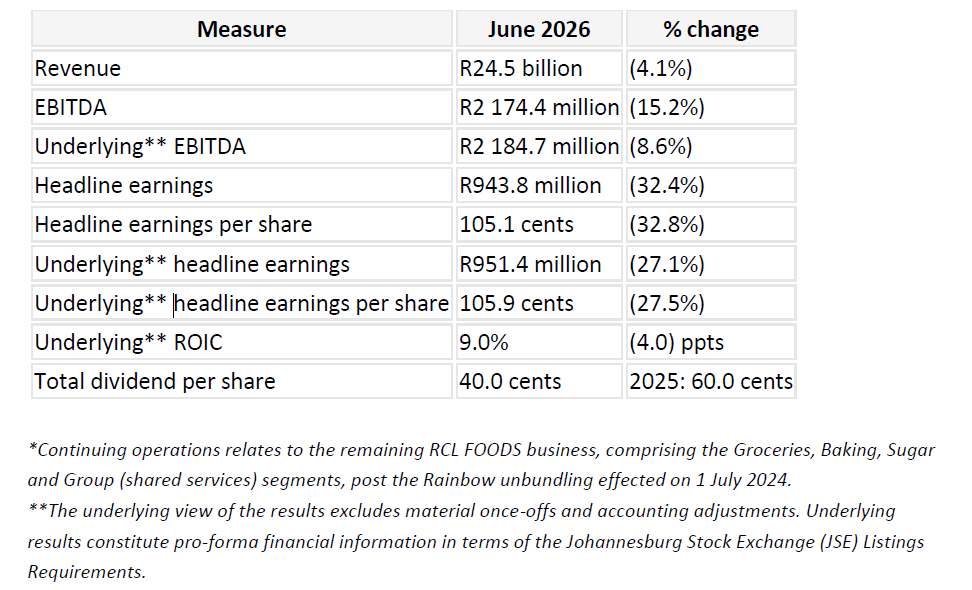
FINANCIAL SUMMARY – CONTINUING OPERATIONS*:
RESULTS COMMENTARY:
RCL FOODS’ results were materially impacted by challenges in its Sugar and Pet Food operations. Sugar was negatively affected by high volumes of deep-sea imports, driven by ineffective tariff protection, which reduced local market demand and increased the proportion of production directed to lower-priced export markets. In Pet Food, production disruptions constrained supply and the business’s ability to meet demand during the second half of the financial year.
Despite a stabilisation in food inflation and lower interest rates compared to prior years, South African households remained cautious with their spending. Several years of elevated inflation, high debt-servicing costs, weak real wage growth and, more recently, higher fuel costs continued to constrain disposable income.
Average international raw sugar prices were down 22.6% from the prior year, which together with an ineffective sugar tariff contributed to 212 684 tons of deep-sea sugar imports, up 24.2% year on year, significantly impacting profitability across growers and millers in the South African sugar industry.
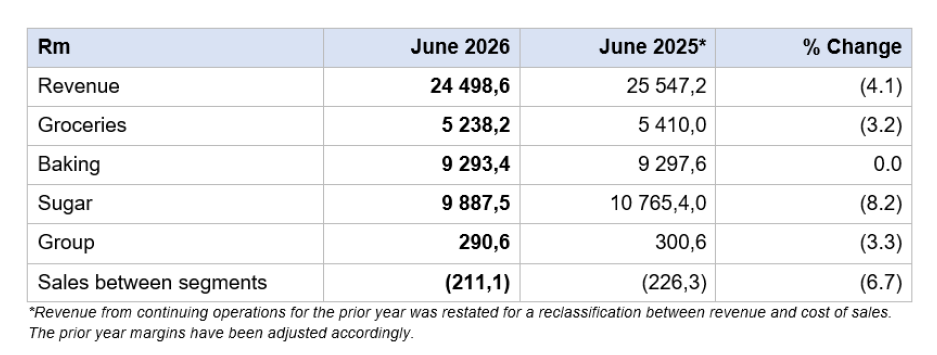
Revenue for the year ended June 2026 decreased by 4.1% to R24.5 billion (2025: R25.5 billion), largely due to lower realised Sugar prices and volumes together with lower Pet Food volumes. Underlying EBITDA declined by 8.6%. Underlying headline earnings declined by 27.1%, compounded by a materially lower share of profits from our associate Royal Eswatini Sugar as it was also impacted by the adverse sugar market dynamics.
The Board of Directors resolved to declare a final cash dividend of 25.0 cents per share for the year ended June 2026, bringing the total dividend for the year to 40.0 cents per share (2025: 60.0 cents per share).
STRATEGIC REVIEW
RCL FOODS completed the agreed reshaping of its portfolio with Rainbow’s exit from the central business services platform at the end of the current year, concluding a journey that began with the disposal of Vector Logistics and the unbundling of Rainbow. The focus going forward will remain on ensuring the platform remains fit for purpose and leveraging its capability through organic and inorganic growth opportunities.
The strategy is guided by three pillars – People First, Right Growth and Future Fit – and by a focused set of Value Creation Levers centred on profitably growing the Culinary core, driving innovation in Baking and Pet Food, building a more sustainable Sugar operation and enhancing margins across the business.
The Group continued to make good progress against the enablers underpinning the People First pillar, with particular emphasis on building a high-performance culture. Leadership changes strengthened capability across the business and new employment equity plans were implemented. The short-term staff level employee incentive scheme is now embedded across the business, aligning effort, performance and shareholder interests.
The Right Growth pillar was advanced through several targeted growth initiatives. The Sunbake Sourdough range was well received by retailers and consumers and rolled out ahead of plan, while Pieman’s Pockets gained promising momentum in the frozen. Culinary maintained category leadership and strengthened brand equity despite intense competition. RCL FOODS also entered into a binding agreement to acquire Martin & Martin, a leading South African producer of wet pet food and pet care products with brands including Husky, Pamper, Beeno and Bob Martin. The acquisition remains subject to Competition Authorities approval.
Under the Future Fit pillar, CI and NRM programmes again performed well and contributed materially to results. The Group advanced the next phase of its IT roadmap, deployed new costing, sales and warehouse-management capabilities and began scaling digital and artificial-intelligence capabilities around a portfolio of high-value use cases to drive competitiveness, manage costs and accelerate innovation.
Sustainability gained further strategic traction as the Group strengthened its ability to support the transition to a lower-carbon, more resilient business. Scope 3 emissions baselining, climate-risk scenario analysis and decarbonisation planning advanced this transition. Enhanced environmental, social, and governance (ESG) data and environmental performance measurement strengthened decision-making, risk management and long-term value creation.
“In a testing year, our response across the business was to focus firmly on the factors within our control. We protected margins in categories under pressure, completed the agreed reshaping of our portfolio, continued investing in our brands and people, and accelerated the programmes that are creating long-term value. CI and NRM remain important drivers of performance across the Group, with further benefits expected in the year ahead,” said Paul Cruickshank, Group CEO.
OPERATIONAL REVIEW – CONTINUING OPERATIONS
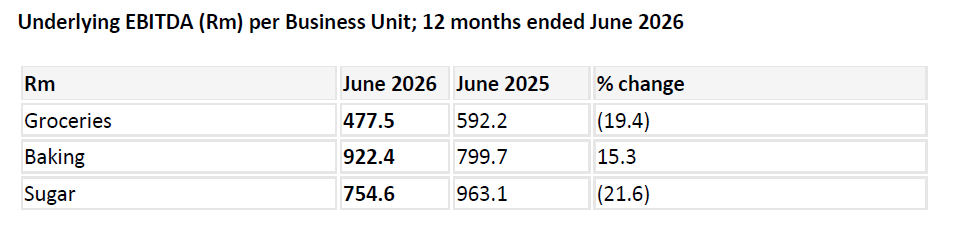
In the Groceries business unit (comprising Culinary, Pet Food and Beverages), revenue decreased by 3.2% to R5 238.2 million, while underlying EBITDA decreased by 19.4% to R477.5 million. Encouraging performances from Culinary and Beverages were overshadowed by Pet Food production disruptions following a nationwide recall in March of certain dry pet food products. Total Pet Food volumes ended 20.5% down on the prior year. Culinary delivered a pleasing result supported by higher margins from CI and NRM initiatives and volume growth in dressings, despite a highly competitive market.
In the Baking business unit (comprising Bread, Buns & Rolls, Milling, Pieman’s and Speciality), revenue was flat at R9 293.4 million, while underlying EBITDA improved 15.3% to R922.4 million. Pleasing performances from Speciality and Pieman’s, together with manufacturing efficiencies and CI savings, supported the result. During the year, a R206.1 million impairment was recognised in the Sunshine business, which continues to face challenges recovering volumes following the December 2024 labour disruption.
In the Sugar business unit (consisting of Sugar and Molatek), revenue declined 8.2% to R9 887.5 million, while underlying EBITDA decreased by 21.6% to R754.6 million. High volumes of deep-sea imports, coupled with inadequate tariff protection, reduced demand in the local market and increased the proportion of production directed to lower-priced export markets. Total industry local-market volumes declined 10.3%, while export volumes increased 48.3% during the year. Despite these headwinds, the business delivered a good operational result, underpinned by improved agricultural and manufacturing performance. Molatek delivered another positive result driven by an improved sales mix, together with production and CI efficiencies, which was partially offset by lower volumes (down 8.3%), largely due to the foot-and-mouth disease outbreak. Following the reporting date, ITAC concluded its investigation into the Dollar-based Reference Price (DBRP) and a revised DBRP was implemented in August 2026. The revised reference price is expected to reduce the influx of subsidised deep-sea imports and support an improved balance between local-market and export sales into the new season.
These developments mark an important step towards improving the long-term sustainability and stability of the South African sugar industry.
The continued operation of Tongaat Hulett Limited (Tongaat) remains important to the stability of the North Coast of KwaZulu-Natal and the South African sugar industry. Tongaat’s business rescue practitioners filed for the company’s provisional liquidation in February 2026, creating a period of uncertainty for the industry. That uncertainty eased considerably in June 2026 when the application was withdrawn following a funding arrangement involving the Industrial Development Corporation and the prospective buyers, with Tongaat remaining in business rescue.
The approved business rescue plan provides for the payment of historic sugar industry obligations of approximately R517 million relating to the 2023 sugar season. The non-payment of these statutory obligations over an extended period placed severe financial strain across the sugar value chain, particularly on small-scale growers.
During the business rescue process, the business rescue practitioners challenged their obligation to make the relevant payments. Following the Constitutional Court’s recent refusal of Tongaat’s application for leave to appeal, the matter has now been finalised. This outcome, together with the withdrawal of the liquidation application, removes the remaining impediments to the implementation of the business rescue plan and the settlement of the outstanding industry obligations.
PROSPECTS
RCL FOODS does not anticipate a meaningful recovery in market volumes in the near term. However, the Group remains focused on the factors within its control, including CI, NRM, innovation and brand investment, and is confident in its ability to adapt and position the business for stronger returns as market conditions improve.
In Pet Food, the focus is on executing the recovery plan, restoring customer confidence and rebuilding market share while continuing to progress the longer-term growth strategy. In Sugar, the operational and agricultural momentum built during the year is expected to continue. With the DBRP now revised, we expect the influx of deep-sea imports to ease and the balance between local-market and export sales to improve, supporting a more favourable outlook for the sugar industry. The interplay of sugar pricing, the tariff environment and the rand/dollar exchange rate will continue to present a degree of risk and volatility.
A protected strike commenced in the South African sugar manufacturing and refining industry following unsuccessful industry-level wage negotiations. While the financial impact remains uncertain, a prolonged strike may adversely affect production volumes and earnings.
“We remain focused on the factors within our control. We have navigated difficult conditions before and are confident in our ability to continue adapting, executing and creating sustainable value for all our stakeholders,” concluded Cruickshank.
“By consistently advancing our five strategic pillars; operational efficiencies, competitive procurement, future-proofing the business, unlocking people potential, and strengthening market-facing capabilities, Rainbow continues to improve its operational resilience and competitiveness. This strategic focus enables us to deliver quality, affordable products to customers and consumers, adapt to changing market dynamics, and support long-term value creation while contributing meaningfully to South Africa’s food system.”
Marthinus Stander, Chief Executive Officer
Through continued investment in agricultural performance, feed optimisation, and operational efficiency, the Group is strengthening its competitiveness, enhancing biosecurity, and building a more resilient business.
Read the full results here. Selected slides from the earnings presentation and results announcement have been provided below for your convenience.
Note: these results have been provided by Rainbow Chicken and do not include any commentary by The Finance Ghost.
We use cookies on our website to give you the most relevant experience by remembering your preferences and repeat visits. By clicking “Accept All”, you consent to the use of ALL the cookies. However, you may visit "Cookie Settings" to provide a controlled consent.
This website uses cookies to improve your experience while you navigate through the website. Out of these, the cookies that are categorized as necessary are stored on your browser as they are essential for the working of basic functionalities of the website. We also use third-party cookies that help us analyze and understand how you use this website. These cookies will be stored in your browser only with your consent. You also have the option to opt-out of these cookies. But opting out of some of these cookies may affect your browsing experience.
Necessary cookies are absolutely essential for the website to function properly. These cookies ensure basic functionalities and security features of the website, anonymously.
Cookie
Duration
Description
cookielawinfo-checkbox-analytics
11 months
This cookie is set by GDPR Cookie Consent plugin. The cookie is used to store the user consent for the cookies in the category "Analytics".
cookielawinfo-checkbox-functional
11 months
The cookie is set by GDPR cookie consent to record the user consent for the cookies in the category "Functional".
cookielawinfo-checkbox-necessary
11 months
This cookie is set by GDPR Cookie Consent plugin. The cookies is used to store the user consent for the cookies in the category "Necessary".
cookielawinfo-checkbox-others
11 months
This cookie is set by GDPR Cookie Consent plugin. The cookie is used to store the user consent for the cookies in the category "Other.
cookielawinfo-checkbox-performance
11 months
This cookie is set by GDPR Cookie Consent plugin. The cookie is used to store the user consent for the cookies in the category "Performance".
viewed_cookie_policy
11 months
The cookie is set by the GDPR Cookie Consent plugin and is used to store whether or not user has consented to the use of cookies. It does not store any personal data.
Functional cookies help to perform certain functionalities like sharing the content of the website on social media platforms, collect feedbacks, and other third-party features.
Performance cookies are used to understand and analyze the key performance indexes of the website which helps in delivering a better user experience for the visitors.
Analytical cookies are used to understand how visitors interact with the website. These cookies help provide information on metrics the number of visitors, bounce rate, traffic source, etc.
Advertisement cookies are used to provide visitors with relevant ads and marketing campaigns. These cookies track visitors across websites and collect information to provide customized ads.