
A reality TV star, a stolen coffin, and the uncomfortable history of how museum preservation can look a lot like theft.
A little while ago, I wrote a brief story in a Weekender newsletter that linked Kim Kardashian to the discovery of a stolen golden sarcophagus (at the Met gala, of all places).
Here’s a refresher: in May of 2018, Kim K arrived at the Met Gala wearing a slinky gold Versace gown. Later that night, she broke a long-standing Met gala rule by posing for a photograph inside the museum during the event. The object that she chose to post next to – an Egyptian sarcophagus completely covered in gold – matched her dress perfectly. It was a striking photo (even if the light was terrible), and it went viral pretty soon after it landed on social media:
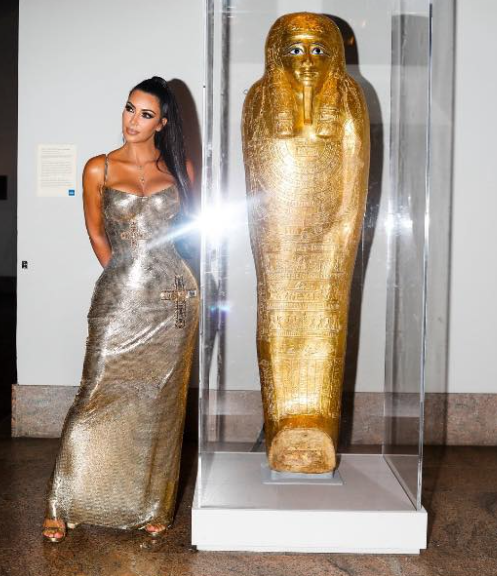
This is how investigators discovered the whereabouts of the coffin of the priest Nedjemankh (circa first century BCE), which had been missing from its country of origin for 7 years.
The artifact had been on display at the Met for only 5 months, having been acquired for roughly $4 million in 2017. Its documentation suggested a clean, lawful journey. Its actual journey had been more… let’s call it “interpretive”.
Nedjemankh’s coffin had spent two thousand years buried in Egypt before being looted from the country’s Minya region during the chaos of the 2011 uprising. From there it was smuggled to the United Arab Emirates, restored in Germany, fitted with a forged Egyptian export licence claiming it had left the country legally in 1971, and finally sold to the Met.

The viral photo was eventually seen by one of the original looters, who – allegedly irritated at never being paid his cut – sent it along to the Manhattan District Attorney’s antiquities-trafficking unit. Say what you will about spite, but it gets results. In the most unintentional way possible, Kim Kardashian and her golden dress had broken an international case wide open. The Met washed its hands and issued a statement, and the coffin was shipped back to its home in Egypt in 2019.
When I first read this, the part that stunned me was that an institution as storied as the Met – the largest art museum in the Americas, with two million works across 17 departments – could either fail to check an object’s provenance or knowingly buy from smugglers. I’ve since done some digging, and I’ve had to put my surprise away. Because this was far from a once-off. In fact, for a good stretch of the 20th century, it was simply how the trade ran.
The 1000-object problem
In 2023, the International Consortium of Investigative Journalists read the Met’s catalogue more closely than the Met might have liked. At least 1,109 pieces, they alleged, had made their way into the Met through the hands of people indicted or convicted of antiquities crimes. Fewer than half of the items under suspicion came with any paperwork explaining how they’d left their home countries. In some cases the silence was near-total: of more than 250 objects tied to Nepal and Kashmir, only 3 allegedly had documents!
It would be comforting to make this a story about one badly behaved museum. But it isn’t. The same dealers, the same gaps in the paperwork, turn up wherever you look. The British Museum holds the largest hoard of Benin Bronzes (looted by the British troops who burned Benin City in 1897) in the world. They are also the proud keepers of the Parthenon Marbles, which Greece has been politely and then not-so-politely requesting to be returned since the 1830s.
This isn’t one museum’s bad choices. It’s the foundation a great many of them are standing on.
So how does something like this not only happen, but become so normalised? The short answer is that we tend to forget that museums operate in a competitive market. A magnificent Greek bronze on show in New York is a magnificent Greek bronze not on show in London or Paris. In the 1960s and 70s, under its ambitious director Thomas Hoving, the Met set out to close that gap.
Wanting became demand, demand became a market, and the market smiled on anyone who could produce a showpiece with a tidy story attached. Dealers like Robert Hecht and Gianfranco Becchina made their names (and their fortunes) supplying both. The Met denied all knowledge of wrongdoing and kept buying from Hecht even after Italian prosecutors charged him with smuggling. Nobody, it turns out, likes to ask the question they don’t want answered.
It may be a long time coming, but it seems the bill is now arriving. The Manhattan DA’s antiquities unit, run by Matthew Bogdanos, has spent years tugging at threads, and the Met keeps surfacing at the other end of them. In 2022 alone, US authorities pulled at least 29 objects from its shelves, some of them older than the alphabet.
One detail I can’t shake comes from a case where investigators opened a crate that had sat in the museum’s storage for 20 years and found the object inside still caked with dirt. To Bogdanos, this was a fairly unambiguous sign that it had been dug up illegally. 20 years in one of the world’s great museums, and not even put on display once
To its credit, the Met has now started combing its own collection for looted pieces. As one expert dryly observed, the Met sets the tone for everyone else – and if things are slipping past its checks, you can imagine how the smaller museums downstream are faring.
The case for the great museums
Now, the museum’s defenders have a real point to make here, and it deserves its share of airtime. Objects in the big Western collections, they’ll tell you, are safe – safe from war, from looters, from the sort of zeal that has wiped heritage off the map elsewhere. And they’re not making it up. In 2003, looters carried 15,000 objects out of Iraq’s national museum in a day and a half; thousands have never come back. A decade later, ISIS packed the temples of Palmyra in Syria with explosives. Against that kind of destruction, “it would have been safer in London” stops sounding smug and starts sounding factual.
There’s another uncomfortable angle to this argument: money. Climate control, conservation labs, insurance, security, specialists who can spend a career on a single collection – all of it is expensive, and the (mostly Western) institutions holding these objects tend to be the ones who can pay. The countries they were taken from, more often than not, cannot. It feels unseemly to reduce a god or a grave to a line in a maintenance budget, but a flaking bronze doesn’t care about the politics of who’s funding its upkeep.
Still, pay attention to the assumption folded inside all of this – that the culture being kept safe is already finished, like a closed book. That it is something to admire, not something still being lived.
When the gods are still being worshipped
This brings me to Nepal. From the 1950s, as the country opened up to outsiders, gods began going missing, lifted from shrines that had held them for centuries. One stone deity, Laxmi-Narayan, had been worshipped at a shrine in Patan for some 800 years before it vanished one night in 1984 and turned up, eventually, in a museum in the United States.
This is the part where the closed-book assumption falls apart. These weren’t keepsakes of a dead world; they were – are – working gods, the beating centre of a faith still practised every day. They were woven into a living culture. When Laxmi-Narayan disappeared, the festivals around it stuttered, and the community stood a humble replica in its place so the worship could carry on.
So what, exactly, is being “preserved” when a god is sealed in a climate-controlled basement an ocean away from everyone who prays to it? You can’t keep a living thing alive by embalming it. The Palmyra argument – better locked up here than blown up there – may hold real weight for the relics of a vanished civilisation, or for artefacts in the way of war or disaster. It holds almost none for a god whose worshippers are alive, asking for it back, and waiting with a procession.
Homecoming
The good news is that the ground really is moving. In 2025, the Netherlands handed 119 Benin Bronzes back to Nigeria, the biggest return of its kind, and Germany has promised more than a thousand. Boston, Rhode Island and Washington have all sent pieces home. The hold-outs – the British Museum chief among them – increasingly take shelter behind the British Museum Act of 1963, which bans them from giving artefacts away for good and so neatly converts “we won’t” into “we can’t.”
Which brings us back to what can happen when a museum finally loosens its grip. When Nepal’s Laxmi-Narayan came home after nearly 40 years away, its worshippers didn’t slip it back onto its plinth in the dark. Instead, they threw a chariot procession to welcome the god, stood it beside the modest stand-in that had held its place all those years, and carried it through the streets with music, back to where it had always belonged.
In November 2025, Egypt opened the Grand Egyptian Museum at the foot of the pyramids. I was lucky enough to visit it myself earlier this year, and it is a marvel – a $1 billion building, the largest archaeological museum on earth, holding 50,000 objects from 5,000 years of a single civilisation. At its heart sits the Tutankhamun collection: all 5,398 artefacts from his tomb, together in one place for the first time since they came out of the ground in 1922.
One museum in this article spent decades hoovering up the scattered treasures of other nations, and is now – slowly, and perhaps a little grudgingly – giving them back. The other built a billion-dollar home so its own treasures could finally come together under one roof, in the country that made them, in sight of the same pyramids their creators saw every day.
We built museums to keep the past safe. The harder question – the one the dirt-caked crate and the empty Nepali shrine keep asking – is safe from whom? And safe for whom?
About the author: Dominique Olivier


Dominique Olivier uses her love of storytelling and ideation to help brands solve problems.
Her first book, Lessons from Loss, has been published by Penguin Random House.
She is a weekly columnist in Ghost Mail and collaborates with The Finance Ghost on Ghost Mail Weekender, a Sunday publication designed to help you be more interesting.
You can learn more about her work at dominiqueolivier.com and she can be reached on LinkedIn here.