
Afrimat was loss-making in the second half of the year (JSE: AFT)
The market wasn’t happy at all
Afrimat’s share price has been under plenty of pressure. The release of a trading statement for the year ended February 2026 only added to the concerns, with the share price closing 5.4% lower on the day.
You have to dig a bit to find out why.
You see, for the full year, HEPS of between 91.8 cents and 99.1 cents is an increase of between 27% and 37.1% vs. the prior year. It’s a depressed base for sure, but that’s still a nice bounce. Isn’t it?
The problem lies in the split of earnings over the year. In the six months to August 2025, Afrimat’s HEPS was 101.9 cents. This means that they made a loss in the second half of the year. That’s awful.
Although Afrimat notes that losses in cement have moderated and that iron ore sales were decent, it’s clearly been an ugly time for them.

They took on a major risk with the Lafarge deal, but then got unlucky with some of the other things that happened in the market – like the near-collapse of the ferrochrome smelting industry in South Africa, a key customer for Afrimat. Although there are positive signs around energy costs for that industry, those benefits will only come through in the 2026 financial year (assuming they materialise).
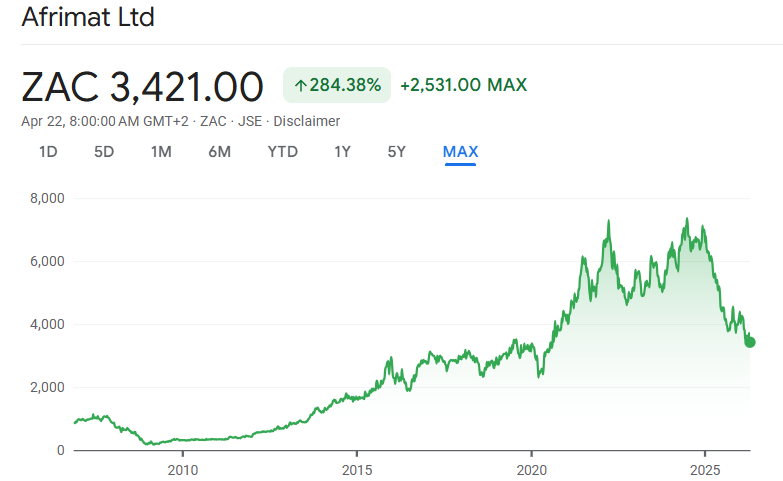
Detailed results are due for release on 20 May. The share price is now back to where it was before the pandemic:
Of course, this leads to today’s poll…
Modest growth at Oasis Crescent (JSE: OAS)
Always keep in mind that this fund has no debt
Oasis Crescent is unique in the South African property fund landscape. To be Shari’ah compliant, the fund has absolutely no debt. In a country with structurally high interest rates, this isn’t necessarily as bad as it sounds from an economic perspective. The total return since inception (NAV plus dividends) is 11.1% per annum.
The year ended March 2025 wasn’t as strong as that long-term average. The distribution per unit (effectively the dividend) increased by 2.1%, while the net asset value (NAV) per unit was up 2.5%.
The distribution of 121 cents is a yield of 4.3% on the closing share price. There is very little liquidity in the stock though, so buying and selling units isn’t easy.
The Octodec board has weighted in on the Emira voluntary offer (JSE: OCT | JSE: EMI)
They have to tread quite carefully here
Emira Property Fund currently has a stake in Octodec of just over 20%. They would like to take it up to 34.9% through a voluntary offer mechanism to Octodec shareholders. If you know anything about Takeover Law in South Africa, you’ll know that 34.9% is just below the 35% stake that would trigger a mandatory offer to all shareholders.
In other words, it’s the largest minority stake that Emira can build without going the full hog and acquiring potentially all of the shares in the company.
The Octodec board wasn’t engaged in advance by Emira, so there’s an underlying smell of Eau de Hostile Takeover here. This fragrance has many spicy elements, assuming we get there. In the meantime, Octodec is engaging with Emira as a significant minority shareholder.
To add to the spiciness, the Octodec board has shared their view in a SENS announcement that the voluntary offer undervalues Octodec. The offer is at a significant discount to the most recently reported net asset value (NAV) – as per usual for property fund deals in South Africa. Octodec is unhappy about this and the directors do not plan to dispose of any of their shares in the voluntary offer process.
Importantly, the announcement is neither investment advice nor a formal recommendation to shareholders. This is why the board needs to tread carefully. But by making a statement of fact (“the offer is lower than the NAV”), they are making their point in an objective way.
Activity of this nature on the shareholder register can be a catalyst for at least two things: (1) a higher share price based on speculation around a larger deal coming through, and (2) the board of the target company moving faster to execute their strategy and gain the support of existing shareholders.
Both those things tends to be good news for Octodec shareholders who had shares before the Emira activity. The share price is up 81% in the past year and 40% over the past 6 months!
Nibbles:
- Director dealings:
- The company secretary of AVI (JSE: AVI) was granted share awards and sold the entire lot worth R1.9 million.
- In a surprise to absolutely no one, Aspen (JSE: APN) announced that the disposal of Aspen Asia Pacific (APAC) – excluding China – was approved by shareholders. It was unanimous to two decimal places, with the “against” column showing a delightful 0.00% of votes. Shareholders love the deal and with good reason!
- After being with the broader Naspers (JSE: NPN) group for nearly four decades, Steve Pacak has passed away. He started his career at M-Net in 1988 and went on to be the financial director of Naspers. Koos Bekker described him in the SENS announcement as “one of the most honest and decent human beings I ever met” – we can all agree that this is a nice way to be remembered!