
Record free cash flow at AngloGold (JSE: ANG)
Q1 free cash flow has nearly tripled year-on-year
It’s not called “a golden age” for nothing! The gold sector is absolutely cooking at the moment, with money just about falling out of the sky on a daily basis for the large mining houses.
AngloGold Ashanti is just the latest example, with numbers for the quarter ended March 2026 reflecting record free cash flow of R1.2 billion.
Although production was only 1% higher year-on-year, free cash flow increased by 190% to $1.2 billion (vs. $403 million a year ago). This was thanks to a 69% increase in the average gold price received.
They refer to “controllable costs” reducing by $22/oz thanks to various operating initiatives that offset residual operating cost pressures. But once you add in exchange rates and higher royalties, cash costs increased by $168/oz to $1,391/oz – that’s a 13.7% increase.
With the gold price moving so much higher though, cash margin jumped from 57% to 71%. Like I said: a golden age!

With three months of the year behind them, full year guidance for production, costs and capex is unchanged. In the meantime, shareholders can enjoy a record interim dividend and a share repurchase programme of up to $2 billion.
Greencoat Renewables could do with more wind (JSE: GCT)
They really need to make a trip to Cape Town
Greencoat Renewables has released a quarterly update for the three months to March 2026. The net asset value per share has ticked up by €0.50 to €0.995.
Net cash generation for the quarter was in line with budget and equated to 2.4x dividend cover. This allowed them to easily handle the Q1 dividend of around €0.017 per share.
Power generation was 10% below budget though, with 6% attributed to low wind resources. It’s mildly ironic writing this while I listen to a massive storm in Cape Town. Perhaps it really is time that Greencoat looked at opportunities down here?
Although they are running at 52% gearing at the moment, there’s a decent amount of cash on the balance sheet and they have even been doing share buybacks.
They’ve also made progress with their Green Digital Infrastructure Platform, which acquired its first asset.
Pan African Resources is making progress with the Emmerson acquisition in Australia (JSE: PAF)
The scheme booklet has been sent to Emmerson shareholders
Pan African Resources is looking to acquire 100% of the listed shares in Emmerson Resources in Australia. As part of this, Pan African will look to list on the Australian Securities Exchange (ASX), making it much easier to get shareholders in Emmerson across the line on this share-for-share deal.
It’s only a Category 2 transaction for Pan African Resources, so a circular isn’t necessary and neither is shareholder approval. But on the other side, Emmerson shareholders need to give 75% approval to the transaction.
Pan African has highlighted the pro forma financial information in Emmerson’s scheme booklet (the Australian equivalent of a circular). It shows that the enlarged group would have a net asset value per share that is 28.35% larger than the current level at Pan African.
The meeting of Emmerson shareholders is scheduled for 15 June. If you would like to check out the scheme booklet, you’ll find it here.
Sea Harvest bids farewell to Ladismith Cheese (JSE: SHG)
With this deal out of the way, the company is more focused
Sea Harvest, as the name suggests, has its DNA firmly in the ocean. They are a large and important fishing group, although the volatility of that sector had previously led them down a path of diversification.
It’s almost always better for a company to focus on its core strengths than to diversify for the sake of it, so I think the company has done the right thing by disposing of Ladismith Cheese. The deal was announced at the end of 2025 and has now closed thanks to the receipt of Competition Commission approval.
If you’re keen to understand more about the company, including the initial entry into Ladismith Cheese and how the proceeds will filter into the group’s capital allocation policy, then you’ll enjoy the podcast I recorded with Sea Harvest in March. CEO Felix Rathed and Muhammad Brey delivered exceptional insights that you’ll find here.
The Foschini Group’s 50% off sale – in its share price! (JSE: TFG)
Things are going from bad to worse
The Foschini Group (which we can refer to as TFG for our collective sanity) has seen its share price roughly halve in the past 12 months. The good ol’ “50% off sale” is what you want to see at end of season, not when you look at the share price chart!
There’s not much indication of things getting any better, with the company releasing a trading update dealing with the three months to 28 March 2026.
In TFG Africa, sales were up 7.5% in total and 5.5% on a like-for-like basis. For the full year, sales increased 5.0% in total and 3.5% on a like-for-like basis. This may sound like a great acceleration towards the end of the year, but sales growth is only one part of the equation.
The other is of course margin, with TFG Africa’s EBIT for FY26 declining at a mid-teens percentage rate. There was some margin recovery in the final quarter, but it clearly wasn’t enough to make up for the awful numbers in the rest of the year.
To make it even worse, TFG Africa is the highlight of the numbers.
TFG London, one of the headaches, suffered flat sales for the year if you exclude the acquisition of White Stuff. If we isolate that acquisition, then pro forma sales growth was 4.3%.
TFG Australia is rapidly becoming another meme, just like Woolworths‘ (JSE: WHL) misadventures with David Jones in the land of animals that want to kill you. Sales fell by 1.3% for the quarter and 1.5% for the year. On a like-for-like basis, sales were down by a shocking 3.4% for the full year.
The trading update doesn’t give specific movements in profit for TFG London and TFG Australia individually, but it’s not hard to guess the direction of travel. The presence of large non-cash impairments in both businesses is another strong clue that all isn’t well.
Add it all together and you get a group performance (excluding White Stuff) of just 2.8% growth in sales. And at HEPS level, there’s a shocking drop of between 30% and 40% for the full year.
TFG Africa is doing all the heavy lifting here, but acquisitions over the years have led to the local business contributing only 68.3% to group turnover.
This is a prime example of “diworsification” instead of diversification, as TFG Africa’s modest positive momentum is being more than offset by the international businesses.
The other big risk is that management distraction in faraway lands can easily contribute to underperformance in TFG Africa, the one part of the business that actually has a right to win in its market.
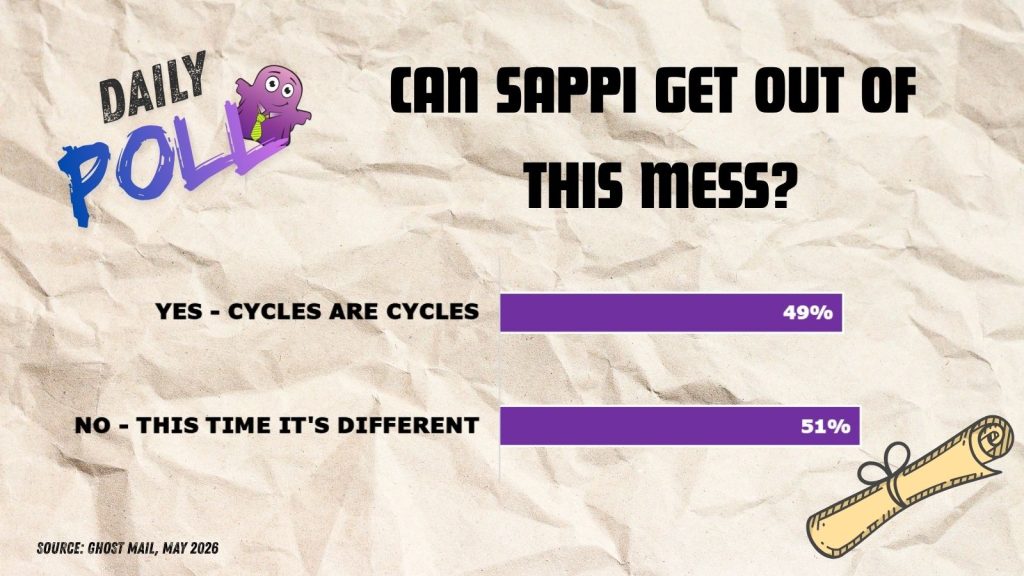
What do you believe needs to happen here?
Results of previous poll:
Nibbles:
- Director dealings:
- A prescribed officer of African Rainbow Minerals (JSE: ARI) sold shares worth a meaty R34.8 million. Separately, two directors of different group subsidiaries sold shares worth R16.3 million in total.
- An entity associated with Marcel Golding, the CEO of Rex Trueform (JSE: RTO | JSE: RTN) bought “N” ordinary shares worth over R2.5 million.
- A director of a major subsidiary of Kumba Iron Ore (JSE: KIO) sold shares worth R97k.
- A number of Anglo American (JSE: AGL) directors bought shares by reinvesting their dividends. Ditto for British American Tobacco (JSE: BTI) directors. These dividend-related trades don’t carry nearly as much weight for me as buying shares outside of the dividend cycle. I’m just mentioning them for the sake of completeness.
- Araxi (JSE: AXX) received resounding approval from shareholders for the transaction to acquire an 80% stake in Pay@ Group. Just as importantly, the Competition Commission has unconditionally approved the acquisition. They will now work to get the final conditions across the line, with the big ones out of the way.
- Sibanye-Stillwater (JSE: SSW) is having no difficulties in the debt market. The company priced an oversubscribed offering of $500 million in senior notes due 2031. The coupon on the notes is 6.25%. This five-and-a-half-year debt is being used to fund the repurchase of notes due in 2026 and 2029. Overall, the group is planning to reduce gross debt by 50% over the next two to three years.
- Finbond (JSE: FGL) has released a trading statement for the year ended 28 February 2026. HEPS is expected to swing positive, moving from a headline loss per share of -1.9 cents to a profit of at least 2.9 cents. The share price is R1.09 though, so this profitability is still marginal relative to the share price.
- Newpark REIT (JSE: NRL) has very thin trade in its stock, but it owns some really interesting and iconic buildings in Sandton. The company initially expected the dividend per share for the year ended February 2026 to be in line with the revised funds from operations per share of between 41.50 and 48.50 cents. But thanks to lower than expected operating costs, the dividend will actually be 50.07 cents for the year. This is unfortunately still a decrease of 36.1% vs. the prior year.
- JSE Limited (JSE: JSE) – the company that is listed on its own exchange – announced a couple of changes to roles on the board. The big one is that Ian Kirk has been appointed as lead independent due to the retirement of Ben Kruger.
- This isn’t something you can invest in directly (well, not yet at least), but African Bank’s deal to buy the home loan book from Eskom Finance has fallen through. African Bank is putting a positive spin on it, with the board deciding to focus on pursuing growth from the acquisitions made between 2022 and 2025. I must point out that the bank has a new CEO, so perhaps the change in management during the implementation of the deal has led to its demise. This wouldn’t be uncommon, as CEOs aren’t always happy to inherit the deals of their predecessors.


Greencoat Renewables(GCT) is a great quarterly income generating share and Rand hedge. The problem is for an individual to recover the extra taxes due to the Double Taxation Treaty(DTT) with South Africa.
The Irish Dividend Withhold Tax(DWT) is 25% where as South Africa’s is 20% therefore there is 5% due to the South African resident taxpayers.
The Irish Taxation Authorities do not entertain refund claims from individuals only companies?
Although GCT are the “dividend payees” they do not have a blanket exemption for JSE listed investors. This is a problem that must be addressed like Richemont has done, etc.
This taxation problem is true of many inwardly listed JSE companies and should be questioned as the investor and South African government are losing millions in revenue each year.
Please start questioning these inconsistencies in the tax treatment of JSE investors because there are many culprits, i.e. UK tax authorities with a company like PHP etc. Foreign DWT is only 15% and 5% to the South African government. This tax relief the JSE investors is not receiving.
Hi Pierre – I’ve heard about the tax issue for Greencoat, it sounds like a proper mess. And it certainly isn’t doing the net yields any favours. I’ll try get this message across to the company to find out if there’s a plan in place.