
Low prices for soft commodities impacted Crookes Brothers (JSE: CKS)
Primary agriculture is a difficult business
Crookes Brothers is an unusual company on the JSE. This is one of the only ways to get direct access to primary agriculture assets, with Crookes operating in soft commodities like bananas, macadamias and sugar cane. There is unfortunately close to zero liquidity in the stock, so I’m including the numbers in detail here as a learning opportunity about the sector rather than because the company is practically investable.
For the six months to September 2025, revenue fell by 5% and operating profit before biological assets was down 21%. Lower commodity prices were largely to blame, along with other issues like storms at the banana plantations. The macadamia business is still dealing with the aftermath of last year’s storm that severely affected yields. If you think that primary agriculture is an easy sector, you are sorely mistaken.
HEPS fell by 44% per share as operating profits decreased across all major segments. The silver lining is that cash from operations only fell by 5%, so the impact on the balance sheet was less severe than the HEPS number might suggest.
Mahube Infrastructure brings us an unusual sight: negative revenue (JSE: MHB)
Fair value movements are recognised in revenue for them
Seeing negative revenue in a set of financials is very rare. It can happen though, as proven by renewable energy investor Mahube Infrastructure.

Dividend income was down from R13 million to R11.1 million, with negative R19.9 million fair value adjustments then pulling revenue into the red. Such is life as a company using investment entity accounting.
The market tends to focus on the movement in net asset value (NAV) per share in these types of companies, with Mahube’s NAV decreasing by 7% to R10.25. The negative fair value moves affect this directly.
This is a good reminder that even if wind farms and huge solar PV projects look great on presentations and corporate websites, that isn’t a guarantee that they will be financially lucrative. These assets come with risk and volatile earnings, just like every other asset.
Still, Mahube’s share price is up by 43% year-to-date, so sentiment is much better than these numbers would suggest!
Can Mantengu get it together in the next six months? (JSE: MTU)
The GEM facility is a key funding line, but would be painful for investors
I was actually left alone after writing about Mantengu’s trading statement, so perhaps the management team has finally decided to go chase ghosts elsewhere. This allows me to do my job in peace, just like I do with every single other SENS announcement on the JSE. Long may it last, as recent online interactions have unfortunately done nothing to build investor confidence in this company.
And investor confidence is exactly what they need, along with a sprinkling of hope.
Mantengu kicked off the results with a note that revenue increased by 109% (i.e. more than doubled), but a big chunk of this is the silicone carbide acquisition. As with every company that has been making acquisitions, you need to be careful of how this distorts the percentage change in total revenue growth. We therefore need to look deeper to understand these numbers.
Another thing to keep in mind is that there’s a seasonal element to the business based on the current portfolio of assets. The silicone carbide business generated substantial losses in this period after being shut down for maintenance in the winter months to avoid Eskom’s highest tariffs. If it’s going to have a “bad winter” every year, then the interim results would always be worse than the full-year numbers.
In the chrome business, currently the most important place to look, revenue of R142 million was up 23% year-on-year. This is the highlight of the numbers, although I must point out that this is a slowdown from the second half of FY25 where they generated R162.2 million in chrome revenue. The reason for this is outside of their control: there was significant flooding earlier this year that reduced access to the chrome pits in those months. In an effort to look at the bright side, the company notes that they’ve stored lots of water as a result and haven’t had to rely on municipal water during this period!
The flooding surely didn’t help the numbers, but the chrome business was actually profitable at EBITDA level (R14.4 million). After depreciation of R27.8 million, this segment fell to an operating loss of R13.4 million. Once you add on the operating loss of R38.7 million in silicone carbide and then the corporate costs as well, you get to a group operating loss of R54.6 million. That’s a nasty outcome vs. the operating profit of R24.3 million in the prior period, putting them firmly in the red on a two-year stack.
It gets worse when you look at the cash flow statement. Mantengu ate its way through R108 million in cash from operating activities – a concerning trend compared to positive cash from operations of R13.6 million in the comparable period.
There’s a lot of underlying noise in these numbers related to exact timing of acquisitions, but the underlying message here is one of a company that has had a disappointing financial period at a time when there is a great deal of other stuff going on around the group. What they really needed was a set of strong numbers to dispel the critics. Instead, they had various unfortunate operating challenges, including Langpan’s contracted off-taker exercising an option to buy chrome concentrate at a lower price vs. the market.
One of the basic things you are taught in finance at university is to look out for a situation where current liabilities exceed current assets. This is unfortunately the case at Mantengu. One of the debts that is cause for concern is R65.8 million that is repayable to Fedgroup Private Capital in February 2026. They would surely need to refinance this, as I can’t see how they would generate enough operating cash to repay it in time. This refinancing will hopefully be achieved with debt, but there’s also risk of them needing to tap into the GEM facility and issue shares at a potentially very low share price (down 30% year-to-date).
Despite a cash balance of just R5.2 million and the situation with current liabilities, the directors are confident about the going concern status. They specifically highlight the GEM facility as a key funding line, reinforcing the risk of dilution for investors.
Could they trade their way out of the dilution risk? There’s all to play for in the second half of the year, with the commissioning of Langpan’s second chrome wash plant expected in the coming days (and fully funded from operating cash flows). Blue Ridge is due to enter full production in the first half of calendar year 2026.
I must also highlight a further concern for investors: a significant uptick in executive remuneration despite the underlying financial performance. Bearing in mind that this company has swung from HEPS of 2 cents to a headline loss per share of 27 cents, we’ve seen a significant jump in the annualised salaries of both the CEO and the CFO based on the disclosure in the report. There were also cash bonuses in this period, as well as significant share awards at a time when the share price is under pressure.
If management wants to improve confidence in their story in the market, they should probably start by buying their own shares now that closed period is behind them. There’s literally no better way to tell the market that the shares are undervalued.
In a separate announcement, Mantengu has withdrawn the cautionary related to the acquisition of a stake in Kilken Platinum. They have terminated the due diligence and the transaction. Even without all the underlying noise, it sounds pretty sensible that they should focus on their existing operations and getting the balance sheet into a healthier position before they take on any new risks.
A much better period for PBT Holdings (JSE: PBT)
Double-digit growth in earnings is never a bad thing
PBT Holdings released results for the six months to September that tell a better story than what we’ve been seeing recently. After navigating the difficult normalisation of demand for services in the post-pandemic period, the group has found a way to achieve a meaningful uplift in profits.
The reference to “profits” is deliberate, as revenue isn’t where you’ll find the excitement. Revenue was up just 3.4%, yet that was enough for EBITDA to climb 12.3% and normalised HEPS to increase by 15.0%. If you look at HEPS as reported instead of normalised HEPS, the increase is 21.8%. It’s always encouraging when the normalised view leads to lower growth rather than higher growth, as this tells you something about the management team’s respect for the market and a desire to tell a balanced story.
This approach isn’t really news to anyone though, as PBT Holdings stands out as having some of the most detailed disclosure on the JSE in terms of the key operating drivers of its business. You’ll very rarely see disclosure like this from any listed company, let alone a sub-R1 billion market cap player:
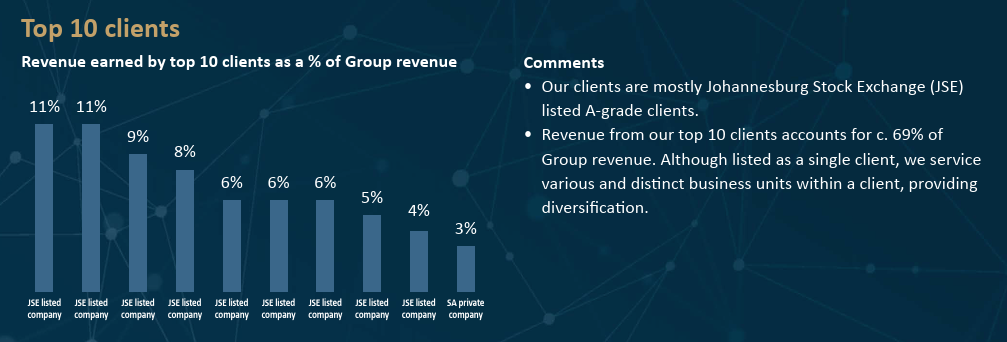
For a measure of cash earnings, you can look at the 11.1% increase in the dividend. That’s not quite as good as the HEPS growth, but still a solid outcome. Cash generated from operations increased by 8%, with timing of working capital flows affecting this percentage growth vs. the underlying increase in earnings.
The share price is up 28% year-to-date and comes with a juicy dividend yield as well, so shareholders have been rewarded well in 2025. The view over three years is far less encouraging, but that’s what happens when people buy shares at stretched valuations. To keep this momentum going, the market will look for stronger revenue growth, not just an improvement in profits.
Premier updated the pro forma numbers for the RFG Holdings deal (JSE: PMR | JSE: RFG)
This is because both companies recently released updated results
When JSE-listed companies release circulars, they need to include the most recently reported numbers. The timing of a deal sometimes works out very well, with fresh public numbers available for the circular and no updates required along the way. But in other deals, the circular goes out with rather stale numbers that were released several months ago. If the next round of financial reporting takes place while the circular is still “live” (i.e. during the timeline for shareholder approval), then it is often necessary to update the circular with the latest available numbers.
This is what has happened in the Premier – RFG Holdings transaction, with both companies having recently released numbers. Premier has therefore released updated pro forma numbers to show what the impact on Premier shareholders would be if the deal goes ahead.
This is just a maths exercise to plug together two sets of financials, make a few adjustments and then work out how many shares would be in issue. It doesn’t tell you anything about what the future performance might be, so just keep that in mind as you read this.
The overall message is that diluted HEPS would improve by 10%. This speaks directly to the relative valuations of the two companies under the terms of the deal.
Quantum Foods signs off on a much stronger year (JSE: QFH)
The CFO describes it as “one of the best profit performances since unbundling from Pioneer Foods just over ten years ago”
When poultry businesses do well, they can do really well. Naturally, this means that when things go badly, they go very badly. If you crave a boring life, you’re better off eating chickens than investing in them.
For the year ended September, revenue at Quantum Foods was up by 12.9% and operating profit jumped by 55.3%. HEPS increased by 67.1%. There’s even a dividend of 34 cents per share vs. nil in the comparable period. Sure, they are only paying out 25% of HEPS as a dividend, but it’s still a sign of confidence.
The broiler and layer farming business is where you’ll find the biggest swing, with revenue up just 8.5% and profits moving sharply from negative R11 million to positive R127 million. As a reminder that the moves sometimes make even less sense, the eggs business saw revenue jump by 47% and profits decrease by 20.8%. Margins in poultry tend to be volatile, so the revenue vs. profit movements can sometimes get rather wild. They can also be tame, as we’ve seen in the animal feeds segment where revenue was up 5.6% and adjusted operating profit was up 9.6%.
Operations in the rest of Africa saw a 16.5% increase in revenue, but a 6.7% drop in adjusted operating profit. You’ll find the usual ups and downs from operating in frontier markets, with Mozambique deserving a special mention for adding looting to the list of risks!
From a cashflow perspective, cash from operations was up by 14.2% to R302 million. The reason for the gap between this growth rate and operating profit growth is the investment in working capital, with a significant portion of the incremental profits landing in inventory.
Despite this strong set of numbers, the share price is flat year-to-date after a rollercoaster ride of note.
Nibbles:
- Director dealings:
- An associate of one of the co-CEOs of iOCO (JSE: IOC) bought shares worth R1.3 million.
- A director of a major subsidiary of Blu Label (JSE: BLU) sold shares worth R1.1 million.
- A director of Momentum (JSE: MTM) bought shares worth R180k.
- An associate of the CEO of Grand Parade (JSE: GPL) bought shares worth R42.4k.
- Curro (JSE: COH) announced that the Competition Commission has recommended the approval of the acquisition by the Jannie Mouton Stigting, subject to certain conditions. The next step would be for the deal to go to the Competition Tribunal, provided that the parties are willing to live with the conditions. It seems that the conditions aren’t a slam dunk, with the company noting that the offeror will provide an update next week on the acceptability of the conditions. Hopefully we aren’t being taken on a journey to crazy town by the regulator on this one.
- Jubilee Metals (JSE: JBL) announced a co-operation and project development agreement with Galileo Resources for the development of Jubilee’s Molefe Mine in Zambia. Galileo would be able to earn up to a 23.75% stake in the Molefe Mine, with 5% to be held by a local Zambian firm and the remaining 71.25% held by Jubilee Metals. Galileo would need to fund $700k towards exploration and development. They would also provide the skills needed to put the mine on an accelerated development path, with the stake in the mine earned by Galileo through completing an agreed scope of work within eight months.
- It’s time to bid farewell to Ascendis (JSE: ASC) after a long and mostly painful journey as a JSE-listed company. The offer to shareholders was successful, achieving acceptances of 6.86% of the offer shares. This offer was unusual in that it had a maximum acceptance condition, so a low acceptance rate is what they were looking for! The shares will be delisted on 4th December.
- Here’s some good news for Goldrush (JSE: GRSP): the court has dismissed an application by Ithuba Lottery to urgently interdict the implementation of the award of the National Lottery licence to Sizekhaya, the winning bidder in which Goldrush is invested. The application was even dismissed with costs! This only deals with the urgent interdict, with the full review application likely to be heard in 2026.
- The chess pieces continue to move at RMB Holdings (JSE: RMH), with well-known shareholder activist Albie Cilliers resigning from the board of Atterbury Property Holdings where he served as an RMH representative. As you may recall, the company is trading under cautionary based on a potential offer by Atterbury for RMH.
- I ignore most non-executive director appointments on the JSE, but here’s one that is worth highlighting: STADIO (JSE: SDO) announced that Capitec (JSE: CPI) founder Gerrie Fourie has joined the education group’s board after retiring from the bank a few months ago. STADIO is having an extraordinary year, with the share price up more than 82% year-to-date!
- ASP Isotopes (JSE: ISO) has established a new Photonics Chair at Wits University through an endowment under a three-year donation agreement. Dr. Angela Dudley will take on that new role. They are looking to not just drive further research in photonics, but produce a pipeline of students who might work at ASP Isotopes after their studies. This looks like a great example of investing in local talent and building a link between commercial applications and academic pursuits.
- The share register of Castleview Property Fund (JSE: CVW) is so tightly held that there is literally no liquidity in this stock. In a trading statement for the six months to September 2025, the fund confirmed that the dividend per share is 11.07 cents, up 21.8%. I’m sure that the small group of investors will be happy with that!
- Salungano (JSE: SLG) is suspended from trading and thus has to release quarterly updates to shareholders. They still have a bunch of issues to sort out, ranging from the financial reporting backlog through to bigger worries around the going concern status and the extent to which a recently announced coal supply agreement with Eskom might address this. The company’s best estimate is that the suspension may be lifted in April 2026.


Thanks for good run-down on Mantengu’s results