
In this edition of Ghost Bites:
- MTN Uganda’s results require a careful read
- Schroder European Real Estate prepares for a “managed wind-down”
- Spur shareholders must stomach a R129.5 million legal provision
- Thungela’s earnings and share price chart are world’s apart
MTN Uganda’s results require a careful read (JSE: MTN)
MTN also released an update on the IHS transaction
I’ll get the news re: IHS out of the way first. As you are probably aware, MTN is in the process of acquiring the remaining shares in IHS. With MTN only wanting to buy the African assets (as they want to control more of the value chain), it makes perfect sense that IHS has announced the completion of the sale of its Latam Tower operations in South America. Those assets needed to get out of the way anyway.
Moving on, MTN Uganda has added its name to the recent results released by MTN’s African subsidiaries. To get up the curve on the latest from MTN Nigeria and MTN Ghana, you can refer to this edition of Ghost Bites.
MTN Uganda is generally less volatile than the other subsidiaries. This is because Uganda tends to have a modest inflation rate and a reasonable geopolitical climate. Relative stability is a rare thing in Africa.
Sure enough, for the six months to June 2026, the inflation rate was 3.1% – not much different to the 3.6% in the comparable period.
MTN Uganda grew service revenue by 9.4% over the six months, which is well ahead of inflation. This was driven by 11.2% growth in total subscribers, so their average revenue per subscriber came under pressure in this period. The highlight within service revenue is data revenue, up 15.6% (vs. voice revenue’s gentle uptick of 1.8%).

EBITDA margin is where the struggles begin, as total expenses for the six months increased by 15.1% (with fuel inflation as one of the issues). This is why EBITDA increased by just 4.7%, with EBITDA margin contracting by 250 basis points to 51.2%. To be fair, MTN Uganda’s medium-term EBITDA margin guidance is 51.2%, so they are bang in line with what they’ve told the market they will achieve.
With net finance costs up by 16.6% and depreciation reflecting the underlying increase in assets, you would expect things to be difficult by the time you reach profit after tax. Instead, you’ll find an increase of 37.7%, driven by a 43.1% decrease in the tax charge after a transfer pricing settlement in the prior year.
Profit before tax is thus the cleanest way to consider the numbers, down around 3.5% due to the abovementioned pressures. That’s certainly not a great story, but hopefully the inflationary pressures will abate soon.
Looking at cash flow, total capex was up by a substantial 62.7%. MTN Uganda puts a similar amount into dividends as they do into capex, serving as a good reminder that telco investors are definitely not buying into a capital-light business model.
Ghost Bite: A dependable growth rate in revenue only works well if costs are also dependable. External shocks like fuel inflation are always a risk.
Schroder European Real Estate prepares for a “managed wind-down” (JSE: SCD)
Good riddance to an awful performer
Schroder European Real Estate’s total return over 5 years is -0.13%. Any shareholder who has walked that journey has gone severely backwards vs. inflation. I will remind you that property is an asset class that is supposed to offer really good protection against inflation!
The problem isn’t property as an asset class. The issue is the fund’s strategy, which simply hasn’t worked at all in Europe. I can’t even blame the region, as there are several funds on the JSE that have found success in Europe.
The fund is now preparing for a “managed wind-down” of the company, which is a fancy way of saying that they are throwing in the towel. This means selling the underlying assets and returning capital to shareholders over time. There’s no guarantee of how long this will take, or the prices that will be achieved.
The guidance is for a two-to-three-year process to get rid of the 14 assets strewn across France, Germany and the Netherlands. I somehow doubt that executive compensation will decrease over that period in line with the reduction in assets.
The company also needs to navigate the tax disaster they are dealing with in France.
The immediate next step is for shareholders to vote on the proposed changes to the investment management agreement, as this will give the board the power to move forward with the intended strategy.
Ghost Bite: Absolutely nobody in the local market is going to lose any sleep over Schroder gently disappearing in the coming years. There are so many great property funds on the JSE. This isn’t one of them.
Spur shareholders must stomach a R129.5 million legal provision (JSE: SUR)
Other than this nasty outcome, recent trading looks good
In a matter that dates back to 2019, GPS Food Group sued Spur based on the alleged non-fulfilment of a verbal agreement to acquire, develop and manage a rib processing facility. The parties agreed to refer the matter to arbitration.
GPS put in two claims. Claim A is a damages claim that was estimated at between R119.9 million and R167.0 million. Claim B was an alternative delictual claim of R95.8 million.
The arbitrator issued a part award in August 2025 for Claim A. Alternative Claim B was dismissed.
The arbitrator has now issued the quantum award of damages, with a capital sum of R74.6 million. Together with 10% interest from the date of the original summons and the estimated legal costs, Spur has now raised a provision of R129.5 million. This could be the most expensive order of ribs in history.
The company will lodge an appeal against the award in its entirety, with Senior Counsel having advised Spur that it is likely that the appeal will succeed. Naturally, Senior Counsel will also be billing all the way to the bank, so this legal advice has the same incentive as the turkey voting for Christmas. Spur shareholders will certainly hope that the legal advice is accurate.
In the meantime, the provision is now sitting on the balance sheet. It’s also directly hit earnings, which is why Spur’s HEPS for the year ended June 2026 is expected to drop by between 34% and 43%.
Underneath all this noise, there’s actually a solid result from the group’s operations. They’ve released an adjusted HEPS number that excludes the claim provision. On this basis, adjusted HEPS would be up by between 5% and 13%, coming in at between 356.87 cents and 384.06 cents.
The midpoint of 370.47 cents is the number that the market will use to value the shares, less an allowance for the legal claim. With a market cap of nearly R3.8 billion, the claim is irritating, but not an existential crisis.
Based on Friday’s closing share price of R41, Spur is trading on a P/E of roughly 11x.
Ghost Bite: The stock barely reacted to the news of the claim. Either shareholders were expecting it, or people had already left their desks for the long weekend. We will find out on Tuesday which one it is.
Thungela’s earnings and share price chart are world’s apart (JSE: TGA)
Many mining companies have been a net beneficiary of the conflict in Iran
When global supply chains clog up, commodity prices tend to increase rapidly. It’s the classic supply and demand balance – or in this case, imbalance. And if fuel prices move sharply higher as well, then the price of commodities can do some particularly crazy things.
If you look at a year-to-date chart of coal futures and various benchmark prices, you’ll see that there was a considerable spike in March. For example, Richards Bay Coal futures are up 23.4% year-to-date. Newcastle Coal Index futures are up by roughly 20% this year as well. These are the two benchmark prices that matter for Thungela, as the company has coal operations in both South Africa and Australia.
With such favourable moves in the underlying commodity price, you would expect to see plenty of fireworks in the share price. As is so often the case with mining stocks though, the chart is a cruel tale of what might have been:
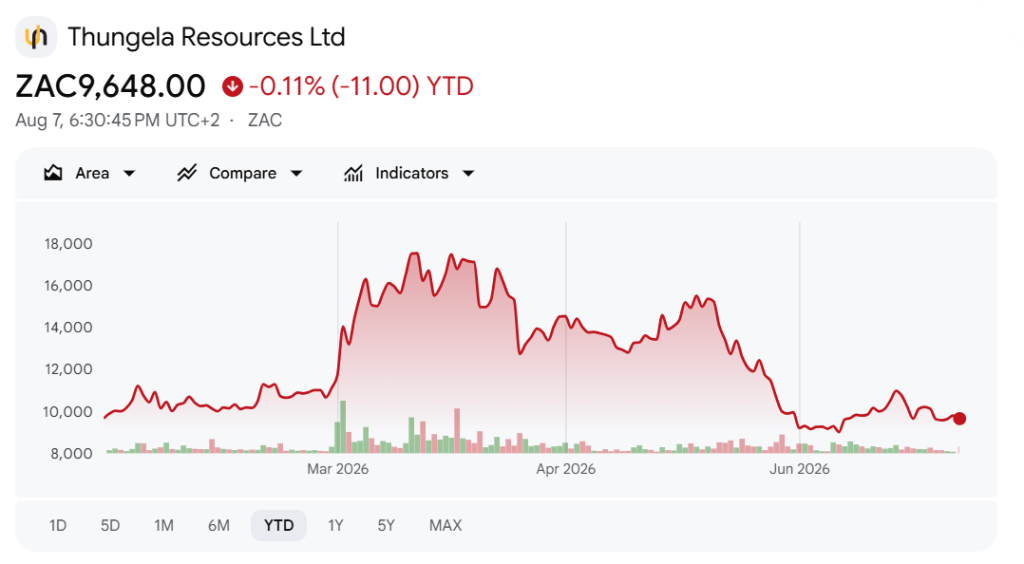
The chart is even more depressing in the context of the latest trading statement. For the six months ended June 2026, Thungela expects HEPS to be between R4.60 and R4.95 – an increase of between 140% and 158%!
Even on a 12-month basis, the total return for shareholders has been 7%. Yes, that’s the return including dividends. This feels like nothing at all compared to the underlying jump in earnings.
Ghost Bite: The disconnect between mining share prices and the underlying earnings can be very difficult to navigate. Coal prices are still much higher than they were at the start of the year, yet Thungela’s share price has given up all its year-to-date gains. Let me know in the poll what your plan is here!
Results of previous poll:

Nibbles:
- Director dealings:
- The CEO of Shuka Minerals (JSE: SKA), Richard Lloyd, has bought around R430k worth of shares in the company. This increases his stake to 2.05%.
- Accelerate Property Fund (JSE: APF) is in the naughty corner at the JSE. The REIT earned itself a public censure and a R500k fine (suspended for three years) based on the decision to appoint Flanagan & Gerard as managers of Fourways Mall. This should’ve only been done with shareholder approval. As you might have guessed, such approval was never obtained. To this day, Flanagan & Gerard are still in place on a month-to-month basis, a situation that the JSE has now instructed Accelerate to rectify with a shareholder vote. Based on how much better things are at Fourways Mall these days, the censure is cheap at the price. Accelerate better get on the right side of the JSE very quickly though, as this is never a good look.
- After the latest round of on-market purchases, Novus (JSE: NVS) now has a direct stake of 51.91% in Mustek (JSE: MST). Together with concert parties, the stake is up to 72.20%.
- Eastern Platinum (JSE: EPS) has announced that Chairman Changyu Liu will become the interim CEO in the wake of Wanjin Yang’s sudden departure. I must point out that the company also replaced its CFO just a couple of months ago. I don’t know what is going on in that boardroom, but the market doesn’t enjoy stuff like this.