

Weaver Fintech’s results are important enough for my portfolio and for the broader consumer economy to have warranted a much deeper dive than you’ll usually see in Ghost Bites. Enjoy it!
Lots of head scratching for investors in Weaver Fintech (JSE: WVR)
And that includes me
Weaver Fintech is one of the positions in my local portfolio. Even after a sharp correction, I’m still up 70%. I’ll take it!
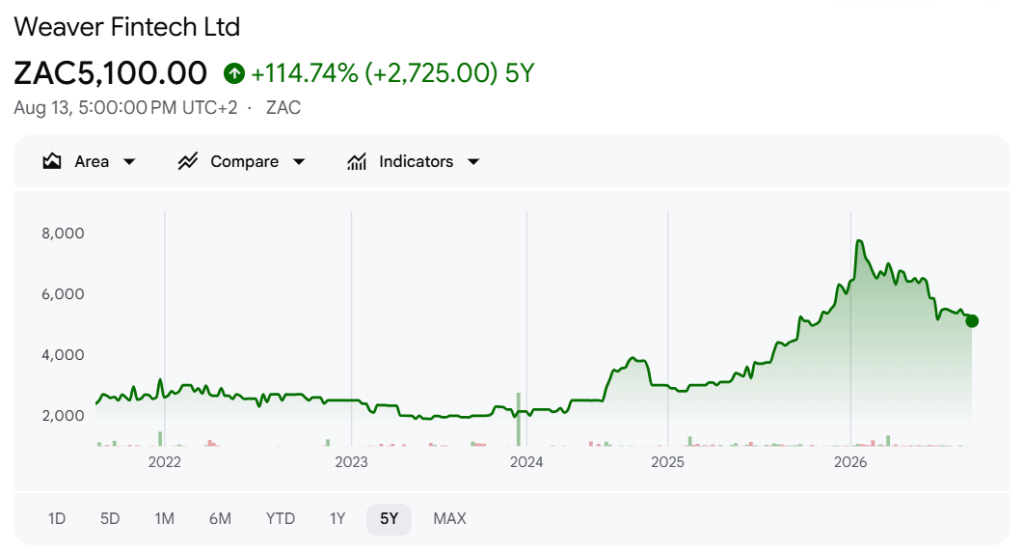
Here’s what the chart looks like:
Why am I long here?
My underlying thesis is simple: BNPL is a fast-growing space, and PayJustNow (the Weaver business) has the leading position.

Yes, they have a zillion competitors snapping at their heels, so caution around growth prospects is always warranted. But because this is South Africa rather than the US, I was able to buy a growth company on a single-digit P/E multiple!
Looking at SA tech vs. US tech is like comparing Joburg and Cape Town house prices. There are some very good reasons for the difference in valuation, but that doesn’t mean that SA (or Joburg in the house price analogy) doesn’t offer opportunities.
Weaver has now released results for the six months to June 2026 that gave the market (and me) a lot to chew on.
Farewell, interim dividend
Although customers increased by 17% and revenue was up 10%, trading profit only grew by 2%. Even worse, profit before tax was down by 9%. What happened to Weaver being a growth company?!?
Here’s perhaps the most concerning comment of all:
“The board has elected not to declare an interim dividend for the six-month period to 30 June 2026, to preserve capital while credit normalises.”
A quick look at the income statement will reveal the problem in credit impairments:
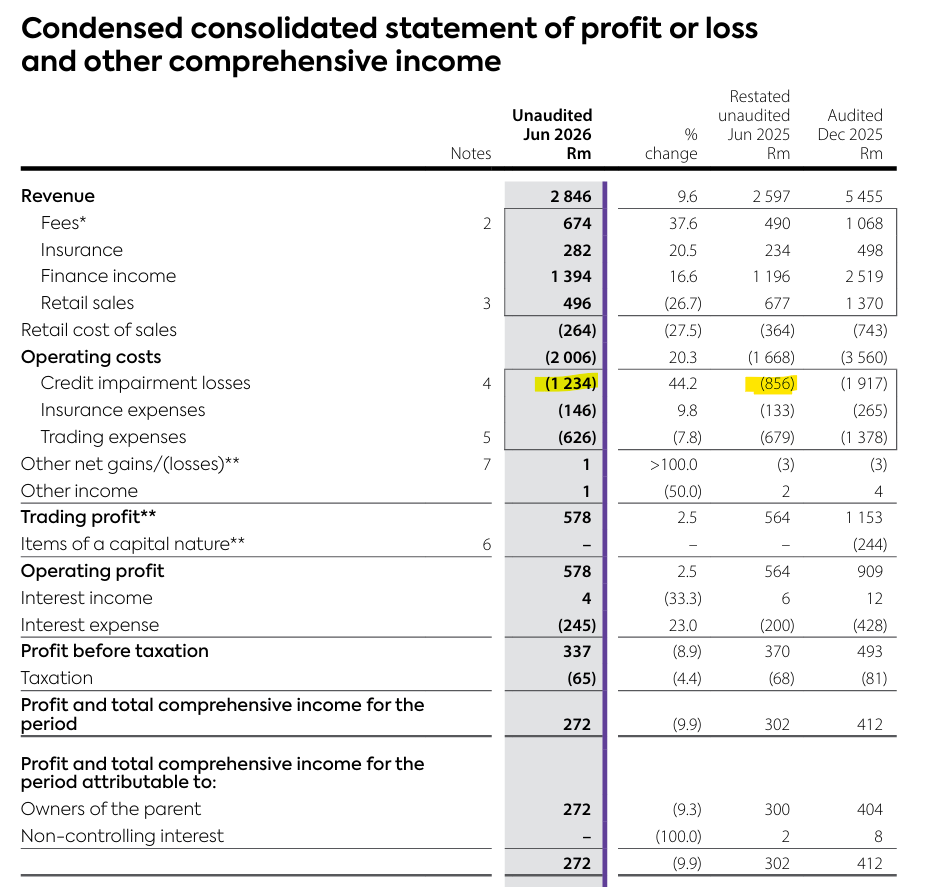
Yes, that’s a 44.2% increase in impairment losses during a period in which revenue increased by only 9.6%. Ouch!
Caution is warranted
Now, we know that local consumers are under pressure. Local retailers have been having a tough time. But has the tide finally gone out during the period in which fuel costs assaulted our budgets? Heck, even the SARB was too scared to hike rates!
Weaver is certainly taking a more cautious approach than before. The provision rate in the Fintech book was raised from 14.7% to 17.3%. The credit loss ratio jumped from 21.2% to 24.7%. The company has increased the number of collection agents by 24%.
The company applied the brakes to disbursements in response to the deteriorating consumer credit environment. Growth in disbursements slowed to 10% in this period (vs. 30% a year ago). The slowdown is even more obvious if we look within the interim period: disbursements grew by just 6% in Q2 vs. 15% in Q1.
They seem to be scrambling to get the book under control, with a need to stabilise it before they can achieve further scale in the business.
Even during a difficult period, collections exceeded disbursements by R270 million. That’s comforting for investors, with the excess reinvested into the business in this period (growth in receivables exceeded additional net debt by R400 million). This means they can grow without relying fully on external debt. By scrapping the interim dividend, they’ve held on to even more cash to shore up the balance sheet.
Conservatism is what I want to see here.
Understanding Fintech vs. Retail
It’s important to understand that Weaver’s Retail segment isn’t the money-spinner that got the market’s attention in recent years. For context, the Fintech business makes 94% of trading profit!
The Retail segment operates the homechoice banner, which has been around for a very long time. They’ve recently shifted away from cold calling customers, with primary focus being on showroom-based customer acquisition. Showrooms now source 65% of new customers, up from 40%. The key point to understand is that homechoice is really just a front door for the Fintech segment, as this is one of the ways that they win customers in a hotly-contested space.
The Retail segment suffered a 27% decline in sales in this period. The profits in that segment were saved by a 60 basis points improvement in gross margin to 46.8%, along with a 30% decrease in the cost base. This allowed trading profit to increase by 15%.
The Fintech segment can’t say the same unfortunately, with trading profit up by just 1% as the credit deterioration ate up profits.
The risk in the lending business needs to be watched carefully
The Fintech segment grew transacting customer numbers by 33%. Fintech revenue was up 30%, with core lending revenue up by 21%. That looks like a balanced relationship, with the issue clearly not being the adoption of the ecosystem by South African consumers.
After all, with retailers taking a more cautious approach to lending, why wouldn’t customers try their luck with getting credit from Weaver?
For those among you who are operating tech businesses, you’ll be interested to know that the cost of acquiring a customer is R60. The average lending customer transacts 6.6 times per year, while the average BNPL customer (3-month debt) transacts 5.1 times per year. Once they’ve gotten a consumer into the ecosystem, it’s all about retention and maximising the lifetime value of that customer.
The focus on cross-selling raises other interesting questions though.
I would see the PayStretch book (12-month customers) as being far riskier than the BNPL book. If Weaver does too much cross-selling, they risk taking the business into a place where it is seen as just another microlender vs. being an appealing ecosystem.
But the bigger risk lies in the even longer-dated stuff, with the lending book averaging 19 to 21 months. I’m glad to see that the disbursements are focused on bringing this down significantly, with the average disbursed loan term reduced from 13.1 months to 12.6 months.
A non-banking business that doesn’t have access to cheap deposits shouldn’t be trying to do longer-dated loans in South Africa.
Another important risk-management point is that PayStretch depends on the pre-qualified BNPL base, so Weaver has experience with these customers before extending loans to them. At a time when retailers are providing a conservative narrative around credit sales, Weaver happily grew its PayStretch gross merchandise value by 215%. It may be off a low base, but that’s something to keep an eye on.
An ecosystem built around cross-selling
It’s great to see merchant advertising coming through as a proper revenue engine. Advertising revenue increased by 17.4%, with Weaver appealing to FMCG players looking to access an ecosystem of customers who have intent to transact (and access to debt to do so).
Together with capital-light fee income on transactions (vs. only earning lending income), this advertising income is a good example of how Weaver will look to drive Return on Equity over time.
Another exciting area is the planned launch of PJN Mobile in Q2, the type of MVNO partnership that we’ve seen across numerous retail and banking players. If you have a large cohort of customers, then sending airtime and other services in their direction is a great way to add to the bottom line.
Insurance income is another important opportunity, with customers up 28% and gross written premium increasing by 18%. They focus on ways to make cross-selling easy, like adding family members to an existing funeral policy in the PayJustNow app. As a reminder that Weaver’s business has been around for many years before they acquired PayJustNow, only 53% of new policies were acquired digitally (up from 49% before). Don’t underestimate the distribution power of the homechoice retail network.
The prize for taking that risk is clear: Weaver notes that a single-product customer generates an average of R678 in revenue vs. a fully cross-sold customer (7 products!) at R18,431.
Driving better unit economics
To build out this ecosystem, Weaver increased its investment in AI capabilities by 54%. One of the measures of efficiency is the unit cost of customer service interactions, which fell by 25%.
Overall, the ratio of expenses to revenue improved from 25% to 23%.
Improving unit economics is what you would expect to see as a platform scales. You’ll often hear people talk about a strong “contribution margin” – the benefit of having one more customer.
My approach
Every investor has a different approach. I like having long-term positions built around specific themes, with enough diversification in my portfolio that I’m not betting the farm on one specific stock or idea.
Weaver is approximately a 2% position in my portfolio. I’m comfortable with just leaving it alone to do its thing and I appreciate management’s conservatism during a difficult period.
For the sake of the entire SA consumer sector, I hope that fuel prices will offer some relief in the second half of the year. I also hope that the SARB keeps their fingers far away from the rate hike button!
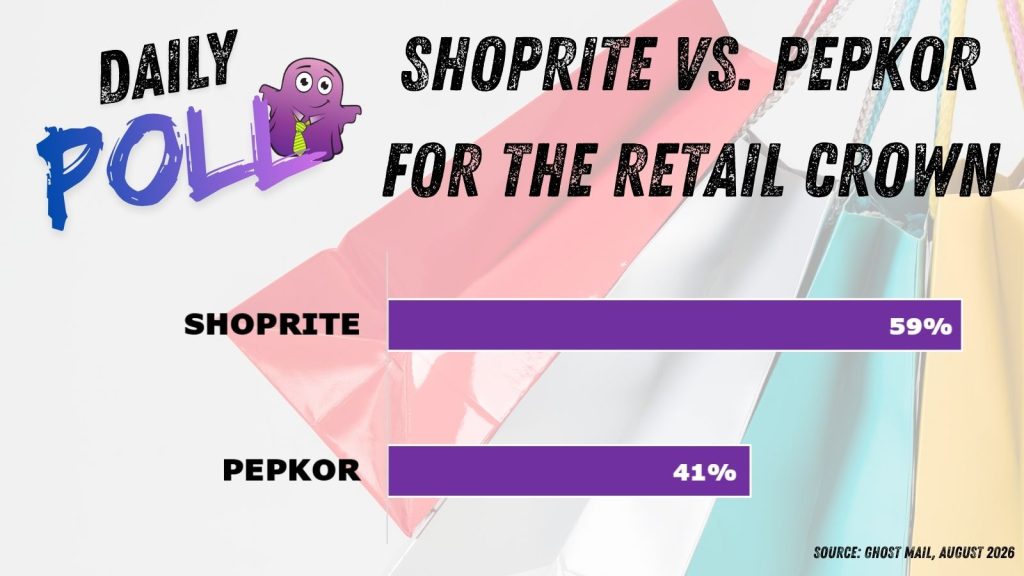
Results of previous poll:


Mr Ghost
Your work is brilliant.
I just wish that you had been around 40 years ago for the likes of me.
Although well retired I still enjoy your ‘reports’ and analyses and I learn something new all the time.
Keep safe and keep well
Robert Young
Thank you very much for the kind words!
Good afternoon, Ghost,
Please do not be despondent, your services are valuable!
I study your Ghostbites every day and articles in FM every week, informational and thought provoking.
I have been in the mining supply industry for 50 years, and the cyclical nature of their capex still leaves me gobsmacked! The enjoyment of being actively involved in growing and maintaining a company through these cycles is extremely challenging. I will be happy to be a subscriber to your posts, they are of value to me.
Best regards, Chris
Thank you so much Chris! Thankfully, no paid subscription needed – but you would certainly be helping a great deal if you recommended the platform to a few friends who might be interested. Thanks so much for reading – and good luck with being on the other end of that cyclical procurement spend. Truly a wild industry.
Hi Ghost.
I am in the financial services industry. Getting loads of info, asset management ideas etc are not a problem. Most of it is also good. What makes your ideas so refreshing, it is straight to the point. As a firm believer of common sense (not so common as one might believe) I really like the common sense you apply to your outlooks coupled with your humor.
Should you in future need to change to paid subscription I will for sure subscribe.
Hi Gordon – thank you so much. The plan is certainly to avoid ever needing a paywall. I’m confident it can be done, despite the broader media industry falling apart by the day!