
Listen to the show on Spotify and Apple Podcasts:
And on YouTube:
Standard Bank and Java Capital have partnered to build an integrated real estate advisory and co-investment platform.
This approach combines Standard Bank’s strong balance sheet, extensive African footprint and proven execution capabilities with Java Capital’s specialist advisory and real estate capital markets expertise.
That’s what the official press release will tell you. But what does it actually mean?
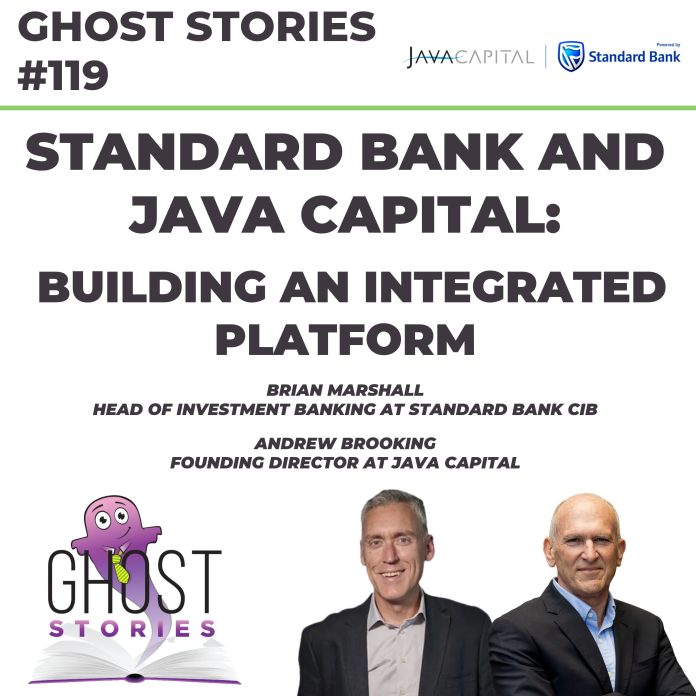
Brian Marshall and Andrew Brooking joined me on this podcast to explain exactly how this joint venture will work, why it has been put in place and what it means for clients.
This is landmark transaction in the local corporate finance industry that deserves to be unpacked in more detail.
In this episode:
00:00 Intro
02:11 Standard Bank and Java Capital form a joint venture
04:38 How the sector focus at Standard Bank underpins this strategy
07:37 Why Java Capital is doing this now
09:37 The combined real estate and infrastructure opportunity
13:43 Managing conflict of interest for clients
18:46 Where Standard Bank is playing on the capital stack
20:49 The private market trend
24:33 Closing thoughts
This podcast is in partnership with Standard Bank and Java Capital.
🎶 by Atlas Audio from Pixabay
Disclaimer:
The information and opinions provided in this podcast are for general information purposes only and does not constitute financial, investment, legal, tax or other advice. Viewers and listeners must obtain independent professional advice before making financial decisions.
The Standard Bank Group, Java Capital, The Finance Ghost and their employees, agents and representatives accept no liability for any loss, damage or claim arising from the use or reliance on information and opinions presented in this podcast.
Transcript:
The Finance Ghost: Welcome to this episode of the Ghost Stories podcast. I must say the corporate finance industry is close to my heart because that’s where I did my ‘army years’, for want of a better description.
In fact, I was in this space during the height of property capital raising in South Africa. I was on the other side watching Java Capital make a lot of money, Andrew, advising on a truly extraordinary deal value every year. And of course, I’m speaking to Andrew Brooking here, who’s been doing this for a long time as the founding director of Java Capital.
The same is true for Brian Marshall, who also joins us today. He’s the head of investment banking at Standard Bank CIB. His career with the group (assuming your LinkedIn is accurate, Brian) goes back more than 20 years, with a particular focus on debt and leveraged finance. So, very interesting. We’ve got the full capital stack here.
Today, these two highly experienced gentlemen have joined me to talk about some exciting recent news, which is Standard Bank and Java Capital partnering to build an integrated real estate advisory and co-investment platform – nice. Congratulations!
Thank you for doing this with me, Andrew and Brian. Looking forward to learning all about this from you.
Andrew Brooking: Thanks, Ghost.
Brian Marshall: Thanks. Nice to be here.
The Finance Ghost: Let’s start with understanding the structure and the timing of the transaction, and then we’ll dig into what this means in terms of the sectors you’re focused on, where you’re going to play on the stack and some of the trends we’re looking at.
My understanding is that Standard Bank and Java have entered into a partnership. It’s this advisory and co-investment platform that I mentioned. In other words, the brands remain distinct in their advisory offerings. It’s not technically a merger.
Would that be the correct understanding? Perhaps you can just explain for the audience what you’re actually putting in place here.
Andrew Brooking: Spot on, Ghost. It’s a joint venture arrangement via a joint venture company that is co-owned by Java Capital and Standard Bank, and that entity is both parties’ exclusive vehicle for addressing the sector where the sector is real estate, real assets encompassing infrastructure.
And then the scope of what’s within that venture would be advisory, M&A, ECM and capital solutions of a sort that might encompass some equity, an underwrite or a bridge; something that advances a client’s interest in the context of those advisory services. Or alternatively, a co-investment piece that is particularly attractive for the joint venture partners.
The Finance Ghost: Just to be clear here, this is exclusivity around real estate. So, if someone wants a real estate piece of advice from Standard Bank and Java, collectively, it’s going to go through this thing?
Andrew Brooking: Correct.
The Finance Ghost: That makes sense. I think an important point to raise here is, as I understand it, you are not directly competing with your clients here. You’re not trying to go and bid alongside them for assets or sell assets or anything like that. This is still very much an advisory and capital solutions-type offering, as opposed to falling over your clients. Right?
Andrew Brooking: I think it’s important to emphasise that our clients have capital-intensive businesses that they manage day to day in an optimum way. This joint venture company doesn’t have the capacity to manage real estate or infrastructure on a day-to-day basis. It’s not looking to get into a competitive, capital-intensive space.
But there are lots of circumstances where a capital component to an overall solution enhances the outcome for the client and in itself represents an attractive piece of business. So, it’s co-investing in, if you like, an advisory-adjacent capacity.
The Finance Ghost: Brian, just to bring you in here, from your side this is pretty interesting, right? This is a banking advisory business partnering with a non-banking advisory business, ultimately. And these have typically been competitors, historically. Now, you’re kind of bringing it all together from a Standard Bank perspective. Why do you feel like that makes sense, and why Java?
Brian Marshall: Well, why Java is probably the easy part. Perhaps let me start with what we’ve been doing at Standard Bank and why we find ourselves in this joint venture arrangement with Andrew and the Java team.
For the last 16 years, we’ve been very focused on building our business around the African continent. It’s in our purpose statement in which we say, “Africa is our home, we drive her growth.”
And in putting that together, in addition to the obvious footprint that we have across the continent, we became very focused around the sectors that were going to be important to driving the growth in Africa.
So, for the last decade and a half we’ve been arranging our business on very much a sectoral basis, and we obviously started with the big ones which were really going to drive the biggest difference. As we stand here today, those are some of our biggest businesses.
For example, we have a flagship energy and infrastructure business that spans across the continent that is responsible for arranging huge amounts of capital for projects, for state-owned enterprises (SOEs), for governments and so forth.
And in sectorising our business, we brought in bankers who were sector experts who could really engage with clients at a sector level. And then behind that, we lined up our products – things you would find in an investment bank (advisory, structuring, financing and so forth) – all along those specific sectors.
So, in a way, a lot of our business then became advisory-led in nature.
Now, commercial real estate is obviously also a pretty important sector for the continent. Business gets conducted out of factories and offices, so real estate is fundamental to any economy.
Historically, we’ve been very much a lending and financing business, and we’ve got quite a strong business around that. But we hadn’t really put our back into bringing about this fully integrated offering to the market.
So, we have built our own sector business. Andrew Robinson, who is a career banker who has also worked in the industry specialising in real estate, joined us last year as the sector lead for real estate.
And then the part that was missing was exactly what Java is exceptionally strong at, which is the advisory bits and specifically their work around capital markets. I’m sure we’ll go into the history of Andrew’s business, but they’ve been the driving force around that segment of investment banking in the real estate sector.
So, it became kind of a natural partnership for us to form this together with the reach, the brand, the balance sheet and the capabilities. Especially around the financing and structuring side, it made a lot of sense for us to get into this partnership with Andrew and the Java team.
The Finance Ghost: Well, one thing I’ve learned today is it’s definitely advantageous to be named Andrew if you have serious ambitions in the property sector, so that’s at least one thing we can certainly bank.
On a more serious note, Andrew, over to you. From a timing perspective, you’ve been doing this for a really long time. I wasn’t kidding when I said that when I was in corporate finance advisory more than 10 years ago, everyone knew who you were; everyone knew who Java was – you’ve been at this for a while.
And you’ve done this now. Is that specifically because of the way that Standard Bank has looked to maybe reorganise their offering; this client-sector focus?
And Brian, I totally understand what you’re saying because when I read the Standard Bank capital markets day presentations (I think it was a couple of months ago), that came through very strongly. So, that all makes sense. I’d encourage our listeners to go check those out if you want to understand more.
But Andrew, from a timing perspective, you’ve decided to do this now. What led to that?
Andrew Brooking: A couple of things, Ghost. Firstly, we think conditions are close to being really conducive to outperformance in the real estate and real asset-related space. Obviously, one never knows for sure when inflation is going to spike, when it’ll come down, quite where interest rates will go, but overall operating performances are good.
After several tough years, the listed real estate sector’s performed well for a couple of years. It’s in good shape. Capital is available. So, not just recovery, but thriving seems to us to be here, or just about here, over the next several years.
So, it’s a great time to be positioned to kind of make hay while the sun shines, so that would be a part of it. It’s a good time. As opposed to going into a down part of the cycle, we’re coming into what we think will be an up part of the cycle.
And secondly, yes, I think Standard Bank’s been receptive to this kind of strategic relationship, whereas perhaps in years gone by it may not have been.
Both sides are receptive. It’s essentially a relationship where the whole is much better than the sum of the parts. That’s how we think about it and we hope to be positioned for really good times as conditions settle.
The Finance Ghost: Yeah, look, I’m that guy who rents my house and invests in REITs, so I’m hoping you’re right. I’d like that to happen. My portfolio would benefit for sure.
So, let’s maybe move on then to talk about the sector focus, because the one thing that we have certainly learned today is that this is an exclusive thing around property (at least, for now, who knows where this develops over time).
But there’s also infrastructure and that kind of stuff that then comes through into this.
That sector focus that came through in Standard Bank’s capital markets day creates a lot of really interesting opportunities here.
Plus, there’s big distribution, obviously, into Africa as well – that Standard Bank brings as the continent champion, let’s be honest.
I’m keen to understand more about that and just how you see the two businesses actually working together and addressing these opportunities around things like infrastructure, for example, property, and maybe opportunities on the rest of the continent.
Brian Marshall: So, the way we approach our business with our clients, with understanding how best to pitch up and provide solutions, is that we kind of go in and, especially when it comes to infrastructure, it’s about understanding the complete ecosystem. So, we’ve done a lot of work.
Renewables is a very obvious example, but that’s gone way beyond just the power sector and it’s gone into infrastructure, specifically on the continent where the biggest opportunity for our business now lies. And when I’m talking infrastructure, I’m talking rails, ports, land borders and that type of infrastructure.
Now, that infrastructure enables a lot of other things to happen around that. It could be the mining sector that’s able to transport minerals out through a port. So, what we do is we go and understand those entire ecosystems and then we go and, from a sector point of view, understand what the fundamentals are and what it is that’s going to inform how clients need to think about things.
And many times, we offer insights which they themselves don’t even have access to.
In so doing, we understand the risk. We’re able to structure for it. We’re able to advise around it. And then importantly, because of the credibility and the strength of our brand, there’s a lot of trust that comes behind that. So, we’re then able to go and place that.
Because at the end of the day, if we’re doing our jobs properly, the capital that we use is not there to necessarily build up massive positions in loan stock or in equity (or whatever it is), even though we do have a massive balance sheet and, with investment banking, we’ve got nearly R600 billion of assets. It’s the multiplier effect around that capital that’s important.
I’ll give a very simple example. This year, we arranged for an SOE on the continent, cumulatively, across three transactions, $4.5 billion (that’s dollars, not rands) of financing capacity for very specific things that they needed to do. And our capital facilitated that.
The strength in the Standard Bank platform is really through our ability to place and risk-transform that capital into places where there are mandates to hold that capital. That’s something we do, together with our global markets business, and we’re able to really find the correct holders of that type of risk. I use those examples because I think they become relevant for what we can achieve in the real estate space.
The other part, which is also very relevant for this conversation, is that public markets have shrunk. Although we are active in the market at the moment with several IPOs, private capital has become a lot more important. Being able to follow that whole ecosystem, we found that the ability to put our own capital into equity alongside sponsors changes the conversation. It changes our own understanding and our own risk.
And therein also lies a whole capability to go and place equity risk with investors who are looking for that type of exposure. It could be all the way from institutions through to family offices.
So, we’re not looking to compete. We’re definitely not looking to sit on boards or influence things. It really is to back the right jockeys. There’s a very good example of that, which is the Optasia listing which we brought to market last year – the fintech that had its beginnings in Nigeria. Now, that’s a very good example of where we used our capital at various iterations through that process in bringing that business ultimately into the public markets.
When we talk about co-investment, specifically in real estate (and Andrew was just outlining some of the opportunities that are coming along), that’s exactly where we’re looking to co-invest when we talk about equity.
The Finance Ghost: Thanks, Brian. Yeah, Standard Bank is definitely a distribution powerhouse across the continent and your access to deals is obviously amazing.
Andrew, maybe because my background sits in that more independent-advisory level where we didn’t actually have balance sheets to tap into in-house, or with partners necessarily (we were kind of spreading it out and then bringing in different investors), I know the Java proposition has always had that more independent flavour.
For your clients, specifically in property, will now essentially fall into this joint venture. And you’ve talked about how you don’t want to compete with clients, etcetera, etcetera. How do you practically manage that with your clients in terms of – I suppose it is a conflict of interest, right? You’ve got Standard Bank there who are able to bring capital in – is that always the best capital deal? That’s something you’ll have to manage each time. Is it still independent advice?
I think it’s important that we just address that, because I’m guessing those are some of the questions that your long-standing clients might have had, right?
Andrew Brooking: Yeah, Ghost, these are real issues. So, from your corporate finance background, you’ll be well aware that complexity (even conflict of interest) is omnipresent in financial services, where you’re addressing something from a kind of 360-degree perspective.
We have made it our business to find ways to match capital to real estate. So, what do we look for? We’re interested in the space where capital gets matched to very tangible assets (if not property, maybe infrastructure, etcetera) where those assets produce very reliable, if not contractual, cash flows.
It’s capital-intensive; it’s sometimes time-sensitive. It’s dependent on access to funding across the capital stack, but particularly the equity piece.
And we’ve been very active in public markets. Public markets have funded real estate effectively over the 30 years that Java Capital has been at it. But a point that is increasingly coming to the fore is that capital is not only via public markets. Often, you need to bridge, to incubate, to partner with players in the public space so that they can land a deal where, for example, market conditions may not allow them to come to the window for the equity that they need to close the deal in the time available to close it.
So, we’ve come through some tough down patches in listed markets in the real estate space. There’s still been great business to be done. Equity has been scarce. The business hasn’t been done.
We also have a conversation with clients where independence is important, and we’re not going to change that. We will continue to be an independently operating team giving objective advice with sectoral expertise and, to some extent, being very deeply familiar with our clients’ affairs, if not feeling like we’re embedded within our clients.
We’re just able to bring another component to the solution now. Because, like anybody in corporate finance, we run at many things and a relatively small proportion of them come off.
And we’re well aware of how capital solutions – in the mix of this independent strategic and financial advice – can up your probabilities of execution.
We can help our clients execute. We also see an evolving world where how you match capital to capital-intensive hard assets is changing. And there are examples of blends of public market capital and private or institutional capital that are starting to develop and cause the listed sector to have different offerings.
So, it’s early days there, but we think that there’s potential in that.
Brian Marshall: Just to add to what Andrew described, certainly conflicts of interest – something that’s, as he says, omnipresent in our industry. We’re very alive to that. In other sectors where we have captive in-house advisory capabilities, these are things that we grapple with every day.
And it’s a careful balance to ensure that we deliver the absolute best result for a client and making sure we keep those conflicts alive – and we’re very clear and upfront about those.
But having an integrated approach and a capability to arrange capital, especially in an M&A environment where often speed and certainty of execution is what makes a difference to a client getting their deal done, there’s a lot of value in being able to arrange that capital, structure and understand the risk, and underwrite it in a very short space of time.
The Finance Ghost: Yeah, thank you both for addressing that because I think it is a very important one.
Andrew, I quite enjoyed the reference running at many things. You’re giving me some PTSD there from my days in corporate finance. Where a deal was your life for six to nine months and then suddenly it would just fall over on a dime and you had to learn to deal with that stuff, which wasn’t so fun. It’s not easy. I can imagine it makes a lot of sense to now bring the deal team, the advisory piece and the capital stack a bit closer.
And Brian, you talked there to speed of execution and that makes sense. People – if they haven’t worked on corporate deals – don’t always appreciate how time-sensitive these things can be. How that one credit committee can make all the difference. How actually understanding the clients and having the relationship and knowing the assets can be a completely different starting point to where it’s a relative unknown and everyone needs to get their head around the deal from day one. It’s a very interesting thing that you’ve put together here.
Brian, I think I understand from Andrew’s perspective how Java is thinking about this. Just to clarify, from a Standard Bank perspective, on the capital stack, there’s debt (which I think has been your bread and butter historically), there’s the world of mezzanine finance (which has always tickled my brain, and I think it’s just a really interesting space), and then of course there’s pure equity (which is, I suppose, traditionally where the banks have struggled to necessarily get involved).
Maybe you can just confirm for us, beyond any doubt, exactly where on the capital stack you see Standard Bank being able to play here and the difference that will make then in this partnership?
Brian Marshall: So, about four years ago, we put together a business called Structured Capital and we combined our leverage finance, our principal finance (so that’s all mezzanine that you just described) capabilities together with an equity mandate. That was very specifically to get closer to the whole private capital markets.
And what we do, as I said previously, is we don’t run a traditional private equity business. That’s completely anaemic for bank capital and bank balance sheet. I know some of our competitors run very successful businesses in that regard, but that’s not something that we’ve focused on at all.
Our private capital business is there to advance some of our clients’ strategies and to put capital into situations (and equity into very specific situations), where we’re able to increase that certainty, bring the brand to a situation and, in so doing, provide confidence for others to come and invest alongside us.
So, that’s really what we’re looking to do. We have built up balance sheets over the last three to four years. We have also, in that, expanded into the real estate sector back into development finance and development equity, but that’s different to what we’re talking about here for the real estate sector. This is looking at shareholder-level-type transactions.
So, we have got a couple billion already built up in other sectors where we’ve worked together with sponsors and with family offices and other sources of private capital. And that specifically, as Andrew outlined, with some opportunities that we think will come along and the type of transactions that would require capital solutions, means we could be putting in equity on a co-investment basis into some of the transactions.
The Finance Ghost: And then Andrew, maybe last question for you (and Brian may want to add to it, but I suspect that this will be particularly relevant to you).
Having been in the equity game for so long and having seen listed property counters raising finance – in the space of a morning, they could raise R1 billion at a premium to book, once upon a time.
That world has largely disappeared now. Most of the REITs are trading at a discount to NAV and they get criticised when they raise. And so, the market expects them to recycle capital and use that to grow. But of course, by its very nature, recycling capital makes it hard to grow, and REITs are stuck paying out almost all their profits as a dividend, so it makes it really hard.
If it’s difficult for them to actually access listed equity capital, then growth becomes that much trickier.
To what extent do you think the private markets will help you address this for your clients? Because I’m sure that’s one of the biggest conversations that you’re having all the time with these clients – “How do we get access to capital to grow?”
How do you think that what you and Brian and the broader teams are doing here might actually help address that need?
Andrew Brooking: Ghost, I think that capital via public markets is not always available and property companies have been through some really lean times. If I think back to 2020, probably the five years from 2019 were lean times.
Very little equity available via public markets. A lot of the REITs were looking for co-investors directly into that asset, where they thought they could access capital more cost-effectively. There were some attempts by the larger institutional asset managers to get pension fund mandates to deploy capital in that manner, but not that much of that business was done. So, we’re still in a space where, if you’re a listed player, you will largely be looking for public market capital when conditions are conducive to it.
On the other hand, if you want to achieve growth in the listed space, you need to develop, incubate; have high-growth experiments that are not too much of a risk in terms of the settled income expectations of your investor constituency, but which allow for growth in the dividends over years to come.
Because maintaining growth when your real estate investment thesis is an income thesis, your first job is to ensure that your income distribution is stable, and your second job is to be able to grow that income. And the variables you have to play with there, if you’re just dealing with a settled portfolio, make the growth quite challenging.
And so, incubation using private capital to generate income off capital that you haven’t raised or funded yourself – these are all really interesting possibilities for public market participants to tap into growth.
And I think there’s a longer conversation about the SA real estate market and how it matches capital to real estate. The returns off real estate over the long term are steady and predictable. Capital markets are volatile.
So, if you look at it over 25 years, you might start and end in roughly the same place. But if your ownership is via a listed instrument, it could be quite a roller coaster as the volatility of the price of that instrument goes up and down, sometimes very dramatically.
Whereas the value of real estate and the income that it generates is much steadier. And I think that’s an opportunity for capital outside of listed markets to provide solutions where volatile markets are not providing the solution for a period of a cycle.
The Finance Ghost: Andrew, I’ll always happily welcome you back for that longer conversation about how these REITs grow because it would be very interesting.
Brian, any closing thoughts from you in terms of the message you want to leave with your existing and prospective clients here?
Brian Marshall: This is a very important partnership for us, but why I’m quite confident this is going to work well (besides all the logical reasons we’ve just outlined over here) is, during our period of courtship, we spent a lot of time with the Java team and I can say there’s a good cultural fit between the two teams.
We were very confident that this is going to work well. And there are some really good things already starting to build up in our pipeline and some really good conversations. So, watch this space.
The Finance Ghost: Andrew, Brian, thank you so much for your time today. Good luck! Andrew, personally I hope that your predictions are right around the real estate sector. As I said, I am invested in REITs. It’s a decent percentage of my portfolio.
And Brian, I’m watching that Standard Bank sector-led story with a lot of interest (obviously beyond just property). So, good luck to both of you. Thank you for your time today. We look forward to seeing how this all develops.
Brian Marshall: Thank you.
Andrew Brooking: Thank you, Ghost.