
Listen to the show on Spotify and Apple Podcasts:
And on YouTube:
Motus sells one in every five new cars in South Africa. This 20% market share tends to put the company in conversations focused on new vehicle sales, but there’s far more to the group once you go digging. One vehicle can create multiple earnings opportunities across the group over its lifecycle.
This is a vertically integrated operation that touches 43 automotive OEMs. There are car rental and aftermarket parts businesses. There’s even a global story, as Motus has important operations in the UK and Australia as well.
In fact, it’s the Australian business that helped Motus understand what the Chinese disruption might look like here. Understanding the company’s approach to the influx of new brands is a fascinating lesson in why moving first may not always be the right idea, and why experience and scale matter.
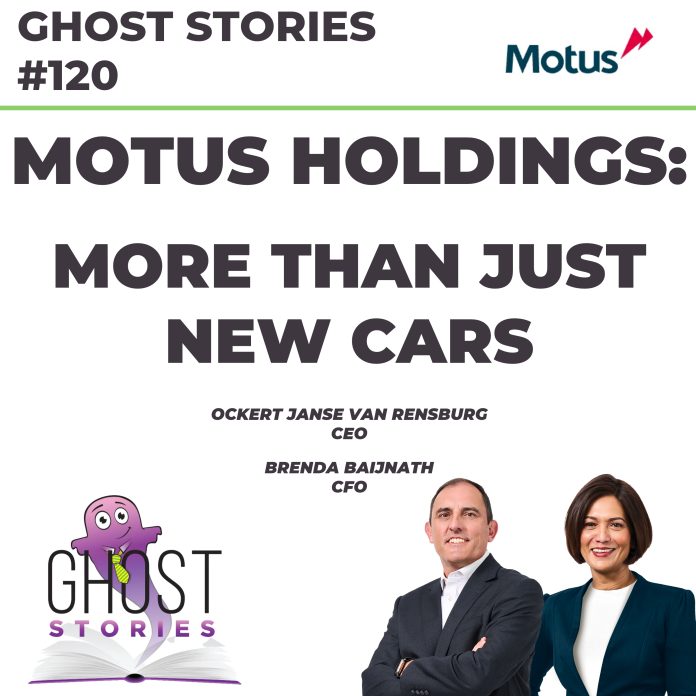
CEO Ockert Janse van Rensburg and CFO Brenda Baijnath have shared generously on this podcast. There’s so much information in here, ranging from an overview of the group operations through to the details of the Chinese opportunity, the financial risk matrix, the cyclical vs. structural nature of the business and the medium-term outlook.
For those looking to do detailed research on Motus, this is an excellent resource and a useful way to understand just how much sits behind that one-in-five statistic.
In this episode:
00:00 Intro
02:04 Motus as a vertically integrated group
03:52 The import business: bringing five brands into Southern Africa
05:26 The retail business: selling 1 in 5 vehicles in South Africa
07:39 Mobility Solutions: value added services and long-term revenue streams
09:07 The pre-owned business: Motus is number 2 in South Africa
09:37 Car rental: Europcar and Tempest and Auto Pedigree
10:46 Workshop activities
11:20 Aftermarket parts extend the customer relationship
15:00 New vehicle sale margins and the broader financial profile of the group
20:27 A few elements of the model that investors miss
21:48 Aftermarket parts as a growth vector
23:30 The Chinese and Indian disruption – or opportunity?
27:40 Avoiding the false start by some Chinese brands
29:08 How Motus is responding to the Chinese opportunity
31:31 Workshop technicians for the Chinese brands
32:52 Margins in the Chinese era
34:34 Recent comments at the AGM
35:25 Ockert’s views on Chinese market share
36:18 Impact on the pre-owned space and the importance of stock turn
38:19 Is Motus a cyclical play, or is there enough of a structural underpin?
39:52 Digging into the financial risk matrix and financial KPIs
44:05 Closing thoughts: Ockert on the investment case
45:32 Closing thoughts: Brenda on the medium-term outlook
46:55 Outro
This podcast has been sponsored by Motus, but The Finance Ghost was allowed to ask whichever questions he felt were most pertinent for an investor audience. Please always do your own research and do not treat this as an endorsement of the stock.
🎶 by Atlas Audio from Pixabay
Transcript:
The Finance Ghost: Welcome to this episode of the Ghost Stories podcast. As we’ve seen in the statistics and certainly on the roads around us, things have changed quickly when it comes to new car sales.
I’ve been a petrolhead pretty much my entire life, and it is quite something to see what’s going on out there and how dramatically everything is changing.
It’s having an impact throughout the value chain. It’s driving some pretty big share price moves internationally and locally in the sector, all the way from car manufacturers down to local distributors.
To help us understand what all of this means for their business, we are lucky today to have the Motus team on the podcast.
That is Motus CEO, Ockert Janse van Rensburg and CFO, Brenda Baijnath. Motus has sponsored this podcast, so just be aware of that, please. But as always, I’ve been allowed to ask whatever I think is pertinent from an investor perspective.
Ockert, Brenda, thank you so much and I really appreciate you being on the show.
Ockert Janse van Rensburg: Thank you very much, and thanks for having us.
Brenda Baijnath: Thank you very much. It’s always a pleasure to join you.
The Finance Ghost: So, Ockert, let’s start with you. Many investors tend to make the mistake of thinking that Motus is really just a vehicle dealership group. I think it’s a relatively easy mistake to make, but if anyone does work through your actual reporting, they’ll quite quickly see that there’s so much more to the business than that.
The dealerships are an important part of what you do, for sure, but there’s way more vertical integration going on here. So, perhaps just to kick us off, it’ll be helpful for you to just give us the full picture of the Motus Group, how these different operating segments fit together, and what you think investors tend to miss when you engage with them about Motus?
Ockert Janse van Rensburg: Thanks, Ghost. I think what we’ve seen is exactly that. A lot of people tend to use the data points that they see, and the easiest mistake people make is just following new vehicle sales per month, because that’s what NAAMSA reports on. And then, of course, people make the secondary mistake of only looking at South Africa.
But I think, as you could see, our group has obviously been put together over 75 years, so clearly a lot of work and effort has gone into it by my predecessors to really make this a fully integrated business model.
Now, integration is sometimes good and sometimes it’s almost frowned upon, because you create over-complexity. But I think, in our case, what has really helped is that it is very focused around a specific market. It is focused around the automotive life cycle.
As one of my predecessors also taught me when I arrived, he said, “The easiest bit is you sell the vehicle, you try to stay with the vehicle for as long as possible. You sell it to a customer, and you try to stay with the customer as long as possible. If you get both of those things right, you are going to have a very successful business over time.”
Obviously, it takes a lot of effort to try to put that all together. But if you’ll allow me some time, I’ll take you through the different segments and just explain a little bit of what is sitting inside this beast called Motus.
The first bit, and almost the entry point for most of our conversations, is that we are an importer of vehicles. So, we are the exclusive distributor and importer of five brands: Hyundai, Kia, Renault, Mitsubishi and (more recently) Tata.
So, those five brands, we are able to negotiate directly with the original equipment manufacturer (OEM). We effectively take over their requirements in the country. Slightly broader than just South Africa – we also move it into neighbouring countries as well, into Africa.
And for those five brands, we actually have a very nice, sleek system that’s been developed over a number of years.
When you start analysing why it is so easy to bring in even a new brand like Tata, as we did last year, it’s because we’ve got a system where you start at the port. We’ve got 23,000 bays at the port. As it’s docking at the port, you can actually put it into a bond store.
Those vehicles move on from there to dealerships – so, there’s a whole dealership network and obviously we’ve got arrangements with carriers, etcetera. So, from a logistics perspective, it’s actually fairly seamless.
When we launched the brand last year, we said, “This is really a plug-and-play, if you understand what you’re doing.” And higher volumes, especially, make a massive difference to this.
Moving further from that importer segment, what you then do is bring in not just the vehicles, but also all the associated parts relating to those vehicles. So, you’re a parts importer at the same time.
Those vehicles then move to our second segment, which is really the retail outlets in this regard. So, let’s just first stick to the importer brands we represent. We’ve got approximately 70% of the retail network that we own, as well.
So, that would mean the dealerships that you see in High Street, where it says Hyundai or Kia or Renault – in 70% of cases, that would be ours.
We also make use of independent dealership groups, from your larger listed groups right through to smaller groups in rural areas where we’re not necessarily able to do justice to a smaller town.
In those cases, you’ll normally find that those dealer groups do a better job than what we can as a large listed group. They’re into the communities, into the golf clubs, etcetera, and making sure that they understand their customer base.
So, apart from the importer brands (which obviously make up a big percentage of what we buy and sell), we also represent all of your other major brands. In fact, we represent 43 brands in South Africa.
Apart from the five, as you can hear, that’s another 38.
Combined, that gives us very nice scale. Scale is always interesting to note. In our business, volume does make a difference. We like to pride ourselves that we’re still selling one out of five new vehicles in South Africa.
Our importer brands, right through the cycles, with all the disruption taking place, if you go back to 2019 and you fast-forward all the way down to where we are now, we’ve always been roughly at about 16% to 17% importer brands of the new vehicles, and then another 4% on top of that for all the other brands that we represent.
That’s basically how we get to this 20% market share that we’ve got.
Obviously, just selling new vehicles, it’s a great business to be in. But even though it’s the one that everyone tends to talk about the most, new vehicle sales is probably the one that’s the toughest, and there’s a lot of competition involved in it.
In this last financial year, we’ve sold 96,000 vehicles in South Africa (so, quite a large number, as you can hear). But then what you also find is you have to load this onto a platform where there’s longevity in the product.
So, coupled with the new vehicle sales, we also have the ability to sell service and maintenance plans, warranties, all kinds of other value-added products and services (VAPS) with those vehicles.
And as this business has matured, we’ve also created a Mobility Solutions business. This is probably the one that most people tend to completely miss when they talk about Motus. Because they see it as that initial, once-off profitability, while Mobility Solutions actually provides you with that long-term annuity income stream.
And as I said at the beginning, you want to try to stay with the customer or the vehicle for as long as possible. So, if there’s a warranty product, there’s a service or maintenance product that you sold with this vehicle, you can then stay with it much longer.
Coupled with that, you also then have the ability to sell the parts into the dealership network as part of that solution.
How that would normally work is, on day one, you’ll sell a service product. You receive the money upfront. The cash will sit on your balance sheet, so you will also have the ability to put that to good use (and I’ll get to how we put it to good use just now).
But at the same time, you then sit on the funds. You have actuarial valuations, of course, of how you need to account for this over the period. And most of that income stream is then over, call it, a five-year period.
If you analyse just that Mobility Solutions piece of ours, you probably sit with about 70% annuity income in that part of our segment.
Over and above that, in the dealership network, you also sell a lot of pre-owned vehicles. We are the second-biggest pre-owned company in South Africa when it comes to vehicles. And this last year, we sold just under 70,000 pre-owned vehicles.
We get that from a number of sources. Most of our sources, obviously, because you trade so aggressively on new vehicles, you get a lot of trade-ins as well. But that’s probably been one area where, maybe a bit later, we can touch on exactly how difficult that market is.
Over and above that, inside our retail and rental is also another area, which is car rental. So, we are the franchisees for the Europcar and Tempest brands. In that space, we have about 18,000 vehicles on average which we rent out on a monthly basis.
We participate in all parts of the market in that regard. So, you obviously have your normal local and international leisure, which most people will be aware of. But there’s also a fairly large component which incorporates government, corporate and then the insurance market.
The insurance market is an interesting area of that business. It gives you a nice utilisation throughout the year. Probably the less profitable piece, but it makes sure that you keep those utilisation levels quite high during the period, while your international travel is the one with the higher margins. But it is a bit more cyclical during your summer periods in Cape Town, for instance.
As those vehicles come to the end of life, also as part of this integration, those vehicles become part of pre-owned, and we sell them through our own dealer network. We’ve got about 65 dedicated Auto Pedigree dealerships just selling the car rental side of things.
Inside those dealerships, obviously, you have a lot of workshop activities, service, etcetera. It also forms part of that integration because, a lot of times, that’s where you get your nicest leads – where customers continuously bring the vehicles in for servicing; you can see when the replacement is required.
You can also upsell products during that period when a service plan comes to an end, or even something like scratch and dent or roadside assistance, etcetera. So, that all becomes part of the bigger grouping inside that.
At the end of a period (let’s call it seven years), when the warranty eventually expires, normally we then find that there is quite a steep drop-off. We tend to try to hang on to the clients, but you find that a lot of people then take it to their brothers, sisters or uncles, to see if someone else can service the vehicle.
We have seen that drop-off happening over a number of years. Prior to our separate listing in 2018, that was probably the one area of the business that was fairly weak. As soon as that drop-off happens, you lose out.
We did put a lot of strategic measures in place to see how we can strengthen the whole aftermarket parts area. And that is where you would, through our own stores – Midas and Alert Engine Parts – actually service the extra part of that business, of this automotive cycle, as there’s this drop-off.
When we stood back – and this is probably just talking a little bit about the strategy. Just bear with me a little bit here. I just need to make this point because I think there are also areas where people don’t really even know we participate in them.
When we stood back, we looked at Midas and Alert Engine Parts and said, “Well, how do you actually make this more profitable? It’s a very competitive environment. You import pretty much from the Far East. How would you actually make this a better business?”
Now, one is obviously just looking at footprint, but over and above that, what we did is analysed the business and said, “Well, where are all these products coming from?”
And since engine parts are mainly coming from Taiwan and hard parts are mainly from China, we then started with a backward integration where we actually went to China. We put up a distribution centre there. We bought a smallish business in Taiwan, which was a wholesaler directly into South Africa. And, in doing so, we were able to immediately have a small margin upliftment.
We realised, however, that by doing that, you could only stall because of the volumes you sell in South Africa. We think we are a big market, but when you talk to China, we are only selling 600,000 cars. They’re selling 24 million. You’re actually not really big enough, and you still have to work through agents to actually get to these parts.
When we looked at it, we said, “Okay, what other markets could we go into to just give us bigger scale and volume so that we can actually unlock a bigger portion of this margin?”
And another big market that we’re in (and we haven’t spoken about it now, but we can talk just now about our other international footprint) is the UK, which we’ve been in for some time. We acquired two businesses in the UK in quick succession after each other in the 2021 and 2022 financial or calendar years.
By doing so, we’ve actually been able to increase the total volume of aftermarket parts that we’re sourcing. That meant we could go to China. Now we don’t have to go through an agent. We can actually go directly to the factory and get an additional margin upliftment.
That’s probably the one other area that we’ve been working at quite hard in the last few years and putting together.
I know it was a bit of a roller coaster trying to take you through the circle, but as you can see, it all fits together in the end. We can touch on a few of the additional aspects, if you want to?
The Finance Ghost: Yeah, thank you. There’s obviously so much going on in this group. The word ‘integration’ comes through there a lot more than diversification. That’s the one thing I definitely picked up. It’s all about that value chain, right?
You also mentioned ‘plug and play’. When you bring in something new, that certainly makes sense. You’ve got the infrastructure there already; you’ve got the stuff you need. In terms of scale, you referenced the 20% market share.
This podcast actually came about because of the YouTube video that I did independently of you, called ‘Motus Operandi’. I just dug into everything you’ve got basically and I focused on the vertical integration, so it’s good to hear it from you in your own words now, as opposed to me just reading your financials and actually interpreting them myself. That’s, of course, why I love doing these things so much.
Brenda, I think it’s time to bring you in here because something that I know about new vehicle sales, is that the margins are not the biggest. In fact, I think it’s really only the poultry sector who still look up at you and go, “Oh, I wish we could have margins like that.”
But I reckon everybody else is looking down going, “Oh, shame,” like the poor poultry people are used to.
But of course, that’s just one part of the value chain. It’s about getting the stuff on the road and then everything else that comes from that, down the line.
I’d love for you to just take us through that. This is such a complex and interesting group, and the economics are different in these different business models. Maybe you can just walk us through things like revenue, revenue quality for that matter, the margin profiles, working capital differences. Just some of the high-level stuff that’s top of mind for you as you look at the shape of this very interesting group.
Brenda Baijnath: Thanks for that, Ghost. What you’re going to hear me talk about a lot is around the integration as well, but also the diversification. Joining Motus just two years ago, that was probably what stood out for me the most, in terms of how diversified this business is and the scale that we have that allows us to be able to manage through the different cycles.
As you rightly pointed out, and as Ockert has illustrated quite nicely, within the importer and distributor business, we see large amounts of volume, right? He quoted a number, saying, “We sell 96,000 vehicles in a year.” So, high volume, highly transactional.
What we see is that, typically in the importer segment, our operating margins average between about 4% to 5% per annum.
Now, the benefit that we have in there is that we do have a well-invested infrastructure base which allows us to be able to plug and play. So, any additional volumes that you are adding in, you are basically extracting operating leverage, because the cash fixed cost base is already settled and anything above that then becomes incremental.
Now, the trade-off of running such a fantastic business or segment is actually then on the working capital. So, because you need to keep the dealer channel fresh at all times, it means on average you need to stock about 90 days of inventory. And, particularly given the Middle Eastern conflict that we are seeing currently, supply chain disruptions can be quite challenging at times.
Carefully planning the supply chain, working very closely with the OEM, ensuring that the product quality remains relevant and attractive to customers – that’s all part of how we actually generate value within this business.
So, 4% to 5% operating margin, really looking at revenue items being slightly lower because the average selling price is about R250,000 a car within this segment.
But, more importantly, when we look at this particular division, how we measure performance is really in terms of their return on invested capital (ROIC).
So, for every rand that we’re investing into this business, we look holistically to make sure that we are at least exceeding the weighted average cost of capital by 2%. Very happy with this type of business.
Importantly, as we look into the medium to longer term, if there are greater needs or opportunities to add more importers, this would definitely be an area where we can immediately see operating leverage being released.
From a retail and rental perspective, so Ockert said to us that we have 43 brands. That is quite significant in terms of the number of OEMs that we manage. And then, with the rental business sitting in there, in South Africa, in Australia and the UK, we are also represented by retail.
Now, as you said earlier, when you are selling new vehicles, the margins that we see are probably at about 2.2% to 2.5%. So, not really making a strong margin on your entry level. But it is a highly cash-generative business because the cash generation is usually sitting at about 95% to 98% in terms of how fast you can convert that cash.
So, high-ticket items – usually, we would see the average car that’s being financed in this particular environment is between R350,000 to R400,000 in the particular trading environment in South Africa. So, high revenue, low margins, particularly.
However, where we do see a lot of extraction in terms of the operating profit is really what we spoke about earlier around parts, servicing and workshops. It’s ensuring that we constantly touch the customer and that we’re able to then extract value across the lifecycle of the vehicles.
What’s unique for us in the UK is that we currently have exposure to the commercial trucks. We have about 20% of the 30% market share that the DAF brand holds in the UK.
And, within the UK environment, the regulatory environment dictates the servicing of those trucks on at least a six-week cycle. So, effectively, that becomes an annuity income for us.
Our presence in the UK in commercial trucks is spread around new truck sales as well as after-sales servicing. More than 80% of the operating profit that you see in the UK coming out of commercial trucks is the servicing thereof. Therefore, we consider that to be an annuity-based income.
Ockert did briefly touch on car rental, and the car rental business is also an annuity-based income because those cars are turning quite regularly. The average utilisation rate that we target is about 70%. Hence, we see that, particularly over the tourism period, we are able to extract maximum value out of there.
But more importantly is that we can then derive a second revenue stream by actually selling that vehicle as a used unit.
One of the things that many of our investors miss is that we do make a 4% to 5% operating margin in the importer, but second to that, we then have a secondary margin when we sell the vehicle via our retail business. So, one would actually have to add those two margins together to look at it from a new-vehicle perspective.
Now, Mobility Solutions. We’ve spent a lot of time talking about the service plans as well as the warranties that we are registering. This business continues to benefit from the higher vehicle sales in South Africa.
As alluded to earlier, about 70% of their operating income is annuity-based because effectively we build the fund on the balance sheet and it gets released as the service plan is being utilised.
Another key feature that investors miss is that we have banking alliances with three of the major banks in South Africa. So, as we are financing these vehicles, effectively we then have a profit-sharing agreement where we then share in the profit post credit risk in terms of the banks. That adds a significant component to the operating profit of Mobility Solutions.
Now, one of the misnomers again is that when many of our investors look at Mobility Solutions, they see the revenue number is quite muted. The reason for that is almost all of their income that is being generated is actually recognised directly in operating profit, as opposed to the revenue line.
Turning to our aftermarket parts business, and even as we look forward, we do see that this business is a growth vector for us. The margins that they realise are significantly higher.
And for example, in our international aftermarket parts business, the margins that we are currently seeing are probably between 10% to 12% (that compares to the new vehicle sales that I referenced earlier of 2.5%).
So, you can see that from a parts business, there’s a significant value unlock that is sitting in there. We’ve already started to unlock some of that value by actually sewing up the supply chain directly out of China. And there’s still more that can be done.
Similarly, on the operating leverage, because the infrastructure and the supply chain are already in place and we have the warehouses being set up, additional volume that we can push through this business will add directly to the bottom line.
Hence, opening warehouses and reaching new customers in new territories that are adjacent to our UK business become a significant value unlock for us as we progress a bit further.
Really, what I’ve said to you is that the diversification of our business model allows us to play in different parts of the vehicle life cycle to access margins that range from 2% all the way up to 12%.
But more importantly, as the market changes – as the customer’s preferences start to change – we are able to still be generating income by accessing those different market streams.
Hopefully that gives you a good sense of how and where we operate.
The Finance Ghost: Thank you so much, Brenda. I’m really excited to hear you talk about things like ROIC as well. I think it’s great when CFOs talk about return on capital and not just margins. I tend to treat that as being very encouraging.
Ockert, back to you. I know we want to try and talk about the UK and Australia and we will see if we have time for that, but there’s something we need to get to first: the disruption from the brands coming from China and India.
Now, disruption versus opportunity is perhaps the first debate here. You’ve already referenced that you’ve gone and picked up Tata as the importer and distributor – well done for that!
But I’ve got to say, what’s going on, on the roads, is probably the most remarkable example of disruption I’ve seen in my life. It’s fascinating. It really is.
But it’s not something that you haven’t seen before, albeit perhaps to a lesser extent. And that’s in the form of Hyundai and Kia coming in a previous era where South Korea suddenly burst onto the scene and became a serious player (and has stayed a serious player, actually). So, that gives you some experience with what’s going on here.
I’d love you to just talk to the way that Motus is responding to what’s going on in terms of how people are changing the way they buy vehicles.
And maybe just also speak to the importance of being in these brands that are pushing cars through the system. Because something that’s come through clearly from both of you is you need to sell new cars today to be make margin down the line with all of the other services that you’ve got in this vertically integrated model.
So, if cars are just sitting, then that can quite quickly become a big problem in this space, right?
Ockert Janse van Rensburg: Yes, I think it’s probably the one conversation that you’re having every time you see anyone around a braai as well. Everyone wants to know about all these new cars coming, and specifically China seems to be quite topical.
I think what is quite interesting still is that, despite everyone talking about China, more than 50% of vehicles still come from India. And that’s also a fact that most people miss because the brands are just more well known.
Because in the case of Hyundai, Kia, Renault and Tata, we actually bring those vehicles from India. But then also Suzuki and Toyota pretty much bring all their vehicles – and Mahindra –bring their entry-level vehicles from India as well.
That’s why there was almost a small takeover of the entry-level space by Indian-manufactured vehicles. And now you see the Chinese almost trying to dominate this SUV, middle-of-the-road type of space.
But listen, disruption provides opportunity. So, that’s why you have to look at it as well. I think if everything was static, it would actually be quite difficult.
And we’ve probably seen, even in years gone by, when all the local OEMs had everything nicely sewn up, you almost had very little opportunity to try and penetrate another area of the market, because it was already so nicely organised. So, disorganisation is sometimes opportunity as well.
So, where we started off is – let’s just talk about the Chinese. I think the Indian side, you understand that we’re already playing quite aggressively there. And of course, bringing in Tata has now certainly helped.
But I think on the Chinese side it was a little bit more difficult. Firstly, because the brands are not well known. We had to do a lot of homework on exactly which brands will eventually be able to make it.
And in this regard, one of the benefits we’ve had is that we actually have this international footprint. The first market that was penetrated by the Chinese has actually been Australia. So, a lot of the learnings we adapt in SA come from what we’ve learned in Australia.
Australia is much closer aligned to China. And you would see, even now, a lot of new energy vehicles being sold there, which is another new phenomenon that’s coming through that hasn’t quite reached SA yet. So, Australia, UK, that’s where we get a lot of learnings.
Over and above that, obviously needing to go to mainland China, trying to see exactly which vehicles are being manufactured in which provinces so that you actually have a sense of who’s going to make it and who’s not.
And why I say that is, there are so many. I mean, you keep on losing count. At one stage it was 80. Now, people say it’s closer to 140 different brands inside China.
What that then means is that, in a lot of cases, the vehicles tend to look very similar, react the same, but there’s also benefit in that (and I’ll get to the benefits now).
The first round, I think we almost just said, “Okay, let’s just see what’s going to happen and what tides are coming in and going out.” Sitting back, sometimes you can be criticised for it, but you do have a much better understanding of what you then need to get into.
Why I say that is, a lot of brands also had a bit of a false start. If you take some of your well-earned footprint with our dealerships, we have 340 dealerships now.
If you give space up to bring a brand in – and we normally bring some of these new entrants in what we call multi-franchising (so, you’ll go to the showroom floor and split it into two or three, still having the workshop activity at the back for the more traditional brands).
But as soon as you give up that space, you can’t easily keep on chopping and changing those brands every day. So, you have to make sure if you go aggressively with a brand, you also know that they’ve got long-term ability to really produce product.
Parts are very important. Obviously, that’s been a big discussion point of recent times as well, because people are struggling a little bit with servicing on those vehicles.
I think where we find ourselves now, we’ve pivoted fairly quickly from, call it, 18 months ago to where we sit now. And now, we actually have a very good representation in South Africa of all your major volume-sellers.
So, the likes of Chery and GWM; all the Chery brands around them (Jaecoo, Omoda and Jetour, and now Lepas and iCAUR – the list just goes on and on). And obviously, the GWMs have actually been doing well. But more recently, we also have BYD, BAIC, MG, and the list, as I said, just keeps on going and going.
But it is difficult to decide which ones you want to take and where to take them.
Now, from an importer perspective, there’s very little opportunity initially. As all the new entrants came in, they were really trying to get market share. Virtually no profitability left at the importer level, so it was really difficult to try to have some sort of joint venture activity there, although we had a lot of discussions.
I think as the markets have now changed a little bit, your opportunity still exists and will probably come up again for discussion. Purely from the fact, as you said earlier as well, I told you, we’ve got a bit of a plug and play here. So, there is definitely opportunity there.
Where we have played more aggressively was in this retail space. And the retail space, I think we’ve probably pivoted towards the brands we feel can produce a lot more going forward.
But it is a balancing act because all your traditional brands are still in play. If you stand back in a dealership space, you’re still making more money from those traditional brands. So don’t give it up while this new one is growing. You basically have to weigh them up against each other with the footprint that you’ve got.
I think our biggest benefit has been the footprint presence that we’ve got. We own about 80% of our own property, so we can decide what we put in, how we actually split it up and try to solve it that way.
Another area where we’ve actually been quite successful in working with the Chinese has also been in administering the service and maintenance plans. We’re doing roadside assistance and other sorts of services, which they want.
If you just imagine starting a new brand in a country, you don’t have all the expertise on day one. So, we’ve been able to also get a few working groups there together and also solve for other solutions or concerns that those brands would have had.
On the parts side, I think that’s probably the one where we feel, at the moment, the disruption has started, but you haven’t quite seen it. The Chinese don’t actually have a great record thus far of having big distribution centres, so workshop activity has been difficult.
You can feel it already that you have a few vehicles off the road still in your workshops. More recently, even the more established Chinese brands have been struggling a little bit.
That gives you a new complexity in your business. Because you’ve already created the space for them, but now they actually need to start giving you those second and third levels of profitability.
We do, however, see that as the next wave and all our businesses have really been geared up towards that. We’ve done a lot of training around it.
A lot of people have asked us, “Well, how do you get workshop technicians for all these Chinese brands?”
The interesting fact is that most of the ICE engine vehicles that you find in the Chinese brands came from your traditional OEMs, when they started off in China, putting brands together.
So, the VW technicians are in high demand because a good VW technician can virtually work on any Chinese vehicle, which is this interesting little fact that’s come into play.
And then, of course, there’s also the new prevalence of hybrids that’s coming through, which is interesting by itself because you had to train for that as well.
We have seen that wave already, as I said earlier, in our other geographies. We’ve learned there what you need to do and how the charge-out rates need to happen, because you obviously have a different calibre of person who needs to work on the electric vehicles. A different skill set is required altogether, and your training needs to be appropriate.
We are fortunate, from Motus’s perspective, that we train virtually for the whole network in South Africa. We train 1,500 technicians a year through our three centres in Gauteng, the Western Cape and KwaZulu-Natal.
We are also able, then, to make sure that we actually start training those technicians already from early on in electric vehicles. So, I think the industry as a whole will benefit from that, but hopefully our own network as well. It’s an interesting dynamic that we’re playing in.
I think the other area that you asked about earlier was around margins, etcetera. Obviously the one driver you had was OEMs post-Covid. There was a lot of supply disruption. In supply disruption, what can happen is – it’s all around supply and demand. In your good old economics days, you will remember that.
What happened was the OEMs were actually just getting slightly greedy. They created more margin at the OEM level and created an opportunity for disruption to take place.
The Chinese brands really just moved into a space where they said, “Well, we can actually produce; we’ve got excess capacity.” And they moved into that corridor. Not just in South Africa, obviously, but around the whole globe.
And now it’s all around the OEMs – the more traditional ones – trying to dial back and actually trying to save costs to stay price competitive.
What it has meant in South Africa is there’s been no selling price inflation on new vehicles. And that’s created a massive amount of pressure on the whole system in totality.
OEMs need to make sure that the dealer network can still be profitable. So, they need to leave enough money on the table for the dealers. But you can see, with cost pressures on the one side and no selling prices on the other side, it is quite difficult.
Over time, you’re probably going to see more amalgamation and shake-up happening in this space. Like I said, disruption provides opportunities, so we just need to make sure we position ourselves correctly for that.
The Finance Ghost: Yeah, absolutely. I don’t think we’re anywhere close to seeing the end of – I suppose the way the legacy brands will have to respond to this? I think the European brands need to really lean into their heritage, and I fully expect to see more amalgamation on that front. We’ll have to see how that ends up playing out.
To your point, it is an opportunity, but it’s also a huge disruption for the space.
If I pick up on the comments you made at your AGM, you talked about how yes, volumes may be up, but because of average selling prices coming down, the net result is not necessarily an exciting story at all for revenue, at least in the near term.
I guess it’s the age-old story that when there’s a huge change like this in a market, it’s generally the consumers that are winning, at least for now. And then at some point we surely have to hit equilibrium, because you can’t have everyone in the sector bleeding forever. There’s a change in market share and everything else, and then at some point there’s a new normal.
There was interesting commentary from one of your competitors recently around a lot of this stuff. Chinese parts availability (you’ve touched on it here); some of the discounting at legacy brands as well.
Before I go back to Brenda, I would like to just ask you if there’s anything you want to add that you haven’t already mentioned? Just around where you think this market is going; Chinese market share as well.
It’s a difficult thing, obviously, for you to put out a forecast publicly. So not necessarily asking for that, but rather if there’s anything else you want to add to the discourse as people try to understand what’s really going on in this market?
Ockert Janse van Rensburg: Yes, I think what is interesting to notice, even in the countries and geographies where you’ve had this disruption taking place over a longer period, you still see that your traditional brands have been able to still retain some market share. So, I don’t think you’re suddenly going to get 100% coming from only one place in the world.
I think South Africa is very different because you’ve got these very large Indian production facilities also sending vehicles here. So, you’re still going to see that continue. That’s not a very attractive area for even the Chinese manufacturers because it’s not really product that they sell in their own country, so it’s a difficult area for them to move into.
We haven’t discussed this really, but it does play out into your pre-owned space now. Because as you see these new vehicles, all the pressure on that, obviously the next cycle is just then going into pre-owned. And you have already seen that part of the disruption starting there, as well.
You buy a vehicle at a cheaper price on day one, there’s still depreciation and a lower price further down the track.
I think that how we’ve positioned our own business around that is just trying to have your stock as fresh as possible so that you spin and turn through it very quickly.
A number of years ago, I think this was something that most dealer groups were almost struggling with. Not from a turn perspective, but making sure that they priced correctly.
And I think the start-ups (or it wasn’t quite start-ups, it was just businesses maturing themselves through these larger supermarket-type concepts) proved that if you can get your valuations right, you can actually price better and turn those vehicles fairly quickly.
So, what we did internally is we bought a business that had the technology in it already. We took the technology, effectively made the algorithm or the robot just smarter by pushing a lot of volume through it.
Obviously, as I said earlier, just in South Africa we sell 70,000 units ourselves, excluding the ones that you could scrape from the internet to really drive it through an algorithm like that.
We’re quite proud of what we’ve been able to do. In these last three reporting cycles now we’ve had 5% volume growth consistently every period with our used vehicle volumes.
And what this has meant is, because we were pricing right and we were able to pivot quite quickly into the right area there (and even at the AGM, like you said now, we’re still seeing it for this six-month period as well), our pre-owned volumes are still up.
That tells us we’re pricing right for all those trade-ins coming our way, and we’re getting a bigger stake of that market, even though there’s a lot of disruption taking place at the moment. I think you just need to be very agile in this environment.
The Finance Ghost: Brenda, let’s bring it back to you because the key theme that’s coming through here across all this disruption, for me at least, is that consumers are looking for deals.
If you bring them a brand, even if they’ve never heard of it before, but they can get into an SUV for half the price, sometimes even less versus some of the, say, German competitors, for example, then people are trying it out. This tells me that consumer spending has got to be one of the front-of-mind risks for you.
But you’ve also got this really important underpin of things like used cars. You’ve got parts, you’ve got Mobility Solutions, you’ve got a lot of other stuff in here as well.
So, in your mind, as you think about the financial risk matrix at the group, do you believe that investors should be seeing Motus as a cyclical play, or do you think there’s enough of an annuity income underpin here that it has got some structural elements to just smooth that out?
Brenda Baijnath: Yeah, thank you. That’s a great question because we’ve really been trying over the past two years to change the narrative that sits with the investor base and to demonstrate that we no longer have that cyclicality play that was probably there for a few years.
And the reason for that is because we’ve been quite intentional to try and grow the non-vehicle services revenue to almost compensate when we do see some cyclicality in vehicle sales.
Hence, you see a lot more investments going into the aftermarket parts that are yielding higher margins. A lot more emphasis also into growing our car rental business, looking at longer-term rentals. So, almost trying to invest more, even into Mobility Solutions, so that we can buffer the annuity income such that our earnings base now becomes a lot more predictable into the future.
In terms of the financial risk metrics, one of the things that we look at very closely is the cash generation. In a year, Motus normally generates about R8 billion in cash. That is usually due to the high cash-generation ability that we have to be able to quickly convert that vehicle stock into cash.
On average, our credit terms range between seven days to a maximum of 30 days. And that allows us to have a very nimble and effective treasury system as well. So, cash generation remains key to us, but more importantly, it’s also around working capital.
We were criticised a few years ago for having extremely high debt levels, high levels of working capital. Hopefully, you’ll see that in the past two to three years we’ve actually managed to get that number really low.
It’s also working very closely with the OEMs, as well as on production cycles, to make sure that, from an ordering and production perspective, we were getting better alignment and that we can now narrow down the ordering to about 60 days. So, that helps us as well.
Working capital is key. Cash generation is also quite important for us.
You would have seen that we’ve issued our inaugural bond. It actually came in very successfully below the price that we were asking for and raised R1.8 billion debt. That amount will now be used to refinance some existing debt that was quite expensive, and that really talks to the strength of the balance sheet.
So, although we may see some margin pressure due to the factors we discussed a bit earlier, I’m proud to say that, from a balance sheet perspective, we’re probably in a very strong position, where we are now, to actually manage some of the cyclicality or volatility that we may experience in the months to come, following the US elections.
I think we often look at the strength of the balance sheet to make sure that we can weather the storms that may lie ahead.
Margin resilience is also really important. You may have heard terms such as “money on the bonnet”. We try not to do that and actually try to maintain the margins that we currently target or aim for. So, margin resilience is quite key.
And of course, as I said to you, it’s return on invested capital (ROIC). Here, it’s important that we don’t just look at it on a portfolio basis, but every single business has to deliver a ROIC that is 2% above weighted average cost of capital (WACC).
Importantly, for our international operations, we don’t take money from South Africa overseas. And even those operations, if they have acquisitions, they have to be able to finance them on their own. So, we’re quite nimble in how we manage that.
More recently, we’ve started to share return on equity (ROE) as a measure with the market. You would have seen that last year we actually had share repurchases to the value of 10% of our market cap. And as a result, our ROE also improved to about 15%. So, that’s also coming onto the radar as we look at cash, ROE and ROIC.
Likewise, we also increased our dividend policy last year and we’ll keep it at that level going forward, which is now 40% of headline earnings per share (HEPS). And that again talks to the earnings as well as the cash generation power that lies within Motus.
And lastly, it’s a bit of a leading indicator as we now look at workshop hours, because that effectively tells us how long in the vehicle cycle we are able to stay with the customer.
Here, we would measure the number of vehicles that we sold versus the number of vehicles that we are servicing. The moment we see that there’s a drop-off, there’s then an action plan that gets put into play, in terms of contacting the customer and actually making sure that they can stay with us over a longer period of time. So, effectively, that is how we manage the cyclicality.
To some extent, geographic representation also helps us. What we have noticed over the past few years, in terms of a trend, is that when South Africa is underperforming, our international operations overperform to compensate. Likewise, we see that now, with South Africa booming and our international operations taking some pressure.
So, that international or geographic representation also helps to balance the scale, to some extent. I hope that gives you some colour in how we manage the business.
The Finance Ghost: Thank you, Brenda. That absolutely does give plenty more detail there. And that’s one of the times where diversification actually comes through, not just integration, and specifically talking about the international exposure there.
Ockert, some of the stuff that you’ve been referencing around international (and you said it earlier) – you can learn from Australia, for example, and you can have these learnings across your markets, right? Across the different divisions and just bringing it all together into one group.
So, as we bring the podcast to a close now, and we’ve really learned a lot about Motus here, what is the one message that you would ideally like to leave investors with, in terms of the Motus investment case? What do you want them to take out of this podcast and consider, as they look at the company?
Ockert Janse van Rensburg: It’s difficult to just have one, but I think the reality is that we’ve built this fantastic platform. I think what is important is that you can leverage off this platform in so many different ways.
We’ve spoken about integration and diversification, but if you actually stand back and you see exactly what we’re trying to do, if you can have market leadership at the front end, you build a team around you – and I think we’re still busy with that – continuously training; letting people understand the complexities (because remember, if you have all these new brands arriving, etcetera, there are lots of complexities).
So, train your people to deal with that and you’re able to actually just unlock that extra value growth. I think that’s how you’re going to strengthen this over a longer period of time.
And probably the one area I’ll leave for investors is don’t have one-lane thinking about this. It’s not just about the new vehicles. It’s actually that full automotive value play that we’ve got, including Mobility Solutions and aftermarket parts, probably the two biggest areas which people tend to completely miss when they look at the share.
The Finance Ghost: Brenda, finishing off with you then. As you cast your mind to the future and you think about your financial planning as the CFO and all the other things that you need to wonder about, what does your medium-term story look like? How are you feeling about the next few years?
Brenda Baijnath: Thank you, Ghost. At the results presentation, I said that the investment case for Motus is compelling, and that really talks to the excitement that’s building over what can come over the next few years.
We have built a solid foundation that we’re able to grow from now. The balance sheet is looking healthy. The cash generation is in place.
So really, in terms of the medium term, the aftermarket parts business remains a growth vector for us to be able to expand into adjacent areas and capture those higher margins that we are seeing.
Second to that is, as we are seeing the rise of new energy vehicles, we are ready; we are prepared. We’ve done the technical work, and we know that we will be able to serve that market.
And lastly is our Mobility Solutions team. I strongly believe that we have one of the most experienced teams in the world and that we can actually cater for the Chinese brands as they start to enter the market, administer and service service plans (so to speak), as well as offer roadside assistance and some of the VAPs that we have.
So, the opportunity is really looking fantastic at this point in time, and we remain optimistic as to the growth of Motus over the next few years.
The Finance Ghost: There we have it, folks. You can either sit back in disruption, or you can run at it and see what you can achieve with it.
Brenda, Ockert, thank you so much for your time and your support of the platform. I think this has been fantastic. This is really what I’m passionate about: giving the listeners and readers of Ghost Mail so much more access to management than they would otherwise have.
Thank you for your time and your support, and all the best for what is a really interesting time in the market that you play in. Good luck to you.
Perhaps just a reminder here to listeners to always do your own research. Treat this as just one part of your research process, and please do not see it as an endorsement of the company by me. The goal here is really just to give you more insight on how things work, and for you to hear directly from management.
Ockert Janse van Rensburg: Thank you very much. We really enjoyed participating, and thanks for taking the time to also speak to us.
Brenda Baijnath: Yeah, thank you, Ghost. It’s always fantastic to talk to you, as well as the industry knowledge that you bring to the podcast. So, thank you very much for hosting us.