
Listen to the show on Spotify and Apple Podcasts:
And on YouTube:
For more than 25 years, Satrix has helped South Africans access local and global markets through ETFs. Now, the business is taking that expertise beyond the country’s borders, with listings in Namibia, Botswana and Kenya as it works to bring simple, low-cost investment solutions to a new generation of African investors.
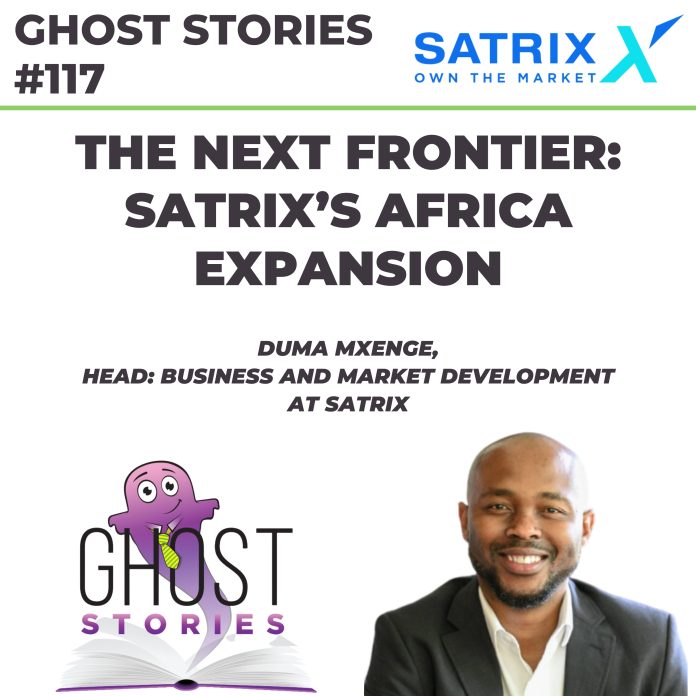
In this episode of the Ghost Stories podcast, The Finance Ghost is joined by Duma Mxenge, Head of Business and Market Development at Satrix, to unpack the opportunities and challenges of expanding ETFs across the continent.
From navigating regulations and market infrastructure to understanding what investors in different African countries actually want, Duma shares insight into the work being done behind the scenes to build deeper, more accessible capital markets.
We also explore why demand for global exposure is often stronger than demand for local equity products, whether an Africa-focused ETF is realistic any time soon, and what the future may hold for cross-border investing on the continent.
In this episode, we cover:
- Why Satrix believes the time is right to expand beyond South Africa
- The journey from initial research in 2019 to listings in Namibia, Botswana and Kenya
- Why African investors are increasingly looking for global market exposure
- The popularity of products tracking the S&P 500, MSCI World and Nasdaq 100
- How ETFs can help deepen African capital markets
- The regulatory, liquidity and operational challenges of cross-border ETF listings
- Why institutional and retail investors are responding differently to these products
- The importance of education, distribution and local partnerships
- Whether an Africa-wide equity ETF is a realistic prospect
- Alternative ways for South African investors to gain exposure to growth elsewhere on the continent
- The role Satrix hopes to play in building Africa’s investment ecosystem over the coming decades
Transcript:
00:00 Intro
01:00 South Africa is the track record, Africa is the opportunity
02:14 Satrix’s strategy to address ETF demand in Africa
04:21 Listings in Namibia, Botswana and Kenya
07:00 Institutional vs. retail investors
08:16 Demand for developed vs. emerging market funds
10:28 Financial markets infrastructure to make this possible
14:01 How far off is the “Africa Basket” ETF?
18:26 Closing thoughts
The Finance Ghost: Welcome to this episode of the Ghost Stories podcast. Today, we will be talking about how Satrix is spreading its wings across Africa. It’s something I am really looking forward to because I think ETFs have played such an important role in just giving access to South Africans to both local and global markets. ETFs really do make it easier to invest.
And who better to speak to today than Duma Mxenge? He is the Head of Business and Market Development at Satrix. Duma, thank you so much as always for joining me. Always fun to chat to you and particularly, I think, on this topic. This is going to be interesting.
Duma Mxenge: Thank you, Ghost, and thank you for having me. I’m really excited to talk about the Africa expansion, looking beyond South Africa.
The Finance Ghost: Yeah, absolutely. That’s the point here, right? Satrix has already done so much in South Africa. You guys literally pioneered the ETF industry and there have been a few podcasts that we’ve done before with the team from Satrix that have really made that point clear.
And now, it’s time for the rest of the continent, hey? I’m going to sound like Shakira here: “It’s time for Africa!”
So, what is happening? Why do you believe that there’s an opportunity here? Why do you believe the timing is right?
Duma Mxenge: As you said, Satrix has been around for… it’ll be our 26th year this year. And through that journey, I think what people underplay is the powerful and important role that an ETF plays. I know you’ve said that Satrix has pioneered, which is true, but it’s not just us. There are a lot of partners in the ecosystem who have actually made this possible.
I think we are at that stage now, where we’ve looked at the growth and adoption rate in South Africa across all segments, that there is value in replicating that in other markets. We can touch on those markets, but again, it’s basically for us to reset as a team, build new partnerships, build new relationships and also take a long-term view in terms of the growth of ETFs.
But as we see it, ETFs can play a meaningful role in terms of deepening capital markets across Africa.
The Finance Ghost: So, I’m curious. Are you taking a product to the people in Africa that you believe they need, or have people been asking for this? What’s been the genesis of this decision to go beyond South Africa now? Is there a real need out there? Is there a hunger on the continent for this stuff?
Duma Mxenge: So, the journey actually started in 2019, just on the back of us listing our global ETFs on the JSE. We saw the excitement in terms of, for once now you could have ETFs that give you global exposure priced in rands, that are listed on the JSE, which are actually well priced.
And we thought that could be quite an interesting proposition, just purely from a product perspective. But as I said, from 2019 we didn’t go out and just put out a product. We engaged the market. We tried to understand different markets.
So, the markets we looked at were Namibia, Botswana, Kenya and Nigeria.
Part of it is the interest. Secondly, who would buy it. And thirdly, also just interacting with the various exchanges, the regulator, and getting an understanding of what would work.
And now across the board, because we thought as a start, we’d do exactly what we did in South Africa and actually list the Satrix Top 40 – so, Africa for Africa – but the need in these markets was, and still is, that they want global exposure.
Not only just for institutional clients, but also the retail clients who are struggling to access offshore strategies because of FX and having to list offshore, and also, the Know Your Customer (KYC) was quite onerous. So, that’s where the journey for us started. That was from 2019.
The Finance Ghost: Yeah. These things tend to be several years in the making, right? So, in reality, I guess the journey started 26 years ago, as you say, then in Africa, 2019, pre-Covid. And here you are today. You’ve mentioned a few countries, but let’s just get a bit closer to that detail.
I think what’s important for people to keep in mind is that ETFs, if you think about them, can work in two directions, right? You could be taking African assets to a broader investor base – for example, on the JSE you could list a basket of African stocks (I doubt the liquidity is there, but that’s the one direction it could go in). Or it could be the other way around (which I think is what you’re doing here), which is taking global assets to an African investor base.
Duma Mxenge: What we’ve decided to do is to provide global assets in the respective countries. So, currently we have listings in Namibia – in fact, we have about five listings in Namibia. We’ve just recently listed in Botswana – it’s three listings, and I’ll share what those strategies are. And then we only have one listing in Kenya, which is the MSCI World.
So, in Botswana it’s three global strategies: the MSCI World, the Emerging Market (EM), as well as the NASDAQ 100. In Namibia, as I said, it’s five listings, so we’ve got the MSCI World, we’ve got the EM, we’ve got NASDAQ 100 and we also have the S&P 500. And what’s different in the Namibian market is that we also have regional exposure. So, we’ve got a Satrix Namibian Bond, which we can touch on.
But the strategy and what we really want to deepen is firstly, to make sure that we get the global assets right, even from an investor experience – the spreads, the liquidity, the education, the distribution and the partnership. So that’s the heavy lifting we’re doing at the moment.
Listing the product is one part of it. The other big part that we need to get right is the distribution and adoption in these respective markets, before we can actually look at any new products to market locally.
The Finance Ghost: Yeah, 100%. And I would imagine it’s a lot of the same things that have contributed to growth in the South African market, right? So, investor education would be one – access to these assets and understanding what’s there and that the stuff is available.
And, of course, it’s nice and low cost, right? I’m sure that that element of the Satrix offering has been carried through into these new products.
Duma Mxenge: No, absolutely. Again, to your point, there are also other reasons as to why you actually want to list in these markets. For example, in South Africa, what has also helped the adoption rate of offshore is the Reg 28. So, reading the regs and understanding what it entails and what sort of exposure you can actually get is very important.
For example, if you look at a market like Botswana (and it’s the same in Kenya), listing on their local exchange, you get local asset status. This then entails that instruments that are listed on their local exchange (in Botswana’s case, they’re priced in pula) will be deemed to be local, albeit on a look-through basis it still applies for institutional clients. In Kenya, once you are listed in-country, priced in Kenyan shillings, it breathes and it lives like a local asset.
And if you follow the western and eastern markets in Africa, what you will find (which is quite unique from the southern tip of Africa) is that a large majority of the exposure, even for institutional clients, is fixed income.
So now, we are bringing equity strategies which are deemed to be local that provide the growth assets that a lot of the investors have been looking for in those markets.
The Finance Ghost: And in terms of the feedback on the ground, I would imagine that it’s a mix of retail investors and institutional investors. Where is the focus at the moment?
Duma Mxenge: Look, in terms of volume and base it’s definitely institutional, but I guess in terms of adoption and excitement, it’s retail. It was exactly the same here in South Africa when we started with the Satrix Top 40. And so, what we see across the board is great activity in terms of retail clients embracing it, because it’s a novel idea, especially if you don’t have any offshore products that you can access.
We got great feedback from Botswana to say, “For once, now, we can actually access the Nvidia’s of the world and the Apples of the world locally, in pula.” And the same thing applies in Kenya.
Where I think a lot of the education and trust still needs to come is more on the institutional side, so we’re doing a lot of work on that end. And it’s not just the product, per se. It’s also understanding a little bit more, in terms of what distribution looks like, the go-to-market strategy, the importance of partnership and also the localisation of the product. So, there’s a lot of work we’re doing, from a marketing perspective, to get that right.
But we’re super optimistic. We’re super excited about these markets, because we’re coming off a lower base and the demand is real. And I must say that both the exchange and the regulators have been super supportive.
The Finance Ghost: And out of interest, are you finding that the demand is stronger for the traditional, offshore-type plays? Or is it more… you mentioned an emerging market fund there, so are people looking for developed market exposure to diversify the fact that they live and earn and have been investing in a place like Botswana, or are they open to emerging markets as well? Where does the interest lie?
Duma Mxenge: Yeah, it’s been quite interesting. We were actually chatting about this as a team. Namibia is different. It lives and breathes like South Africa, so they understand the MSCI World a lot better, and EM, and also the combination of the two.
But our engagements in Botswana, as well as in Kenya, show that there seems to be a great interest for the S&P 500 – so basically, exposure into America – which I found to be quite interesting. I guess it’s the orientation, globally, and America’s got a very good brand. So, when I see retail clients, specifically from a flow perspective, a large majority of the flows that we’re seeing is actually the S&P 500.
That being said, for institutional investors, as you know, the world is global, so is having exposure into EM. And it also helps that EM has actually done well, from a performance point of view. We are seeing flows on that end, albeit largely driven by the performance of that region or with exposure, but I think, over time, there’s also going to be a greater appreciation of what EM brings into someone’s portfolio.
The Finance Ghost: Yeah, I think people tend to be attracted to the big, exciting names in AI, etcetera, and obviously, those are mainly found on the S&P side. Although, if you dig and you go look in emerging markets, you’ll find some pretty interesting exposures, often further up the value chain, or adjacent stuff. It’s really interesting. It’s all the work that we try and do on this podcast to just show people the breadth of ETFs, right?
Duma Mxenge: Absolutely. Your podcast also plays a pivotal role, in terms of getting that right. What I also love about ETFs and the transparency, the ease of understanding, is that porting that education is a lot easier than when you have these complex strategies where different markets don’t understand it because it’s not consistent.
Whereas in this case, I guess for us, the big job that we need to do is more the plumbing, the distribution, the understanding of the wrapper and what an ETF is. And I think, once people understand that and they’re comfortable with it, we should see great adoption in those markets.
The Finance Ghost: Let’s talk about the plumbing then, which allows you to actually expand into Africa. You raised it earlier in the podcast when I mentioned the pioneering approach that Satrix has taken to ETFs in South Africa. As you’ve correctly pointed out, it’s obviously not just you guys, there’s a whole ecosystem that has to be built around it.
I would imagine there have been a number of hurdles that you’ve had to jump over to actually get the compliance stuff right, the regulatory stuff right, all of the approvals, dealing with the exchanges (because obviously these are exchange-traded products, I mean, that’s what the E and the T stand for).
So, perhaps you can just give us an idea of this expansion into Africa and some of the issues you’ve had to overcome? Obviously, to the extent you can share.
Duma Mxenge: Yeah, look, I mean every market is different and every market runs their infrastructure differently and there’s a good reason behind it. And again, as we said, we started in 2019. That’s not to say we immediately started listing ETFs. There’s a lot of understanding of what that market is trying to achieve.
For example, there had needed to be greater appreciation, not just the FX (meaning, you have to convert rands into pula), but who’s actually going to be your FX provider? You need to get that right.
Also, each market has its own playbook. If you’re going to come to this market, there needs to be greater local industry players. And we get it. That’s part of deepening the knowledge and expertise, and also the capital market, as I said.
And so, within that, there are probably four areas or layers of plumbing that one needs to think about. It’s basically the market quality or liquidity. What does that mean? You talk about two-way pricing and making sure that the spreads are in keeping. You need to think about what role your local provider will play in-country and how they get connected with our primary market maker who’s based in South Africa, making sure that their experience is almost the same as in South Africa. So, the liquidity piece is very important.
And when we talk about liquidity, it’s not just the availability of the instruments. It’s making sure that the segment market is thriving (so, local brokers need to be playing that market), and that the private market is thriving as well. That’s a big consideration.
The other big consideration is, yes, getting the regs right, but obviously, continuously making sure that, from a compliance point of view, you’re in lockstep with the respective countries.
And the tax treatment is different. What we’ve done in order to make sure that there’s clarity around the tax is the products we provide are actually non-distributing funds, which means that they don’t pay out dividends. Any dividend that sits within the fund gets reinvested automatically, so that helps with thinking about tax from that standpoint.
Also, I did touch on the institutional side, just understanding the classification of this instrument because that’s key to provide clarity for local players and getting the right approvals in place so that you don’t have to do it afterwards.
And then obviously building new relationships around settlement and custody. So, that’s been quite interesting, and every market is different. We’ve also pulled in our local players as well to assist us with that process.
And then lastly, which is more my bread and butter, is around just making sure that, from a distribution and education point of view (and every market is different, as I said), we work quite closely with the exchanges to help us with the tone and the pitching and how we should position these products so that there’s greater acceptance and adoption.
So that’s the work that we do with these markets. The long and short of it is we don’t go into these markets saying, “This is how we’ve done it in SA. Therefore, you have to do it this way.” We go in, we listen, we appreciate what they are going through and we also try to figure out how we can help and make sure that we can actually improve the saving rates of the respective countries.
The Finance Ghost: Maybe a final question from my side, Duma, and obviously it’s a tricky one, but how long do you think it’ll be until we have an ETF on the JSE that says, “The Africa Basket” and it’s sitting with a whole selection of stocks based elsewhere on the continent? I think it’s a long way off, I would wager.
Duma Mxenge: It’s a long way off.
The Finance Ghost: It’s liquidity, right? It’s liquidity. It’s selection. It’s investment universe. It’s all the things, isn’t it?
Duma Mxenge: It’s a long way off. I don’t know about you, but I’ve been getting a lot of queries about, you know, “I want to invest in Dangote. How do I do that?” I was like, “We haven’t even looked at how we can actually provide a true representative of the equity market across the continent.”
As you rightfully put, liquidity is an issue. I think, at the moment, it’s a space that your actively managed Africa mandates are more suited for it. Where we think there might be an opportunity is African sovereign bonds. That is something which we think could be doable and something we can maybe provide to African investors as a whole.
The Finance Ghost: Yeah, that makes absolute sense. So, for now, if you want to invest on the continent, you actually just need to do the research, right? You need to do the work to go through the JSE-listed companies and say, “Well, who’s got big exposure into Africa?” And there are a number of them.
Duma Mxenge: Yeah.
The Finance Ghost: So, specifically, from a banking perspective and that kind of thing, if you want to take a view on Africa, that’s probably the only real way to do it from here, at the moment. But hopefully, in years to come, we may see that change, Duma, and I don’t doubt that Satrix will be at the forefront of that.
But certainly, for the time being, the focus is on taking other assets to an African investor audience. I think that’s very exciting and I really hope that it’ll be much the same journey that you’ve seen in South Africa over the next 25 years and more.
Duma Mxenge: I hope so too. I mean, we started this conversation saying that it’s a function of a partnership. What we are hoping in these respective countries is that it’s very important to also have an equity-only local strategy like we have with the Satrix Top 40.
If you go to Nigeria, for example, they’ve got what they call the NGX 30, which is basically the top 30 listed companies. And there are ETF providers who are based in Nigeria. I think they need to think about doing dual listings into South Africa because they understand their market a lot better and can provide exposure into Africa.
I think the same thing ought to take place in Kenya because when I was there, I mean, I don’t know when last you’ve been into Nairobi, or if you’ve ever been…
The Finance Ghost: I have been to Nairobi, yeah. I’ve been to Kenya once.
Duma Mxenge: The pride and joy of Kenya is Safaricom. They’ve got very good things to say about that company. As a South African, I wish I could have exposure. And again, it’s very difficult to actually access these good counters which are domiciled elsewhere on the continent. I think that is also something we want to encourage, in terms of local players thinking about doing cross-border listings.
The Finance Ghost: Yeah, absolutely. And there you’ve touched on the point, which is, if you wanted to go and invest in that, you’d have to go via Vodacom, and then you get everything else that comes with it. You get a very mature South African business. You get their exposure elsewhere on the continent.
It’s quite hard to drill down and say, “Hey, I really want East Africa.” Even just an East African ETF would be great, but even that’s really hard…
Duma Mxenge: It would be great. Yeah, yeah, that’s true [laughing].
The Finance Ghost: …So [laughing], you know, we live in a world where the index we want isn’t always available. As I’ve said many times, there isn’t even a proper retail index on the JSE. Even though we have all these retailers, there is no retail ETF tracking all the grocers, the apparel plays, and just consumer South Africa.
That ETF doesn’t exist, let alone the East Africa ETF. So, it’s not an easy thing. Liquidity can get quite thin as you move outside of the big indices.
Duma Mxenge: Yeah, no, I think we’ll get there. If you look at your global issuers, I think your broad-based indices have been covered, from an ETF perspective. What you’re starting to see now is more of the niche precision, as you said. Do you want only global banks? We can give you that.
I think at some stage we will get there in South Africa, as well as the rest of the continent, but I think we’re still way, way off. It’ll be a matter of scale. And is there increased demand? Are institutional investors and retail investors at a critical mass asking for these strategies? If there are, issuers such as ourselves are more than willing to provide ease of access to the respective markets.
So yeah, I guess we must all watch this space. We’re always monitoring and engaging even our clients to get a sense of where the interest is, where are they finding difficulty in accessing those markets. And then we can see if we can list a product that meets those needs. So, we are always listening, always taking great care in terms of making sure that we give our clients what they’re looking for.
The Finance Ghost: Fantastic. Duma, thank you so much for your time. You’re doing such exciting stuff. I imagine that you’re getting on planes a lot and that you’ve had lots of yellow fever injections and have to show your certificate at all kinds of interesting airports across the continent.
Africa is a fascinating place to do business, it really is. I’ve enjoyed my travels there.
Duma Mxenge: Yeah, it’s fine. I’m looking forward to it. I think I’ll need to also pick up new languages, especially the local languages, so I’m learning, I’m learning.
The Finance Ghost: Yeah, absolutely. It’s really cool, well done.
Duma Mxenge: Thank you!
The Finance Ghost: Duma, thanks. I look forward to seeing what’s next. We’ll definitely have you back on the show and I suspect that you’ve got lots of cool stuff in the pipeline. All the best for what’s left of 2026, and we’ll do one of these again.
Duma Mxenge: Thanks Ghost, I really appreciate it. I’m sure maybe in a year’s time I’ll be able to give you proof points in terms of how it has gone in the respective countries. But we’re quite excited and really enjoying the engagement. So, if we can make this thing work, I think I’ll be super chuffed. And the team also, it’s a big thumbs up. So yeah, there’s still a hard road ahead, but we’re excited to make it work.
The Finance Ghost: Fantastic. Ciao Duma.
Duma Mxenge: Thanks Ghost.
Satrix Investments (Pty) Ltd is an approved financial service provider in terms of the Financial Advisory and Intermediary Services Act, No 37 of 2002 (“FAIS”). The information above does not constitute financial advice in term of FAIS.
Satrix Managers (RF) (Pty) Ltd a registered and approved Manager in Collective Investment Schemes in Securities. Collective investment schemes are generally medium- to long-term investments. With Unit Trusts, Exchange Traded Funds (ETFs) and Actively-managed ETFs (AMETFs), the investor essentially owns a “proportionate share” (in proportion to the participatory interest held in the fund) of the underlying investments held by the fund. With Unit Trusts, the investor holds participatory units issued by the fund while in the case of an ETFs and AMETFs, the participatory interest, while issued by the fund, comprises a listed security traded on the stock exchange. ETFs and AMETF are registered as a Collective Investment and can be traded by any stockbroker on the stock exchange, LISP platforms and or via online trading platforms. ETFs and AMETFs may incur additional costs due to being listed on the JSE. Past performance is not necessarily a guide to future performance, and the value of investments / units may go up or down. A schedule of fees and charges, and maximum commissions are available on the Minimum Disclosure Document or upon request from the Manager. Collective investments are traded at ruling prices and can engage in borrowing and scrip lending. Should the respective portfolio engage in scrip lending, the utility percentage and related counterparties can be viewed on the ETF and AMETF Minimum Disclosure Document. The index, the applicable tracking error and the portfolio performance relative to the index can be viewed on the ETF and AMETF Minimum Disclosure Document.
Performance is based on NAV to NAV calculations with income reinvestments done on the ex-div date. Performance is calculated for the portfolio and the individual investor performance may differ as a result of initial fees, actual investment date, date of reinvestment and dividend withholding tax. Some funds may hold assets in foreign countries and could be exposed to risks such as potential constraints on liquidity and the repatriation of funds, macroeconomic, political, foreign exchange, tax risks, settlement risks and potential limitations on the availability of market information.
A feeder fund is a portfolio that invests in a single portfolio of a collective investment scheme, which levies its own charges and which could result in a higher fee structure for the feeder fund. The manager has the right to close the portfolio to new investors in order to manager it more efficiently in accordance with its mandate. A money market portfolio is not a bank deposit account. The price is targeted at a constant value. The total return to the investor is made up of interest received and any gain or loss made on any particular instrument and in most cases the return will merely have the effect of increasing or decreasing the daily yield, but that in the case of abnormal losses it can have the effect of reducing the capital value of the portfolio. Excessive withdrawals from the portfolio may place the portfolio under liquidity pressures and in such circumstances a process of ring-fencing of withdrawal instructions and managed pay-outs over time may be followed. Seven day rolling yield is calculated by taking into account the interest earned by the fund during a seven-day period minus any management fees incurred during those seven days. The yield is a current and is calculated on a daily basis. A fund of funds portfolio is a portfolio that invests in portfolios of collective investment schemes that levy their own charges, which could result in a higher fee structure for the fund of funds. AMETF are ETFs which are actively traded by a Portfolio Manager to adjust the AMETF holdings and asset allocation with the aim to outperform the benchmark. AMETF differ from ETFs which only track indices. The Manager does not provide any guarantee either with respect to the capital or the return of a portfolio. Satrix retains full legal responsibility for the co-named portfolios. For further information related to performance of a specific fund please refer to the MDD of the fund on Satrix.co.za website. Full details and basis of the award are available from the Manager.